One handheld meter for duct air, pressure and room-comfort checks
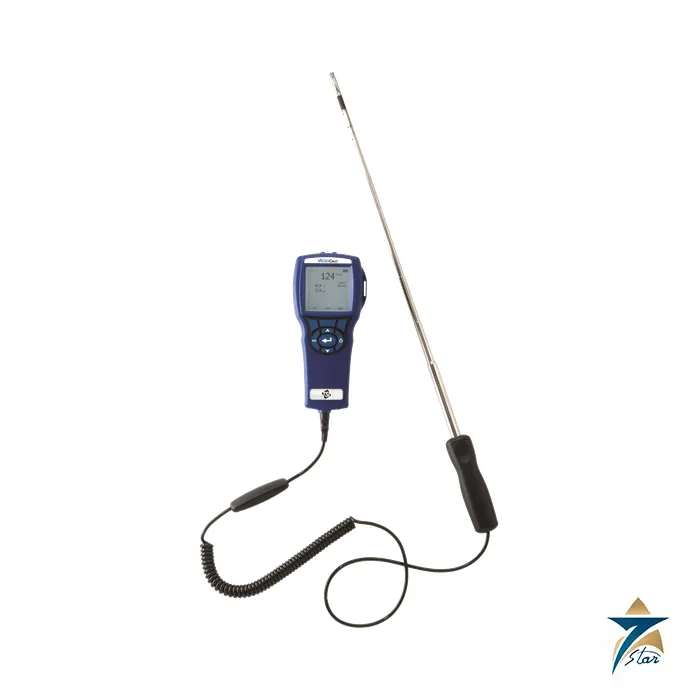
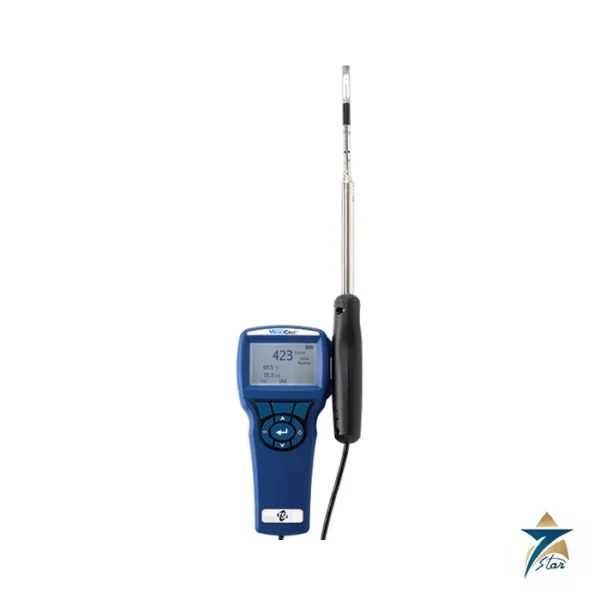
The TSI VelociCalc 9565 series is a handheld multi-function ventilation meter. The base unit reads differential and static pressure through two ports, barometric pressure from an internal sensor, and two K-alloy thermocouples. On top of that it accepts TSI plug-in probes, so the same meter can measure velocity, temperature, humidity, CO2, CO or VOC depending on the probe fitted.
A balancing contractor can run a duct traverse with a pitot probe, a commissioning engineer can read diffuser flow from a K-factor and the pressure ports, and an HSE team can log indoor air quality with a CO2 probe. The manual covers four variants, listed in the selection section below. Related instruments are grouped under Portable Test & Measurement.
Capabilities described in the manual
- Pressure ports (9565-P versions) for static and differential pressure and pitot traverses, plus a static pressure tip with a magnet for holding it to ductwork.
- Two thermocouple ports for any K-alloy thermocouple with a mini-connector; display TC1, TC2 or TC1-TC2.
- Data logging with Manual, Auto-save, Cont-key, Cont-time and two programmable modes; 26,500+ samples and 100 test IDs.
- Applications menu with Draft Rate, Heat Flow, Turbulence, % Outside Air and Leakage Test routines, plus Bluetooth printing on the 9565-P and 9565-X.
Technical specification
Velocity, flow and pressure
| Parameter |
Specification |
| Models covered by the manual |
9565-P, 9565-P-NB, 9565-X, 9565-X-NB |
| Velocity range (TA probe) |
0 to 9999 ft/min (0 to 50 m/s) |
| Velocity accuracy (TA probe) |
Whichever is larger of 3 % of reading or 0.015 m/s (3 ft/min), applying from 0.15 m/s; air 5 to 65 C |
| Velocity resolution |
0.01 m/s |
| Velocity range (pitot tube) |
250 to 15500 ft/min (1.27 to 78.7 m/s); best above 2000 ft/min |
| Pitot velocity accuracy |
1.5 % at 10.16 m/s (2000 ft/min) |
| Duct size entry |
2.5 to 1270 cm (1 to 500 in.), 0.1 steps |
| Volumetric flow rate |
Depends on velocity, pressure, duct size and K factor |
| Static / differential pressure range |
+/-15 in. H2O, equal to +/-3735 Pa or +/-28.0 mm Hg |
| Pressure accuracy |
1 % of reading plus 0.005 in. H2O (1 Pa; 0.01 mm Hg) |
| Pressure resolution |
0.1 Pa (0.001 in. H2O; 0.01 mm Hg) |
| Overpressure |
190 in. H2O (7 psi, 360 mm Hg, 48 kPa); the sensor can burst at higher pressure |
| Barometric pressure |
517.15 to 930.87 mm Hg (20.36 to 36.648 in. Hg); 2 % of reading |
Temperature, humidity and logging
| Parameter |
Specification |
| Temperature (TA probe) |
-10 to 60 C (14 to 140 F), 0.3 C accuracy, 0.1 resolution |
| Relative humidity (TA probe) |
5 to 95 % RH, 3 % RH accuracy incl. 1 % hysteresis, 0.1 resolution |
| Wet bulb / dew point |
Wet bulb 5 to 60 C; dew point -15 to 49 C; 0.1 resolution |
| Data storage |
Over 26,500 samples, 100 test IDs, fourteen measurement types per sample |
| Logging interval |
From 1 s up to 1 h |
| Response time |
Velocity 200 ms, pressure 0.1 ms, humidity under 1 min, temperature 2 min (to 66 %) |
Physical and power
| Parameter |
Specification |
| Operating temperature |
Meter 5 to 45 C; probe -10 to 60 C |
| Storage temperature |
-20 to 60 C |
| Operating conditions |
To 4000 m altitude; 80 % RH maximum, no condensation |
| Meter dimensions |
9.7 x 21.1 x 5.3 cm |
| Meter weight |
0.36 kg with batteries |
| Telescoping probe |
101.6 cm long; 7.0 mm tip; 13.0 mm base; 15.24 cm articulating section |
| Power |
Four AA cells (DIP switch picks alkaline or NiMH) or adapter p/n 801761 (90-240 VAC in, 9 VDC 2 A out) |
| Wireless |
Classic Bluetooth 2.0, +4 dBm peak, 2.4-2.5 GHz (9565-P, 9565-X) |
| Package contents |
Case, meter, USB cable, adapter; -P models add static pressure tip and tubing |
Choosing between the 9565 variants and probes
The suffix tells you what you get. 9565-P has the differential pressure sensor and Bluetooth; 9565-P-NB has the pressure sensor without Bluetooth; 9565-X has Bluetooth but no pressure sensor; 9565-X-NB has neither. Choose a -P version if you plan pitot traverses or K-factor diffuser readings, because those use the pressure ports.
Plug-in probes are ordered separately (Appendix B): thermoanemometers 960 and 962 (velocity, temperature) and 964 and 966 (adding humidity), 995 rotating vane, 980 and 982 IAQ probes (CO2, with CO on 982), VOC probes 984 to 987, 792 and 794 thermocouple probes, and pitot probes in lengths from 12 to 60 in.
Setup and field notes from the manual
Power the unit with four AA cells or the AC adapter; set the DIP switch inside the battery compartment before using NiMH cells, and never try to charge alkaline cells. Align the D-shaped mini-DIN connector when plugging in a probe, and turn the meter off and on again if a probe plugged in later is not recognised.
Warm the unit for at least five minutes, then use Zero Press with both ports open to atmosphere. For temperature and humidity, keep at least 3 in. (7.5 cm) of the probe in the airflow with the orientation dimple facing upstream. The pitot velocity needs a valid temperature, so set Temp Source to Entered if no temperature probe is connected.
Where it is used in ventilation and IAQ work
In Gulf projects the meter suits air balancing of AHU and FCU duct networks and filter pressure-drop readings. Keep the electronics inside the 5 to 45 C range printed in the manual, which in summer means a shaded site office rather than direct sun. CO2 and CO probes support IAQ surveys in offices and plant buildings.
Probes, printer and software
Accessories named in the manual include the Model 8934 wireless printer (Bluetooth versions), the AC adapter p/n 801761, the Air Cone kit p/n 801749 for use with the 995 vane probe, TrakPro data analysis software and LogDat2 for downloads, plus the application notes TSI-106 (duct traverse), TSI-107 (pressure ports), TSI-109 (actual vs standard conditions) and TSI-150 (Bluetooth).
Frequently asked questions
Which 9565 variant has the pressure ports? The 9565-P and 9565-P-NB include the differential pressure sensor and ports; the 9565-X versions do not.
Can the 9565 use a pitot tube? Yes on the -P models. The total pressure port of the pitot connects to the + port and the static port to the – port, using tubes of equal length.
What thermocouples does it accept? Any K-alloy thermocouple with a mini-connector; third-party types must have the metal sheath electrically isolated from the wires.
How many samples can it log? Over 26,500 samples and 100 test IDs, at intervals from 1 second to 1 hour.
Is Seven Star LLC a TSI distributor? No. Seven Star LLC is an independent supplier based in Muscat; it does not act for TSI and quotes genuine instruments on request.
Documents and quotation
Attached: the official TSI document (P/N 6004851 Rev J, December 2024). Please confirm the model variant, probes, accessories and calibration certificate in an RFQ; this page carries no price.









Reviews
There are no reviews yet.