Compact reflector supplied with W250 and V180 sensors
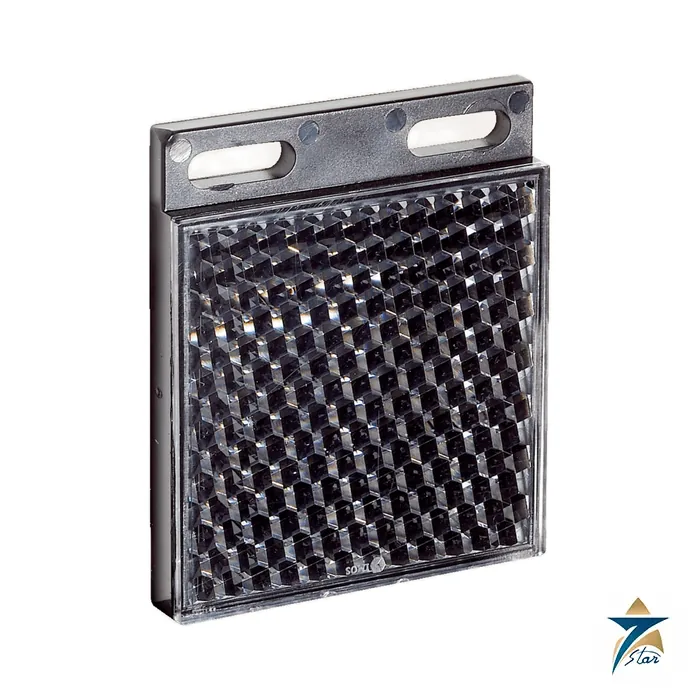
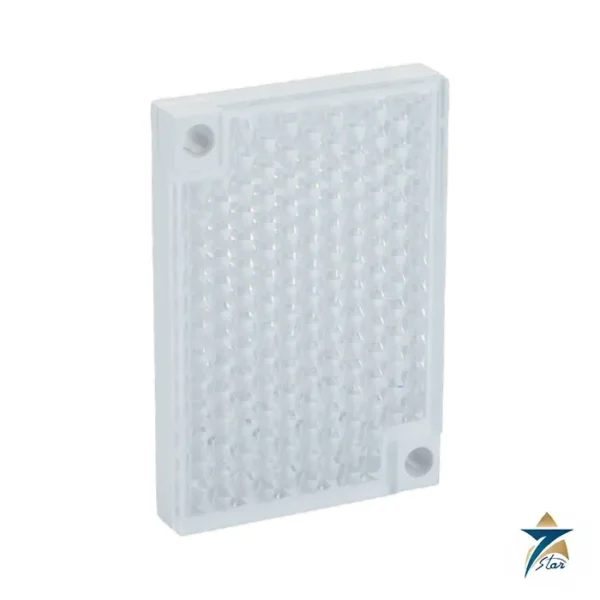
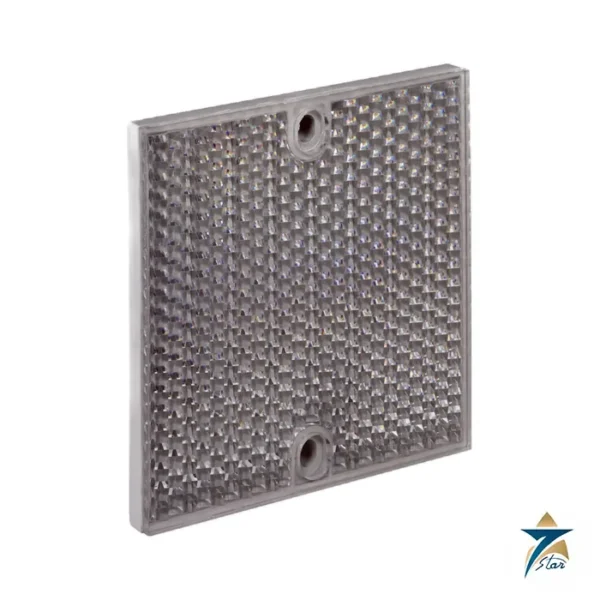
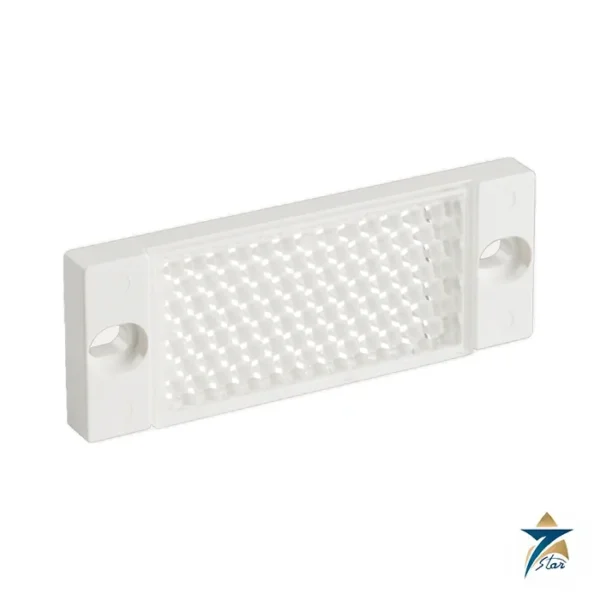
The SICK P250 (part no. 5304812) is a compact rectangular standard reflector, 51.2 mm by 60.9 mm, with screw-on fixing. SICK ships it as the supplied reflector with several photoelectric sensors, for instance the WL250-2P2431 and the VL180-2P42436, and names it as an alternative reference reflector for others such as the GL10-F4551.
It is a passive part. Its triple prisms send the light back along the incoming path, which is what a retro-reflective sensor needs to see a clear beam.
Technical specifications
| Parameter |
Specification |
| Manufacturer |
SICK |
| Type |
P250 |
| Part no. |
5304812 |
| Product segment |
Reflectors and optics |
| Product |
Reflectors |
| Product version |
Standard reflectors |
| Description |
Rectangular, screw connection |
| Mounting system type |
Screw-on |
| Material |
PMMA/ABS |
| Dimensions (W x H x L) |
51.2 mm x 8.2 mm x 60.9 mm |
| Ambient operating temperature |
-30 °C … +65 °C |
| Conformity document |
RoHS manufacturer declaration |
Where the P250 appears in sensor data sheets
In the WL250-2P2431 data sheet the P250 is listed under Items supplied together with the BEF-W250 bracket, and the same sheet gives a shorter range for the P250 (11 m) than for the PL80A (13 m). The VL180-2P42436 also ships with a P250 plus fastening nuts. So when a replacement reflector is needed for these sensors, the P250 restores the as-delivered condition.
Check that the reflector face is clean and square to the beam, and fit it without clamping stress. The data sheet repeats SICK guidance that reflectors used in freezer areas must be acclimatised before mounting.
At 51.2 mm by 60.9 mm and 8.2 mm high, the part fits behind small guards and in the narrow brackets that go with compact W250 and V180 housings. It is often kept as a spare because dirt or impact damage affects the reflector long before the sensor.
Part number and related reflectors
P250 is the exact type code and 5304812 the part number. The fine-prism variant P250F carries a different part number and a different height, 6.5 mm, and is aimed at laser sensors; do not mix the two when a laser sensor is specified. Always cite the full part number on a quotation request.
Deciding whether the P250 suits your sensor
The simplest rule is to follow the sensor’s own data sheet. If the P250 is listed as the supplied or reference reflector for your sensor, the operating range and switching behaviour quoted for that sensor already assume this reflector, and swapping to a different one changes the result. When a data sheet gives a longer range with a larger reflector, as the WL250-2P2431 sheet does with the PL80A, the P250 is still the right choice where space is tight and the actual distance across the conveyor or doorway is well inside its listed range.
Sensors that use a laser light source are a separate case. The page already notes that the P250F is the fine-prism version for laser sensors, so check the light source of the sensor before ordering, and do not take the standard P250 as a universal spare for every retro-reflective sensor on a line.
Mounting and aligning the reflector
- Fix the P250 on a rigid surface that does not flex when the machine vibrates or a guard door is closed; a reflector that moves slightly will cause the sensor to flicker between states.
- Tighten the screws only enough to hold the part, so the PMMA/ABS body is not bent, in line with the instruction to fit it without clamping stress.
- Align the sensor to the centre of the reflector using its alignment indicator, then move the sensor slightly in each direction to confirm a stable margin.
- Check that shiny objects passing through the beam, such as stretch-wrapped pallets or polished cans, do not return enough light to look like the reflector; if they do, review the sensor type with the sensor data sheet.
Cleaning and fault finding
Most nuisance trips on retro-reflective sensors come from a dirty or scratched reflector rather than from the sensor. Wipe the prism face with a soft, damp cloth and avoid solvents or abrasive pads, which can cloud the plastic. If the sensor still shows a weak signal after cleaning, look for cracks from impact, a reflector that has been knocked off square, or condensation inside a cold area. A scratched, cracked or crazed reflector should be replaced rather than polished, because surface damage scatters the returned light and weakens the signal.
Use in Omani and GCC facilities
In warehouses, bottling plants and logistics centres across Oman, airborne dust settles on reflectors and gradually reduces the returned light, so add the P250 to the routine cleaning list for each sensor. The listed operating range of -30 to +65 °C covers most indoor plant conditions, but avoid mounting the reflector on sun-exposed metal sheeting outdoors, where surface temperatures in summer can climb well beyond the air temperature. Cold stores and freezer rooms used for food distribution in the region should follow the acclimatisation guidance before mounting, and in humid coastal sites a reflector that fogs after door openings should be positioned away from the warm air stream.
Documents and quotation
The official SICK data sheet for P250 (part no. 5304812) is attached to this page, and the figures in the table above are taken from it. Seven Star LLC is an independent supplier in Muscat and quotes SICK items against a written request. In your enquiry, give the exact type code, part number, quantity and delivery location, and say whether you need accessories such as a matching sensor or fixing screws. Data sheets carry a note that content is subject to change without notice, so confirm current details before ordering. More items are listed under automation accessories, and you may also look at the SICK WTB4-3 miniature photoelectric sensor.
Before ordering, compare the type code and part number on your existing unit or drawing with the details on this page, and confirm supply voltage, output type, connector and mounting against the data sheet. Send the nameplate details with your enquiry and we will check them against the manufacturer data before quoting.












Reviews
There are no reviews yet.