- Automation & ControlView all 2,764 products
- Automation Accessories
- AC Drives
- PLC & I/O Cards
- Industrial Communications
- Vibration Monitoring
- Controllers & Data Acquisition
- Isolator & Barrier
- Safety Switches & Guard Locking
- Motor Soft Starters
- CCTV & Security
- Encoders
- HMI Displays
- Pneumatic Cylinders
- Servo Drives
- Industrial Computers
- Machine Vision
- Automation Software
- Robotics
















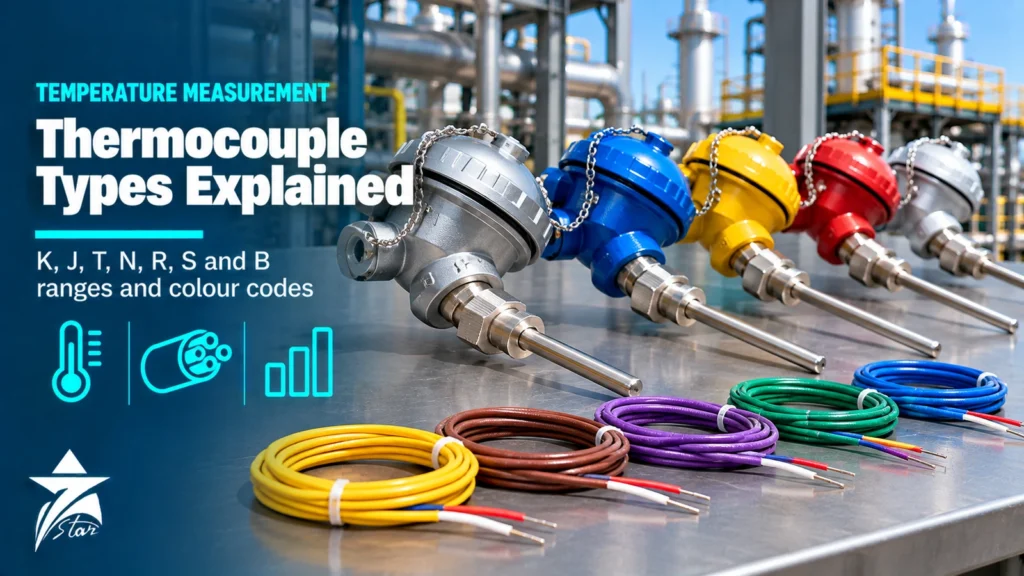
A thermocouple is two dissimilar metal wires joined at the measuring point. When that junction is hotter or colder than the other end of the wires, a small voltage appears, a few microvolts to tens of microvolts per degree, and the instrument converts it into temperature. The metal pair decides the range, the sensitivity, the stability and the cost, which is why there are several standard thermocouple types, each identified by a letter. This guide compares the common thermocouple types, their colour codes and cables, and how to choose between them for process plants, furnaces, power stations and laboratories.
If you are still deciding between a thermocouple and a resistance thermometer, read our comparison of RTD vs thermocouple sensors first.
How a Thermocouple Measures Temperature
The voltage depends on the temperature difference between the measuring (hot) junction and the reference (cold) junction, where the thermocouple wires connect to copper in the transmitter or input card. Every modern instrument measures the reference junction temperature, usually with a built-in RTD or thermistor at the terminals, and adds the equivalent voltage; this is called cold junction compensation. The relationship between voltage and temperature for each type is defined in reference tables in IEC 60584-1 and ASTM E230.
Two consequences matter in practice. First, everything between the hot junction and the instrument terminals must be thermocouple material of the same type, or an error appears wherever the metals change. Second, the signal is small, so long unshielded runs near motors and power cables pick up noise. Many plants therefore mount a head transmitter close to the sensor and send 4–20 mA instead; see our guide to temperature transmitter selection.
Thermocouple Types Compared
| Type | Conductors (+ / −) | Typical range | Approx. sensitivity | Main uses |
|---|---|---|---|---|
| K | Nickel-chromium / nickel-aluminium | −200 to 1,260 °C | 41 µV/°C | General purpose, furnaces, exhaust gas, most process plants |
| J | Iron / copper-nickel | 0 to 750 °C | 52 µV/°C | Plastics machinery, older equipment, vacuum and inert atmospheres |
| T | Copper / copper-nickel | −200 to 370 °C | 43 µV/°C | Low temperatures, cold stores, food and laboratory work |
| E | Nickel-chromium / copper-nickel | −200 to 900 °C | 68 µV/°C | Highest output, low and medium temperatures |
| N | Nicrosil / nisil | −200 to 1,260 °C | 39 µV/°C | Stable alternative to type K at high temperature |
| R | Platinum-13% rhodium / platinum | 0 to 1,480 °C | 10–12 µV/°C | Glass, ceramics, high-temperature furnaces |
| S | Platinum-10% rhodium / platinum | 0 to 1,480 °C | 10 µV/°C | High-temperature process and calibration reference |
| B | Platinum-30% rhodium / platinum-6% rhodium | 870 to 1,700 °C | Very low below 50 °C | Steel, glass and ceramic furnaces at the highest temperatures |
Ranges are typical continuous limits for bare wire per ASTM E230; the real limit depends on wire diameter, sheath material and atmosphere. Thin wires and unprotected elements must be derated.
Base-Metal Thermocouple Types: K, J, T, E and N
Type K is the default choice for most industrial applications because it covers a wide range at low cost. Its weaknesses are drift: between roughly 250 and 550 °C the alloy can shift by a few degrees (short-range ordering), and in reducing or low-oxygen atmospheres at high temperature the positive leg can suffer selective oxidation known as green rot.
Type N was developed to overcome those problems. It is more stable than type K above about 500 °C and is a good choice for long-term high-temperature service where recalibration is difficult, such as furnaces and heaters running continuously.
Type J has a higher output but the iron leg oxidises and rusts, so it is limited to about 750 °C and is unsuitable for moist sub-zero conditions. It remains common on plastics injection and extrusion machines. Type T is the most accurate base-metal type at low temperatures and is widely used from cryogenic conditions up to about 370 °C. Type E gives the largest signal of all the common types, which helps where small temperature differences must be resolved.
Noble-Metal Thermocouple Types: R, S and B
Platinum-rhodium thermocouples are used where base metals would fail or drift. Types R and S are very stable up to around 1,480 °C, and type S has long served as a reference standard in calibration laboratories. Type B extends the range to about 1,700 °C and has such a low output near room temperature that cold junction errors are negligible.
Noble-metal elements are expensive and sensitive to contamination. Silicon, phosphorus, sulphur and metal vapours in reducing atmospheres attack the platinum, so these sensors are normally fitted with high-purity alumina insulators and ceramic protection tubes, sometimes with a gas purge, and should be handled carefully during installation.
Thermocouple Tolerance Classes and Accuracy
| Type | IEC 60584-1 Class 1 | IEC 60584-1 Class 2 |
|---|---|---|
| K, N | ±1.5 °C or ±0.004 × |t| (−40 to 1,000 °C) | ±2.5 °C or ±0.0075 × |t| (−40 to 1,200 °C) |
| J | ±1.5 °C or ±0.004 × |t| (−40 to 750 °C) | ±2.5 °C or ±0.0075 × |t| (−40 to 750 °C) |
| T | ±0.5 °C or ±0.004 × |t| (−40 to 350 °C) | ±1.0 °C or ±0.0075 × |t| (−40 to 350 °C) |
| R, S | ±1.0 °C or ±[1 + 0.003 × (t − 1,100)] (0 to 1,600 °C) | ±1.5 °C or ±0.0025 × |t| (0 to 1,600 °C) |
The larger of the two values applies. At 800 °C a Class 2 type K element may therefore read up to ±6 °C from the true value before any drift, while a Class 1 element is within ±3.2 °C. Where tighter accuracy is needed, specify Class 1 and calibrate the sensor and transmitter together.
Colour Codes for Thermocouple Types: IEC and ANSI
Colour codes identify the type and polarity of thermocouple wire, extension cable and connectors. Two systems are common in Oman: the IEC 60584-3 scheme used on European equipment and the ANSI/ASTM scheme used on American equipment. Mixing them up is a frequent cause of reversed polarity.
| Type | IEC 60584-3 (positive / negative / sheath) | ANSI extension (positive / negative / jacket) |
|---|---|---|
| K | Green / white / green | Yellow / red / yellow |
| J | Black / white / black | White / red / black |
| T | Brown / white / brown | Blue / red / blue |
| E | Violet / white / violet | Purple / red / purple |
| N | Pink / white / pink | Orange / red / orange |
| R, S | Orange / white / orange | Black / red / green |
| B | Grey / white / grey | Grey / red / grey |
A simple rule helps: in IEC the negative conductor is always white, and in ANSI the negative conductor is always red. Intrinsically safe circuits use a blue sheath in the IEC scheme.
Extension and Compensating Cables
Between the sensor head and the instrument you need cable that behaves like the thermocouple itself. Extension cable (for example KX) uses the same alloys as the thermocouple and is accurate over a moderate temperature range. Compensating cable (for example KCA or SC) uses cheaper alloys that match the thermocouple output only over a limited range near ambient, which is acceptable for noble-metal types where platinum extension wire would be very expensive.
- Use cable of the correct type and grade for the thermocouple; copper instrument cable creates an error equal to the temperature difference between the head and the panel.
- Keep polarity consistent at every joint, terminal and connector. A single reversal can create an error of twice the temperature difference across the joint.
- Use shielded, twisted-pair cable and earth the screen at one end only to limit noise.
- Use thermocouple connectors and terminals of matching alloy where the cable is broken.
- For long distances, convert to 4–20 mA close to the sensor instead of running thermocouple cable.
Junction Styles, Sheaths and Construction
- Grounded junction: welded to the sheath tip; fast response but susceptible to ground loops and electrical noise.
- Ungrounded (insulated) junction: isolated from the sheath; slightly slower but electrically isolated, the usual choice for process plants.
- Exposed junction: fastest response for gas measurement, but unprotected from corrosion and mechanical damage.
- Mineral-insulated (MI) cable: conductors packed in magnesium oxide inside a stainless or Inconel sheath; robust, bendable and available in small diameters.
- Thermowells: drilled bar-stock or fabricated protection tubes that allow the sensor to be removed without opening the process; check the wake frequency calculation to ASME PTC 19.3 TW for high-velocity flows.
How to Choose Between Thermocouple Types
- Up to about 350 °C with good accuracy, especially below zero: type T, or consider an RTD.
- General process and machinery up to about 1,100 °C: type K.
- Continuous high-temperature duty with minimal drift: type N.
- Plastics machinery and replacement of existing equipment: type J, where the instrument is already set for it.
- Above about 1,200 °C or where long-term stability is critical: type R or S; above 1,500 °C, type B.
- Always match the instrument input, transmitter configuration and cable to the selected type.
In practice, the choice between thermocouple types is often fixed by the existing control system. When replacing a sensor, check the type letter on the head label, the cable colours or the input configuration of the transmitter before ordering.
Thermocouples and Accessories We Supply
Examples of thermocouples, thermowells and test equipment in our catalog. Each link goes to the product page.
Browse more in our RTD and thermocouple sensors category. To get a quotation, send the thermocouple type, tolerance class, range, insertion length, sheath diameter and material, junction style, process connection and terminal head, or the part number of the existing sensor, through our quote request form or to [email protected].
Sourcing Thermocouples in Oman Through Seven Star LLC
Seven Star LLC is an independent supplier in Oman of temperature measurement equipment for oil and gas, power, water and manufacturing plants. We quote base-metal and noble-metal thermocouples, mineral-insulated probes, multipoint assemblies, thermowells, extension cables, transmitters and calibrators from manufacturers such as WIKA, JUMO, Endress+Hauser and Fluke, and can match existing sensors by part number. Construction, tolerance class and lead time are confirmed against the manufacturer data at quotation.
Frequently asked questions
What is the most common of the thermocouple types?
Type K is the most widely used because it covers about −200 to 1,260 °C at low cost and suits most industrial processes. Type N is often chosen instead where long-term stability at high temperature is important.
Which thermocouple is best for high temperatures?
For continuous use up to about 1,200 °C, type N or K with a suitable sheath. Above that, the platinum types R and S are used up to around 1,480 °C, and type B up to about 1,700 °C.
What is the difference between extension and compensating cable?
Extension cable uses the same alloys as the thermocouple and is accurate over a wider range. Compensating cable uses different, cheaper alloys that match the thermocouple output only over a limited range near ambient temperature, mainly for noble-metal types.
How can I identify a thermocouple type by its wire colours?
In the IEC system the negative wire is white and the positive wire and sheath colour identify the type, for example green for type K. In the ANSI system the negative wire is red and the positive colour identifies the type, for example yellow for type K.
Can I replace a type J thermocouple with type K?
Only if the instrument or transmitter input is reconfigured for type K and the extension cable is changed as well. Otherwise the reading will be wrong, because each type produces a different voltage at the same temperature.
Who supplies thermocouples in Oman?
Seven Star LLC is an independent supplier in Oman that quotes thermocouples of all common types, thermowells, extension cables, transmitters and calibrators from leading manufacturers. Send your requirements through the quote request form or to [email protected].
Was this guide helpful?One click helps us write better guides for engineers.
Thank you! Glad it helped. Need this equipment for your project? Request a quotation
Thank you. We will use this to improve the guide.