- Automation & ControlView all 2,760 products
- Automation Accessories
- AC Drives
- PLC & I/O Cards
- Industrial Communications
- Vibration Monitoring
- Controllers & Data Acquisition
- Isolator & Barrier
- Safety Switches & Guard Locking
- Motor Soft Starters
- CCTV & Security
- Encoders
- HMI Displays
- Pneumatic Cylinders
- Servo Drives
- Industrial Computers
- Machine Vision
- Automation Software
- Robotics
















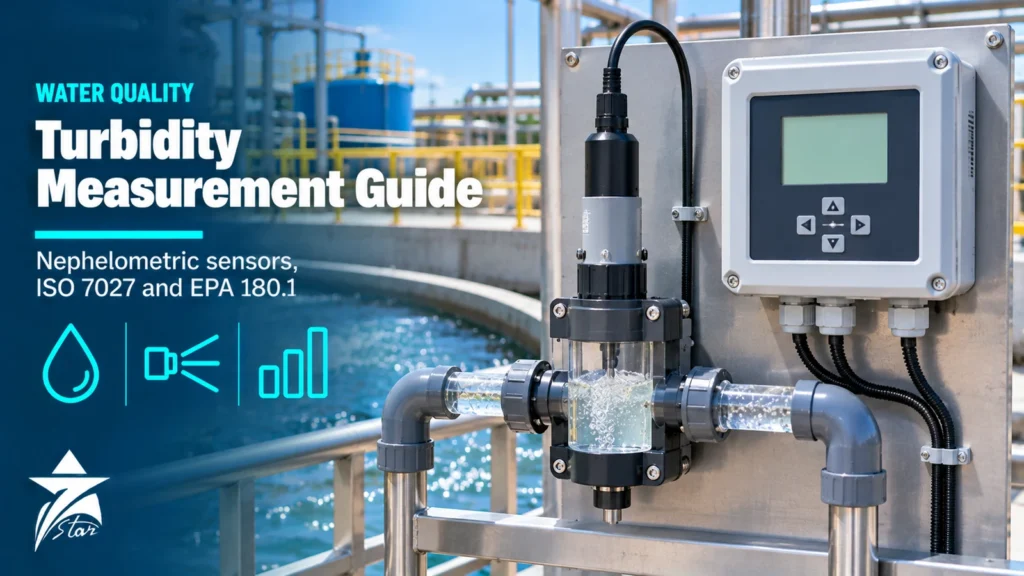
Turbidity is the cloudiness of water caused by suspended particles such as clay, silt, algae, organic matter and precipitates. It is one of the most important water quality parameters, because particles can shield microorganisms from disinfection, foul RO membranes and show that a filter is breaking through. This guide explains how turbidity measurement works, the difference between the ISO 7027 and EPA 180.1 methods, how to choose an online or portable instrument, and how to get readings you can trust.
How Turbidity Measurement Works
A turbidimeter shines a light beam through the sample and measures how much light the particles scatter. Most instruments are nephelometers: the main detector sits at 90° to the beam, which gives good sensitivity at low turbidity. Some instruments also measure transmitted light (180°) or back-scattered light, which helps at high turbidity or in coloured samples.
- NTU (Nephelometric Turbidity Unit): measured with white light and a 90° detector, as in US EPA Method 180.1.
- FNU (Formazin Nephelometric Unit): measured with near-infrared light at 860 nm and a 90° detector, as in ISO 7027.
- FAU (Formazin Attenuation Unit): measured as the reduction of transmitted light at 180°, used for higher turbidity.
- Ratio turbidimeters combine several detectors to reduce the effect of colour and lamp ageing, and are common in water treatment.
All of these units are calibrated against formazin, so on formazin they read the same. On real samples, they can give different results because particles scatter white and infrared light differently. Always record which method and unit was used, and compare like with like.
ISO 7027 vs EPA 180.1: What Is the Difference?
| Feature | EPA Method 180.1 | ISO 7027 |
|---|---|---|
| Light source | Tungsten filament lamp, colour temperature 2,200 to 3,000 K | Infrared LED at 860 nm |
| Detector angle | 90° (within ±30°) | 90° (within ±2.5°) for nephelometric FNU |
| Reported unit | NTU | FNU (or FAU for attenuation) |
| Colour interference | Coloured samples absorb white light and read low | Much lower, because few dissolved colours absorb at 860 nm |
| Light source stability | Lamp ages and must be checked | LEDs are stable and long-lived |
| Where it is required | US regulatory reporting for drinking water | Europe and many international and industrial applications |
In practice, the right method is the one your regulator or customer specifies. Many utilities in the Gulf follow ISO-based practice, but projects designed to US standards may require EPA-compliant instruments. Some manufacturers offer both versions of the same turbidimeter. Laser-based nephelometers are also available for very low-level measurement, such as filter effluent monitoring.
Typical Turbidity Limits and Targets
| Application | Typical target or limit | Why it matters |
|---|---|---|
| Drinking water (WHO guidance) | Ideally below 1 NTU for effective disinfection; below 5 NTU for appearance | Particles shield microorganisms from chlorine and UV |
| Filtered surface water (US EPA rule) | 0.3 NTU or less in 95% of monthly samples, never above 1 NTU | Shows that the filters are removing pathogens |
| RO feed water (seawater and brackish) | Typically below 1 NTU, and often below 0.2 NTU, as specified by the membrane supplier | Protects membranes from particulate fouling |
| Wastewater final effluent | Set by the discharge or reuse permit | Correlates with suspended solids and treatment performance |
| Boiler condensate | Low and stable; a rise signals contamination | Detects oil, iron or process ingress |
National standards add their own limits. In Oman, check the current Omani drinking water standard and the requirements of the utility or regulator for the project. For a wider view of analyzers used in desalination and wastewater plants, see our guide to water quality analyzers for desalination, wastewater and boiler water.
Where to Place Turbidity Measurement Points in a Treatment Plant
A single analyzer at the plant outlet tells you that something went wrong, but not where. A well-designed turbidity measurement scheme follows the water through each treatment stage, so operators can react before poor water reaches the network or the membranes.
| Location | Typical range | What the reading tells you |
|---|---|---|
| Raw water or seawater intake | 0 to 100 NTU or higher | Changes in source quality after storms, algae blooms or dredging; used to adjust coagulant dose |
| After clarification or dissolved air flotation | 0 to 20 NTU | Settling and coagulation performance |
| Each filter outlet | 0 to 1 NTU, low-level | Filter ripening after backwash and early breakthrough, so each filter can be backwashed at the right time |
| Combined filtered water or RO feed | 0 to 1 NTU, low-level | Overall filtration performance and membrane protection, often alongside SDI testing |
| Treated water to the network | 0 to 5 NTU | Compliance reporting together with residual chlorine |
Individual filter monitoring is one of the most valuable uses of online turbidity measurement, because a turbidity spike of a few tenths of an NTU after backwash is often the first sign that a filter needs attention. Placing analyzers close to the sample point, with short sample lines, keeps the response time low.
Choosing a Turbidity Instrument
Online flow-through turbidimeters
A sample stream flows continuously through a measuring chamber. These instruments are the standard for low-range drinking water, filter effluent and RO pretreatment monitoring, often reading down to 0.001 NTU with resolution in the thousandths. Look for an effective bubble trap, a stable sample flow, automatic cleaning or easy access to the chamber, and verification without removing the instrument.
Immersion and insertion sensors
Probes installed directly in a tank, channel or pipe cover higher ranges, up to thousands of NTU, and can also be calibrated for suspended solids in mg/L. They suit raw water intakes, clarifiers and wastewater. A wiper or compressed-air cleaning keeps the optical windows free of fouling.
Portable and benchtop turbidity meters
Cuvette-based meters are used for grab samples, field checks and verification of online instruments. They are only as good as the sample handling: clean, unscratched cuvettes, a consistent orientation (indexing), and careful wiping make the difference between a good reading and noise.
| Selection point | What to check |
|---|---|
| Range | Low range (0 to 10 NTU or less) for treated water; high range for raw water and wastewater |
| Method | ISO 7027 (FNU) or EPA 180.1 (NTU) as specified by the regulator |
| Sample | Bubbles, colour, temperature, pressure and the risk of fouling |
| Output | 4-20 mA, Modbus or fieldbus to the controller, plus alarm relays |
| Maintenance | Cleaning method, calibration and verification procedure, spare parts |
Common Errors in Turbidity Measurement
Most problems with turbidity measurement come from the sample and the optics rather than the electronics:
- Air bubbles scatter light and give falsely high readings. Use a bubble trap, avoid sample pumps that entrain air and keep sample lines full. In grab samples, let bubbles rise or degas gently.
- Colour absorbs light and gives low readings with white-light methods. An ISO 7027 instrument or a ratio design reduces this.
- Stray light from scratches, dirty windows and condensation affects low-range readings most. Keep optics clean and use desiccant or purge where condensation occurs.
- Fouling of windows and chambers by algae, biofilm or scale causes drift. Plan cleaning or automatic wipers.
- Settling of heavy particles in long or slow sample lines gives low readings. Keep sample lines short with adequate velocity.
- Wrong comparison: comparing an online FNU reading with a portable NTU reading on a real sample can show differences even when both are correct.
Calibration and Verification
- Calibrate with formazin, the primary reference for turbidity, or with stabilised formazin standards, at the intervals the manufacturer and regulator require.
- Verify between calibrations with secondary standards (gel or solid references) supplied for the specific instrument.
- Prepare dilutions with low-turbidity water and clean glassware; formazin is hazardous and should be handled following its safety data sheet.
- Keep a log of calibration, verification and cleaning, because regulators often audit turbidity records.
Turbidity is often monitored together with residual chlorine at the same point in a treatment plant. See our chlorine analyzer guide for desalination and potable water.
Turbidimeters From Our Catalog
Examples of turbidity measurement instruments in our catalog. Each link goes to the product page.
Browse more in our water quality analyzers category. To get a quotation, send the application, measuring range, required method (ISO 7027 or EPA 180.1), sample conditions, output signal and any existing model number through our quote request form or to [email protected].
Sourcing Turbidity Instruments in Oman Through Seven Star LLC
Seven Star LLC is an independent supplier in Oman of water quality instrumentation for desalination, drinking water, wastewater, power and industrial plants. We quote online turbidimeters, immersion sensors, portable meters, calibration standards and spare parts from manufacturers such as Hach, Swan, Endress+Hauser, JUMO, Hanna Instruments, Horiba and Monitek, and can match an installed instrument by part number. Specifications, method compliance and lead time are confirmed against the manufacturer data at quotation.
Frequently asked questions
What is the difference between NTU and FNU?
Both are calibrated with formazin. NTU comes from white-light nephelometry as in EPA 180.1, while FNU comes from 860 nm infrared nephelometry as in ISO 7027. On real samples the readings can differ, so always state the method used.
What turbidity is acceptable for drinking water?
WHO guidance says turbidity should ideally be below 1 NTU for effective disinfection, and below 5 NTU for appearance. Regulators often set stricter limits for filtered water, so check the national standard and utility requirements.
Why does my turbidimeter read high?
The most common causes are air bubbles, dirty or scratched optics, condensation and fouling. Check the bubble trap and sample flow, clean the chamber and verify with a secondary standard.
Can a turbidity sensor measure suspended solids?
Yes, many immersion sensors can be calibrated to read suspended solids in mg/L. The correlation depends on the particles, so it must be set up with laboratory TSS results for each application.
How often should a turbidimeter be calibrated?
Follow the manufacturer and regulator requirements. Many plants calibrate with formazin every few months and verify more often with secondary standards, keeping a log of every check.
Who supplies turbidimeters in Oman?
Seven Star LLC is an independent supplier in Oman that quotes online and portable turbidimeters and turbidity sensors from Hach, Swan, Endress+Hauser, JUMO, Hanna Instruments and Horiba. Send your requirements through the quote request form or to [email protected].
Was this guide helpful?One click helps us write better guides for engineers.
Thank you! Glad it helped. Need this equipment for your project? Request a quotation
Thank you. We will use this to improve the guide.