- Automation & ControlView all 1,651 products
- AC Drives
- Industrial Communications
- PLC & I/O Cards
- Vibration Monitoring
- Automation Accessories
- Controllers & Data Acquisition
- CCTV & Security
- Safety Switches & Guard Locking
- Encoders
- Industrial Computers
- Servo Drives
- Motor Soft Starters
- HMI Displays
- Isolator & Barrier
- Pneumatic Cylinders
- Automation Software
- Machine Vision
- Robotics
















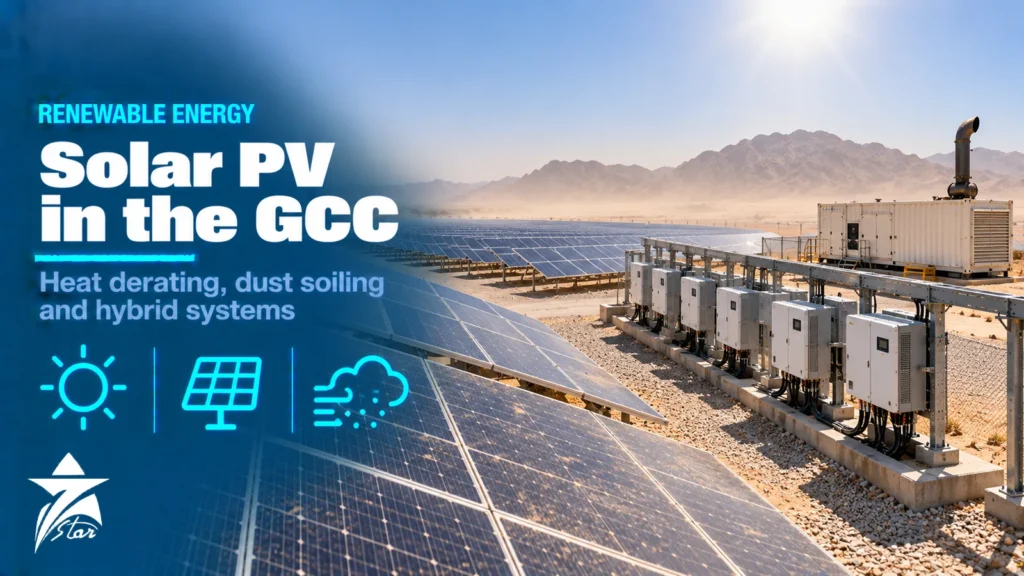
Remote wellheads, pumping stations, telecom shelters, desert camps and factory rooftops across the region share one advantage: abundant sunshine. They also share the conditions that make photovoltaic systems underperform if they are designed with temperate-climate assumptions, namely very high module temperatures, airborne dust and long distances to maintenance crews. Designing solar PV in Oman and the wider GCC well means treating heat, soiling and the interaction with existing diesel generation as primary design inputs rather than afterthoughts. It is written for EPC contractors, consultants and site owners looking for a solar inverter supplier in Oman, whether for a rooftop in Muscat or an off-grid wellsite. This guide explains the resource, the losses that matter most, how to choose the inverter, the standards to specify, and how to combine PV with diesel and batteries on industrial and off-grid sites.
The Solar Resource in Oman and the GCC
The Arabian Peninsula receives some of the highest solar irradiation in the world, with clear skies for most of the year. Global horizontal irradiation across much of Oman is commonly reported in the range of roughly 5.5 to 6.5 kWh/m² per day on an annual average, with interior desert locations at the upper end and coastal areas affected by humidity, haze and the summer khareef in Dhofar at the lower end. These are indicative figures only; a site design should use a recognised irradiation dataset or measured data for the exact coordinates.
High irradiation does not translate directly into high energy yield. Summer dust events, aerosols and very high ambient temperatures all erode the gain, which is why specific yields in the Gulf are often lower than the irradiation alone would suggest. The design task is to capture as much of the resource as possible while controlling those losses.
Heat Derating: Why Hot Modules Produce Less
Module ratings are given at Standard Test Conditions (STC): 1000 W/m² irradiance, 25 °C cell temperature and AM1.5 spectrum. In the field, cell temperature is typically 20 to 35 °C above ambient under strong sun, depending on mounting and wind. On a 45 °C summer afternoon, cells can therefore run at 70 °C or more.
Crystalline silicon modules lose power as temperature rises. The power temperature coefficient is stated on the datasheet, typically between about -0.30 and -0.45 %/°C. With a coefficient of -0.35 %/°C and a cell temperature of 70 °C, the module produces roughly 16% less than its STC rating before any other loss is counted.
- Choose a low temperature coefficient: some heterojunction and TOPCon modules have better coefficients than older PERC designs; compare the datasheet values directly.
- Allow ventilation: open-rack ground mounts and elevated roof structures run cooler than flush-mounted arrays.
- Check the NOCT or NMOT: the nominal operating cell temperature on the datasheet helps estimate real operating temperature.
- Recheck string voltages: voltage falls as temperature rises, so the inverter’s MPPT window must still be reached on the hottest days, while the open-circuit voltage at the coldest morning must stay below the inverter and module maximum system voltage.
- Derate inverters and cables: inverters reduce output above their rated ambient, and cable ampacity falls with temperature and grouping.
Dust Soiling and Cleaning Strategy
Soiling is the loss most specific to desert sites. Fine dust settles on the glass every day, and dew or humidity can cement it into a crust that wind will not remove. Field research in Qatar has measured soiling losses of roughly 0.4 to 0.5% per day on uncleaned modules, which can approach 15% in a month without cleaning. A single sandstorm can cause a larger step loss overnight.
| Factor | Effect on soiling | Design response |
|---|---|---|
| Tilt angle | Low tilts hold more dust | Use a tilt that balances yield and self-cleaning, avoiding very flat arrays where possible |
| Humidity and dew | Turns dust into an adherent film | Plan early-morning or night cleaning before the crust hardens |
| Nearby sources | Roads, quarries and construction raise local dust | Orient and locate arrays away from traffic and open ground |
| Water availability | Manual washing uses scarce water | Consider dry brushing robots or waterless cleaning where suitable |
| Module coatings | Anti-soiling coatings can reduce adhesion | Treat as a supplement, not a substitute for cleaning |
Studies in the Gulf have found that cleaning when soiling loss reaches around 10% can be close to economically optimal for some sites, but the right frequency depends on water cost, labour, access and the value of the lost energy. Remote sites without regular staff often justify robotic cleaning or a reference cell pair (one cleaned, one soiled) to trigger cleaning by measurement.
Standards to Specify for Modules and Systems
Using international standards in the specification gives a common basis for comparing offers from different suppliers and protects the owner against weak products.
- IEC 61215: design qualification and type approval of terrestrial PV modules, including thermal cycling and damp heat tests.
- IEC 61730: PV module safety qualification.
- Sand and dust test reports (for example to IEC 60068-2-68): useful extra evidence for desert sites where the module maker offers them.
- IEC 62548: design requirements for PV arrays, covering string sizing, protection and wiring.
- IEC 62446-1: documentation, commissioning tests and inspection of grid-connected systems.
- IEC 62109-1 and -2: safety of power converters used in PV systems.
- Local utility or regulator requirements for grid-connected systems, which differ between GCC countries and should be checked for each project.
PV-Diesel Hybrid Systems for Remote Sites
Many remote industrial loads in Oman are supplied by diesel generators running around the clock. Adding PV to such a system cuts fuel use, fuel deliveries and engine running hours. The challenge is that the generator must still control voltage and frequency, and it should not be pushed into very low load.
Diesel engines running for long periods below about 30% of their rating suffer from incomplete combustion and wet stacking. In a simple fuel-saver system without storage, a hybrid controller therefore limits PV output so that the generator always carries a minimum share of the load. That minimum, typically around 30 to 40% of the running generator rating, sets how much PV the system can absorb, often expressed as the PV penetration level.
- Low penetration (fuel saver): PV supplies part of daytime load; the generator runs continuously and remains the grid former. The controller curtails PV when the generator approaches its minimum load.
- Medium penetration: several generators of different sizes, with the controller choosing which to run, allow more PV to be used.
- High penetration with storage: a battery and grid-forming inverter can take over voltage and frequency control, allowing the generator to stop during sunny hours and restart when the battery or load requires it.
- Spinning reserve: because a passing dust cloud can cut PV output quickly, the controller must keep enough generator or battery reserve to cover a sudden drop.
Existing diesel generator sets need to be assessed before PV is added: their governors and AVRs must handle the changing net load, and their controllers must communicate with the hybrid controller.
Rooftop and carport PV at grid-connected plants
Factories and warehouses connected to the grid use PV mainly to offset daytime consumption, which in the Gulf is driven by air conditioning and process cooling that peak at the same time as the sun. Before committing, check the roof’s structural capacity and remaining life, the waterproofing method, fire access routes and the export or self-consumption rules of the local utility. Carport structures over parking areas add shade for vehicles and avoid roof penetrations. Where the plant also has standby generators, the protection scheme must make sure PV inverters disconnect or operate correctly when the generator takes over, so that the generator is not back-fed or destabilised during an outage.
Batteries in Hot Climates
Battery life is strongly affected by temperature. Lead-acid batteries lose life rapidly above 25 °C, and lithium-ion systems also age faster and need thermal management. In off-grid and hybrid PV systems on hot sites, batteries should be housed in shaded, ventilated or air-conditioned enclosures, and the energy used for cooling must be included in the energy balance. Chemistry selection, depth-of-discharge limits, battery management systems and fire protection are all part of the design; see the UPS and batteries range for storage-related equipment.
Balance-of-System Components for Desert Conditions
Inverters, combiner boxes and cabling face the same environment as the modules, often without the cooling benefit of wind.
- Inverters with a rated operating temperature suited to the site and a clear derating curve, installed in shade where possible.
- Enclosures with suitable IP ratings and UV-resistant materials, with attention to dust ingress at cable glands and filters.
- DC cables rated for PV use, sun exposure and high conductor temperature, with connectors from compatible families only.
- Surge protection on DC and AC sides, especially on long cable runs to remote equipment.
- Corrosion protection for structures near the coast, where salt-laden air is common.
Estimating Energy Yield and Performance Ratio for Solar PV in Oman
The performance ratio compares actual energy delivered with the energy that would be produced at STC efficiency from the measured irradiation. It captures temperature, soiling, mismatch, wiring, inverter and availability losses together. In hot, dusty locations it is common for the temperature and soiling losses alone to dominate the loss diagram, so energy yield models should use site temperature data and a realistic soiling assumption tied to the cleaning plan rather than a generic default.
Monitoring should record irradiance in the plane of the array, module temperature, inverter output and alarms. Comparing measured with expected yield shows when cleaning is due and when a string or inverter has failed.
Solar PV in Oman: Project Checklist
- Site irradiation data from a recognised dataset or on-site measurement.
- Load profile, including night loads and motor starting, for off-grid and hybrid systems.
- Module datasheet with temperature coefficient, NMOT, IEC 61215 and IEC 61730 approvals.
- String sizing checked at the site’s maximum and minimum cell temperatures.
- Inverter and battery derating at site ambient temperature.
- Cleaning method, frequency, water source and access for crews.
- Generator minimum load and hybrid controller strategy agreed.
- Monitoring, spares and maintenance plan for remote operation.
Choosing a Solar Inverter: String, Hybrid, Off-Grid and Central
The inverter is the component that most often decides whether a PV system in the GCC performs as designed. The right type depends on whether the site is grid-connected, whether batteries are needed and how large the array is.
| Inverter type | Typical size | Where it fits | Examples |
|---|---|---|---|
| Single-phase string inverter | 3–10 kW | Villas, small shops and offices on a grid connection | Sungrow SG3.0RS, Deye SUN-10K-G02P1 |
| Three-phase string inverter | 10–150 kW | Commercial and industrial rooftops, car parks, factories | Sungrow SG10RT-P2, SG125CX-P2, Huawei SUN2000-150K-MG0, SMA STP 50-41 |
| 1500 V utility string inverter | 300 kVA and above | Ground-mounted solar plants | Sungrow SG350HX, Huawei SUN2000-506KTL-H1 |
| Hybrid inverter | 5–20 kW | Grid-connected sites that want battery backup or self-consumption | Deye SUN-6K-SG04LP1 (48 V), Deye SUN-10K-SG05LP3, Deye SUN-20K-SG01HP3 (high voltage) |
| Off-grid inverter/charger with MPPT | 3–10 kVA per unit, can be paralleled | Remote telemetry, camps, pumping and PV-diesel hybrids | Victron MultiPlus-II, Victron Quattro, EasySolar-II |
A few points matter more in Oman than in temperate markets:
- Inverter heat derating. Inverters reduce their output when internal temperature rises, and most datasheets show derating starting somewhere around 45–50 °C ambient. Mount inverters in shade, leave the clearances the manufacturer specifies and check the derating curve against your site’s summer temperatures.
- Low-voltage vs high-voltage batteries. Hybrid inverters are built for either 48 V battery banks or high-voltage battery stacks. Choose the inverter and battery together; they are not interchangeable.
- MPPT inputs. Roofs with several orientations or shading need an inverter with enough independent MPPT inputs, or module-level electronics such as microinverters.
- Grid connection rules. Grid-connected systems must meet the current connection requirements of the distribution company and the regulator, so confirm the approved inverter list and protection settings before ordering.
- DC cabling and isolation. Use 1500 V or 1000 V rated solar cable such as Helukabel SOLARFLEX-X H1Z2Z2-K and UV-resistant DC isolators sized for the string voltage at the coldest morning temperature.
Solar and Storage Equipment We Supply
These examples cover string, hybrid and off-grid inverters, charge controllers, cable and batteries.
Send the load, site, and backup needs through our quote request form.
Buying Solar Inverters in Oman Through Seven Star LLC
Seven Star LLC supplies solar power equipment, batteries and related electrical components on request for commercial, industrial and remote sites in Muscat, across Oman and in the GCC, alongside generators and other emergency power equipment. We help with selection and cross-checking part numbers for modules, inverters, controllers and protection devices. As an independent solar inverter supplier in Oman, we quote the make in your design or offer comparable alternatives. Availability and lead time are confirmed at quotation.
Share your load profile, site location and the datasheets or nameplates of existing generators and inverters, and we will prepare an itemised RFQ response for the equipment you need.
Frequently asked questions
How much do high temperatures reduce solar panel output?
Output falls by the module's power temperature coefficient for each degree of cell temperature above 25 °C, typically around 0.30 to 0.45% per degree for crystalline silicon. With cells at 70 °C on a hot day, losses of around 14 to 20% compared with the STC rating are common.
How often should solar panels be cleaned in desert conditions?
It depends on local dust, humidity and the value of the energy lost. Research in Qatar measured soiling losses of roughly 0.4 to 0.5% per day without cleaning. Many sites clean every one to four weeks, or trigger cleaning when a reference measurement shows a set loss, often around 10%.
What is a PV-diesel hybrid system?
It is a system in which PV modules and one or more diesel generators supply the same load, managed by a hybrid controller. The PV reduces fuel use during the day, while the generator maintains voltage and frequency and supplies the load at night or in poor weather. Batteries can be added to allow higher PV shares.
Why can't PV supply all the load when a diesel generator is running?
A diesel engine should not run for long periods at very low load, typically below about 30% of its rating, because of incomplete combustion and wet stacking. The hybrid controller limits PV output so that the generator keeps a minimum load and enough spinning reserve.
Which standards should solar modules meet?
Modules are normally specified to IEC 61215 for design qualification and IEC 61730 for safety. Array design follows IEC 62548, and commissioning and documentation follow IEC 62446-1. Inverter safety is covered by IEC 62109. Local utility requirements also apply to grid-connected systems.
Do batteries work well in hot climates?
Batteries age faster at high temperature. Lead-acid life drops sharply above 25 °C, and lithium-ion systems also need thermal management. In hot climates, batteries should be kept in shaded, ventilated or cooled enclosures, and the cooling energy should be included in the system design.
What is the difference between a string inverter and a hybrid inverter?
A string inverter converts PV power to AC for the grid or the building and has no battery connection. A hybrid inverter also manages a battery, so it can store surplus solar energy and supply backup power during outages. Hybrid inverters are designed for either 48 V or high-voltage batteries, so the inverter and battery must be chosen together.
Where can I buy solar inverters in Muscat or elsewhere in Oman?
Seven Star LLC is an independent supplier in Oman that quotes string, hybrid and off-grid inverters, charge controllers, batteries and solar cable from makers such as Sungrow, Huawei, SMA, Deye and Victron. Send the array size, grid or off-grid requirement, battery needs and site location through the quote request form or to [email protected].
Was this guide helpful?One click helps us write better guides for engineers.
Thank you! Glad it helped. Need this equipment for your project? Request a quotation
Thank you. We will use this to improve the guide.