- Automation & ControlView all 1,651 products
- AC Drives
- Industrial Communications
- PLC & I/O Cards
- Vibration Monitoring
- Automation Accessories
- Controllers & Data Acquisition
- CCTV & Security
- Safety Switches & Guard Locking
- Encoders
- Industrial Computers
- Servo Drives
- Motor Soft Starters
- HMI Displays
- Isolator & Barrier
- Pneumatic Cylinders
- Automation Software
- Machine Vision
- Robotics
















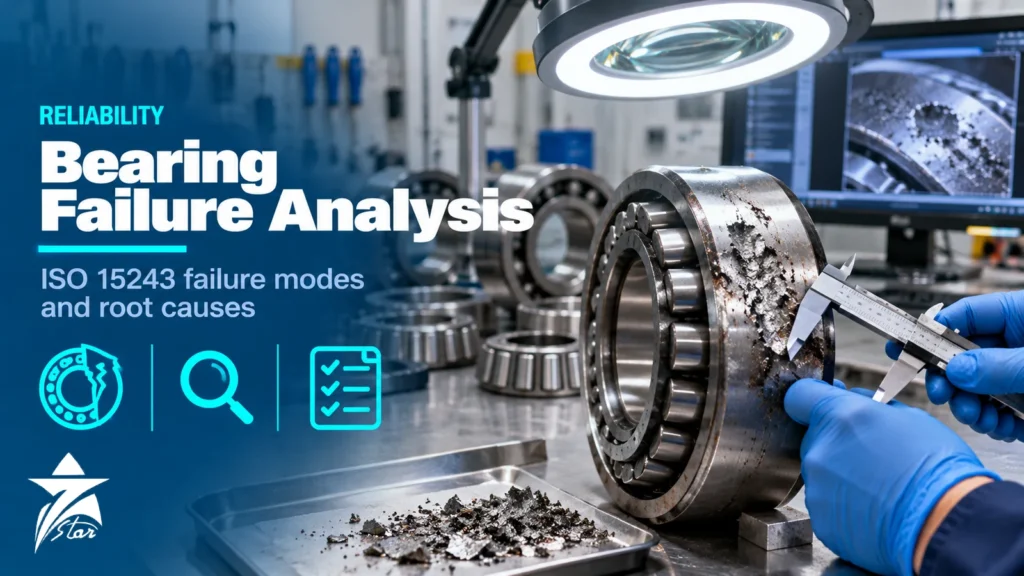
A failed bearing is evidence, not scrap. When a bearing in a critical pump or fan fails early and is thrown away, the plant usually buys another one, mounts it the same way and gets the same failure a few months later. Structured bearing failure analysis breaks that cycle. This guide uses the classification in ISO 15243, the international standard for rolling bearing damage terms, characteristics and causes, to explain how to read the damage, connect it to a root cause and decide what to change so it does not happen again.
Why ISO 15243 Matters
ISO 15243 gives maintenance teams, bearing manufacturers and insurers a common language. It classifies damage that occurs while the bearing is installed and operating, based on what can be seen on the rings, rolling elements and cage, and it describes the typical causes of each appearance. The current edition is ISO 15243:2017, which replaced the 2004 edition. The standard does not cover manufacturing defects. It also recognises that several mechanisms often act together, so the visible damage may be a mix, and the analyst must find the primary mode that started the chain.
The Six Failure Modes at a Glance
| Main mode | Sub-modes | Typical appearance | Common root causes |
|---|---|---|---|
| Rolling contact fatigue | Subsurface-initiated; surface-initiated | Flaking or spalling in the load zone; micro-pitting or glazed bands | Overload, end of normal life, poor lubrication film, contaminants |
| Wear | Abrasive; adhesive | Dull, matt surfaces, grey lubricant; smearing and material transfer | Particles or sand in the lubricant; sliding of rollers under light load or rapid acceleration |
| Corrosion | Moisture corrosion; frictional corrosion (fretting corrosion, false brinelling) | Rust spots at roller pitch; reddish-brown marks on bore or outside diameter; polished marks at element pitch | Water ingress, condensation, loose fits, vibration while stationary |
| Electrical erosion | Excessive current; current leakage | Craters and burn marks; regular grey fluting across the raceway | Welding current through the bearing, drive-induced shaft voltages |
| Plastic deformation | Overload; indentation from debris; indentation from handling | Dents at rolling element pitch; small scattered dents; nicks | Shock loads, hammer mounting, hard particles over-rolled |
| Fracture and cracking | Forced fracture; fatigue fracture; thermal cracking | Cracked rings or rollers, broken flanges, cracks across heat marks | Excessive interference fit, impact, bending, heat from sliding contact |
Rolling Contact Fatigue
Fatigue is the failure mode that L10 life predicts. Repeated stress cycles create microcracks that grow until material flakes from the surface. Subsurface-initiated fatigue starts below the surface in the zone of highest shear stress and is the classic end-of-life failure in a clean, well-lubricated bearing. If it appears early, look for higher load than designed: belt over-tension, unbalance, misalignment, or an interference fit that removed internal clearance and preloaded the bearing.
Surface-initiated fatigue begins at the surface where the lubricant film is too thin to separate the contacts. The early sign is a frosted or glazed band and fine micro-pitting; later it develops into flaking. Root causes include wrong viscosity for the operating temperature, degraded or insufficient lubricant, and dents from contaminants that act as stress raisers. In hot climates, a grease selected for a lower operating temperature is a frequent contributor.
Wear: Abrasive and Adhesive
Abrasive wear removes material evenly and leaves dull, matt raceways and greyish lubricant loaded with fine metal. It is the typical result of sand, dust or process particles entering through worn seals or being pumped in during relubrication with dirty grease guns. Increased internal clearance follows, which raises vibration and noise.
Adhesive wear, often called smearing, happens when rolling elements slide instead of roll. Material transfers between surfaces and they look torn and discoloured. It is common on large roller bearings that run with very light load at high speed, during rapid acceleration, or where the lubricant is too stiff for start-up. Solutions include ensuring a minimum load, choosing a suitable lubricant and, in some designs, changing cage or internal geometry.
Corrosion: Moisture and Frictional
Moisture corrosion appears as dark stains or rust, often at the spacing of the rolling elements, because water collects at the contacts during standstill. Sources include washdown water, rain on outdoor equipment, condensation in humid coastal air and water in the lubricant. Pitting from corrosion later becomes a starting point for fatigue.
Frictional corrosion has two forms. Fretting corrosion occurs between a ring and its seat when the fit is too loose or the seat is not round, leaving reddish-brown oxide on the bore or outside diameter. False brinelling occurs on the raceways of stationary bearings subjected to vibration, for example a standby pump next to a running unit or equipment transported without securing the shaft. The marks sit at rolling element pitch, but unlike true brinelling the original grinding marks are worn away.
Electrical Erosion
When current passes through the rolling contacts, it melts tiny areas of the surface. Excessive current, such as welding current earthed through a machine, causes craters and burn marks. Current leakage, a lower current over longer periods, typically produces fluting: a regular washboard pattern of grey lines across the raceway, with darkened, burnt grease. Fluting is strongly associated with motors fed by variable frequency drives, where common-mode voltage discharges through the bearings. Prevention combines shaft grounding devices, current-insulated or hybrid ceramic bearings, and correct drive cabling and earthing. Never connect a welding earth clamp so that the current path crosses a bearing.
Plastic Deformation
Overload deformation, or true brinelling, leaves shallow dents at rolling element pitch, often from hammering a bearing during mounting or from an impact load. Indentation from debris produces many small dents with raised edges when hard particles are over-rolled; each dent is a future fatigue starting point. Indentation from handling includes nicks and gouges from dropping bearings or using the wrong tools. Using induction heaters and correct mounting tools, and keeping bearings in their packaging until fitting, removes most of these causes.
Fracture and Cracking
Forced fracture comes from stress beyond the material strength, for example an inner ring driven too far up a tapered seat or an impact. Fatigue fracture develops from repeated bending, such as an outer ring poorly supported in a housing. Thermal cracking forms across the ring when sliding generates high frictional heat, for example a ring creeping on its seat or a seal rubbing hard. Cracks are serious because the bearing can seize suddenly; finding the source of the excessive stress or heat is essential before restarting.
A Step-by-Step Bearing Failure Analysis Procedure
- Collect operating history: run hours, trend data, temperature, alarms and the last maintenance actions.
- Before removal, note the bearing position, load direction and any visible leakage, and take a lubricant sample.
- Mark the load zone on the outer ring and the orientation in the housing before dismantling.
- Photograph each component: rings, rolling elements, cage, seals, shaft seat and housing bore.
- Examine the running track pattern. Its position and width show load direction, misalignment and fit problems.
- Classify the damage using the six ISO 15243 modes and identify the primary mode.
- Check the shaft and housing dimensions, roundness and fits against the drawing.
- Identify the root cause and decide the corrective action, then record it in the maintenance system.
What the Lubricant and Seals Tell You
The lubricant is often the fastest route to the root cause. Grease that is dark brown or black and hard has usually oxidised from high temperature or an extended relubrication interval. Grey or silvery grease points to wear particles, while a milky or emulsified appearance shows water ingress. Gritty grease that feels sandy between the fingers confirms external contamination. Where possible, send a sample for laboratory analysis of water content, particle count and wear metals, and compare it with a sample of the fresh grease from stores.
Seals and shields deserve the same attention. Worn or hardened lip seals, a damaged labyrinth, a missing V-ring or a blocked grease relief port all change the operating conditions of the bearing. A seal running on a scored shaft surface will leak whatever grease is chosen, and a housing with no free path for old grease to escape will overheat after every relubrication. Record seal condition with the same care as the bearing itself.
Reading Running Track Patterns
The path where the rolling elements have run is often more informative than the damage itself. A normal pattern under a stationary radial load is centred on the outer ring raceway and covers less than half its circumference, while the rotating inner ring shows a band all around. A track running around the entire outer ring indicates preload, typically from an excessive interference fit or a non-locating bearing that cannot float. A pattern offset to one side shows axial load, and a diagonal track on the stationary ring shows misalignment between shaft and housing. Comparing these patterns with the expected loads tells you quickly whether the problem lies in the bearing or in the machine.
GCC Field Factors That Shape Bearing Damage
Plants in Oman and the wider GCC see some failure modes more often than others. Fine sand drives abrasive wear on outdoor fans, conveyors and cooling tower drives when seals are not maintained. High ambient temperature thins lubricants and accelerates oxidation, leading to surface-initiated fatigue. Humid coastal air at desalination and port sites encourages moisture corrosion, particularly on standby equipment, and vibration from neighbouring machines creates false brinelling on idle units. Widespread use of variable frequency drives in water and HVAC services makes electrical erosion a common finding. A practical response is to rotate standby equipment on a schedule, check seal condition at every relubrication and include drive grounding in motor inspections.
Prevention and Monitoring
- Use correct mounting tools and heaters; never transmit mounting force through the rolling elements.
- Keep lubricants clean and use dedicated, labelled grease guns for each grease type.
- Align couplings and check soft foot after every motor change.
- Verify shaft and housing fits during overhauls.
- Monitor vibration and temperature to detect damage early; our overview of vibration monitoring system types explains the options, and the vibration monitoring category lists hardware.
- Use proper tooling and lubricants from the lubrication and bearing maintenance range.
Bearing Failure Analysis Checklist
- Operating history and condition monitoring trends gathered.
- Lubricant sample taken before cleaning.
- Load zone, orientation and running track recorded.
- All components photographed in good light.
- Damage classified into one primary ISO 15243 mode.
- Shaft and housing fits measured.
- Root cause identified and corrective action recorded.
- Replacement bearing designation confirmed, including clearance and seal type.
Bearing Maintenance Products We Supply
Many of the failure modes above start with poor mounting or lubrication. These products address both, plus detection.
| Product | Type | Where it fits |
|---|---|---|
| SKF TIH 030m Small Induction Bearing Heater | Small induction bearing heater | Heating bearings evenly before mounting. |
| SKF TMFT 36 Bearing Fitting Tool Kit, 36 Impact Rings | Bearing fitting tool kit | Cold mounting small bearings without damaging the rolling elements. |
| SKF LGMT 2 General Purpose Industrial Bearing Grease | General purpose bearing grease | Motors, fans and pumps. |
| SKF LGEP 2 High Load Extreme Pressure Bearing Grease | Extreme pressure bearing grease | Heavily loaded or shock-loaded bearings. |
| PCB Piezotronics 682C05 Bearing Fault Detector Transmitter | Bearing fault detector transmitter | Early warning of bearing damage on critical machines. |
| SKF TKSA 41 Laser Shaft Alignment Tool | Laser shaft alignment tool | Removing misalignment, a common cause of bearing failure. |
Send the bearing designation, machine type and operating conditions through our quote request form.
Sourcing Replacement Bearings Through Seven Star LLC
Seven Star LLC supplies replacement bearings, mounting tools and lubrication products from established manufacturers on request. If the failure analysis points to a different clearance class, seal type or an insulated design, we help cross-check part numbers and confirm equivalents between brands. Availability and lead time are confirmed at quotation. See our roller bearings range for typical types.
Send us the failed bearing’s designation, photos of the damage and the machine datasheet or nameplate, and we will reply with suitable replacement options in our quotation.
Frequently asked questions
What are the six failure modes in ISO 15243?
ISO 15243 groups in-service rolling bearing damage into six main modes: rolling contact fatigue, wear, corrosion, electrical erosion, plastic deformation, and fracture and cracking. Each main mode has sub-modes, such as subsurface-initiated and surface-initiated fatigue. The classification is based on the visible appearance of the damage, and it does not cover manufacturing defects.
How can I tell subsurface fatigue from surface-initiated fatigue?
Subsurface-initiated fatigue starts below the raceway surface after many load cycles and appears as flaking in the most heavily loaded zone, often on an otherwise smooth, well-lubricated track. Surface-initiated fatigue starts from surface distress caused by poor lubrication or debris and is usually preceded by a glazed, frosted or micro-pitted band. Surface-initiated damage usually points to a lubrication or contamination problem rather than overload.
What does fluting on a bearing raceway mean?
Fluting is a washboard pattern of evenly spaced grey lines across the raceway, a form of electrical erosion caused by current leakage through the bearing. It is common on motors and driven equipment fed by variable frequency drives. Prevention includes shaft grounding, current-insulated or hybrid bearings, and correct cabling and earthing of the drive system.
Is false brinelling the same as true brinelling?
No. True brinelling is plastic deformation from an overload or impact, such as hammering a bearing during mounting, and the dents retain the original grinding marks. False brinelling is wear-type damage from small oscillating movements while the bearing is stationary, for example standby pumps exposed to vibration; the marks are polished or corroded and the grinding marks are worn away.
Should I clean a failed bearing before inspecting it?
Not before you have recorded its condition. Photograph the bearing and its mounting, take a sample of the lubricant, and note the load zone position before dismantling or washing. Cleaning too early removes evidence such as discoloured grease, wear particles or water contamination that is often the key to the root cause.
How do I prevent repeat bearing failures?
Treat the failure mode as a symptom and correct the root cause: fix lubrication, improve sealing, correct alignment and fits, or address electrical currents. Then verify the fix with condition monitoring such as vibration trending and temperature checks. Replacing the bearing with an identical one without correcting the cause usually leads to the same failure.
Was this guide helpful?One click helps us write better guides for engineers.
Thank you! Glad it helped. Need this equipment for your project? Request a quotation
Thank you. We will use this to improve the guide.