
- Vibration Monitoring
- Industrial Communications
- PLC & I/O Cards
- Automation Accessories
- Controllers & Data Acquisition
- AC Drives
- Industrial Computers
- Encoders
- Safety Switches & Guard Locking
- Isolator & Barrier
- Automation Software
- HMI Displays
- Motor Soft Starters
- Servo Drives
- CCTV & Security
- Robotics
- Pneumatic Cylinders
- Machine Vision
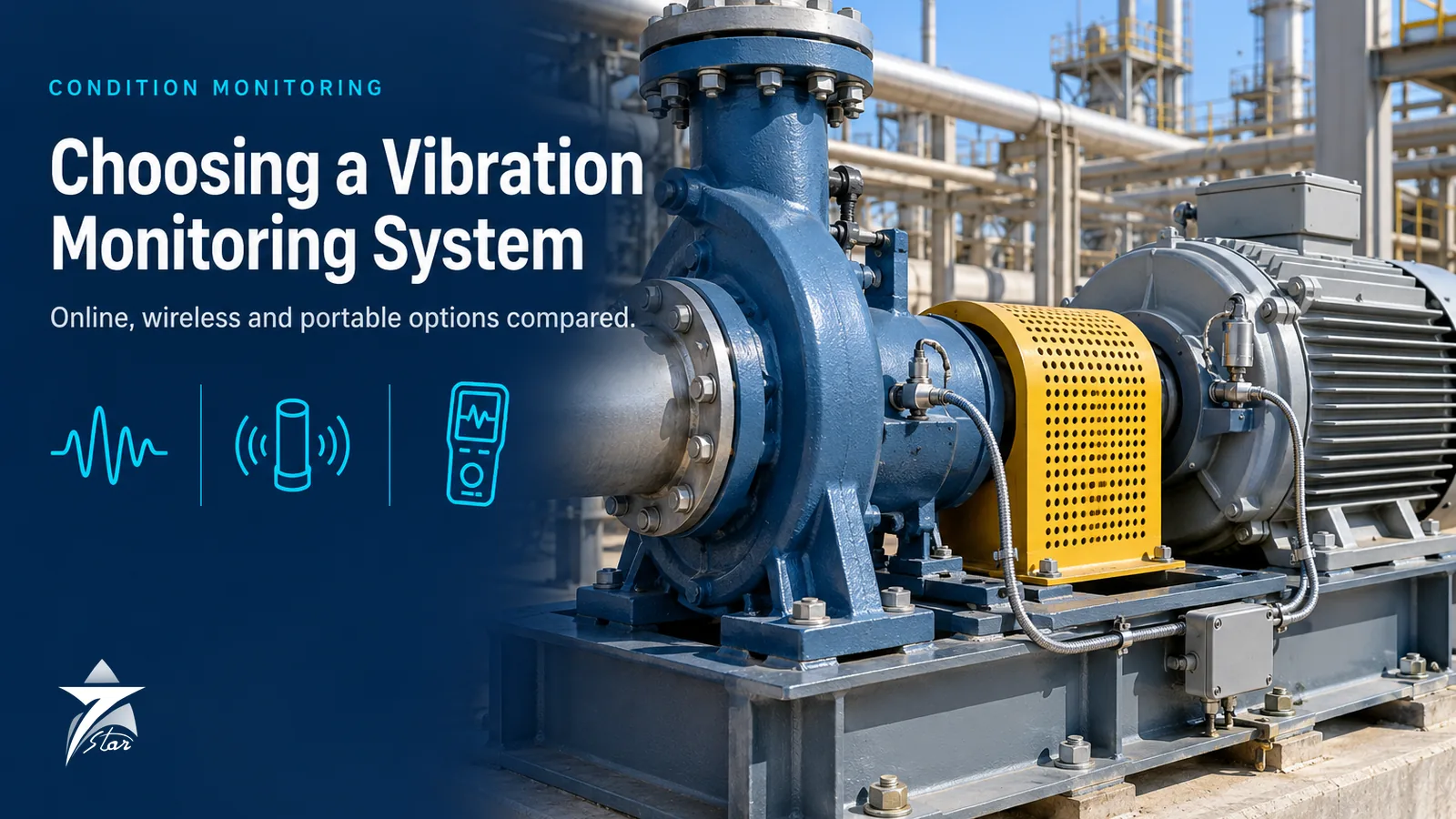
Choosing a Vibration Monitoring System: Online Protection, Online Condition Monitoring, Wireless Sensors and Portable Analyzers
Most plants do not need one vibration monitoring system; they need several, layered across the asset base according to how much each machine matters. A 20 MW gas compressor, a pair of spared cooling-water pumps and a hundred small fan motors present very different risks, and putting the same technology on all of them either wastes money or leaves critical failures undetected. The engineering task is to rank assets, match each class to a monitoring approach, and make sure the data actually reaches someone who acts on it.
This guide covers the four main technology families: online protection, online condition monitoring, wireless sensors and portable analyzers, and what changes when the plant sits in 48 °C ambient with sand in the air. For protection racks specifically, see our separate API 670 machinery protection system guide.
Start With Criticality, Not Technology
A criticality ranking is the foundation of any vibration program. The usual approach scores each machine on consequence of failure (safety, environment, production loss, repair cost) and on likelihood (duty, history, redundancy). The result typically falls into three classes:
- Critical: unspared, high-power or high-speed machines where a failure stops production or creates a safety hazard. Typical examples are compressors, steam and gas turbines, large export pumps and main generators.
- Essential: machines that matter but have a spare, or whose failure causes partial loss. Examples include spared process pumps, large fans, cooling tower drives and gearboxes.
- General purpose: the balance of plant, such as small pumps, HVAC fans, utility motors and agitators.
Once each machine has a class, the monitoring approach follows with little argument.
| Criticality class | Typical machines | Recommended approach | Data frequency | Automatic trip |
|---|---|---|---|---|
| Critical | Compressors, turbines, unspared large pumps, generators | Permanent proximity probe protection rack plus online condition monitoring software | Continuous, with waveforms on event | Yes, with voting logic |
| Essential | Spared pumps, large fans, gearboxes, blowers | Online monitor or wireless sensors with alarm, periodic detailed analysis | Minutes to hours | Usually alarm only |
| General purpose | Small motors, utility pumps, HVAC fans | Route-based portable analyzer, or low-cost wireless on hard-to-reach units | Monthly to quarterly routes | No |
| Remote or hazardous access | Unmanned pumping stations, wellhead pumps, tank farm equipment | Wireless sensors or 4–20 mA transmitters into existing SCADA | Minutes to hours | Rarely |
What Vibration Reveals and How It Is Measured
Common fault signatures
Each mechanical fault produces a characteristic signature in the frequency domain, which is why spectrum capability matters more than an overall number for anything beyond basic alarming:
- Unbalance: dominant 1X running speed in the radial direction, with phase stable and roughly 90 degrees between horizontal and vertical readings.
- Misalignment: elevated 2X and often high axial 1X, with phase differences across the coupling.
- Mechanical looseness: multiple running speed harmonics, sometimes half-order components, and erratic phase.
- Rolling element bearing defects: non-synchronous frequencies (BPFO, BPFI, BSF and FTF) that appear first at high frequency, long before they show in velocity.
- Gear problems: gear mesh frequency (number of teeth times shaft speed) with sidebands spaced at the speed of the faulty gear.
- Fluid-film bearing instability: oil whirl or whip at sub-synchronous frequency, typically around 0.4 to 0.48X, visible on proximity probes.
Measurement types
The sensor and unit must suit the fault. Displacement, measured with eddy-current proximity probes in micrometres peak-to-peak, observes shaft motion relative to the bearing and is the correct parameter for machines with fluid-film (sleeve or tilting-pad) bearings. Velocity, in mm/s RMS, is the standard measure of overall casing vibration severity in the roughly 10 Hz to 1 kHz band and is what ISO 20816 zone limits are expressed in. Acceleration, in g, emphasises high frequencies and is needed for gear mesh and early bearing faults. Enveloping (also called demodulation or bearing condition units by different vendors) filters out low-frequency content and extracts the repetition rate of bearing impacts, giving the earliest practical warning of rolling element bearing damage.
A velocity sensor such as the Bently Nevada 330500 Velomitor piezo-velocity transducer is a common choice for casing measurements on rolling element bearing machines, while proximity probe systems remain the standard for turbomachinery shafts.
ISO 20816 severity zones
ISO 20816 is progressively replacing the ISO 10816 (casing) and ISO 7919 (shaft) series. Part 1 gives general guidance and Part 3 covers industrial machines above 15 kW. Both use four evaluation zones: A (newly commissioned), B (acceptable for unrestricted long-term operation), C (unsatisfactory, limited operation) and D (damage likely). Zone boundaries depend on machine group, power and whether the foundation is rigid or flexible. As an indication from the Part 3 tables, a medium-sized machine on a rigid foundation has its B/C boundary in the order of 2.8 mm/s RMS and C/D around 4.5 mm/s RMS, while large machines on flexible foundations allow considerably more. Always use the current edition for the actual values, and treat zone limits as a starting point: trending against the machine’s own baseline catches problems far earlier than an absolute limit.
The Four Technology Families Compared
| Approach | Typical sensors | Detects well | Limitations | Typical use |
|---|---|---|---|---|
| Online protection rack | Proximity probes, keyphasor, velocity or acceleration on casings | Rapid changes in shaft vibration, axial position, overspeed inputs; trips machine | Protection logic only; diagnostics need separate software | Critical turbomachinery to API 670 |
| Online condition monitoring | Same transducers plus additional accelerometers | Full spectra, waveforms, orbits, transient startup data, trend analysis | Higher cost per point; needs analyst time and network infrastructure | Critical and high-value essential machines |
| Wireless sensors | Triaxial or single-axis accelerometers with temperature | Overall trends, spectra at intervals, bearing and unbalance faults | Update rates limited by battery life; not suitable for protection | Essential and remote assets |
| Portable analyzer routes | Handheld accelerometer, tachometer | Detailed spectra, phase, balancing and diagnostics in the hands of a skilled analyst | Snapshot only; misses fast-developing faults between routes | General purpose machines and diagnostic follow-up |
Online protection
Permanent protection systems monitor continuously and trip the machine on validated high-high alarms, usually with 2-out-of-2 or 2-out-of-3 voting. The Bently Nevada 3500 rack is the most widely installed example on API 670 turbomachinery, and the Shinkawa VM-5W1 rack is found on many machines from Japanese packagers. For smaller essential machines that need local protection without a full rack, standalone monitors such as the Bently Nevada 1900/65A general-purpose equipment monitor or the Brüel & Kjær VIBROCONTROL 1000 provide alarm and relay outputs at lower cost. Confirm channel count, sensor compatibility and relay configuration on the datasheet for each.
Loop-powered transmitters
Where only an overall value is needed in the DCS or SCADA, a 4–20 mA transmitter is often enough. The Bently Nevada 990 transmitter is one example designed to bring proximity probe measurements into a control system as a loop-powered signal. Transmitters are cheap to integrate but provide no spectrum, so they detect that something has changed, not what.
Online condition monitoring
Condition monitoring software sits on top of protection hardware or dedicated acquisition units and stores spectra, waveforms, orbits and startup and coastdown data. This is where an analyst distinguishes a misalignment from a rub. Its value depends on someone reviewing the data.
Wireless sensors
Wireless sensors make monitoring of essential machines economical by removing cable and junction box costs, which often exceed the sensor cost in brownfield plants. The Ranger Pro wireless vibration sensor is an example of a hazardous-area wireless device intended for this role. The key trade-off is between update rate and battery life. Battery life is typically quoted in years at a given configuration, but sending full spectra frequently can reduce it substantially, and high ambient temperatures shorten lithium cell life further. Ask the supplier for battery life at your actual reporting interval and temperature, not the brochure best case.
Portable analyzers and routes
Route-based monitoring with a portable data collector remains the most cost-effective approach for general purpose machines and the essential diagnostic tool even in plants with extensive online systems. Units such as the SCOUT100-EX portable vibration analyzer are intended for hazardous areas, while the VIBXPERT II vibration analyzer supports multi-channel analysis and field balancing. For maintenance teams without a dedicated analyst, the Fluke 810 handheld vibration tester provides automated fault diagnosis with severity ratings. Route frequency is commonly monthly for essential machines and monthly to quarterly for general purpose, tightened when a fault is developing.
Data, Integration and ROI
A vibration program creates value only when a finding becomes a work order. Integration with the CMMS should allow an alarm or analyst recommendation to raise a notification with the asset tag, fault description and urgency, and should feed back the as-found condition after repair so diagnoses can be verified.
The main ROI drivers are avoided secondary damage (a bearing replaced on schedule instead of a seized shaft and wrecked seal), unplanned outages converted into planned ones, and extended overhaul intervals on machines proven healthy. On critical machines a single avoided failure usually pays for the system; on general purpose machines the case rests on labour efficiency.
Considerations for Oman and the GCC
Site conditions in the region change several design decisions:
- Heat: sensor and transmitter enclosures in direct sun can run well above the 45–50 °C ambient. Check the maximum operating temperature of wireless sensors and their batteries, and fit sunshades where practical.
- Remote unmanned sites: pumping stations along pipelines and water transmission systems are often hours from the nearest technician. Wireless sensors with gateway backhaul over the existing SCADA network, or transmitters into the RTU, are typically more practical than routes.
- Connectivity: confirm that the gateway can reach the historian or cloud platform through the site’s network and cybersecurity rules before purchasing. Many wireless projects stall at the firewall rather than at the sensor.
- Dust and sand: specify adequate ingress protection on connectors, glands and junction boxes.
- Coastal corrosion: plants at Sohar, Duqm, Sur and Salalah need stainless steel mounting studs, sealed connectors and attention to probe extension cable connectors, which corrode and cause intermittent faults.
- Spares lead time: proximity probes, extension cables and drivers are matched sets, and lead times for specific lengths can be long. Hold spares for critical trains on site.
Common Mistakes
- Installing proximity probes on rolling element bearing machines, where shaft relative motion is small and casing measurement is more informative.
- Using magnetic mounts for permanent sensors or careless magnet placement on routes, which reduces usable high-frequency response and makes bearing fault detection unreliable.
- Setting alarm limits from a generic table and never adjusting them to the machine’s baseline.
- Buying online systems without allocating analyst time to review the data.
- Configuring wireless sensors for maximum data rate and then replacing batteries far earlier than budgeted.
Vibration Program Selection Checklist
- Criticality ranking completed and approved for all rotating equipment
- Bearing type recorded for each machine (fluid-film or rolling element)
- Measurement types defined per class (displacement, velocity, acceleration, enveloping)
- Protection requirements identified and voting logic agreed for critical machines
- Hazardous area classification and required Ex certification for each sensor location
- Maximum ambient and surface temperatures checked against sensor and battery ratings
- Wireless update rate and resulting battery life confirmed in writing
- Network path, cybersecurity approval and historian integration planned
- CMMS integration and work order workflow defined
- Route frequencies set and analyst resources allocated
- Spares list for probes, extension cables, drivers and monitor modules agreed
Sourcing Vibration Monitoring Equipment Through Seven Star LLC
Seven Star LLC supplies and sources vibration monitoring hardware for operators, maintenance contractors and EPCs in Oman and the GCC, including protection racks, standalone monitors, transducers, wireless sensors and portable analyzers. Browse the vibration monitoring category or the Bently Nevada brand page; Brüel & Kjær and Shinkawa equipment can be sourced on request. Send the part number, sensor length and certification requirement with each enquiry so the correct variant can be identified quickly.
Send your vibration monitoring requirements or part numbers to Seven Star LLC through our contact page for a quotation.
Was this guide helpful?One click helps us write better guides for engineers.
Thank you! Glad it helped. Need this equipment for your project? Request a quotation
Thank you. We will use this to improve the guide.
Need a Quotation for Your Project?
Seven Star LLC supplies the industrial equipment covered in this article to customers across Oman and the GCC. Send us the part numbers, models or a short description with quantities, and our sales team will reply with a formal quotation.
- Genuine OEM products
- Supply across Oman & the GCC
- Formal quotation from our sales team
Free, no-obligation quotation · takes about 1 minute
Other enquiries: [email protected] · WhatsApp
More Blog







Frequently Asked Questions
Protection systems monitor continuously and automatically trip a machine when vibration exceeds a validated danger limit, so their priority is reliability and fast response. Condition monitoring collects spectra, waveforms and trends to diagnose developing faults weeks or months before they become dangerous. Critical machines normally have both, often sharing the same transducers.
ISO 20816 is progressively replacing both the ISO 10816 series for casing vibration and the ISO 7919 series for shaft vibration. ISO 20816-1 gives general guidance and ISO 20816-3 covers industrial machines above 15 kW. The zone A to D evaluation concept is retained, but engineers should use the values in the current edition.
Battery life is typically quoted in years, but it depends heavily on how often the sensor sends overall values and full spectra. Frequent spectral uploads and high ambient temperatures can shorten life considerably. Always request a battery life estimate for your actual update rate and site temperature.
Proximity probes are the correct choice for machines with fluid-film bearings, such as compressors and steam turbines, because they measure shaft motion relative to the bearing where most of the dynamic behaviour occurs. Accelerometers and velocity sensors are better for rolling element bearing machines, where faults appear as casing vibration and high-frequency impacts. Many turbomachines use both.
Common practice is monthly for essential machines and monthly to quarterly for general purpose machines. The interval should be shortened when a fault is developing or after a repair. Machines whose failure modes develop faster than the route interval need online or wireless monitoring instead.
A dominant 2X component most often indicates misalignment, especially when accompanied by high axial vibration and phase differences across the coupling. Mechanical looseness and some electrical faults in motors can also produce 2X content. Phase measurements and a check of the coupling alignment usually confirm the cause.