- Automation & ControlView all 2,968 products
- Automation Accessories
- AC Drives
- PLC & I/O Cards
- Industrial Communications
- Vibration Monitoring
- Isolator & Barrier
- Controllers & Data Acquisition
- Safety Switches & Guard Locking
- Motor Soft Starters
- CCTV & Security
- Encoders
- Pneumatic Cylinders
- HMI Displays
- Servo Drives
- Industrial Computers
- Machine Vision
- Automation Software
- Robotics
















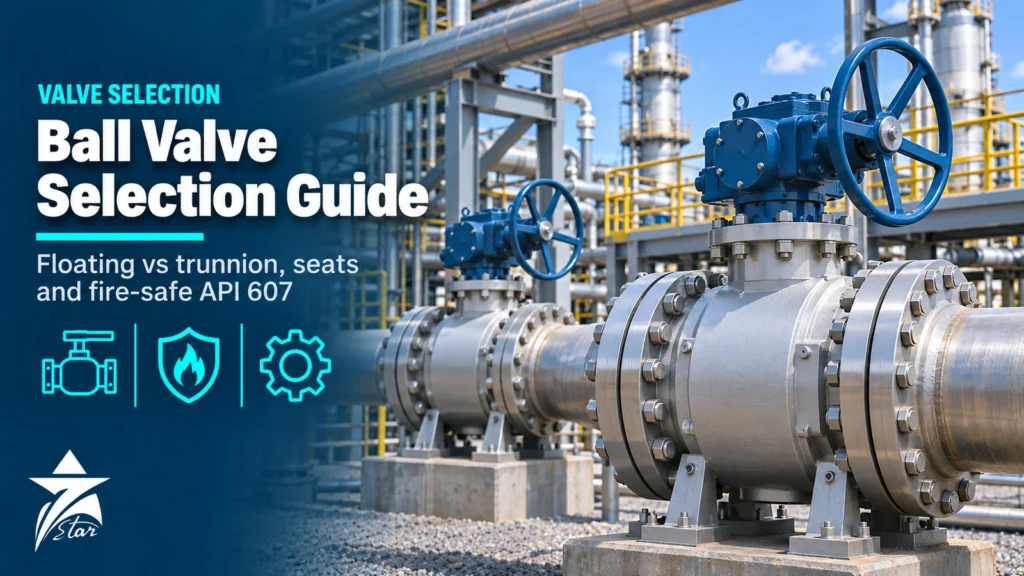
Ball valves are the most widely used quarter-turn valves in oil and gas, water, chemical and utility service. They open and close with a 90 degree turn, give tight shut-off and offer a straight flow path with low pressure drop. Yet a ball valve that works perfectly on a utility water line can fail quickly on high pressure gas, abrasive slurry or hot steam. Good ball valve selection means matching the design, seat, materials and certifications to the pressure, temperature, fluid and safety requirements of each line.
How a Ball Valve Works
A ball valve contains a spherical closure element with a bore through its centre. When the bore lines up with the pipe, the valve is open; a 90 degree rotation turns the solid side of the ball across the flow to close it. Seats, usually in the body on each side of the ball, press against the ball surface to seal. A stem connects the ball to a lever, gear operator or actuator. Our guide to ball vs gate vs globe vs butterfly valves compares this design with other valve types.
Ball Valve Selection: Floating vs Trunnion Mounted
| Feature | Floating ball | Trunnion mounted ball |
|---|---|---|
| Ball support | Ball is held only by the seats and moves slightly downstream under pressure | Ball is fixed by a top stem and bottom trunnion; seats are spring loaded against the ball |
| Sealing | Line pressure pushes the ball onto the downstream seat | Upstream seat is pushed onto the ball by springs and line pressure |
| Typical sizes and classes | Small to medium sizes, commonly up to about 6 to 10 inch in Class 150 to 300, smaller in higher classes | Larger sizes and higher pressure classes, from about 2 inch upward, Class 150 to 2500 |
| Operating torque | Rises with pressure and size | Lower and more predictable, suits large actuated valves |
| Cost and complexity | Simpler and lower cost | More complex, higher cost |
| Common standards | ISO 17292, API 608 | API 6D, ISO 14313 |
In ball valve selection, a useful rule of thumb is that floating designs suit smaller and lower pressure valves, while trunnion mounted designs are preferred for pipelines, large diameters and high pressure classes, where seat loads and torque on a floating ball would become excessive.
Full Bore vs Reduced Bore
A full bore, or full port, ball valve has a bore equal to the pipe internal diameter. It gives minimum pressure drop and allows pipeline pigging, so it is required on most piggable pipelines. A reduced bore valve has a bore one size smaller or more, which makes the valve lighter, cheaper and lower in torque, and is perfectly adequate for most process and utility lines where pigging is not required and a small extra pressure drop is acceptable.
Soft vs Metal Seats in Ball Valve Selection
| Seat type | Typical materials | Strengths | Limitations |
|---|---|---|---|
| Soft seat | PTFE, reinforced PTFE, PEEK, Devlon, nylon, PCTFE | Bubble tight shut-off, low torque, low cost | Temperature limits, wear with abrasive media, damage by high velocity |
| Metal seat | Stellite, tungsten carbide or chrome carbide coatings on ball and seat | High temperature, abrasive slurry, catalyst and severe service | Higher cost and torque, leakage class depends on lapping and test standard |
PTFE seats are common up to about 200 degrees C, PEEK extends this to around 250 to 260 degrees C depending on pressure, and PCTFE is used for cryogenic service. Metal seated valves handle temperatures above 400 degrees C and abrasive or solids-laden media, where soft seats would be eroded.
Fire-Safe, Antistatic and Blowout-Proof Features
In hydrocarbon service, a fire can destroy soft seats and seals. A fire-safe ball valve has secondary metal-to-metal seating and graphite seals, so that it limits leakage during and after a fire. Fire-safe designs are type tested to API 607 for quarter-turn valves with non-metallic seats, API 6FA for pipeline valves or ISO 10497. When reviewing a fire-safe claim, ask for the type test certificate covering the valve size, class and design.
- Antistatic device: a spring and plunger provide electrical continuity between ball, stem and body, so static charge from flowing fluids can drain to earth. This is required by ISO 17292 and API 608 for most hydrocarbon service.
- Blowout-proof stem: the stem is inserted from inside the body with a shoulder, so it cannot be ejected by line pressure if the packing gland is removed.
- Fugitive emission packing: low emission stem seals tested to ISO 15848-1 or API 641 for volatile or toxic fluids.
Double Block and Bleed and Double Isolation and Bleed
Trunnion ball valves are often specified with double block and bleed (DBB) or double isolation and bleed (DIB) capability. In a DBB valve, both seats seal when the valve is closed and the body cavity can be vented through a bleed valve to prove isolation. In a DIB-1 valve, both seats are bidirectional and seal against pressure from either side, including from the cavity. A DIB-2 valve has one unidirectional and one bidirectional seat. Cavity pressure relief must also be considered, because a liquid trapped in the closed body can expand when heated and overpressurise the cavity. These terms are defined in API 6D, which is the standard to reference when specifying these functions.
Body Construction and End Connections
| Construction | Description | Typical use |
|---|---|---|
| One-piece or bar stock | Body machined from one piece, no body joint | Instrumentation and small bore utility lines |
| Two-piece | Body and end cap, ball loaded from the end | General process and utility service |
| Three-piece | Centre section removable without disturbing pipe | Lines that need in-line maintenance, often with weld ends |
| Split body | Bolted body sections | Floating and trunnion flanged valves |
| Top entry | Ball and seats removed through a bonnet | Welded pipelines and cryogenic service with in-line maintenance |
| Fully welded | Welded body with no bolted joints | Buried pipelines and gas transmission |
End connections include threaded NPT or BSP, socket weld and butt weld for small bore, flanged to ASME B16.5 for process piping, and compression or tube fittings for instrumentation, where small one-piece and trunnion instrument ball valves are common.
Materials for Ball Valve Selection
- Body: carbon steel A105 or A216 WCB for general service, low temperature carbon steel LF2 or LCC, stainless steel F316 or CF8M for corrosive and water service, duplex and super duplex for seawater, and ductile iron or bronze for utility water.
- Ball and stem: usually stainless steel, with ENP, chrome or carbide coatings for wear and corrosion resistance.
- Sour service: materials must meet NACE MR0175 / ISO 15156 where H2S is present.
- Lined valves: PFA or PTFE lined bodies for aggressive acids and chemicals.
- Thermoplastic valves: PVC-U, PP and PVDF for water treatment and chemical dosing.
Operation and Automation
Small ball valves are operated by lever, while larger and higher pressure valves need gear operators to keep handwheel forces reasonable. Automated valves use pneumatic, electric or hydraulic actuators sized on the valve breakaway torque, plus a safety margin that accounts for media, temperature and how often the valve is cycled. ISO 5211 top flanges make actuator mounting straightforward. For emergency shutdown, spring return pneumatic actuators provide fail-safe closure. Our guide to electric valve actuator selection covers sizing and control options.
Testing and Inspection
Production valves are pressure tested for shell strength and seat leakage to API 598, ISO 5208 or API 6D. Soft seated valves are typically required to show no visible leakage, while metal seated valves are tested to a stated leakage rate. Our article on valve leak testing and leakage rates explains these standards and classes in detail.
Ball Valve Selection Checklist
- Fluid, including solids, corrosive components and H2S content.
- Design pressure, temperature and ASME pressure class.
- Floating or trunnion mounted, full or reduced bore.
- Seat material and required leakage class.
- Fire-safe, antistatic, blowout-proof stem and low emission packing requirements.
- DBB or DIB function and cavity relief.
- Body, ball and stem materials, including NACE compliance.
- End connections, face-to-face standard and operator or actuator type.
- Testing, certification and documentation required by the project.
Ball Valves in Our Catalogue
| Product | Type | Typical use |
|---|---|---|
| Argus FK79 | Floating ball valve | Process isolation and control |
| Flowserve Argus FK75M | Floating ball valve, ASME 150/300 | Chemical and refining service |
| Neles Series D | Trunnion mounted ball valve | Large and high pressure lines |
| Neles Series 6D | API 6D trunnion ball valve | Pipelines and gas service |
| Flowserve Valbart API 6D | Trunnion ball valve | Oil and gas pipelines |
| Bray Series M1 | Metal seated ball valve | Severe and abrasive service |
| Velan Memoryseal Cryogenic | Top-entry ball valve | LNG and cryogenic service |
| Flowserve Atomac AKH3 | Fluoropolymer lined ball valve | Corrosive chemicals |
| Bray Flow-Tek 5000/6000 | Three-piece full port valve | Process and utility lines |
| Flowserve Worcester Series 44 | Three-piece ball valve | General industrial service |
| Swagelok SS-83KS4 | Trunnion instrument ball valve | Instrumentation and sampling |
| FITOK BRSS-FNS8-10 | Bar stock ball valve | Instrument and utility lines |
| GF Type 546 Pro | Thermoplastic ball valve | Water treatment and dosing |
Browse more in our ball valves category. To get a quotation, send the size, pressure class, materials, end connection, operator and quantity through our quote request form or to [email protected].
Sourcing Ball Valves in Oman Through Seven Star LLC
Seven Star LLC is an independent supplier in Oman of floating, trunnion mounted, metal seated, lined, instrument and thermoplastic ball valves for oil and gas, water, chemical and utility projects. We quote products from manufacturers such as Flowserve, Neles, Bray, Velan, Swagelok, FITOK, Georg Fischer and Spirax Sarco. To support your ball valve selection, the design standard, materials, fire-safe certification and lead time are confirmed against the manufacturer data at quotation.
Frequently asked questions
What is the difference between a floating and a trunnion ball valve?
In a floating ball valve, the ball is held by the seats and line pressure pushes it onto the downstream seat. In a trunnion valve, the ball is fixed by a trunnion and spring loaded seats move against it, which reduces torque in large and high pressure valves.
What does fire-safe API 607 mean?
API 607 is a fire type test for quarter-turn valves with non-metallic seats. A certified design limits internal and external leakage during and after exposure to a fire, typically through secondary metal seating and graphite seals.
When should I choose a metal seated ball valve?
Choose metal seats for high temperature, abrasive slurries, catalyst fines, or where soft seats would be damaged by high velocity or thermal cycling.
What is an antistatic ball valve?
An antistatic valve has a spring loaded device that provides electrical continuity between the ball, stem and body, allowing static charge to drain to earth. It is required for most hydrocarbon services.
What is the difference between DBB and DIB?
DBB means both seats seal and the cavity can be bled to verify isolation. DIB means at least one seat is bidirectional and can seal against cavity pressure, giving additional isolation as defined in API 6D.
Who supplies ball valves in Oman?
Seven Star LLC is an independent supplier in Oman that quotes floating, trunnion, metal seated and instrument ball valves from leading manufacturers. Send your requirements through the quote request form or to [email protected].
Was this guide helpful?One click helps us write better guides for engineers.
Thank you! Glad it helped. Need this equipment for your project? Request a quotation
Thank you. We will use this to improve the guide.