- Automation & ControlView all 2,953 products
- Automation Accessories
- AC Drives
- PLC & I/O Cards
- Industrial Communications
- Vibration Monitoring
- Controllers & Data Acquisition
- Isolator & Barrier
- Safety Switches & Guard Locking
- Motor Soft Starters
- CCTV & Security
- Encoders
- Pneumatic Cylinders
- HMI Displays
- Servo Drives
- Industrial Computers
- Machine Vision
- Automation Software
- Robotics
















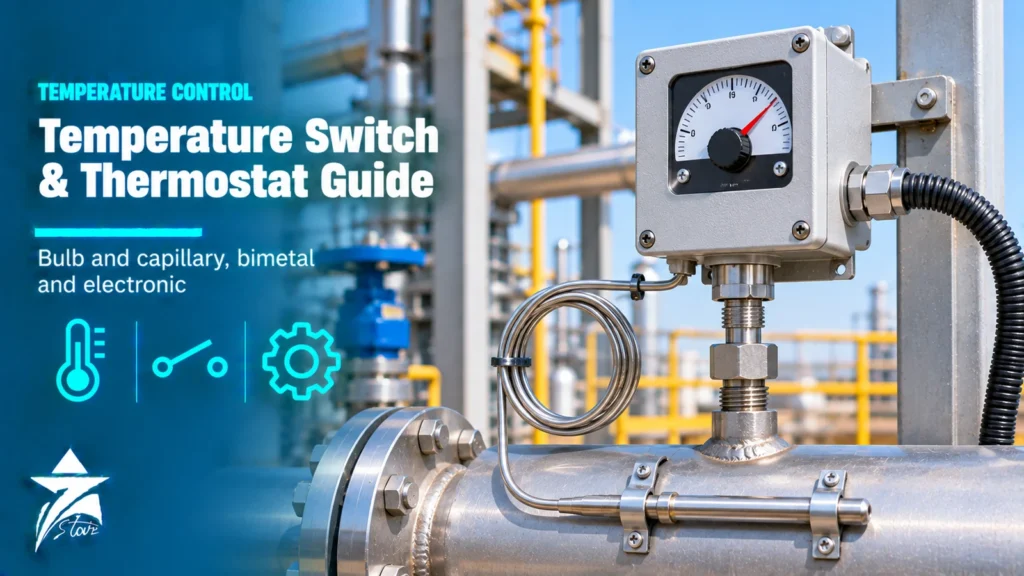
A temperature switch opens or closes an electrical contact when a process, surface or room reaches a set temperature. It is one of the simplest and most dependable control devices in industry, used to start cooling fans, stop heaters, protect motors and pumps, trigger alarms and shut down equipment before it overheats. This guide explains the main types, how setpoint and deadband work, how to choose contact ratings and enclosures, and where electronic switches and certified safety limiters are the better choice.
What a Temperature Switch Does
An industrial thermostat has three basic parts: a sensing element that responds to temperature, a mechanism or electronics that compares the reading with a setpoint, and an output contact that changes state. Unlike a temperature transmitter, which sends a continuous 4 to 20 mA signal, a switch gives a discrete on or off output. That makes it ideal for local control and protection where a simple, fail-safe action is needed without a PLC. Many plants use both: a transmitter for monitoring and trending, and an independent switch for alarm or trip duty. Our guide to pressure switch vs pressure transmitter explains the same trade-off for pressure.
Main Types of Industrial Thermostat
| Type | How it senses | Typical uses |
|---|---|---|
| Bulb and capillary (liquid or vapour filled) | Fill expands in a bulb and moves a bellows or diaphragm through a capillary tube | Remote sensing in tanks, ducts, ovens, refrigeration and HVAC |
| Bimetal disc or strip | Two bonded metals bend at different rates and snap a contact | Motor, transformer and panel overheating protection, fixed setpoints |
| Rod and tube (differential expansion) | Inner rod and outer tube expand differently | Water heaters, boilers and furnaces |
| Electronic with RTD or thermocouple | Sensor signal is processed by electronics with relay or transistor outputs | Hydraulics, machine tools, process skids with display and analogue output |
| Safety temperature limiter (STB) and monitor (STW) | Certified mechanical or electronic design with latching trip | Boilers, thermal oil heaters, heat transfer systems to EN 14597 |
| Heat trace thermostat or controller | Sensor on pipe or ambient, switches heating cable | Freeze protection and temperature maintenance on piping |
Bulb and Capillary Thermostats
The classic industrial thermostat uses a sealed system of a sensing bulb, a capillary tube and a bellows. As the bulb heats, the fill expands and moves the bellows, which acts against an adjustable spring to operate a snap-action microswitch. Capillary lengths of 2 to 10 metres let the switch head sit outside a hot or vibrating zone while the bulb sits in a duct, tank or thermowell. Points to check:
- Fill type: vapour filled systems respond to the coldest part of the system, so the bulb must always be colder than the capillary and head; liquid or adsorption fills average more evenly.
- Capillary routing: avoid sharp bends, clamp it along its route and protect it from mechanical damage; a cut capillary means a lost fill and a failed switch.
- Bulb immersion: install the bulb fully in the medium, ideally in a thermowell with heat transfer paste for faster response.
- Fail-safe action: many models are designed so that loss of fill moves the contact to the safe position; confirm this in the data sheet for protection duties.
Bimetal Thermal Switches
A bimetal disc snaps from one curvature to another at a fixed temperature, opening or closing a contact directly. These switches are compact, need no power and are very low cost, which is why they are fitted inside motors, transformers, power supplies and control panels as thermal protectors. Setpoints are factory fixed, usually with a tolerance of about plus or minus 3 to 5 K, and the reset point is a fixed number of degrees lower. Bimetal switches are available normally open or normally closed, with manual or automatic reset, in surface-mount, screw-in and probe styles.
Setpoint, Deadband and Switching Differential
Every thermostat has a switching point and a reset point. The difference between them is the deadband, also called the differential or hysteresis. Without it, a contact would chatter on and off as the temperature hovered around the setpoint.
- Fixed differential: common on bimetal and simple capillary thermostats, often 2 to 10 K depending on range.
- Adjustable differential: allows a wide band for compressor or pump protection, reducing short cycling.
- Electronic switches: setpoint and reset point are programmed separately, with switching delays to ignore short spikes.
- Range selection: choose a range so the setpoint falls in the middle third of the scale for best accuracy and repeatability.
For example, a cooling fan thermostat might switch on at 45 degrees C and off at 40 degrees C, a 5 K deadband that prevents the fan from cycling every few seconds.
Electronic Thermostat Options
Electronic switches combine a sensor, usually a Pt100 or Pt1000 RTD, with a microprocessor, display and one or more outputs. They are widely used on hydraulic power units, lubrication systems and test benches. Their advantages are precise setpoints, multiple independent switch points, window functions, adjustable delays and an optional analogue output for monitoring. Many now support IO-Link, which allows remote parameter setting and diagnostics. The trade-off is that they need a power supply, typically 24 V DC, and the output is often a PNP transistor rather than a heavy duty relay. Our article on RTD vs thermocouple sensors covers the sensing elements behind these devices.
Safety Temperature Limiters and SIL Rated Devices
Where overheating could cause a fire, explosion or damage to a pressure vessel, a standard thermostat is not enough. Safety temperature limiters to EN 14597 are designed and tested for protection duty. A temperature limiter (STB) trips and latches, requiring manual reset after the cause has been fixed, while a temperature monitor (STW) resets automatically once the temperature falls. Some electronic limiters and boiler temperature limiters are certified for SIL 2 or SIL 3 applications under IEC 61508. When a device forms part of a safety instrumented function, the whole loop, including the sensor, logic and final element, must meet the target safety integrity level.
Contact Ratings, Wiring and Enclosures
- Contact form: SPDT changeover contacts give the most flexibility, allowing either normally open or normally closed wiring.
- Electrical rating: check both resistive and inductive ratings at your voltage; motors, contactor coils and solenoids are inductive loads.
- Low energy signals: for PLC inputs, gold plated contacts avoid problems caused by oxide films at very low currents.
- Heavy loads: switch a contactor or relay rather than a large motor or heater directly.
- Enclosure: IP65 or higher for outdoor and washdown areas; consider UV and heat resistance in direct Gulf sun.
- Hazardous areas: use ATEX or IECEx certified explosion-proof (Ex d) or intrinsically safe (Ex ia) versions in classified zones of oil and gas plants.
Choosing a Temperature Switch for Oman Conditions
High ambient temperatures, dust and humidity in Oman affect switch selection. Head temperatures in sun-exposed enclosures can exceed 60 degrees C, so check the permitted ambient for the switch head, not only the sensing range. For capillary types, high ambient around the head can shift vapour filled systems. Use sunshades or mount the switch head in shade, choose stainless steel or coated housings near the coast, and specify cable glands that keep out dust. For freeze protection on cold water lines, ambient sensing heat trace thermostats are rarely needed in the lowlands, but process temperature maintenance on heavy oil, sulphur or viscous chemicals still relies on pipe sensing heat trace controllers.
Installation and Testing Checklist
- Mount the sensing element where it sees the true temperature, away from dead legs, heaters or direct sunlight.
- Use a thermowell for pressurised or flowing media, so the switch can be removed without draining.
- Seal the conduit or cable entry and fit drip loops so water cannot run into the head.
- Record the setpoint, reset point and differential on the loop sheet.
- Function test by heating or cooling the sensor in a calibration bath or dry block and watching the contact change.
- For safety duties, test the trip and manual reset at the interval set by the safety requirements specification.
Thermostat Selection Summary
| Requirement | Suggested type |
|---|---|
| Remote sensing with no power supply | Bulb and capillary thermostat |
| Built-in overheating protection for motors and panels | Bimetal switch, fixed setpoint |
| Multiple setpoints, display and analogue output | Electronic switch with RTD sensor |
| Boiler or thermal oil overtemperature protection | Safety temperature limiter to EN 14597 |
| Hazardous area installation | ATEX or IECEx Ex d or Ex ia thermostat |
| Pipe freeze protection or temperature maintenance | Heat trace thermostat or controller |
Thermostats and Temperature Switches in Our Catalogue
| Product | Type | Typical use |
|---|---|---|
| Danfoss RT 101 (017-150066) | Capillary thermostat, 25 to 90 C | Industrial process and plant rooms |
| Danfoss KPS 77 (060L310066) | IP67 thermostat, 20 to 60 C | Harsh industrial and marine areas |
| Trafag EXS 404/414 Ex Industat | Explosion-proof thermostat | Hazardous area process sensing |
| JUMO exTHERM-AT | Ex surface-mounted thermostat | Hazardous area pipes and vessels |
| WIKA TFS35 | Bimetal switch | Motor and equipment protection |
| JUMO 608301 | Bimetal switch, fixed setpoint | Panel and device protection |
| JUMO DELOS T 902940 | Electronic switch with display | Machine and process monitoring |
| Barksdale BTS3000 | Electronic dual switch, IO-Link | Hydraulic and lubrication systems |
| Hydac ETS 1700 | Electronic switch, 4 relays | Hydraulic power units |
| Endress+Hauser TTR31 Thermophant T | Compact electronic switch | Process skids and utilities |
| JUMO safetyM TB/TW 701160 | Temperature limiter and monitor to EN 14597 | Heating and thermal oil systems |
| GESTRA TRS 5-50 | SIL 3 safety temperature limiter | Steam boiler protection |
| Raychem Elexant 4010i | Heat trace controller | Process temperature maintenance |
Browse more in our thermostats and temperature switches category. To get a quotation, send the model or required range, contact rating, enclosure and quantity through our quote request form or to [email protected].
Sourcing a Temperature Switch in Oman Through Seven Star LLC
Seven Star LLC is an independent supplier in Oman of thermostats, temperature switches, safety temperature limiters and heat trace controllers for oil and gas, utilities, HVAC and manufacturing. We quote products from manufacturers such as Danfoss, JUMO, WIKA, Trafag, Hydac, Barksdale, Endress+Hauser, GESTRA and Raychem. For every temperature switch we quote, the range, contact rating, approvals and lead time are confirmed against the manufacturer data at quotation.
Frequently asked questions
What is the difference between a thermostat and a temperature switch?
The terms are often used interchangeably. Thermostat usually refers to a device that controls heating or cooling around a setpoint, while temperature switch is used more for alarm, protection and trip duties. Both change a contact at a set temperature.
What is deadband on a temperature switch?
Deadband, or differential, is the difference between the temperature at which the contact switches and the temperature at which it resets. It prevents the contact from chattering when the temperature hovers around the setpoint.
When should I use an electronic temperature switch instead of a mechanical one?
Choose an electronic switch when you need precise or multiple setpoints, a local display, adjustable delays, an analogue output or IO-Link diagnostics. Mechanical switches suit simple duties where no power supply is available.
What is a safety temperature limiter?
A safety temperature limiter is a certified device, usually to EN 14597, that trips and latches when a temperature limit is exceeded and requires manual reset. It is used to protect boilers, thermal oil heaters and similar equipment.
Can a temperature switch be used in a hazardous area?
Yes, provided it is certified for the zone and gas group, for example an ATEX or IECEx explosion-proof Ex d or intrinsically safe Ex ia design with suitable cable entries.
Who supplies temperature switches and thermostats in Oman?
Seven Star LLC is an independent supplier in Oman that quotes mechanical, electronic, hazardous area and safety rated temperature switches from leading manufacturers. Send your requirements through the quote request form or to [email protected].
Was this guide helpful?One click helps us write better guides for engineers.
Thank you! Glad it helped. Need this equipment for your project? Request a quotation
Thank you. We will use this to improve the guide.