- Vibration Monitoring
- Industrial Communications
- PLC & I/O Cards
- AC Drives
- Automation Accessories
- Controllers & Data Acquisition
- Industrial Computers
- Encoders
- Safety Switches & Guard Locking
- CCTV & Security
- Isolator & Barrier
- Motor Soft Starters
- HMI Displays
- Pneumatic Cylinders
- Automation Software
- Servo Drives
- Robotics
- Machine Vision
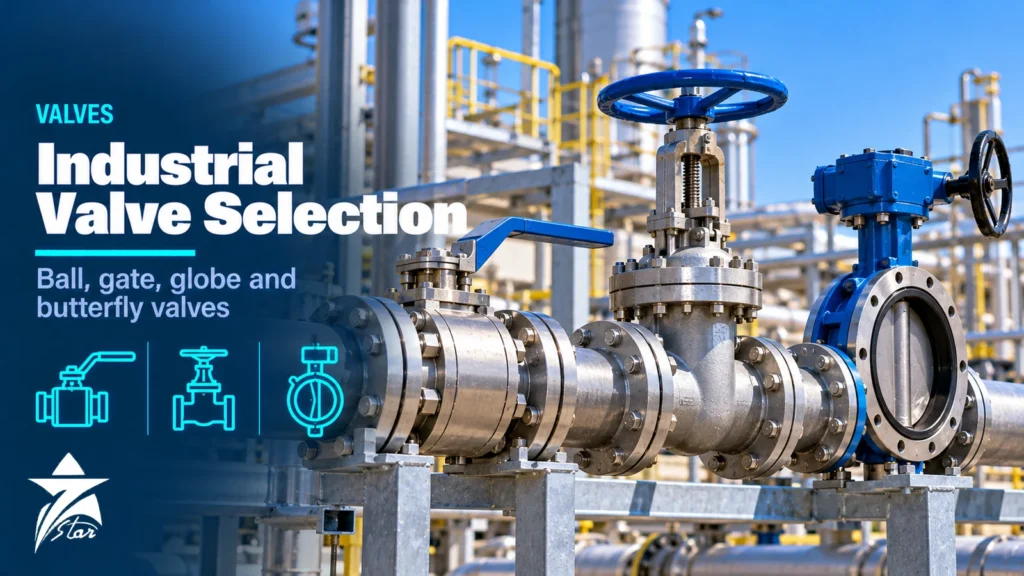
Most valve problems in a process plant start on the datasheet, not in the field: a gate valve asked to throttle, a butterfly valve put where a pig has to pass, a globe valve installed on a large cooling water header where its pressure drop costs pumping power for twenty years. Industrial valve selection between the four workhorse types – ball, gate, globe and butterfly – is mostly a matter of matching the closure mechanism to the duty. This guide explains how each type works, compares them side by side, lists the data you need before you specify, and covers the installation and maintenance mistakes that shorten valve life in GCC plants.
Start With the Duty, Not the Valve Type
Before choosing a valve family, define what the valve has to do. Almost every manual valve in a plant falls into one of four duties, and each duty favours a different closure mechanism:
- Isolation (on/off): the valve is either fully open or fully closed, and must seal tightly when closed. Ball, gate and butterfly valves are designed for this.
- Throttling or regulation: the valve sits partly open for long periods to control flow or pressure. Globe valves are the classic choice; butterfly and characterised ball valves can also do it within limits.
- Frequent operation: valves cycled many times a day need low operating torque and a mechanism that does not wear its sealing faces during travel. Quarter-turn valves generally win here.
- Special functions: pigging, double block and bleed, fire-safe service, cryogenic or high-temperature duty. These narrow the choice quickly and often dictate a specific design standard.
Once the duty is clear, pressure class, temperature, fluid, line size and end connection decide the remaining details.
How Each Valve Type Works
Ball Valves
A ball valve closes with a bored sphere that rotates 90° against two seats. Full-bore designs have a bore equal to the pipe inside diameter, so pressure drop is close to that of straight pipe and pigs can pass. Reduced-bore designs are smaller and cheaper but add some restriction. Floating ball designs let line pressure push the ball onto the downstream seat; they suit smaller sizes and lower classes. Trunnion-mounted designs hold the ball on fixed stubs and use spring-loaded seats, which keeps torque manageable in large sizes and high pressure classes and allows double block and bleed arrangements. Soft seats (PTFE, reinforced PTFE, PEEK, nylon) give tight shut-off but limit temperature; metal seats handle abrasive or hot service at higher torque and cost.
Gate Valves
A gate valve lifts a wedge or parallel slide out of the flow path with a multi-turn stem. Fully open, it offers a straight, almost unrestricted passage. Wedges can be solid, flexible (to tolerate thermal distortion of the body) or split. Rising-stem designs with an outside screw and yoke show valve position at a glance and keep the stem threads out of the process. Gate valves are robust, available in very high pressure classes and large sizes, and remain common for block valves on hydrocarbon and steam lines. They are slow to operate, need tall clearance for rising stems, and must not be used partly open: the high-velocity jet under a partly lifted wedge erodes the seats and can make the gate vibrate.
Globe Valves
A globe valve moves a disc or plug perpendicular to a seat ring. Because flow changes direction inside the body, pressure drop is higher than for the other three types, but the relationship between lift and flow is stable and controllable. That makes the globe valve the standard choice for manual throttling, bypasses around control valves, drains and vents on steam, and fine regulation. Plug, needle and composition discs suit different duties. Y-pattern and angle bodies reduce pressure drop compared with the standard T-pattern. Globe valves seal well and are easy to repair, because the seat and disc are accessible once the bonnet is removed.
Butterfly Valves
A butterfly valve rotates a disc mounted on a shaft through 90° within a short body. It is light, compact and inexpensive in large sizes, which is why it dominates cooling water, seawater intake, desalination and HVAC lines from DN 100 upward. Concentric (resilient-seated) designs suit low-pressure water service; double offset and triple offset designs handle higher pressure classes, hydrocarbons and steam. The disc always stays in the flow path, so the valve adds some pressure drop, cannot be pigged and limits access for line cleaning. Wafer, lug and double-flanged bodies are available; only lug and double-flanged types allow dead-end service with the downstream flange removed.
Ball vs Gate vs Globe vs Butterfly: Comparison Table
The table summarises typical characteristics. Actual performance depends on the specific design, seat material and manufacturer, so always confirm against the datasheet.
| Criterion | Ball | Gate | Globe | Butterfly |
|---|---|---|---|---|
| Operation | Quarter-turn | Multi-turn, linear | Multi-turn, linear | Quarter-turn |
| Primary duty | Isolation | Isolation | Throttling and isolation | Isolation, coarse throttling |
| Pressure drop fully open | Very low (full bore) | Very low | High | Low to moderate |
| Throttling ability | Poor (unless V-port or segmented) | Not suitable | Good | Fair, typically best in the mid-travel range |
| Shut-off tightness | Very good with soft seats | Good; metal seats may weep | Very good | Good (concentric); very good (triple offset) |
| Speed of operation | Fast | Slow | Slow | Fast |
| Weight and face-to-face | Moderate | Long, heavy | Long, heavy | Shortest, lightest |
| Piggable | Yes, full bore | Yes, through-conduit types | No | No |
| Typical design standards | API 6D, API 608, ISO 17292 | API 600, API 602, API 6D | API 623, BS EN 13709 | API 609, EN 593 |
Industrial Valve Selection Criteria That Actually Decide the Choice
When two valve types could both work, these factors usually settle the question:
- Line size. In larger line sizes, the weight, cost and actuator size of ball and gate valves rise steeply, and butterfly valves become attractive wherever pressure class and fluid allow.
- Pressure class and temperature. Check the pressure–temperature rating of the body under ASME B16.34 and the separate rating of the seat material. A Class 300 body with a PTFE seat is limited by the seat, not the steel.
- Fluid. Slurries and solids favour full-bore ball or knife gate designs and metal seats. Clean water and air suit butterfly valves. Steam and condensate often call for globe or gate valves with metal seats.
- Leakage requirement. Specify the acceptable seat leakage and the test standard (for example API 598 or ISO 5208) instead of writing “bubble tight”.
- Actuation. Quarter-turn valves pair with compact pneumatic or electric actuators; multi-turn gate and globe valves need larger multi-turn or linear actuators and take longer to stroke.
- Maintenance access. Top-entry ball valves, bolted-bonnet globe valves and gate valves can often be repaired in line; wafer butterfly and welded-body ball valves usually come out of the line.
If the valve must modulate continuously under automatic control, you are no longer selecting a manual valve; see our control valve selection and sizing guide for Cv, characteristics and cavitation checks.
Data to Collect Before You Request a Quote
A complete valve enquiry avoids rounds of clarification and wrong offers. Collect the following for each tag:
- Valve type and design standard, nominal size and pressure class
- End connection: flanged (RF, RTJ), butt-weld schedule, socket-weld or threaded; wafer or lug for butterfly valves
- Body, trim, stem and seat materials, including NACE MR0175 / ISO 15156 compliance if the service is sour
- Fluid, normal and maximum operating pressure and temperature, and design conditions
- Required shut-off class, fire-safe requirement (for example API 607 or API 6FA) and fugitive emission requirement if any
- Operator: lever, gearbox, or actuator with supply voltage or air pressure
- Face-to-face standard (ASME B16.10 or the relevant EN series) where the valve replaces an existing one
- Existing nameplate data and photos when replacing an installed valve
Installation Practices That Protect the Valve
Many early failures are installation failures. A few habits make a large difference:
- Flush lines before installing soft-seated ball and butterfly valves; weld spatter and mill scale destroy seats on the first closure.
- Install butterfly valves with the disc slightly open so the seat is not pinched while flange bolts are tightened, and check that the disc clears adjacent pipe, fittings and lined pipe when it swings.
- Keep butterfly valves away from elbows, pump discharges and other valves where possible, because uneven flow puts unbalanced torque on the disc.
- Orient globe valves according to the flow arrow; many designs are intended for flow under the seat, and reversing them changes operating force and sealing behaviour.
- Support heavy gate and globe valves and their actuators independently; do not let them hang on the flanges.
- Mount gearboxes and handwheels where operators can reach them safely, and leave clearance for rising stems and for removing bonnets.
Common Industrial Valve Selection Mistakes
- Using gate valves for throttling, then blaming the manufacturer for seat erosion.
- Specifying a soft-seated ball valve on hot oil or steam above the seat material’s limit.
- Choosing a concentric butterfly valve for hydrocarbon or fire-safe duty where an offset design is required.
- Ordering reduced-bore ball valves on a line that is pigged.
- Writing “stainless steel” without a grade, or forgetting NACE requirements for sour service.
- Ignoring operating torque when sizing actuators, especially after long periods without cycling, when breakaway torque rises.
GCC Service Conditions to Consider
Plants in Oman and the wider Gulf add specific stresses. Outdoor valves on desert sites can see metal temperatures well above ambient in direct sun, so check elastomer and soft-seat limits and actuator ratings rather than relying on the nominal 50 °C shade temperature. Fine dust abrades exposed stems and enters gearboxes; stem protectors and sealed gear operators help. Seawater intake and brine lines in desalination plants need suitable materials, such as duplex or super duplex stainless steel, nickel-aluminium bronze or lined bodies, and attention to galvanic couples between disc, shaft and body. Sour gas service in upstream oil and gas requires materials and hardness controls in line with NACE MR0175 / ISO 15156, and actuated valves in classified areas need Ex-certified accessories – see our electric valve actuator selection guide for the actuation side.
Maintenance and Troubleshooting Basics
- Stem leakage: adjust gland packing evenly; repeated leaks point to scored stems or packing that is unsuitable for the temperature.
- Passing when closed: on gate and globe valves, check for debris or seat erosion; on ball valves, check for damaged soft seats and incorrect stop settings on the actuator.
- Hard operation: exercise seldom-used isolation valves on a schedule, lubricate stem threads and check gearbox grease.
- Butterfly disc flutter or noise: often caused by operating close to the closed position or by turbulent flow from nearby fittings.
- Keep records: tag number, model code, materials and seat type let you order the right repair kit or replacement without guesswork.
Valve Selection Checklist
- Duty defined: isolation, throttling, frequent cycling or special function
- Line size, pressure class and design temperature confirmed
- Fluid characterised: solids, corrosives, H2S, chlorides, viscosity
- Body and seat materials checked against pressure–temperature limits
- Leakage class and test standard stated
- Fire-safe, fugitive emission and pigging requirements stated
- End connections and face-to-face dimensions matched to the existing line
- Operator or actuator type and power supply defined
- Hazardous area classification and ambient temperature range noted
- Spare parts and repair kits identified for critical valves
Sourcing Industrial Valves Through Seven Star LLC
Seven Star LLC supplies ball, gate, globe valves, butterfly valves and related fittings and valves on request for plants in Oman and the GCC, together with valve actuators and accessories. We help with type selection and cross-checking part numbers and model codes from manufacturers’ datasheets. Availability and lead time are confirmed at quotation.
Send us your valve datasheet, nameplate photo or RFQ with size, class, materials and service conditions, and we will come back with a matched offer.
Frequently asked questions
Can a gate valve be used for throttling?
No. A partly open gate creates a high-velocity jet under the wedge that erodes the seats and can make the gate vibrate. Use a globe valve for manual throttling, or a control valve for automatic regulation.
When is a butterfly valve better than a ball valve?
Butterfly valves win in large line sizes on clean or moderately dirty liquids and gases, where their short face-to-face, low weight and small actuators reduce cost. Ball valves are preferred where the line must be pigged, where full-bore flow is needed, or in high pressure classes and smaller sizes.
What is the difference between floating and trunnion-mounted ball valves?
In a floating ball valve, line pressure pushes the ball onto the downstream seat. In a trunnion-mounted valve, the ball is held on fixed stubs and spring-loaded seats move against it, which keeps operating torque lower in large sizes and high pressure classes.
Why does a globe valve have higher pressure drop?
Flow changes direction as it passes through the seat opening inside the body. That path gives good throttling control but adds resistance; Y-pattern and angle bodies reduce the loss compared with a standard T-pattern body.
Which standards cover these valve types?
Commonly cited standards include API 6D and API 608 for ball valves, API 600 and API 602 for steel gate valves, API 623 for steel globe valves and API 609 for butterfly valves. ASME B16.34 covers pressure–temperature ratings for flanged, threaded and welding-end valves.
What information is needed to replace an existing valve?
Provide the nameplate data, size, pressure class, end connection, face-to-face dimension, body and trim materials, and service conditions. Photos of the valve and its operator help confirm the design when the original model code is incomplete.
Was this guide helpful?One click helps us write better guides for engineers.
Thank you! Glad it helped. Need this equipment for your project? Request a quotation
Thank you. We will use this to improve the guide.