- Automation & ControlView all 2,947 products
- Automation Accessories
- AC Drives
- PLC & I/O Cards
- Industrial Communications
- Vibration Monitoring
- Controllers & Data Acquisition
- Isolator & Barrier
- Safety Switches & Guard Locking
- Motor Soft Starters
- CCTV & Security
- Encoders
- Pneumatic Cylinders
- HMI Displays
- Servo Drives
- Industrial Computers
- Machine Vision
- Automation Software
- Robotics
















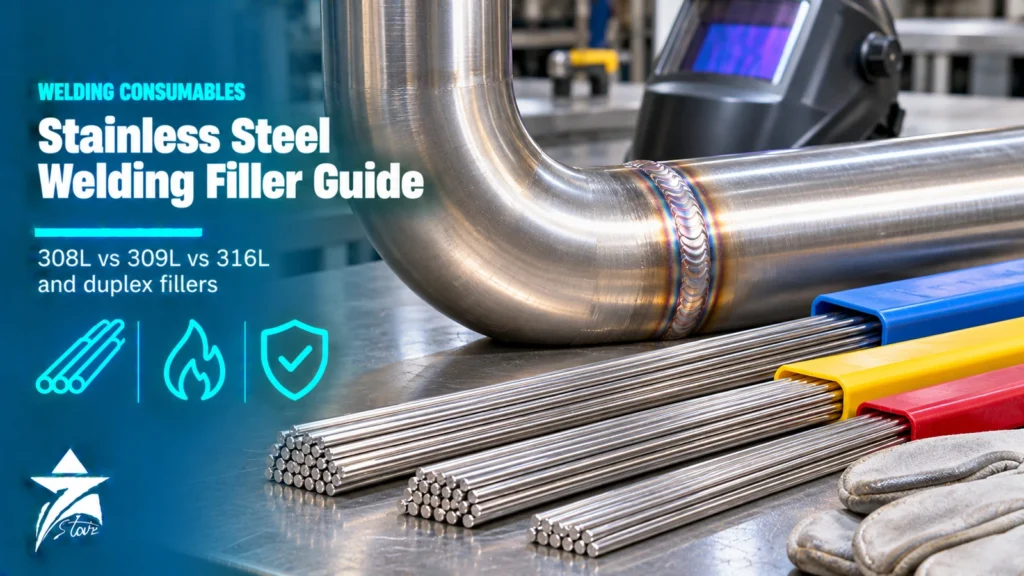
Stainless steels are chosen for corrosion resistance, and a weld is only as good as the filler that joins them. The wrong filler can leave a joint that cracks during welding, corrodes faster than the base metal or loses toughness in service. Selecting the right stainless steel welding filler metal depends on the base metal grades, whether the joint is dissimilar, the service environment and the welding process. This guide compares the most common grades, explains the classifications and covers the practical steps that protect corrosion resistance.
How Stainless Steel Welding Filler Metal Is Classified
Stainless consumables are classified by chemical composition and by product form. The main AWS specifications are:
| Specification | Product form | Example designation |
|---|---|---|
| AWS A5.4 | Covered electrodes for SMAW (stick) | E308L-16, E316L-17, E2209-15 |
| AWS A5.9 | Bare solid wires and rods for TIG, MIG and SAW | ER308L, ER308LSi, ER316L, ER2209 |
| AWS A5.22 | Flux-cored and metal-cored wires, flux-cored TIG rods | E308LT1-1, E316LT1-4, E309LT1-1 |
| ISO 3581 | Covered electrodes (international) | E 19 9 L R, E 19 12 3 L B |
| ISO 14343 | Wires and rods (international) | G 19 9 L Si, W 22 9 3 N L |
| ISO 17633 | Tubular cored wires (international) | T 19 12 3 L R M21 3 |
In AWS electrode designations, the suffix describes the covering. A -15 suffix is a basic coating for DC positive, -16 is a rutile coating for AC or DC, and -17 is a rutile-silica coating with a smoother, flatter bead that is easy to use in flat and horizontal positions. Our welding electrode classification guide explains how the AWS system works for carbon and low alloy electrodes.
308L vs 309L vs 316L: Choosing a Stainless Steel Welding Filler Metal
| Filler | Nominal composition | Main uses |
|---|---|---|
| 308L / 308LSi | 19 percent Cr, 10 percent Ni, low carbon | Welding 304 and 304L; general austenitic fabrication |
| 316L / 316LSi | 19 percent Cr, 12 percent Ni, 2.5 percent Mo, low carbon | Welding 316 and 316L where chlorides or acids are present |
| 309L | 23 percent Cr, 13 percent Ni, low carbon | Carbon steel to stainless joints, buffer layers on clad steel |
| 309MoL | 23 percent Cr, 13 percent Ni, 2.5 percent Mo | Dissimilar joints and cladding where 316 type chemistry is needed |
| 347 | 19 percent Cr, 10 percent Ni, niobium stabilised | Welding 321 and 347 for high temperature service |
| 2209 | 22 percent Cr, 9 percent Ni, 3 percent Mo, nitrogen | Duplex 2205 and dissimilar duplex joints |
| 2594 | 25 percent Cr, 10 percent Ni, 4 percent Mo, nitrogen | Super duplex 2507 and similar grades |
The basic rule is to match or slightly overmatch the base metal. Use 308L for 304L, 316L for 316L, and never use 308L on 316L, because the weld would lack molybdenum and become the weak point for pitting. The L grades limit carbon to 0.03 percent for wires, or 0.04 percent for electrodes, which reduces the risk of sensitisation. The Si versions, such as ER308LSi, contain more silicon, which improves wetting and bead shape in MIG welding.
Ferrite Number and Hot Cracking
Fully austenitic weld metal is prone to solidification cracking. Standard austenitic fillers are designed to solidify with a small amount of delta ferrite, usually expressed as a ferrite number (FN) in the range of about 3 to 10, which makes the weld much more resistant to hot cracking. Too much ferrite, however, can reduce toughness at low temperatures and can transform to brittle sigma phase in high temperature service. For cryogenic work, low ferrite or fully austenitic fillers may be specified, and for high temperature service the ferrite range is often limited. The WRC-1992 and Schaeffler diagrams are used to predict ferrite content from the chemistry of the filler and the base metals, including dilution.
Dissimilar Metal Joints: Carbon Steel to Stainless
When carbon or low alloy steel is welded to austenitic stainless steel, the weld is diluted by the carbon steel. A 308L filler would end up with too little chromium and nickel, forming martensite that can crack. A more highly alloyed filler such as 309L, which contains about 23 percent chromium and 13 percent nickel, absorbs this dilution and still produces an austenitic structure with some ferrite. 309L is also used as the first buffer layer when overlaying carbon steel with stainless steel, followed by 308L or 316L layers. For high temperature dissimilar joints, or where thermal cycling is severe, nickel base fillers such as ERNiCr-3 or ENiCrFe-3 are often preferred because their thermal expansion is closer to that of carbon steel and they limit carbon migration.
Duplex and Super Duplex Stainless Steel Welding Filler Metal
Duplex stainless steels have a balanced structure of roughly equal austenite and ferrite, which gives high strength and resistance to chloride stress corrosion cracking. They are widely used in desalination, offshore and produced water systems in Oman. Welding them requires care:
- Use an overalloyed filler with higher nickel, such as 2209 for 2205 or 2594 for 2507, to promote austenite formation in the weld.
- Control heat input within the range specified in the welding procedure, commonly around 0.5 to 2.5 kJ/mm for 2205, so cooling is neither too fast nor too slow.
- Limit interpass temperature, often to 100 to 150 degrees C, to avoid intermetallic phases.
- Use argon with nitrogen additions for TIG shielding and purging where specified, to compensate for nitrogen loss.
- Verify ferrite content and corrosion performance during procedure qualification, for example with ferrite measurement and ASTM G48 testing where the project requires it.
Autogenous welds, made without filler, should be avoided on duplex grades because the weld metal becomes highly ferritic and loses toughness and corrosion resistance.
Sensitisation and How to Avoid It
Sensitisation occurs when austenitic stainless steel is held between roughly 450 and 850 degrees C. Chromium combines with carbon to form chromium carbides at the grain boundaries, leaving the adjacent areas depleted in chromium and vulnerable to intergranular corrosion. In welding, this happens in the heat affected zone. The main controls are:
- Use low carbon L grade base metals and fillers, or stabilised grades such as 321 and 347 with matching fillers.
- Keep heat input moderate and use stringer beads rather than wide weaves.
- Limit interpass temperature, typically to 150 degrees C or as specified in the procedure.
- Avoid unnecessary post-weld heat treatment in the sensitising range.
Back Purging, Cleaning and Post-Weld Treatment
The root side of a stainless weld must be protected from oxygen. Without a purge, the root oxidises heavily, a condition often called sugaring, which destroys corrosion resistance. Argon back purging, with oxygen levels checked before and during welding, is standard for TIG roots on pipe. Flux-cored TIG rods and some root wires can reduce or remove the need for purging in specific applications.
After welding, heat tint and oxide must be removed to restore the passive layer. This is done by pickling with acid pastes or gels, electrochemical cleaning or mechanical methods using stainless-only abrasives, followed by passivation where specified. Tools such as wire brushes and grinding discs used on carbon steel must never be used on stainless steel, because embedded iron particles cause rust spots.
Storage and Handling of Stainless Consumables
- Store electrodes in sealed packaging in a dry area; re-dry them according to the manufacturer instructions if they have absorbed moisture, which can cause porosity.
- Keep wires and rods clean and covered to avoid contamination by dust, oil or carbon steel particles.
- Label and segregate grades clearly; 308L, 316L and 309L rods look identical once removed from their packaging.
- Use dedicated stainless steel wire feed liners and drive rolls for MIG wire.
- Keep material certificates for traceability, especially for pressure equipment and piping.
Quick Selection Table for Stainless Steel Welding Filler Metal
| Base metal A | Base metal B | Typical filler |
|---|---|---|
| 304 / 304L | 304 / 304L | 308L |
| 316 / 316L | 316 / 316L | 316L |
| 321 or 347 | 321 or 347 | 347 |
| 304L or 316L | Carbon steel | 309L or 309MoL |
| 2205 duplex | 2205 duplex | 2209 |
| 2205 duplex | 316L | 2209 or 309MoL, per procedure |
| 2507 super duplex | 2507 super duplex | 2594 |
| Stainless steel | Carbon steel, high temperature service | ERNiCr-3 or ENiCrFe-3 |
Final selection always follows the approved welding procedure specification and the project or code requirements.
Stainless and Duplex Welding Consumables in Our Catalogue
| Product | Type | Typical use |
|---|---|---|
| Hyundai S-308L.17 | E308L-17 covered electrode | Welding 304 and 304L |
| Böhler Thermanit JE-308L | ER308L TIG rod | Root and fill passes on 304L |
| KISWEL M-308LSi | ER308LSi MIG wire | MIG welding of 304L |
| Elga Cromarod 316LP | E316L-17 pipe electrode | 316L piping |
| Böhler FOX EAS 4 M-VD | E316L-17 electrode, vertical down | 316L in vertical positions |
| Böhler FOXcore 316L-T1 | E316LT1-4 flux-cored wire | High deposition 316L welding |
| Elga Cromarod 309MoL | E309MoL-17 electrode | Dissimilar and clad steel joints |
| LongTeng E309LT1-1 | 309L flux-cored wire | Carbon steel to stainless joints |
| Böhler Thermanit 22/09 | ER2209 TIG rod | Duplex 2205 pipe roots |
| Böhler FOX CN 22/9 N-B | E2209-15 basic electrode | Duplex 2205 fabrication |
| Selectarc UP 2209 | ER2209 submerged arc wire | Duplex plate and vessels |
| Elga Cromarod 82 | ENiCrFe-3 nickel alloy electrode | High temperature dissimilar joints |
Browse more in our welding electrodes category and TIG welding wire category. To get a quotation, send the AWS or ISO classification, diameter, packaging and quantity through our quote request form or to [email protected].
Sourcing Welding Consumables in Oman Through Seven Star LLC
Seven Star LLC is an independent supplier in Oman of stainless, duplex, nickel alloy, carbon and low alloy welding consumables, including covered electrodes, TIG rods, MIG wires, flux-cored wires and submerged arc wires and fluxes. We quote products from manufacturers such as Böhler Welding, Elga, Hyundai Welding, KISWEL, Selectarc, Lincoln Electric and Kobelco. For every stainless steel welding filler metal we quote, the classification, diameter, certificates and lead time are confirmed against the manufacturer data at quotation.
Frequently asked questions
Can I use 308L filler on 316L stainless steel?
No. 308L contains no molybdenum, so the weld would have lower pitting resistance than the 316L base metal. Use 316L filler for 316L, or a more highly alloyed filler where the procedure specifies it.
When should 309L filler be used?
309L is mainly used for joining stainless steel to carbon or low alloy steel and as a buffer layer when overlaying carbon steel with stainless steel, because its higher alloy content tolerates dilution.
What filler is used for duplex 2205?
2209 filler is normally used. It has higher nickel than the base metal to achieve the correct austenite and ferrite balance in the weld metal.
What is the difference between ER308L and ER308LSi?
ER308LSi contains more silicon, which improves arc wetting and bead appearance in MIG welding. Chemistry otherwise matches ER308L, and both are used for 304 and 304L stainless steels.
Why do stainless steel welds need back purging?
Without an inert gas purge, the root side oxidises heavily, producing a rough, sugared surface with poor corrosion resistance. Argon purging protects the root during TIG welding of pipe and tube.
Who supplies stainless steel welding consumables in Oman?
Seven Star LLC is an independent supplier in Oman that quotes stainless, duplex and nickel alloy electrodes, rods and wires from leading manufacturers. Send your requirements through the quote request form or to [email protected].
Was this guide helpful?One click helps us write better guides for engineers.
Thank you! Glad it helped. Need this equipment for your project? Request a quotation
Thank you. We will use this to improve the guide.