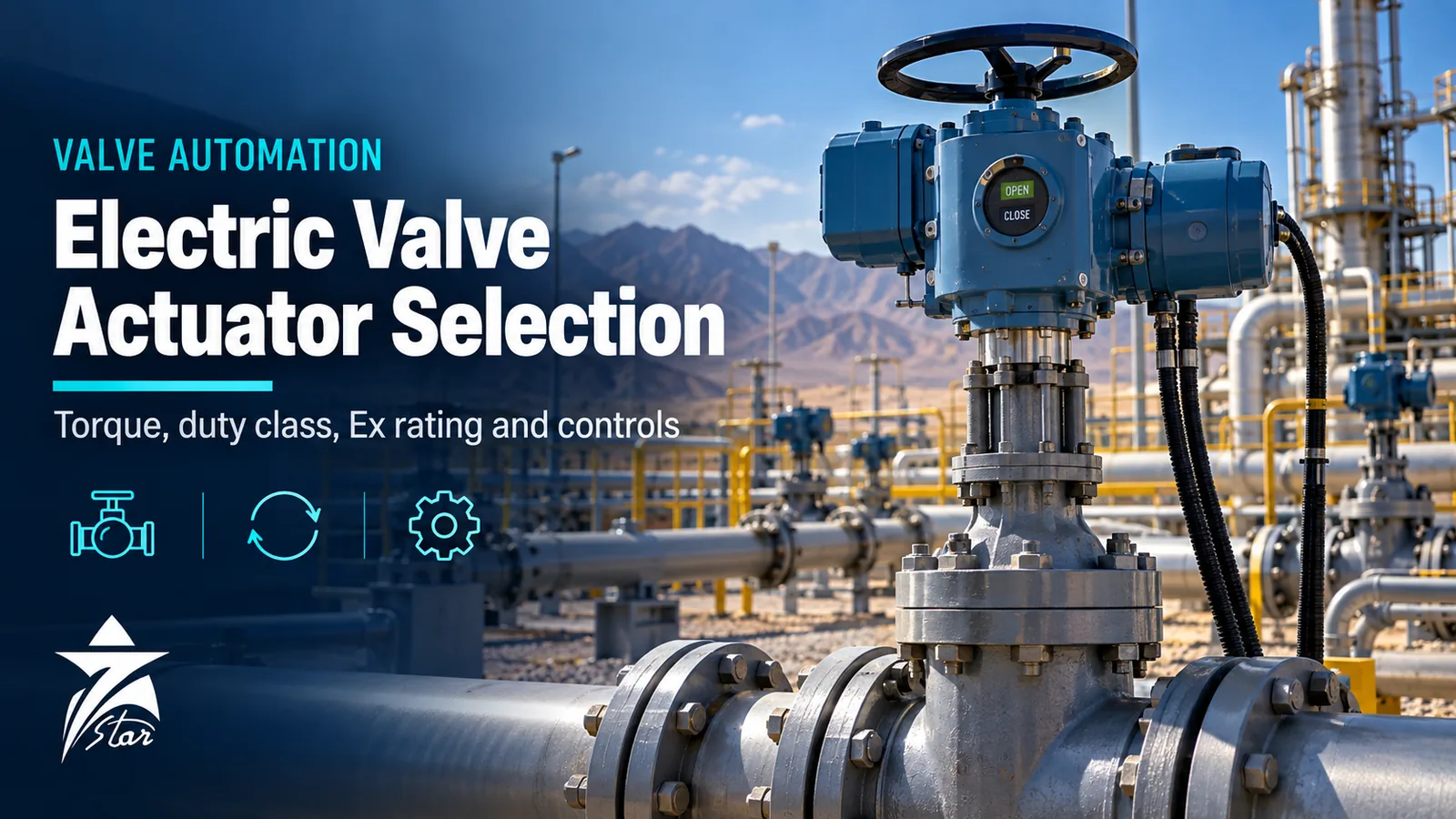
Electric Valve Actuator Selection Guide: Multi-Turn, Part-Turn and Linear Actuators for Oil, Gas and Water Service
Valves do the physical work in every pipeline, tank farm, pumping station and treatment plant, but it is the actuator that decides whether a valve opens on time, holds position and survives years of operation in the field. Selecting an electric valve actuator is often left until late in a project and treated as a catalogue exercise. The result is familiar to every maintenance team: actuators that stall on breakaway torque, overheat in modulating service, or cannot be integrated with the control system without extra hardware.
This guide explains how to select an electric actuator properly, from valve type and torque through duty class and certification to controls and site conditions, using AUMA and ABB products from Seven Star LLC’s range as practical examples.
Step 1: Match the Actuator Type to the Valve
The valve determines the type of motion the actuator must provide.
| Actuator type | Motion | Typical valves | Examples |
|---|---|---|---|
| Multi-turn | Several output revolutions | Gate valves, globe valves, penstocks, sluice gates | AUMA SA / SAR, SAEx, TIGRON TR-M |
| Part-turn (quarter-turn) | 90° rotation, or a limited angle | Ball, butterfly and plug valves, dampers | AUMA SQ / SQR, SQEx, SQV |
| Multi-turn with part-turn gearbox | Multi-turn input converted to 90° at high torque | Large butterfly and ball valves | AUMA SA with GS gearbox |
| Linear | Straight-line thrust | Globe control valves with sliding stems | AUMA LE linear thrust unit combined with SA |
| Rotary for continuous control | Continuous modulating rotation | Dampers, control valves in power and process plants | ABB Contrac RHD series with EBS electronic units |
Multi-turn actuators connect to the valve through a flange defined by ISO 5210, while part-turn actuators use ISO 5211. Confirming the flange size and the drive coupling (bore, keyway, square or stem nut) early avoids adaptor plates and delays during installation.
Step 2: Size for Torque or Thrust, With a Real Margin
The most important number in actuator selection is the valve’s required torque, and in particular its breakaway torque, the torque needed to unseat the valve after it has been closed for a long time. This figure should come from the valve manufacturer, taking into account:
- Maximum differential pressure across the valve, not just normal operating pressure
- Seat and packing friction, which increases over time and with deposits
- Process conditions that increase friction, such as sand, scale or waxy crude
- Stem thread friction for rising-stem valves
A safety margin is then added so the actuator can still operate the valve as conditions deteriorate. Many operators and valve suppliers apply a margin in the range of 25 to 50 percent, but the correct figure depends on the application and the operator’s own specification. Oversizing is not free either: an actuator that is far too large for a small valve can damage the stem or seat if torque limits are not set correctly.
For linear control valves, the equivalent calculation is based on thrust. The AUMA LE linear thrust unit converts the rotary output of a multi-turn actuator into linear motion for globe and control valves.
Step 3: Define the Operating Time
Operating time, the time for a full open-to-close stroke, is set by the process, not by the actuator catalogue. Pipeline block valves may need to close within a defined time for leak isolation. Water hammer can make fast closure dangerous on long water mains. Emergency isolation valves may have a maximum closing time specified in the safety requirements.
For multi-turn actuators, operating time depends on the output speed and the number of turns needed for full stroke. Variable-speed actuators such as the AUMA SQV allow closing speed to be profiled, fast through most of the stroke and slow near the seat, which helps protect both the valve and the pipeline.
Step 4: Choose the Right Duty Class
Electric actuators are designed for specific duty types. EN 15714-2 defines the main classes:
| EN 15714-2 class | Duty | Typical application |
|---|---|---|
| Class A | Open-close (on-off) | Isolation valves, block valves |
| Class B | Inching and positioning | Valves moved to intermediate positions occasionally |
| Class C | Modulating | Control valves adjusting continuously to a setpoint |
| Class D | Continuous modulating | Control duties with very frequent, continuous movement |
Using an open-close actuator on a control loop is one of the most common mistakes in the field. The motor overheats, the thermal protection trips, and the loop goes to manual. For modulating service, specify a modulating actuator such as the AUMA SAR multi-turn or SQR part-turn versions, and for continuous control of dampers and control valves, rotary actuators such as the ABB Contrac RHD series, for example the RHD4000.
Step 5: Hazardous-Area Certification
Most actuators in oil and gas plants, terminals and pipelines are installed in classified areas. Explosion-proof actuators such as the AUMA SAEx multi-turn and AUMA SQEx part-turn are certified for use in potentially explosive atmospheres. When specifying, confirm:
- The area classification (Zone 1 or Zone 2) and gas group
- The required temperature class
- The certification scheme accepted by the operator, typically ATEX or IECEx
- Cable gland and entry requirements that match the actuator’s certified entries
Step 6: Integrate the Controls
Actuator controls range from simple wiring for an external motor starter to fully integrated controls with diagnostics and fieldbus.
- Integral controls combine the motor starter, local operation and signal processing in the actuator. The AUMA MATIC AM provides straightforward open-close control, while the AC version adds programmable parameters, diagnostics and data logging.
- Communication. Choose between hardwired signals, 4-20 mA positioning with feedback, HART, Modbus, Profibus DP or Foundation Fieldbus depending on the DCS and the operator’s standards.
- Diagnostics. Torque profiles, operating cycle counts and event logs make it possible to detect a valve that is getting harder to operate before it fails to move.
Step 7: Decide What Happens on Loss of Power
A standard electric actuator is fail-as-is: on power loss, the valve stays where it is. For many isolation valves this is acceptable. For valves that must move to a safe position on a trip, options include a spring-return or pneumatic actuator, an electro-hydraulic actuator, or an electric actuator with a guaranteed emergency power supply. This decision should come from the process safety review, not from the actuator catalogue.
Site Conditions in Oman
- Heat and solar gain. Enclosures in direct summer sun can run far above air temperature. Confirm the actuator’s rated ambient range, use sun shades where needed, and consider the effect on electronic controls and displays.
- Dust and sand. Specify high ingress protection, keep covers and cable entries properly sealed after maintenance, and inspect seals during routine rounds.
- Humidity near the coast. Coastal plants in Sohar, Duqm, Sur and Salalah see humid, salty air. Corrosion protection classes and paint systems suited to marine environments are worth specifying.
- Remote pipeline stations. Actuators with local data logging, Bluetooth configuration and clear diagnostics reduce the need for specialist visits.
Common Selection Mistakes
- Sizing from the valve’s normal operating torque instead of its maximum breakaway torque.
- Using an open-close actuator for a modulating control loop.
- Ignoring the required operating time until the pre-commissioning stroke test.
- Specifying the wrong mounting flange or drive coupling.
- Leaving the fail position undefined until the safety review raises it.
- Choosing a communication protocol that the DCS does not support without gateways.
Actuator Selection Checklist
- Valve type, size, rating and manufacturer
- Required torque or thrust, including breakaway torque and margin
- Number of turns or stroke, and required operating time
- Duty class: open-close, positioning or modulating
- Mounting flange (ISO 5210 or ISO 5211) and drive coupling
- Power supply voltage, phase and frequency
- Area classification, gas group and temperature class
- Controls and communication protocol
- Fail position and emergency operation requirements
- Ambient conditions, enclosure protection and corrosion class
Sourcing Actuators Through Seven Star LLC
Seven Star LLC supplies AUMA multi-turn, part-turn, explosion-proof, high-torque TIGRON and linear actuators, AUMA gearboxes, and ABB Contrac rotary actuators, together with pneumatic valve positioners such as the Emerson DVC6200 for control valve applications. See the complete actuator range.
Send your valve list with torque data, and Seven Star LLC will propose a sized, certified actuator for each valve, including mounting and control options.
Need a Quotation for Your Project?
- Genuine OEM products
- Supply across Oman & the GCC
- Formal quotation from our sales team
Free, no-obligation quotation · takes about 1 minute
Other enquiries: [email protected] · WhatsApp
More Blog