- AC Drives
- Industrial Communications
- PLC & I/O Cards
- Vibration Monitoring
- Automation Accessories
- Controllers & Data Acquisition
- Safety Switches & Guard Locking
- CCTV & Security
- Encoders
- Industrial Computers
- HMI Displays
- Motor Soft Starters
- Isolator & Barrier
- Pneumatic Cylinders
- Servo Drives
- Automation Software
- Robotics
- Machine Vision
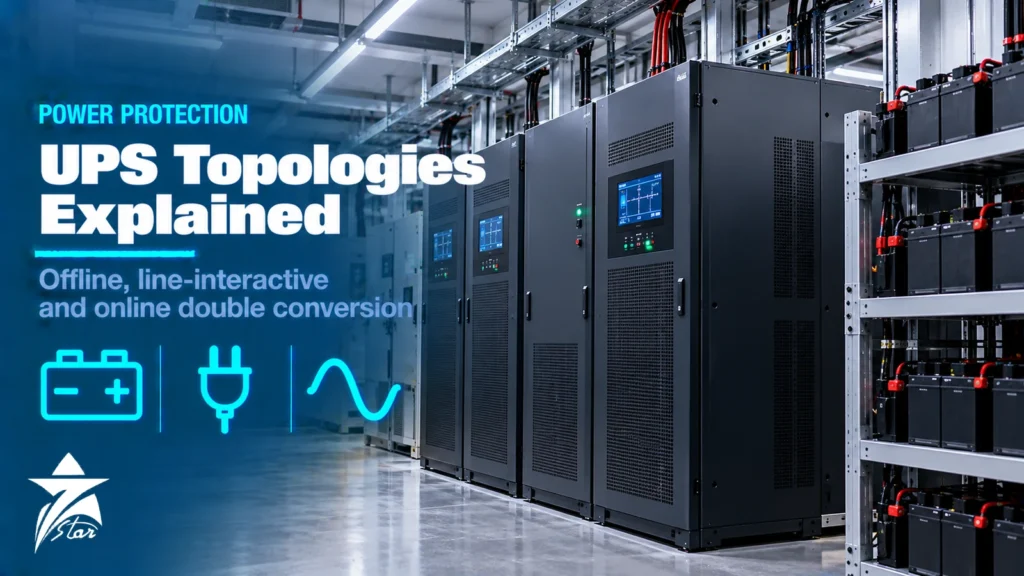
Every UPS promises to keep the load running when the mains fails, but how it does that varies a great deal, and the differences matter for a PLC rack, a control room server or a hospital imaging system. The three main UPS topologies are offline (standby), line-interactive and online double conversion. They differ in how they condition the power the load sees every day, how they transfer to battery, how efficient they are and what they cost to run. This guide explains each topology and the IEC 62040-3 classification, then covers sizing in kVA and kW, runtime, bypass arrangements and how a UPS works alongside a standby generator.
What a UPS Actually Protects Against
Mains supply problems range from complete outages to events most people never notice: short sags during large motor starts, swells, surges from switching and lightning, frequency drift on generator supply, and harmonic distortion. Industrial sites in remote areas, or those fed from long overhead lines, often see more of these than a city office. A UPS topology is effectively a decision about which of these disturbances reach the load and which are corrected before they do.
Offline (Standby) UPS
In an offline UPS the load is normally fed directly from the mains through a filter and surge suppression. The battery charger keeps the battery topped up, and the inverter sits idle. When the input voltage moves outside limits or disappears, a relay transfers the load to the inverter. Transfer takes a few milliseconds, which most switch-mode power supplies ride through, but some sensitive loads do not.
- Strengths: simple, compact, low cost and very efficient in normal operation because the load runs on mains.
- Limitations: no voltage regulation in normal mode, a transfer break on every outage, and frequent battery use on unstable supplies.
- Typical use: desktop PCs, small office equipment and non-critical single devices.
Line-Interactive UPS
A line-interactive UPS adds an automatic voltage regulator, usually a tapped autotransformer, in the mains path. It boosts or bucks the voltage within a range without touching the battery, so moderate sags and swells are corrected in normal mode. The inverter is connected in parallel and often also acts as the charger. On a complete outage, there is still a short transfer to battery, though usually faster than offline designs.
- Strengths: good efficiency, voltage regulation without battery cycling, and a moderate cost.
- Limitations: the output frequency follows the mains, so frequency variations and generator instability pass through, and there is still a brief transfer.
- Typical use: network racks, small servers, point-of-sale and branch office equipment.
Online Double-Conversion UPS
An online UPS converts the incoming AC to DC through a rectifier, which feeds the battery and the inverter, and the inverter continuously produces the output. The load never sees the raw mains. When the input fails, the inverter simply draws on the battery instead of the rectifier, so there is no transfer and no break. A static bypass switch provides an alternative path if the inverter fails or is overloaded.
- Strengths: the output is regulated in voltage and frequency, isolated from most input disturbances, with zero transfer time on mains failure. It is also tolerant of generator supply with drifting frequency.
- Limitations: higher cost, more heat and lower efficiency in double-conversion mode, and more complex maintenance.
- Typical use: data centres, control rooms, PLC and DCS systems, telecom, medical equipment and anything fed from a generator.
Many online UPS models also offer an eco or high-efficiency mode that runs the load on bypass while conditions are good and transfers to the inverter on a disturbance. This raises efficiency but brings back a short transfer and exposes the load to the mains, so it should be a conscious decision for each application.
IEC 62040-3 Classification of UPS Topologies
IEC 62040-3 classifies UPS performance with a three-part code. The first part describes how dependent the output is on the input:
| Class | Meaning | Usual topology | Output in normal mode |
|---|---|---|---|
| VFD | Voltage and frequency dependent on the input | Offline (standby) | Follows mains voltage and frequency |
| VI | Voltage independent within limits, frequency dependent | Line-interactive | Voltage regulated, frequency follows mains |
| VFI | Voltage and frequency independent | Online double conversion | Fully regenerated by the inverter |
The second part, two letters such as SS, describes the output waveform in normal and battery mode, and the third part, three digits such as 111, describes dynamic output performance during load and mode changes, with 1 being the best class. A full code like VFI-SS-111 therefore describes the best-performing online UPS with a sinusoidal output. Comparing codes is far more useful than comparing marketing terms.
Sizing a UPS: kVA, kW and Power Factor
A UPS has two ratings: apparent power in kVA and real power in kW. The load must fit within both. Older UPS units had an output power factor of 0.8, so a 10 kVA unit could supply 8 kW. Many current designs are rated at 0.9 or unity output power factor, so kVA and kW are much closer. Modern IT loads with power factor correction draw close to unity, so the kW rating is often the limiting factor.
- List every load with its actual measured or nameplate power in watts, not just the breaker size or power supply rating.
- Add the inrush and starting requirements of any motors, transformers or lamps, or keep them off the UPS where possible.
- Check both kW and kVA totals against the UPS rating at its rated output power factor.
- Add headroom for growth and to avoid running continuously near full load, commonly sizing so normal load is well below the rating.
- For redundancy, size N+1 modules or parallel units so the load is carried with one unit out of service.
- Check derating for ambient temperature and altitude in the manufacturer’s data, particularly for outdoor or poorly cooled rooms.
Runtime and Battery Autonomy
Runtime depends on load power, inverter efficiency, battery capacity and battery temperature and age. A UPS in a facility with a standby generator usually needs only enough autonomy to cover generator start, transfer and a margin for a failed first start, commonly in the range of several minutes. Sites without a generator, or where the UPS must support an orderly shutdown of a process, may need much longer autonomy and an external battery cabinet.
Always calculate runtime with the manufacturer’s tools or discharge tables for the actual load, and design for end-of-life battery capacity, since batteries lose capacity with age. In hot rooms, battery life is shortened significantly, so battery temperature should be part of the runtime design. Replacement batteries and cabinets are listed in our UPS and batteries category.
Bypass, Maintenance and Generator Compatibility
- Static bypass: transfers the load automatically to mains if the inverter fails or is overloaded. It needs a compatible, synchronised bypass supply.
- Maintenance bypass: a manual switch, ideally in an external panel, that lets the UPS be isolated for service while the load runs on mains.
- Input harmonics: rectifier input current distortion affects generator sizing. IGBT rectifier designs draw near-sinusoidal current and are much easier on a generator than older thyristor rectifiers.
- Generator sizing: size the generator for the UPS input power, including battery recharge, and check the UPS input frequency window so it accepts the generator during load steps.
- Walk-in: a soft-start function that ramps the rectifier load onto the generator gradually after transfer.
For sites combining UPS and standby power, our diesel generator sets category covers the generator side.
Single-Phase, Three-Phase and Modular Systems
Small UPS units up to a few kVA are usually single-phase in and out. Larger systems are three-phase input, with either single-phase or three-phase output, and are typically installed as floor-standing cabinets with separate battery cabinets or racks. When the load grows or availability requirements rise, there are three common ways to scale:
- Parallel systems: two or more identical standalone UPS units share the load on a common output bus. With N+1 configuration, the load continues if one unit fails or is taken out for maintenance.
- Modular UPS: a frame accepts hot-swappable power modules, so capacity and redundancy can be added module by module, and a faulty module can be replaced without transferring the load to bypass.
- Dual-bus (2N) systems: two independent UPS systems feed dual-corded loads through separate distribution paths, removing single points of failure for the most critical equipment.
Each approach changes the bypass design, the battery arrangement and the switchboard layout, so the decision should be made early in the project rather than after the UPS has been selected. For existing installations, adding a unit to a parallel system usually requires the same model, firmware level and options as the units already installed, which makes the existing nameplate and configuration details essential when requesting a quotation.
Choosing Between UPS Topologies
For industrial control, telecom and any load fed from a generator, online double conversion is normally the right choice, because it isolates the load from frequency drift and gives zero transfer time. Line-interactive units suit network and IT equipment on a stable grid. Offline units are best limited to individual, non-critical devices. Beyond topology, consider the output waveform, bypass arrangement, battery technology, monitoring and communication options, and whether the unit is single-phase or three-phase.
Our overview of APC by Schneider Electric UPS and power protection shows how one manufacturer’s ranges map to these topologies.
UPS Selection Checklist
- Load list with real power in kW and apparent power in kVA, plus any inrush loads.
- Required IEC 62040-3 class (VFD, VI or VFI) and acceptable transfer time.
- Input and output voltage, phases and frequency, plus generator compatibility.
- Runtime at end-of-life battery capacity and battery technology.
- Redundancy: single unit, N+1 or parallel system.
- Bypass: static and external maintenance bypass arrangement.
- Ambient temperature, ventilation and room space for UPS and batteries.
- Monitoring: network card, dry contacts or Modbus to the control system.
UPS Systems We Supply, by Topology
These examples show how the three topologies look in real product ranges, from desktop units to modular three-phase systems.
| Product | Type | Where it fits |
|---|---|---|
| APC BR1600MI Back-UPS Pro 1600VA/960W Line-Interactive UPS | Line-interactive UPS | Desktop PCs and small network equipment. |
| APC SMT750I Smart-UPS 750VA/500W Line-Interactive UPS | Line-interactive UPS | Servers, switches and control PCs in rooms with reasonably stable mains. |
| APC SRT2200XLI Smart-UPS SRT 2200VA Online UPS | Online double-conversion UPS | PLC and DCS cabinets and critical IT that need zero transfer time and conditioned output. |
| Riello UPS Sentinel Tower STW 10000 10 kVA Online UPS | Online double-conversion UPS, 10 kVA | Control rooms and server racks. |
| Vertiv Liebert APM2 30-600kW 400V Modular UPS | Modular three-phase online UPS | Larger loads where power modules can be added for capacity or N+1 redundancy. |
| EnerSys PowerSafe SBS EON VRLA Battery 62-3900Ah | VRLA battery | Replacement batteries and extended autonomy for larger UPS systems. |
To size a UPS, send the load in kW and kVA, the backup time needed and the input and output voltages through our quote request form. For battery replacement, the UPS model and the existing battery label are enough.
APC by Schneider Electric models from our catalogue, grouped by type. Each model page lists the ratings, the replacement battery it uses and the manufacturer documents.
Line-interactive APC Smart-UPS models: APC SMT750I Smart-UPS 750VA/500W Line-Interactive UPS, APC SMC1000IC Line-Interactive UPS 1000VA 600W, APC SMC1500I Smart-UPS C 1500VA/900W Line-Interactive UPS, APC SMX1500RMI2U Smart-UPS X 1500VA Rack/Tower Convertible UPS, APC SMX3000HV Smart-UPS X 3000VA Rack/Tower LCD UPS, APC SMT1000I Smart-UPS Line Interactive 1000VA Tower 230V and APC SCL500RMI1UC Smart-UPS Line Interactive 500VA Lithium-ion.
Online double-conversion APC Smart-UPS SRT and Easy UPS On-Line models: APC SRT2200XLI Smart-UPS SRT 2200VA Online UPS, APC SRT3000XLI Smart-UPS SRT 3000VA Online UPS, APC SRT5KRMXLI Smart-UPS SRT 5000VA RM 230V Online UPS, APC SURT8000XLI Smart-UPS RT 8000VA Online UPS, APC SRV1KIL Easy UPS Online 1000VA/800W Tower UPS and APC SRV2KIL Easy UPS Online 2000VA/1600W Tower UPS.
Modular and three-phase APC systems: APC SYA8K16RMI Symmetra LX 8kVA Scalable to 16kVA UPS and APC SY128K160H Symmetra PX 128kW Scalable to 160kW UPS.
See every model on the APC brand page or in UPS and Batteries.
Sourcing UPS Systems Through Seven Star LLC
Seven Star LLC supplies UPS systems, battery cabinets, network cards and related emergency power equipment on request, from manufacturers such as APC by Schneider Electric, Eaton, Vertiv and Socomec. We help with selection by topology and load and cross-check part numbers for replacements and spares; availability and lead time are confirmed at quotation.
Planning a new UPS or replacing an existing one? Send us the UPS nameplate or model number, your load list and runtime requirement, or your RFQ, and we will prepare a quotation.
Frequently asked questions
What is the difference between line-interactive and online UPS?
A line-interactive UPS feeds the load from regulated mains and switches to battery on an outage, with a short transfer time. An online double-conversion UPS feeds the load continuously from its inverter, so there is no transfer and the output frequency is independent of the input. Online units are preferred for critical and generator-fed loads.
What does VFI mean on a UPS?
VFI stands for voltage and frequency independent, the IEC 62040-3 class for online double-conversion UPS systems. The output voltage and frequency are regenerated by the inverter and are not affected by normal input variations. Offline units are classed VFD and line-interactive units VI.
Should I size a UPS in kVA or kW?
Check both. The load must fit within the UPS kW rating and its kVA rating at the rated output power factor. Modern IT loads usually have a power factor close to one, so the kW rating is often the limiting value.
How much battery runtime do I need?
With a standby generator, the UPS usually only needs to bridge generator start and transfer with a margin, often several minutes. Without a generator, runtime should cover the outage duration you must ride through or the time needed for a controlled shutdown. Design for battery capacity at end of life.
Can a UPS run from a diesel generator?
Yes, but the UPS input frequency window, the rectifier harmonic distortion and the battery recharge load must be considered when sizing the generator. Online UPS systems with IGBT rectifiers and walk-in functions generally work best with generators.
What is eco mode on an online UPS?
Eco mode runs the load on the bypass path while the mains is within limits and switches to the inverter on a disturbance. It improves efficiency but reintroduces a short transfer and exposes the load to mains disturbances, so it should be applied only where the load can tolerate that.
Was this guide helpful?One click helps us write better guides for engineers.
Thank you! Glad it helped. Need this equipment for your project? Request a quotation
Thank you. We will use this to improve the guide.