- AC Drives
- Industrial Communications
- PLC & I/O Cards
- Automation Accessories
- Vibration Monitoring
- Controllers & Data Acquisition
- CCTV & Security
- Safety Switches & Guard Locking
- Encoders
- Industrial Computers
- Servo Drives
- HMI Displays
- Motor Soft Starters
- Isolator & Barrier
- Pneumatic Cylinders
- Automation Software
- Machine Vision
- Robotics
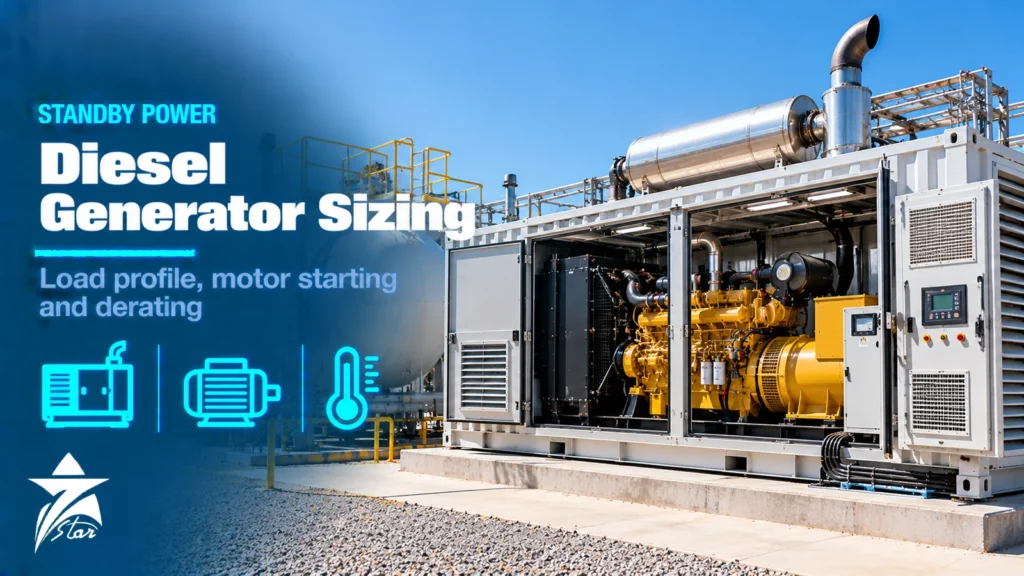
Most undersized gensets are not short of kilowatts. They trip, stall or let the voltage collapse when a large motor starts, when a block of load lands in one step after a transfer, or when the afternoon ambient climbs past the temperature the engine and radiator were rated for. Diesel generator sizing therefore has to cover four checks, not one: steady running load, motor starting kVA and voltage dip, step load acceptance, and site derating. This guide walks through each check in the order an engineer should do them, shows the data you need to collect, and highlights the conditions in Oman and the wider GCC that push the answer upward.
Start With the Right Rating Basis
A genset nameplate figure means nothing until you know which ISO 8528-1 rating it refers to. The same engine and alternator can be sold with noticeably different kVA numbers depending on whether the duty is standby or prime, so compare offers on the same basis.
- Emergency standby power (ESP): for use during a utility outage only, with limited annual hours (commonly quoted as up to 200 h per year) and a 24-hour average load factor of around 70% of the standby rating unless the manufacturer allows more. No overload capability is implied.
- Prime power (PRP): unlimited hours with a variable load, again with a 24-hour average load factor commonly set at 70% of the prime rating. This is the normal basis for remote sites, camps and wellsites with no grid.
- Limited-time running power (LTP): a constant-load rating for a limited number of hours per year, used for some peak-shaving duties.
- Continuous operating power (COP): a constant load for unlimited hours, typical of base-load plants. It is the lowest number on the datasheet for a given set.
- Data centre continuous ratings: some manufacturers publish an additional rating for data centre duty. It is a manufacturer definition, so read its conditions rather than assuming it matches an ISO class.
For a standby set, size against the standby rating but keep the expected running load comfortably below it. For a prime set on a remote site, size against the prime rating and check the average load factor over a realistic day, including night-time light loading.
Build a Load Schedule That Reflects Real Operation
The load schedule is the foundation, and the most common error is adding up nameplate ratings without asking what actually runs together. Collect, for every load, the rated kW, power factor, efficiency, starting method, whether it is linear or non-linear, and whether it starts automatically after a transfer. Then group the loads into the sequence in which they will come on line.
- Running kW and kVA for each load at its expected duty, not at nameplate maximum.
- Diversity: which loads run simultaneously in the worst realistic case (for example peak cooling in summer while a fire pump test is underway).
- Motor details: kW, voltage, full-load current, locked-rotor current or NEMA code letter, starting method, and driven-load inertia.
- Non-linear loads: UPS input rating and rectifier type, VFD ratings, LED lighting drivers, battery chargers.
- Regenerative loads such as cranes, hoists or lifts that can push power back into the generator.
- Future growth allowance agreed with the client, recorded as a separate line rather than hidden in every load.
Motor Starting: The Check That Usually Decides the Size
An induction motor started direct-on-line draws a locked-rotor current several times its full-load current at a very low power factor. The engine sees relatively little extra kW at that instant, but the alternator sees a large kVA demand, and its terminal voltage dips in proportion to that kVA and its own transient reactance. If the dip is too deep, contactors drop out, the motor cannot accelerate, and sensitive equipment on the same bus resets. The starting method changes the picture dramatically.
| Starting method | Typical starting current (× FLC) | Effect on generator sizing |
|---|---|---|
| Direct-on-line (DOL) | about 6–8; higher on some premium-efficiency motors | Largest starting kVA; often forces a much larger alternator |
| Star-delta | about one third of the DOL value, plus a transient at changeover | Lower dip, but reduced starting torque and a second current spike |
| Autotransformer | set by tap, roughly 40–65% of DOL line current | Suits high-inertia loads that need more torque than star-delta gives |
| Soft starter | adjustable current limit, commonly about 2.5–4 | Predictable, repeatable dip; widely used on pumps and fans |
| Variable frequency drive | close to rated current, rarely above about 1.5 | Smallest starting kVA, but adds harmonic loading |
Use the motor’s own locked-rotor data where available rather than a rule of thumb; IE3 and IE4 motors can have higher inrush than older designs. Then compare the starting kVA with the alternator’s motor-starting curve from the manufacturer, which shows voltage dip against starting kVA for that frame. Many specifications accept a dip of 15–20% during motor starting, and tighter values where the bus also feeds controls, instruments or medical equipment. Moving a large pump from DOL to a motor soft starter or a variable frequency drive is often cheaper than buying the larger genset that DOL starting would require.
Check the largest motor starting last
Voltage recovery is easier when the largest motor starts first on an unloaded set, but the more severe case is usually the largest motor starting with everything else already running, for example after an automatic restart. Check that case explicitly. Where several motors must restart after a transfer, stagger them with time delays in the PLC or the transfer switch logic instead of letting them all pick up together.
Step Loads and Transient Performance Classes
ISO 8528-5 defines performance classes G1 to G4 that set the permitted frequency and voltage deviations and recovery times for sudden load changes. G2 is commonly specified for general commercial and industrial loads; G3 is the tighter class used where telecommunications, control systems or other sensitive loads are connected. As an indication, manufacturer summaries of the 2018 edition give G2 limits of about 20% voltage dip and 10% frequency dip on load acceptance, and G3 limits of about 15% and 7% respectively for diesel sets, with G3 also requiring faster recovery.
The engine’s ability to accept a block of load depends heavily on its brake mean effective pressure. Highly turbocharged, high-output engines usually need the load applied in several smaller steps because the turbocharger needs time to build boost. Ask the manufacturer for the tested load acceptance in percentage steps for the exact engine and governor combination, then plan your load sequence around it. If a code or client specification requires all emergency loads to pick up in a single step within a set time, that requirement can dictate the engine choice by itself.
Non-Linear Loads, UPS Systems and Drives
Rectifier loads draw distorted current. That current flows through the alternator’s subtransient reactance and distorts the voltage, which in turn can upset voltage regulators, other drives and electronic equipment. Typical responses are to oversize the alternator rather than the engine, to specify a permanent magnet generator (PMG) excitation system that is less sensitive to waveform distortion, and to prefer active front end or multi-pulse rectifiers on large drives. Our guide to VFD selection for hot climates covers drive-side harmonic mitigation in more detail.
Two UPS-specific issues deserve attention. First, include battery recharge power in the running load, because after an outage the UPS and battery system will draw its full load plus recharge current at the moment the genset takes over. Second, some UPS input filters present a leading power factor at light load, which can push an alternator outside its capability curve and cause voltage instability. Check the UPS input power factor across its load range with the UPS supplier and the alternator manufacturer.
Derating for 50 °C Ambient, Altitude and Enclosures
Engine power is published at stated reference conditions of air temperature, barometric pressure and humidity, and every manufacturer provides derating curves above those conditions. Hot, thin air carries less oxygen per cycle; above the reference point the engine control reduces fuel to protect exhaust temperatures, and output falls. The alternator derates separately because its windings are rated for a temperature rise above a stated ambient, commonly 40 °C.
- Ambient temperature: use the design maximum for the site, not the annual average. Inland Oman and much of the GCC regularly exceed 45 °C in summer, so a 50 °C design ambient is common in specifications.
- Radiator capability: the cooling package has its own maximum ambient rating, independent of engine power. A set may produce full power at 50 °C on paper but overheat because the radiator was selected for 40 °C. State the required radiator ambient explicitly.
- Enclosure and room temperature rise: air entering a canopy or a plant room is already hotter than outside, especially with recirculation. Size the ventilation and allow for that rise when reading derating curves.
- Altitude: most coastal GCC sites are near sea level, but sites in the Hajar Mountains or other highlands should be checked against the engine’s altitude curve.
- Air filtration: sand-laden air needs heavy-duty or two-stage air filtration, which adds restriction; confirm that filter pressure drop stays within the engine’s limits when the elements are dirty.
Apply the engine derating and the alternator derating independently, then size for whichever is more limiting. Never assume that a set rated at 25 °C can be taken at face value for a site that reaches 50 °C.
A Worked Diesel Generator Sizing Sequence
The illustration below uses rounded numbers for a small facility on 400 V, 50 Hz. It shows the method and does not replace a manufacturer’s sizing software.
- Sum the running loads that operate together: lighting and small power 40 kW, air conditioning 60 kW, a 55 kW pump on a soft starter (about 58 kW input), and a UPS drawing about 32 kW including recharge. Running total is about 190 kW, or roughly 225 kVA at an overall 0.85 power factor.
- Estimate the pump’s full-load current: about 98 A at 400 V. With a soft starter current limit of 3.5 × FLC, starting current is about 340 A, equal to roughly 240 kVA of starting demand.
- Check the worst starting case: the pump restarting with the other loads already connected. Read the alternator’s dip curve for that starting kVA and confirm the dip stays within the specified limit.
- Check load acceptance: if all loads re-connect after a transfer, confirm the engine accepts the first block within the required ISO 8528-5 class, or split the loads into steps.
- Apply derating: read the engine and alternator curves at the 50 °C site ambient plus enclosure temperature rise, and select a set whose derated rating still covers the running load with a sensible margin.
- Check light load: confirm the set will not spend long periods below about 30% load at night, which encourages wet stacking; if it will, consider a smaller second set or periodic load bank running.
Common Diesel Generator Sizing Mistakes
- Comparing quotations where one set is quoted at standby rating and another at prime rating.
- Ignoring locked-rotor current on the single largest motor and sizing only on running kW.
- Forgetting UPS battery recharge, or assuming UPS input power factor is always lagging.
- Specifying 50 °C for the engine but accepting a radiator rated for a lower ambient.
- Oversizing heavily for safety, then running the set at very light load for years and paying for it in carbon build-up, oil dilution and injector problems.
- Letting every motor restart simultaneously after a transfer instead of sequencing them.
Data to Send With a Generator Enquiry
A quotation is only as good as the information behind it. The checklist below is what a supplier or manufacturer needs to propose a correctly sized set the first time.
- Duty: standby, prime or continuous, and expected annual running hours.
- Voltage, frequency, phases and earthing system.
- Load schedule with running kW, power factor and the loading sequence.
- Largest motor details: kW, starting method, locked-rotor current and driven load.
- Non-linear load details: UPS kVA and rectifier type, VFD ratings.
- Allowable voltage and frequency dip, or the required ISO 8528-5 performance class.
- Site maximum ambient, altitude, indoor or outdoor installation, canopy and sound level requirements.
- Fuel tank autonomy, controller and paralleling requirements, and any hazardous-area or client standards.
Generators and Starting Equipment We Supply
Generator size is often set by the largest motor start rather than the running load. These products cover the generator and the equipment that reduces starting demand.
| Product | Type | Where it fits |
|---|---|---|
| Cummins C150D5 150 kVA Diesel Generator Set | 150 kVA diesel generator set | Small plants, pump stations and standby supply for buildings. |
| Cummins C275D5 275 kVA Diesel Generator Set | 275 kVA diesel generator set | Medium standby and prime power duties. |
| Cummins C1000D5B 1000 kVA Diesel Generator Set | 1000 kVA diesel generator set | Large standby and prime power at plants and camps. |
| Danfoss VLT Soft Starter MCD 600, 20 to 1250 A | Soft starter | Lowering motor starting current so a smaller generator can start large pumps and compressors. |
| STAMFORD MX321 Automatic Voltage Regulator (AVR), 3-Phase Sensing | Alternator AVR | Replacement voltage regulator; voltage recovery during motor starts depends on it. |
| ComAp InteliLite 4 AMF 25 Single Gen-Set Controller | Genset controller | Automatic mains failure start, load transfer and engine protection. |
To size a generator, send the load list with motor ratings and starting methods, the site altitude and ambient temperature through our quote request form.
Sourcing Diesel Generators Through Seven Star LLC
Seven Star LLC supplies diesel generator sets, alternators, controllers and related equipment on request for industrial, utility and oil and gas users across Oman and the GCC. We help with selection, compare offers on the same rating basis and cross-check part numbers against your existing fleet. Availability and lead time are confirmed at quotation.
Send us your load schedule, largest motor data and site conditions, or the nameplate of the set you want to replace, and we will come back with a matched proposal and a clear quotation.
Frequently asked questions
What is the difference between standby and prime rating on a diesel generator?
Under ISO 8528-1, emergency standby power is for use during utility outages with limited annual hours, while prime power allows unlimited hours at a variable load. Both are commonly defined with a 24-hour average load factor of about 70% of the respective rating. The prime rating of a given set is lower than its standby rating, so always compare quotations on the same basis.
How much bigger than the running load should a generator be?
There is no fixed percentage. The set must cover the running load at site derating conditions, the starting kVA of the largest motor within the allowed voltage dip, and the largest load step the engine can accept. Once those checks are met, a modest margin for growth is usually enough; heavy oversizing causes light-load problems.
Why does motor starting matter so much for genset sizing?
A motor started direct-on-line draws several times its full-load current at a low power factor. The alternator voltage dips in proportion to that kVA demand, and a deep dip can drop out contactors or stall the motor. Soft starters and VFDs reduce starting kVA and often allow a smaller generator.
What are ISO 8528-5 classes G2 and G3?
ISO 8528-5 defines performance classes that limit voltage and frequency deviation and recovery time during sudden load changes. G2 is typical for general industrial and commercial loads, while G3 is tighter and used for sensitive loads such as telecom and control systems. The class you specify affects engine, governor and alternator selection.
How does a 50 °C ambient affect a diesel generator?
Engine output and alternator capacity are both rated at reference conditions, and above those conditions the manufacturer's derating curves apply. The radiator also has its own maximum ambient rating. For hot GCC sites, specify the site maximum ambient explicitly and check engine, alternator and cooling package against it.
Is it bad to run a diesel generator at low load?
Prolonged operation at low load, often taken as below about 30% of rating, can lead to wet stacking, where unburned fuel and carbon accumulate in the exhaust system. It also promotes oil dilution and cylinder glazing. If a set will spend long periods lightly loaded, consider a smaller unit, multiple sets or periodic load bank running.
Was this guide helpful?One click helps us write better guides for engineers.
Thank you! Glad it helped. Need this equipment for your project? Request a quotation
Thank you. We will use this to improve the guide.