- Industrial Communications
- AC Drives
- Vibration Monitoring
- PLC & I/O Cards
- Automation Accessories
- Controllers & Data Acquisition
- CCTV & Security
- Encoders
- Industrial Computers
- Safety Switches & Guard Locking
- HMI Displays
- Motor Soft Starters
- Isolator & Barrier
- Pneumatic Cylinders
- Servo Drives
- Automation Software
- Robotics
- Machine Vision
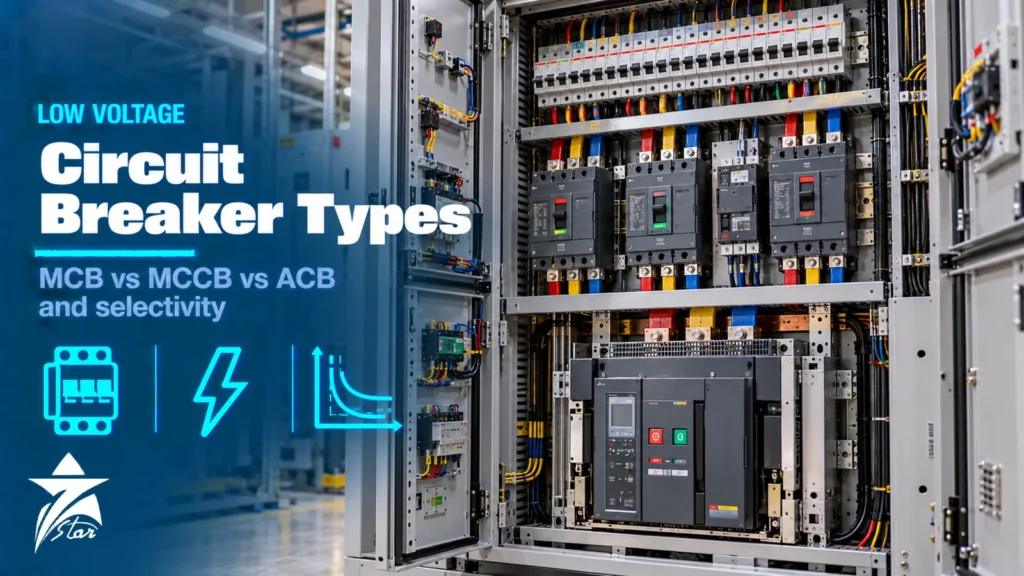
A low-voltage distribution system usually contains three families of protective device: miniature breakers on final circuits, moulded case breakers on feeders and motor circuits, and air circuit breakers at the main incomer. Understanding circuit breaker types is not just about frame size. Each family follows a different standard, carries a different set of ratings and uses a different kind of trip unit, and those differences decide whether a fault is cleared safely and whether only the nearest breaker opens. This guide compares MCB, MCCB and ACB designs, explains breaking capacity ratings, trip curves and LSIG settings, and shows how selectivity is built between levels.
Circuit Breaker Types: The Three Main Low-Voltage Families
| Feature | MCB | MCCB | ACB |
|---|---|---|---|
| Typical rated current | Up to about 125 A | From around 16 A up to about 1,600 A, some frames higher | From about 630 A up to 6,300 A |
| Main standard | IEC 60898-1 (household and similar) or IEC 60947-2 | IEC 60947-2 | IEC 60947-2 |
| Trip unit | Fixed thermal-magnetic curve (B, C, D) | Thermal-magnetic or electronic, adjustable on most frames | Electronic with LSI or LSIG, metering and communication options |
| Short-time withstand (Icw) | Not rated | Generally not rated (selectivity category A) | Rated (selectivity category B) |
| Mounting | DIN rail | Fixed, plug-in or withdrawable | Fixed or withdrawable on a cradle |
| Maintenance | Replaced, not maintained | Limited; inspection and testing | Designed for maintenance, contacts and arc chutes can be inspected |
| Typical location | Final circuits, control panels | Sub-main feeders, motor feeders, panel incomers | Main incomers, bus couplers, large feeders, generator breakers |
The boundaries overlap. Large MCCB frames and small ACB frames cover the same current range, and some industrial MCBs are certified to IEC 60947-2 rather than IEC 60898-1. The choice is driven by the fault level, the need for selectivity and the maintenance philosophy of the site as much as by current.
Miniature Circuit Breakers (MCB)
MCBs protect cables and final loads against overload and short circuit. They combine a thermal element for overload with a magnetic coil for instantaneous trip. Under IEC 60898-1 the instantaneous tripping band is defined by the curve letter:
- Curve B: instantaneous trip between 3 and 5 times rated current (In). Used for resistive loads and long cable runs where fault currents are low.
- Curve C: between 5 and 10 times In. The general-purpose curve for lighting, sockets and small motors.
- Curve D: between 10 and 20 times In. For loads with high inrush such as transformers, welding sets and some motors.
Other curves, such as K and Z, are offered under IEC 60947-2 for motor and electronic circuits. MCBs to IEC 60898-1 are rated with Icn, the rated short-circuit capacity, commonly 6 kA or 10 kA for industrial use. They are tested for operation by ordinary persons, which is why they suit distribution boards.
Moulded Case Circuit Breakers (MCCB)
MCCBs house their mechanism, contacts and trip unit in an insulating moulded case. They cover a wide current range and usually offer adjustable protection. Typical options are:
- Thermal-magnetic trip units with adjustable thermal setting (Ir) and either fixed or adjustable magnetic setting (Ii). Simple and common on smaller frames.
- Electronic trip units that measure current through sensors and allow long-time, short-time, instantaneous and sometimes ground-fault protection, along with metering and communication.
- Motor protection versions with magnetic-only trip for use with a separate overload relay, or with integrated motor overload protection and trip classes.
- Current-limiting designs that open fast enough to cap the let-through peak current and energy, protecting downstream equipment and enabling cascading.
- Accessories such as shunt trips, undervoltage releases, auxiliary and alarm contacts, motor operators, rotary handles and residual current modules.
Many MCCB families are offered in several breaking-capacity versions within the same frame, so a feeder at a high-fault switchboard and a feeder far downstream can use the same physical breaker size with different interrupting ratings.
Air Circuit Breakers (ACB)
ACBs are the main incomer and bus-coupler breakers in larger switchboards. Their contacts interrupt the arc in air, assisted by arc chutes, and their stored-energy spring mechanism allows fast closing for generator synchronisation and transfer schemes. Withdrawable versions sit on a cradle with connected, test and disconnected positions, allowing the breaker to be removed for maintenance without de-energising the busbar.
The key difference from most MCCBs is the short-time withstand current, Icw. An ACB can carry a fault current for a defined time, often expressed for 1 second, without tripping or damage. This lets it wait while a downstream breaker clears the fault, which is the basis of time-based selectivity at high fault levels. Electronic trip units on ACBs typically provide full LSIG protection, energy metering, event logs and communication to the plant control or energy management system.
Breaking Capacity Ratings: Icu, Ics, Icw and Icm
IEC 60947-2 defines several short-circuit ratings, and they are often confused in specifications:
- Icu (rated ultimate short-circuit breaking capacity): the highest prospective fault current the breaker can interrupt. After breaking at Icu, it is not required to carry rated current continuously, so it may need replacement.
- Ics (rated service short-circuit breaking capacity): the fault current the breaker can interrupt and then return to normal service. It is expressed as a percentage of Icu, such as 50, 75 or 100 percent.
- Icw (rated short-time withstand current): the current a category B breaker can carry for a stated time without tripping, enabling time-delayed selectivity.
- Icm (rated short-circuit making capacity): the peak current the breaker can close onto, important when switching onto an existing fault.
The basic rule is that Icu at the installation voltage must be at least equal to the prospective short-circuit current at the point of installation. For critical feeders and main incomers, many designers also require Ics to cover the prospective fault current, so the breaker remains serviceable after a fault. Ratings fall as voltage rises, so always read the value at the actual system voltage.
Trip Units and LSIG Protection
Electronic trip units describe their functions with letters:
| Function | Protects against | Typical adjustment |
|---|---|---|
| L (long time) | Overload of cables and equipment | Current setting Ir and time band |
| S (short time) | Downstream short circuits, with a delay for selectivity | Pickup Isd and delay tsd, optionally I squared t |
| I (instantaneous) | High-level faults close to the breaker | Pickup Ii, or switched off on category B breakers |
| G (ground fault) | Earth faults below the overcurrent pickup | Pickup Ig and delay tg |
An LI unit suits simple feeders. An LSI unit is needed where the breaker must coordinate with downstream devices. G protection is important on solidly earthed systems where arcing earth faults may not draw enough current to trip the phase elements quickly. Many trip units also provide neutral protection, which deserves attention where non-linear loads create high third-harmonic neutral currents.
Selectivity Between Breakers
Selectivity, also called discrimination, means only the breaker immediately upstream of a fault opens. Without it, a fault on a single motor feeder can trip the main incomer and stop the whole plant. Designers use four techniques, often in combination:
- Current selectivity: the upstream instantaneous pickup is set above the maximum fault current at the downstream breaker. Simple, but only works when fault levels drop significantly between levels.
- Time selectivity: the upstream breaker has a short-time delay so the downstream device clears first. Requires a breaker with an adequate Icw, typically an ACB or a category B MCCB.
- Energy selectivity: uses the current-limiting behaviour of the downstream breaker, so the upstream breaker does not reach its trip energy. It can only be confirmed from manufacturer selectivity tables.
- Zone selective interlocking (ZSI): trip units exchange restraint signals by wiring or communication. A breaker that sees a fault but receives no restraint from downstream trips with minimum delay, which reduces fault energy without losing selectivity.
Selectivity is either total (up to the full prospective fault current) or partial (up to a stated limit). Manufacturers publish selectivity tables for pairs of their own breakers. Mixing manufacturers between levels makes selectivity hard to prove, so replacement breakers should be checked against the original study.
Cascading, or backup protection, is related but different. Here an upstream current-limiting breaker helps a downstream breaker with a lower Icu interrupt a fault beyond its own rating. It reduces cost but works against selectivity, because both breakers may trip. Cascading combinations must also come from the manufacturer’s tested tables.
Derating for Heat, Altitude and Harmonics
Breaker ratings are given at a reference ambient, commonly 40 °C for MCCBs and ACBs around the breaker, and 30 °C for MCBs under IEC 60898-1. In GCC switchrooms that are poorly cooled, and especially in outdoor kiosks, the air inside the enclosure can be far hotter. Thermal-magnetic breakers then trip at lower currents, and all breakers may need current derating. Check the manufacturer’s temperature derating tables and the switchboard assembly rating under IEC 61439, not just the breaker catalogue.
Above about 2,000 m, both voltage and current ratings fall. Non-linear loads such as drives, UPS systems and LED lighting increase RMS current and neutral loading; electronic trip units measuring true RMS current give more reliable protection than older peak-sensing designs.
When to Use MV Instead
Above 1,000 V AC, protection moves to medium-voltage switchgear with vacuum or SF6 breakers controlled by separate protection relays. The principles of grading and selectivity are similar, but the equipment, standards and testing are different. Our guide to medium-voltage vacuum circuit breakers and protection relays covers that side of the system.
Circuit Breaker Types Selection Checklist
- System voltage, earthing arrangement and number of poles (3P or 4P with switched neutral).
- Rated current and load type, including motor starting or transformer inrush.
- Prospective short-circuit current at the point of installation, and required Icu and Ics.
- Need for time selectivity and therefore Icw, or a published selectivity table with the upstream device.
- Trip unit type: fixed curve, thermal-magnetic, or electronic LI, LSI or LSIG.
- Mounting: fixed, plug-in or withdrawable; terminals, cable size and busbar connections.
- Accessories: shunt trip, undervoltage release, auxiliary contacts, motor operator, interlocks.
- Enclosure temperature, altitude and derating, plus the existing part number for replacements.
Circuit Breakers We Supply, by Type
Here is how the breaker types in this guide map to products in our catalogue. Always confirm the rated current, breaking capacity at the installation point and the trip curve against your own short-circuit study.
| Product | Type | Where it fits |
|---|---|---|
| ABB S201-C6 Single-pole Miniature Circuit Breaker, C 6 A | MCB, C curve | Final circuits feeding lighting, sockets and small loads. |
| Schneider Electric Acti9 iC60N Miniature Circuit Breaker | MCB | Distribution boards and control panels. |
| CHINT NXBLE-32 RCBO Residual Current Circuit Breaker, 6-32 A | RCBO | Circuits that need earth-leakage protection for people as well as overcurrent protection. |
| Schneider Electric Compact NSX250N 250A MCCB | MCCB | Feeders and sub-distribution boards up to 250 A. |
| ABB SACE Tmax XT Moulded Case Circuit Breakers | MCCB range | Feeders and motor circuits where adjustable or electronic trip settings are needed. |
| Schneider Electric GV2ME08 TeSys Deca Motor Circuit Breaker | Motor circuit breaker | Single motor starters, combining short-circuit and thermal overload protection in one device. |
| ABB SACE Emax 2 Low Voltage Air Circuit Breaker | ACB | Main incomers and bus couplers on low voltage switchboards with high rated currents. |
| Schneider Electric Masterpact MTZ1 Air Circuit Breaker | ACB | Main incomers on compact low voltage switchboards. |
Replacing a breaker in an existing board? Send the full reference from the front label, the trip unit type and any accessories fitted (shunt trip, auxiliary contacts, motor operator) through our quote request form.
Sourcing Circuit Breakers Through Seven Star LLC
Seven Star LLC supplies circuit breakers on request, from MCBs to MCCBs and ACBs, together with trip units, accessories and related electrical and power components, from manufacturers such as ABB, Schneider Electric, Siemens, Eaton and LS Electric. We help with selection and cross-checking part numbers, including breaking capacity and accessory codes; availability and lead time are confirmed at quotation. Our electrical modules overview lists related product lines.
Replacing a breaker or building a new board? Send us the breaker nameplate or part number, the prospective fault level and the trip unit settings, or your full RFQ, and we will prepare a quotation.
Frequently asked questions
What is the main difference between an MCB, MCCB and ACB?
They differ mainly in current range, breaking capacity and adjustability. MCBs cover final circuits up to about 125 A with fixed curves, MCCBs cover feeders up to around 1,600 A with adjustable trip units, and ACBs serve main incomers up to several thousand amps. ACBs also carry a short-time withstand rating that allows time-delayed selectivity.
What is the difference between Icu and Ics?
Icu is the maximum fault current the breaker can interrupt, after which it may not be fit for further service. Ics is the fault current it can interrupt and then continue in normal use, expressed as a percentage of Icu. For critical feeders, designers often require Ics to cover the prospective fault current.
Which MCB curve should I choose?
Curve B suits resistive loads and long cables with low fault current, curve C is the general-purpose choice for mixed loads, and curve D is for high inrush loads such as transformers and some motors. The curve must also allow the breaker to trip within the required disconnection time for the cable and earthing system.
What does LSIG mean on a trip unit?
LSIG stands for long-time, short-time, instantaneous and ground-fault protection. Long-time protects against overload, short-time adds a delayed response to downstream faults for selectivity, instantaneous clears high faults immediately, and ground-fault detects earth faults below the phase pickup.
How is selectivity achieved between two breakers?
Selectivity can be based on current settings, time delays, energy limitation or zone selective interlocking. In practice, total selectivity at high fault levels is confirmed from manufacturer selectivity tables for the specific upstream and downstream breakers, together with the settings used.
Do circuit breakers need derating in hot climates?
Yes, when the air around the breaker exceeds the reference temperature in the catalogue. Thermal-magnetic breakers trip earlier as temperature rises, and manufacturers publish derating tables for current. The switchboard assembly rating and ventilation should also be checked for hot switchrooms and outdoor kiosks.
Was this guide helpful?One click helps us write better guides for engineers.
Thank you! Glad it helped. Need this equipment for your project? Request a quotation
Thank you. We will use this to improve the guide.