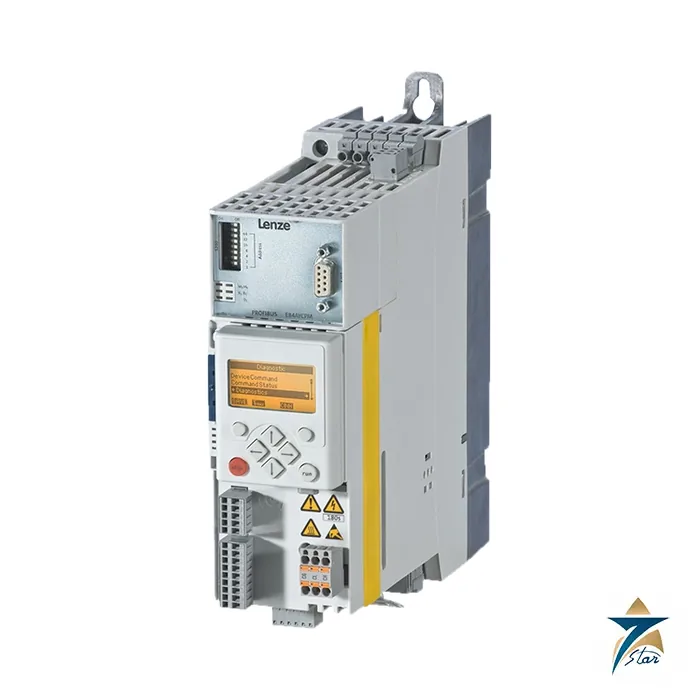
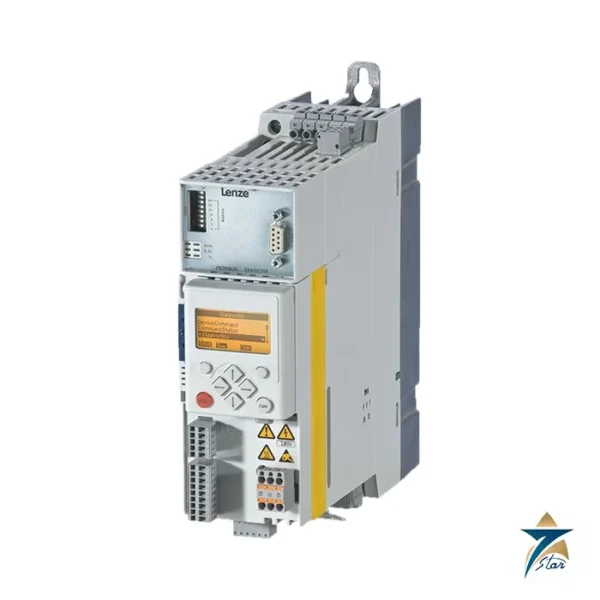
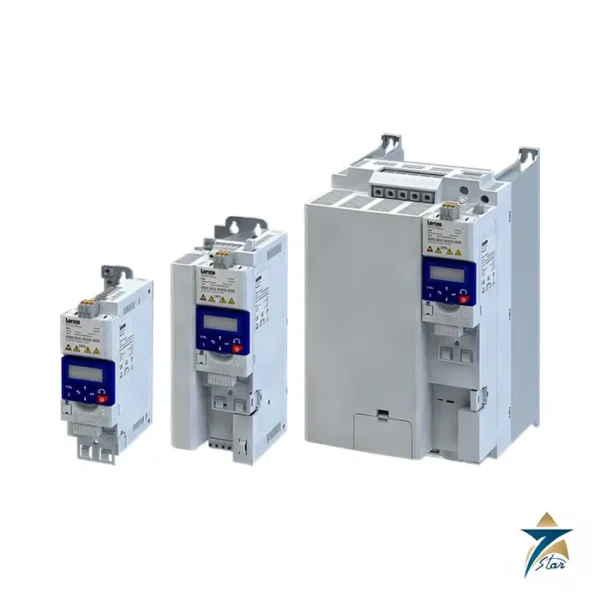
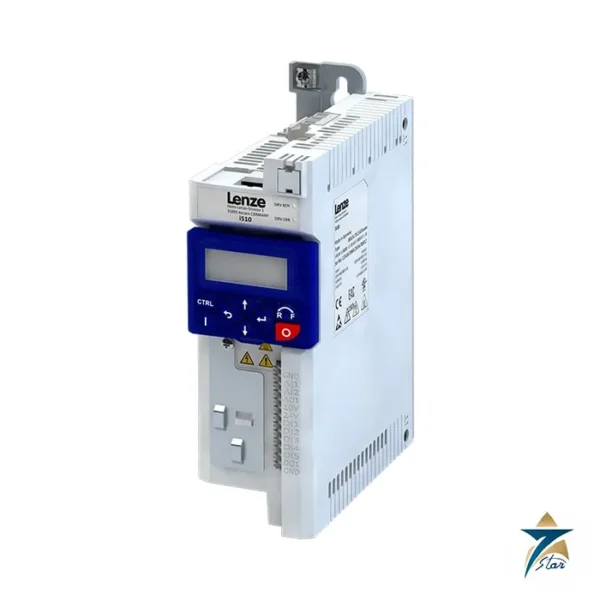
0.75 kW StateLine C inverter, standard version
Looking for a 0.75 kW 8400 StateLine C drive? The Lenze E84AVSCE7514SX0 is that rating in device size GG 2: it takes 3/PE AC 400 V (320 to 440 V) or 500 V (400 to 550 V), supplies 2.4 A continuously and up to 4.8 A for the 3 s overload cycle. The numbers come from the 8400 hardware manual EDS84ASC552 EN 10.0 published by Lenze for StateLine C, HighLine C and TopLine C devices of 0.25 to 45 kW; please confirm availability and the hardware version of this exact code before ordering.
Technical specifications
| Parameter |
Specification |
| Type |
E84AVSCE7514SX0 |
| Motor power (4-pole ASM) |
0.75 kW |
| Supply |
3/PE AC 400 V (320 to 440 V) or 500 V (400 to 550 V), 45 to 65 Hz |
| Input current without / with choke |
3.6 A / 2.5 A (400 V) |
| Output power |
1.5 kVA |
| Rated output current, 45 C / 55 C |
2.4 A / 1.8 A |
| Overload current IaM |
4.8 A (3 s load, 12 s recovery) |
| Current at 16 kHz |
1.6 A (IaM 4.0 A) |
| Power loss at rated current |
80 W |
| Internal brake chopper |
RBmin 390 ohm, peak 1.9 A, 1.3 kW |
| Size and dimensions |
GG 2 / 215 x 70 x 199 mm |
| Mass |
1.8 kg |
General data and approvals
Rated conditions include an output range of 0 to 1000 Hz and IP20 protection with NEMA 250 type 1 contact protection. Certificates named in the manual: CE, EAC (two technical regulations of the Customs Union), UL 508C and, with external mains choke only, CSA 22.2 No. 14.
Decoding E84AVSCE7514SX0
Following the manual’s product key: E84 is the 8400 range, A the first version, V the vector-controlled type, SC the StateLine C, E the installation mounting, 751 the power (75 x 10^1 W = 0.75 kW), 4 the voltage class (4 = 400/500 V three-phase), S the standard industrial environment, then X (without safety system) and 0, the standard design.
Control functions and I/O
Control modes comprise VFCplus V/f operation, VFCplus eco and sensorless vector control, backed by S-shaped ramps, flying restart, brake management and a built-in brake chopper, with 200 percent overload for 3 s. Terminals: 5 digital inputs, 1 digital output, 1 analog input and output, a relay, and HTL encoder input up to 10 kHz. CANopen is integrated; MCI modules provide PROFIBUS, PROFINET, EtherCAT, POWERLINK or INTERBUS.
Mounting and sizing
Dimensions of the GG 2 unit are 215 mm in height and 70 mm in width. The data assume 2 or 4 kHz and no mains choke; at 16 kHz the rating is 1.6 A. The brake chopper needs a resistance of 390 ohm or more. With a mains choke the input current drops from 3.6 A to 2.5 A. Keypad X400 (EZAEBK1001) and fieldbus modules are ordered separately.
Wiring limits: the manual gives maximum shielded motor cable lengths that depend on the switching frequency, for example 50 m at 4 and 8 kHz for the smaller sizes, and it requires motor cables with limited capacitance per unit length. DC-bus operation is possible with direct connection on devices with a 400 V mains connection. Short-circuit and earth-fault protection of the motor connection is limited, meaning an internal protective device responds and inhibits the controller until an error acknowledgement is given.
Where the E84AVSCE7514SX0 fits in a plant
A 0.75 kW StateLine C inverter is sized for the small motors that sit around larger process equipment: conveyor sections, dosing and transfer pumps, mixers, extraction blowers and indexing tables. In these duties the drive is valued less for raw power than for controlled starting, adjustable speed and the ability to stop a load in a repeatable way. The integrated brake chopper and brake management named in the manual make it a sensible choice where a load must be slowed under control rather than allowed to coast, for example on short inclined conveyors or machines with noticeable inertia.
Because CANopen is built in and MCI modules add PROFIBUS, PROFINET, EtherCAT, POWERLINK or INTERBUS, the same base device can be dropped into very different control architectures. That is useful for OEMs and maintenance teams in Oman who look after mixed fleets of machines from European and Asian builders and want one drive family they can standardise on.
Selecting the control mode for the load
The control modes listed above suit different loads. VFCplus V/f operation is the straightforward choice for pumps and blowers where torque rises with speed and precise low-speed torque is not critical. VFCplus eco reduces magnetising energy at partial load, which suits machines that spend long periods running below full output. Sensorless vector control is the better starting point for conveyors, mixers and other loads that need good torque at low speed or that start under load. Where speed feedback is required, the HTL encoder input can be used instead of relying on the motor model alone.
Flying restart is worth enabling on loads that may still be turning when the drive is enabled, such as a blower windmilling in a duct; S-shaped ramps help on conveyors where product could shift or spill during sharp acceleration.
Integration and installation practice
Plan the panel layout around the stated size and power loss, and respect the cable-length and cable-capacitance limits from the hardware manual, particularly when motors are remote from the panel. Decide early whether a mains choke will be fitted, since it lowers input current and is a condition of the CSA approval listed above. Keep motor, control and fieldbus cabling separated, terminate shields properly at both the drive and the motor end, and use the brake chopper only with a resistor that meets the minimum resistance in the table.
Site conditions in Oman and the GCC
The rated output current is given for two ambient temperatures, and the lower figure applies to the hotter case. In Gulf plant rooms and outdoor kiosks, where enclosure interiors can run hot in summer, this derating should be the default design assumption rather than an exception. IP20 means the drive must sit in a cabinet that keeps out dust, sand and moisture; coastal sites with salt-laden air and desert sites with fine dust both benefit from a closed, well-built enclosure with adequate ventilation. Choosing a lower switching frequency also keeps more of the rated current available when heat is the limiting factor.
Documents and quotation
Complete rating, dimension, fuse and accessory tables are in the attached Lenze hardware manual. See AC Drives for related inverters. Please give the full type code, voltage, motor data and fieldbus when requesting a quotation, and check the variant against the nameplate before ordering.







Reviews
There are no reviews yet.