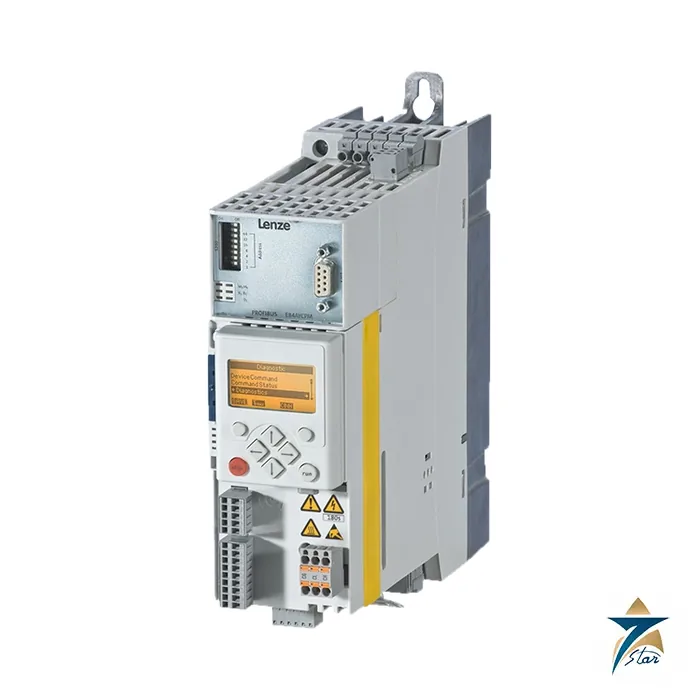
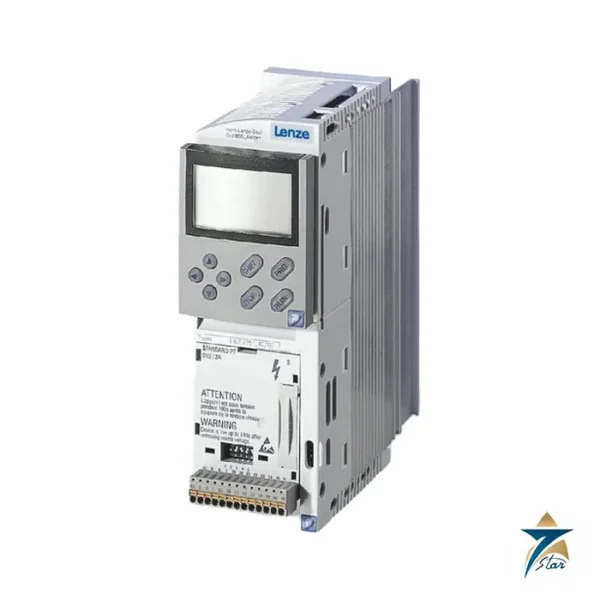
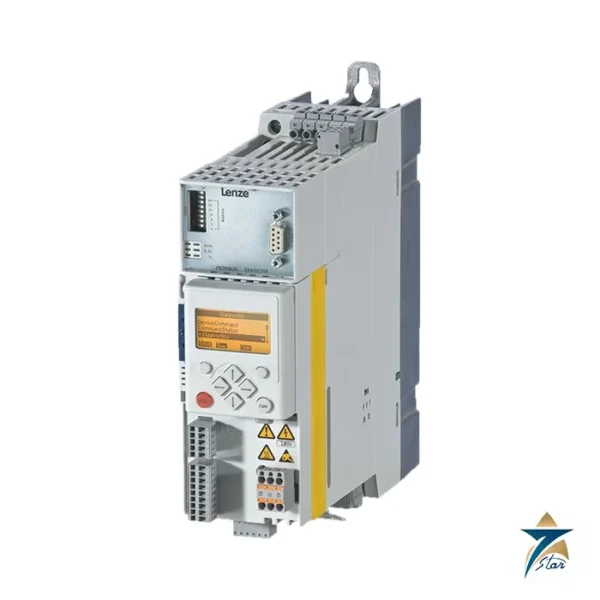
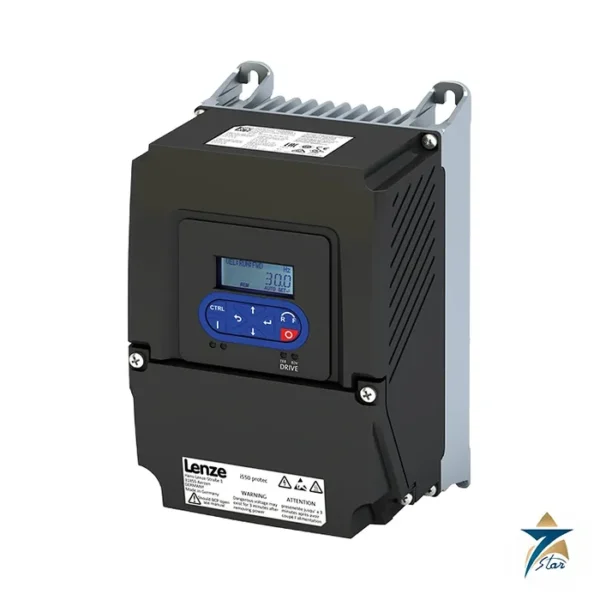
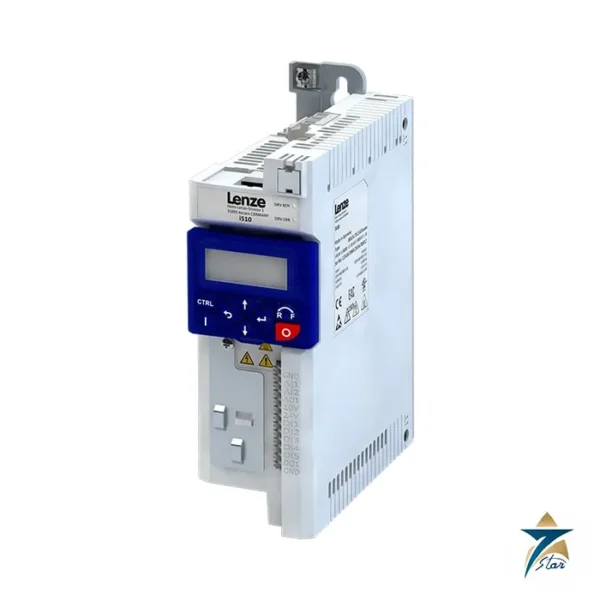
8400 StateLine C drive rated 0.55 kW
Lenze E84AVSCE5514SB0 is rated 1.8 A at 45 degrees C (1.4 A at 55 degrees C), which suits a four-pole motor of 0.55 kW. Supply is 3/PE AC 400 V (320 to 440 V) or 500 V (400 to 550 V). Source: Lenze Inverter Drives 8400 hardware manual, EDS84ASC552 EN 10.0 (0.25 to 45 kW, StateLine C, HighLine C, TopLine C). Lenze shows the 8400 StateLine on its website; availability and hardware version of this code remain to be confirmed.
Technical specifications
| Parameter |
Specification |
| Type |
E84AVSCE5514SB0 |
| Motor power (4-pole ASM) |
0.55 kW |
| Mains connection |
3/PE AC 400 V (320 to 440 V) or 500 V (400 to 550 V), 45 to 65 Hz |
| Input current without / with choke |
2.5 A / 2.0 A (400 V) |
| Apparent output power |
1.1 kVA |
| Continuous current at 45 / 55 C |
1.8 A / 1.4 A |
| Overload current IaM |
3.6 A (3 s load, 12 s recovery) |
| Current at 16 kHz |
1.2 A (IaM 3.0 A) |
| Heat loss |
65 W |
| Internal brake chopper |
RBmin 390 ohm, peak 1.9 A, 1.3 kW |
| Size and dimensions |
GG 2 / 215 x 70 x 219 mm |
| Weight |
1.9 kg |
General data and approvals
Rated conditions include an output range of 0 to 1000 Hz and IP20 protection with NEMA 250 type 1 contact protection. Certificates named in the manual: CE, EAC (two technical regulations of the Customs Union), UL 508C and, with external mains choke only, CSA 22.2 No. 14.
Reading the type code E84AVSCE5514SB0
The hardware manual’s product key splits the code as E84 (Inverter Drives 8400), A (first version), V (vector-controlled), SC (StateLine C), E (installation, the standard mounting), 551 (power: 55 x 10^1 W, that is 0.55 kW), 4 (voltage class 4 = 400/500 V three-phase), S (standard industrial environment IE33), B (integrated safety system Safe Torque Off), and 0, the standard design.
Safe Torque Off on this version
The B in the type code means the drive carries the integrated drive-based safety system. The manual states that the STO function directly causes the torqueless state according to EN 60204-1, and chapter 10 says the safety functions suit applications up to SIL 3 per IEC 61508 and reach PL e, Category 4 per EN ISO 13849-1. Only qualified personnel may install and commission safety functions, and the housing is 219 mm deep instead of 199 mm.
Installation and selection notes
Dimensions of the GG 2 unit are 215 mm in height and 70 mm in width. The data assume 2 or 4 kHz and no mains choke; at 16 kHz the rating is 1.2 A. The brake chopper needs a resistance of 390 ohm or more. With a mains choke the input current drops from 2.5 A to 2.0 A. Keypad X400 (EZAEBK1001) and fieldbus modules are ordered separately.
The hardware manual adds operating limits for all sizes. Mains switching is allowed three times in nine minutes without restriction, and the starting current is twice the rated current. TT and TN systems are permitted without restriction, whereas IT systems or grounded-phase networks require the special measures in the manual, and IT operation is not permitted with the integrated safety system. Leakage current exceeds 3.5 mA AC or 10 mA DC, so observe the earthing rules for the 0.55 kW size.
Matching the inverter to the motor and load
A small vector drive such as this one is usually chosen by motor current rather than by kilowatts alone. The continuous current at the expected cabinet temperature should be compared with the motor nameplate current, and the lower rating at the higher ambient temperature should be used whenever the enclosure runs warm. If the application needs a high switching frequency for quieter motor operation, the reduced current at 16 kHz becomes the figure to design around. Loads with short peaks, such as conveyors starting under load or small hoists, should be checked against the overload current and its load and recovery cycle.
Where the machine must stop quickly or handle overhauling loads, the internal brake chopper can be used with an external resistor that respects the minimum resistance in the table. Fans, pumps and simple conveyors without regeneration may not need a resistor at all, which keeps the panel simpler.
Planning the safety function
Because this version carries Safe Torque Off, the safety concept of the machine should be defined before the drive is wired. The risk assessment decides which performance level or SIL is needed, and the STO inputs must then be connected and validated as part of that safety chain. STO removes torque but does not isolate the motor electrically, so maintenance work on the motor or cabling still requires proper isolation from the mains.
Panel installation and commissioning
The IP20 rating means the drive belongs inside a control cabinet. Mounting space should allow for the deeper housing of the safety version and for air to move past the unit, since the stated heat loss has to be removed by the cabinet ventilation or cooling. Shielded motor cable, short and well-bonded earth connections and correct fusing from the manual reduce interference and protect the installation. The high leakage current makes a reliable protective earth connection essential.
Commissioning normally starts with entering the motor data, checking direction of rotation at low speed, and then setting ramps, limits and the control source. The keypad or engineering software can be used for parameter work; the keypad is a separate order item, as noted above. Once the drive runs correctly, a parameter backup should be kept with the machine documentation.
Operation in Gulf plants
In Oman and other GCC sites, control rooms and machine panels often face high summer temperatures, fine dust and humidity near the coast. The derated current at the higher ambient temperature is a practical guide here, and panels in hot areas may need filtered fans or air conditioning to keep the drive within its rated conditions. Dust on heat sinks reduces cooling, so periodic inspection and cleaning of the cabinet filters is good practice. Condensation risk should be considered where cabinets are cooled strongly and then opened in humid air.
Routine maintenance
Typical checks include tightening of power terminals, inspection of fans and filters, review of the fault history, and a functional test of the STO circuit at the interval defined by the machine’s safety documentation. Any change of motor or load should be followed by a review of the parameter set.
Documentation and quote requests
The attached Lenze hardware manual carries the complete rating, dimension, fuse and accessory tables. Related inverters are listed in AC Drives. Quote with the full type code, supply voltage, motor nameplate data and required fieldbus, and confirm the exact variant against the nameplate before ordering.





Reviews
There are no reviews yet.