A single-stage brass regulator for oxy-fuel and shielding gas
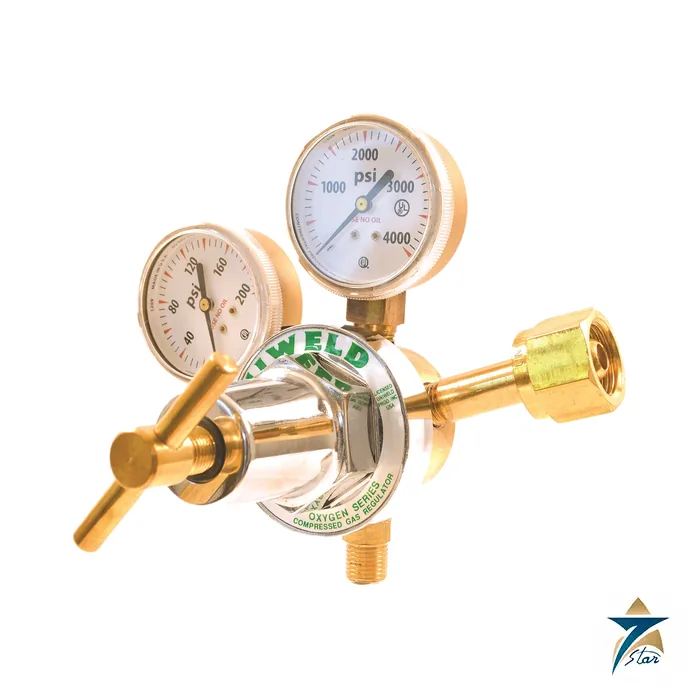
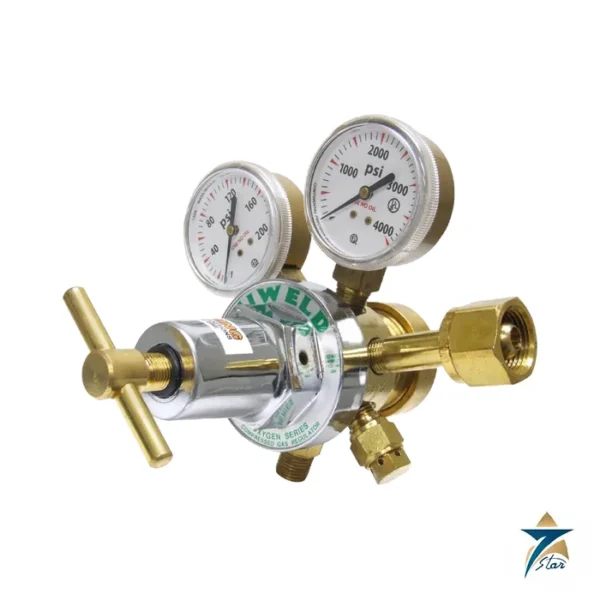
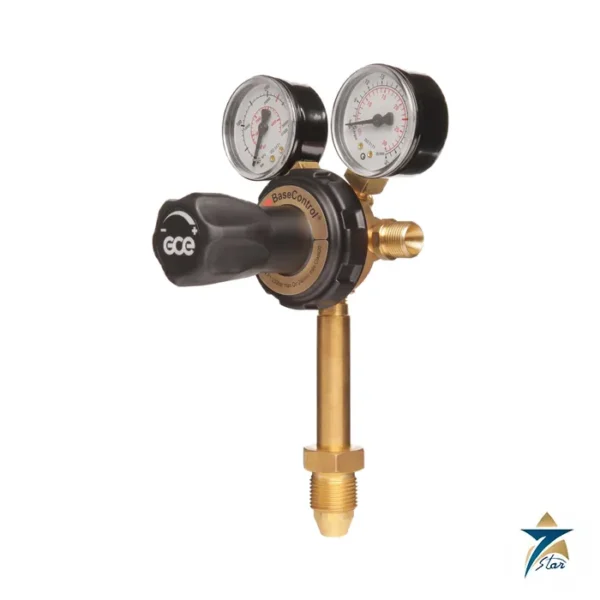
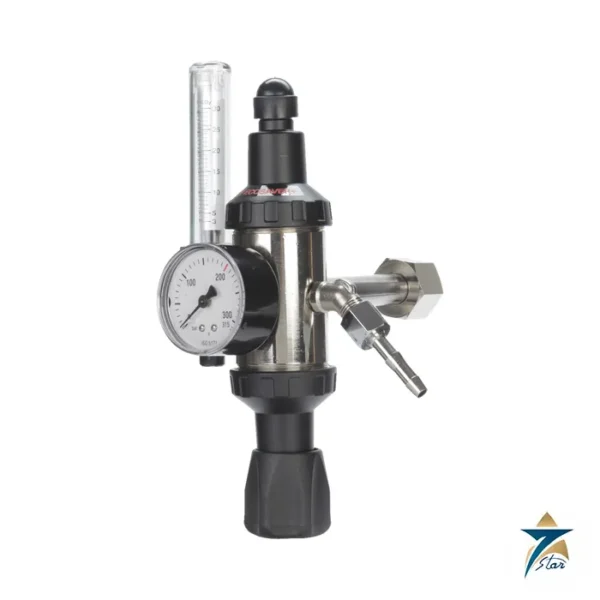
The Uniweld RUH82 series is a single-stage cylinder regulator line for oxygen, acetylene, LPG and other fuel gases, carbon dioxide, argon, nitrogen, helium, hydrogen and air. Uniweld builds it with a machined brass body, a polished chrome bonnet, easy-to-read single-scale 2 in gauges and a 2 in tri-layered reinforced neoprene diaphragm. A heavy-duty mechanical stem-type seat and nozzle assembly and a Delrin bushing give smooth flow adjustment.
A porous metal inlet filter protects the seat on all models except CO2, and a fine mesh filter screen sits between the inlet and the seat. A pressure relief device protects the low-pressure gauge only. Uniweld notes that other pressure scales and inlet connections are available on request.
Technical specifications
| Parameter |
Specification |
| Manufacturer / series |
Uniweld / RUH82 series, single stage |
| Body |
Machined brass |
| Bonnet |
Polished chrome |
| Gauges |
2 in single-scale gauges |
| Diaphragm |
2 in tri-layered reinforced neoprene |
| Seat and nozzle |
Heavy-duty mechanical stem type |
| Adjustment bushing |
Delrin |
| Inlet filtration |
Porous metal inlet filter (except CO2) and fine mesh screen |
| Relief |
Pressure relief device for low-pressure gauge protection only |
| Gauge codes |
G4S (200 psi), G7S (4000 psi), G2S (30 psi), G1S (400 psi), G5S (60 psi), G3S (3000 psi) |
Part numbers by gas
Uniweld lists the series by gas, CGA inlet connection, outlet thread and delivery range. Replacement gauges are listed by gauge code on the manufacturer page.
| Part # |
Gas |
CGA inlet |
Outlet connection |
Delivery psig |
Gauges |
| RUH8210 |
Oxygen |
540 B (RH) |
9/16 in-18 M |
5-125 |
G4S 200 psi; G7S 4000 psi |
| RUH8211 |
Acetylene |
510 B (LH) |
9/16 in-18 M |
2-15 |
G2S 30 psi; G1S 400 psi |
| RUH8211-1 |
Acetylene |
300 B (LH) |
9/16 in-18 M |
2-15 |
G2S; G1S |
| RUH8211-2 |
Acetylene |
520 B (LH) |
9/16 in-18 M |
2-15 |
G2S; G1S |
| RUH8211-CND |
Acetylene |
410 B (LH) |
9/16 in-18 M |
2-15 |
G2S; G1S |
| RUH8212 |
LPG and all fuel gas |
510 B (LH) |
9/16 in-18 M |
2-40 |
G5S 60 psi; G1S 400 psi |
| RUH8213 |
Carbon dioxide |
320 |
5/8 in-18 (RH) F |
5-125 |
G4S; G3S 3000 psi |
| RUH8214 |
Argon |
580 |
5/8 in-18 (RH) F |
5-125 |
G4S; G7S |
| RUH8215 |
Nitrogen |
580 |
5/8 in-18 (RH) F |
5-125 |
G4S; G7S |
| RUH8216 |
Helium |
580 |
5/8 in-18 (RH) F |
5-125 |
G4S; G7S |
| RUH8217 |
Hydrogen |
350 B (LH) |
9/16 in-18 M |
5-125 |
G4S; G7S |
| RUH8218 |
Air |
346 |
9/16 in-18 (RH) M |
5-125 |
G4S; G7S |
Using the regulator safely
The manufacturer instructions cover cylinder handling, connection and adjustment for all Uniweld regulators. Cylinders are secured upright, the valve outlet is inspected and cracked briefly while standing to one side, and the regulator is turned off before the cylinder valve is opened slowly. The instructions say that acetylene must not be used above 15 psig, that regulator relief devices protect the regulator only, and that downstream equipment needs its own relief device. Hoses are blown out at 5 psig before connection, oxygen uses a green hose with right-hand threads, and fuel gas uses a red hose with left-hand threads.
Key features of the RUH82 series
- Single-stage design: one pressure-reducing stage keeps the regulator simple, compact and easy to service, which suits cutting, heating and general welding stations.
- Machined brass body: brass is the usual material for oxygen and fuel gas regulators, and machining gives accurate seat and port geometry.
- Large reinforced diaphragm: the tri-layered neoprene diaphragm gives sensitive control of delivery pressure.
- Two filters: the porous metal inlet filter and fine mesh screen keep particles from the cylinder valve away from the seat.
- Gas-specific connections: each part number has the CGA inlet and outlet thread for its gas, which helps prevent connecting the wrong cylinder.
Choosing single-stage or two-stage
A single-stage regulator reduces cylinder pressure to working pressure in one step. As the cylinder empties, the delivery pressure tends to drift and the operator may need to readjust it. For oxy-fuel cutting, heating and most MIG and TIG shielding gas work this is acceptable and the single-stage regulator is the economical choice. Where a constant outlet pressure is critical over the whole cylinder, such as for laboratory instruments, purging or precise flow control, a two-stage regulator is usually specified instead. For shielding gas, many users fit a flowmeter on the outlet to set the flow in litres or cubic feet per hour.
Installation and maintenance tips
- Check that the CGA inlet matches the cylinder valve; do not use adaptors to connect a regulator to a different gas.
- Keep oxygen regulators and fittings free of oil and grease.
- Release the adjusting screw before opening the cylinder valve, then open the valve slowly.
- Leak-test connections with a suitable leak detection solution, never with a flame.
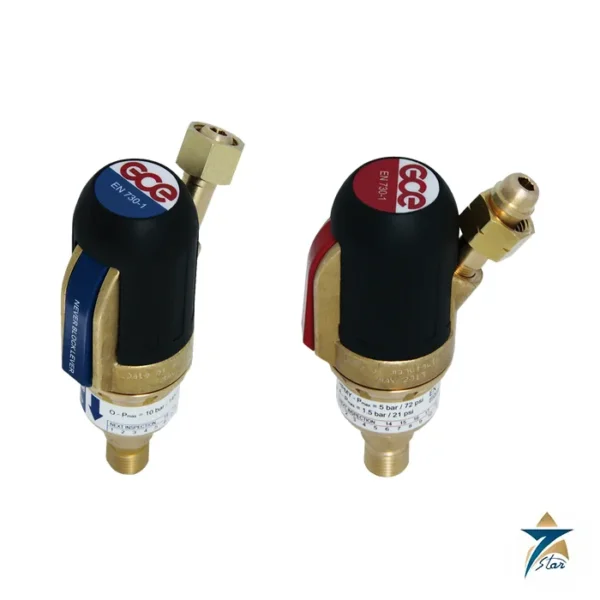
- Fit flashback arrestors and check valves on oxy-fuel equipment as required by your site rules.
- Replace gauges with cracked lenses or pointers that do not return to zero, and remove from service any regulator that creeps.
Use in Oman and GCC workshops
Fabrication shops, shipyards, maintenance workshops in oil and gas facilities and construction sites across Oman use oxy-acetylene and argon or CO2 shielding gas daily. Heat raises cylinder pressure, so store cylinders upright, chained and shaded, away from direct sun. Dust and sand easily enter an open cylinder valve or regulator inlet on outdoor sites, so keep dust caps fitted when regulators are removed and crack the cylinder valve briefly before connecting. Coastal humidity can corrode exposed fittings over time, which makes periodic inspection worthwhile.
What to include in your RFQ
- Part number, or the gas and CGA inlet connection.
- Required delivery pressure range.
- Quantity of regulators and replacement gauges by gauge code.
- Any special inlet connection or pressure scale.
- Delivery location.
Documents and quotation
The Uniweld operating instructions for regulators (all models) are attached under Datasheets & Documents; they are the manufacturer document for this series and are not a model-specific datasheet. See related equipment in our Oxy-Fuel Cutting Equipment category.
For a quotation, send the part number, gas, inlet standard and quantity.


Reviews
There are no reviews yet.