A compact rack and pinion rotary actuator
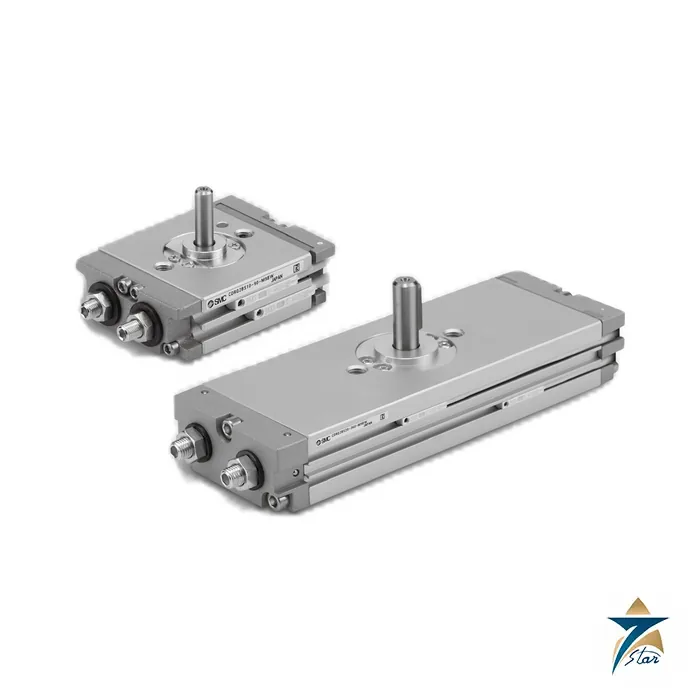
CRQ2BS20-90 is a compact rotary actuator of the rack and pinion type from the SMC CRQ2 series. Compressed air pushes a piston that drives a rack, and the rack turns a pinion shaft through a fixed angle. It is used to turn, flip, index or sort parts, for example in a pick-and-place unit, where a short, compact unit with a simple, repeatable turn is wanted.
The code reads CRQ2B (series, the version without a built-in magnet; CDRQ2B has the magnet), S (single shaft), 20 (size 20) and 90 (rotating angle of 90 degrees, a range of 80 to 100 degrees). The version for 180 degrees is 90 replaced by 180, and 360 degrees by 360. With no thread letter, the port of size 20 is Rc 1/8; TF, TN and TT give G, NPT and NPTF versions.
Technical specifications
| Parameter |
Specification |
| Series / type |
CRQ2 compact rotary actuator, rack and pinion, single shaft |
| Fluid |
Air (non-lube) |
| Size / rotating angle |
20 / 90 deg (80 to 100 deg) |
| Maximum operating pressure |
1.0 MPa |
| Minimum operating pressure |
0.1 MPa |
| Ambient and fluid temperature |
0 to 60 deg C (no freezing) |
| Angle adjustment range |
Rotation end +/-5 deg |
| Output torque at 0.5 MPa |
1.8 N.m (catalogue figure for size 20) |
| Allowable kinetic energy |
0.025 J without cushion; 0.12 J with the air cushion option |
| Stable rotation time adjustment range |
0.2 to 1 s per 90 deg |
| Weight |
600 g for the 90 deg version, excluding auto switch |
Reading the output and the energy limit
The output torque of 1.8 N.m is the figure at 0.5 MPa and decreases in proportion with lower pressure. It is the torque the shaft can deliver, not the torque the load needs; accelerating an inertia load takes extra torque, so the load must be checked against both the output and the allowable kinetic energy. For size 20 the limit without cushion is 0.025 J, and it is raised to 0.12 J by the air cushion option (suffix C).
If the kinetic energy of the load at the end of the swing is higher than the figure, the internal parts can be damaged, so the catalogue tells the user to slow the movement with speed controllers or to choose a larger size or the cushion option.
Setting and mounting
The rotation angle can be trimmed by +/-5 degrees with the adjustment screws. The catalogue warns that these screws are set at random near the maximum angle when shipped, so the angle must be readjusted to suit the application before use. Auto switches (the CDRQ2 version with a built-in magnet) can be added for position detection.
The rotary actuator is not a water-resistant construction, even when a water-resistant auto switch is fitted, according to the catalogue note.
Sizing the CRQ2BS20-90 for a real load
Sizing a rotary actuator takes two checks, not one. First, compare the torque the load needs with the output torque at the pressure that will actually be available at the machine, remembering that the catalogue value is quoted at 0.5 MPa and falls as pressure drops. A load that hangs off-centre, or that must be lifted against gravity during the swing, needs more torque than one turning in a horizontal plane. Second, estimate the moment of inertia of the arm, gripper and part, and work out the kinetic energy at the chosen rotation time. If it exceeds the allowable value for this size, slow the movement, add the cushion option, or move to a larger size.
- Include the gripper, fixtures and fasteners in the inertia, not only the part being moved.
- Keep the rotation time inside the stable adjustment range; very slow settings can cause stick-slip movement.
- Choose the CDRQ2 variant at the design stage if end-position sensing will be needed, since this version has no magnet.
- Confirm the port thread required by the machine builder’s fittings.
Installation and commissioning
Supply clean, dry, filtered air; the actuator is designed for non-lube operation, so there is no need to add oil, but once lubricated air has been used it should be continued. Fit meter-out speed controllers on both ports and start with them almost closed, then open them gradually while watching the end of the swing. Before running at full speed, set the rotation angle with the adjustment screws, because the factory setting is not tuned to the application. Mount the load on the shaft without hammering, and avoid applying radial or axial loads larger than the catalogue permits; where the load is heavy or long, support it with an external bearing.
Maintenance and troubleshooting
Uneven or jerky rotation usually points to contaminated air, a speed controller set too tightly, or a load beyond the actuator’s capacity. A hard knock at the end of rotation means the kinetic energy is too high and should be reduced immediately to protect the rack and pinion. Air leaking from the body suggests worn seals. Check fittings and tubing for leaks, drain the filter bowl regularly, and recheck the angle setting after any mechanical change to the tooling.
Using it in Oman and GCC conditions
The rated temperature range covers most indoor factories, but actuators near ovens, sealing stations or in unshaded outdoor equipment can approach the upper limit in summer, so check local temperatures before installing. In humid coastal plants, compressed air carries a lot of moisture; an air dryer and drain traps protect the seals and avoid corrosion, and because the unit is not water-resistant it should be kept away from washdown and spray. Dust from cement, food powders or sand should be kept off the shaft and the adjusting screws with suitable guarding.
Documents and quotation
The SMC CRQ2 catalogue PDF below has the how-to-order page, the specification tables, shaft variations and dimensions. Please confirm size, angle, shaft type, cushion and thread before ordering. More actuators are listed under Pneumatic Cylinders. Seven Star LLC is an independent supplier and quotes the exact code on request.














Reviews
There are no reviews yet.