- Automation & ControlView all 3,006 products
- Automation Accessories
- AC Drives
- PLC & I/O Cards
- Industrial Communications
- Vibration Monitoring
- Isolator & Barrier
- Controllers & Data Acquisition
- Safety Switches & Guard Locking
- Motor Soft Starters
- CCTV & Security
- Encoders
- Pneumatic Cylinders
- HMI Displays
- Servo Drives
- Industrial Computers
- Machine Vision
- Automation Software
- Robotics
















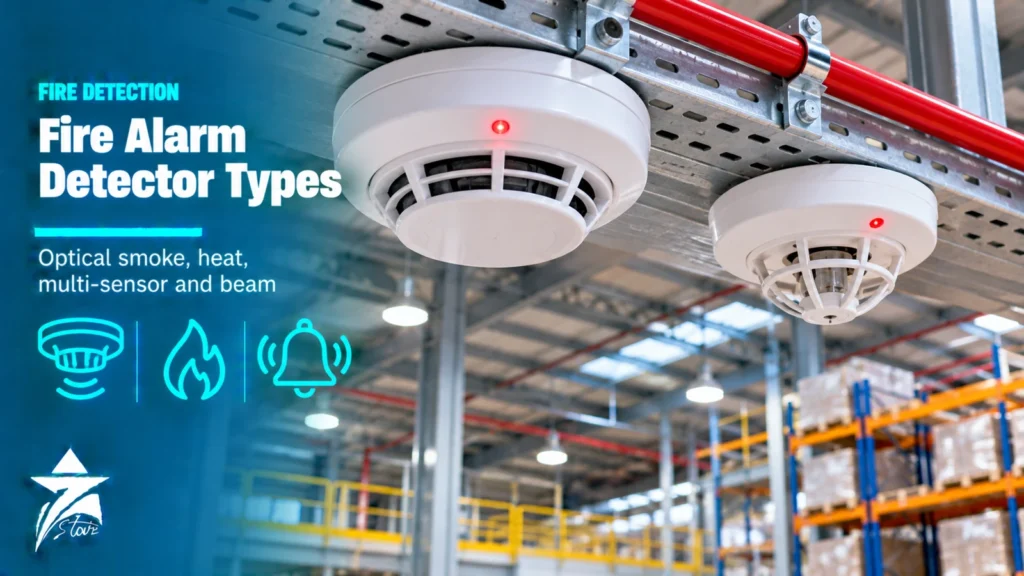
A fire alarm system is only as good as its detectors. The control panel, sounders and beacons all depend on the first signal from a device that senses smoke, heat or flame early enough for people to escape and for the fire to be controlled. Choosing among the main fire alarm detector types means matching the way a fire is likely to start and grow in each room to a sensing principle that will respond quickly without creating false alarms. This guide explains how each detector works, where it fits and what to check before you order.
How Automatic Fire Detection Works
A fire produces several phenomena that a detector can measure: visible and invisible smoke particles, a rise in air temperature, combustion gases such as carbon monoxide, and electromagnetic radiation in the ultraviolet and infrared bands. Each detector type responds to one or more of these signals. Smoke detection is usually the earliest for smouldering and slow growing fires in offices, rooms and corridors. Heat detection is slower but very stable in dirty or steamy areas. Flame detection responds in seconds to fast burning liquid and gas fires that produce little smoke. In a modern system, the detector sends its state or an analogue value to the control panel, which decides when to raise a pre-alarm, a fire alarm or a fault.
European detectors are tested to the EN 54 series, and system design in the UK and much of the Gulf region follows BS 5839-1, while many projects designed by American consultants follow NFPA 72. The local authority having jurisdiction, in Oman the Civil Defence and Ambulance authority, approves the final design and the equipment used.
Fire Alarm Detector Types Compared
| Detector type | Sensing principle | Typical standard | Best suited to |
|---|---|---|---|
| Optical (photoelectric) point smoke | Light scattered by smoke particles inside a chamber | EN 54-7 | Offices, bedrooms, corridors, escape routes, electrical rooms |
| Ionisation point smoke | Smoke changes current between two plates near a small radioactive source | EN 54-7 | Legacy installations; now largely replaced because of disposal rules |
| Fixed temperature heat | Alarm when air reaches a set temperature, for example 54 to 65 C for class A1/A2 | EN 54-5 | Kitchens, plant rooms, car parks, dusty areas |
| Rate-of-rise heat | Alarm on a fast temperature increase, plus a fixed upper limit | EN 54-5 (class R suffix) | Stores and areas with stable ambient temperature |
| Multi-sensor | Optical and heat (sometimes CO) signals combined by an algorithm | EN 54-29 / EN 54-31 | Hotels, mixed use areas, places prone to nuisance alarms |
| Optical beam | Infrared beam across the space is obscured by smoke | EN 54-12 | Warehouses, atriums, hangars, high ceilings |
| Aspirating (ASD) | Air drawn through pipes to a sensitive laser chamber | EN 54-20 class A, B or C | Data centres, clean rooms, cold stores, heritage buildings |
| Flame (UV, IR, UV/IR, multi-IR) | Radiation emitted by flames | EN 54-10 | Fuel stores, turbine enclosures, process areas, loading bays |
| Linear heat cable | Cable responds to heat along its whole length | EN 54-22 | Cable trays, conveyors, tunnels, floating roof tanks |
| Carbon monoxide fire detector | Electrochemical cell senses CO from smouldering fires | EN 54-26 | Residential and hotel rooms, in combination with other sensors |
Optical Smoke Detectors
The optical point detector is the default choice for most rooms. An infrared LED and a photodiode sit in a dark labyrinth; when smoke enters, light is scattered onto the photodiode and the signal rises. Optical detectors respond well to the larger particles from smouldering fires involving cables, furniture and paper, which is why they are preferred on escape routes and in sleeping risk areas. Ionisation detectors, which respond better to small particles from fast flaming fires, have largely been withdrawn from new projects because of the radioactive source, and modern multi-sensors fill the gap.
Heat Detectors: Fixed Temperature and Rate of Rise
Heat detectors are used where smoke detectors would give false alarms, such as kitchens, boiler rooms, laundry areas, car parks and dusty workshops. EN 54-5 classifies them by the typical application temperature: class A1 for normal ambient up to about 25 C, A2 for slightly warmer areas, and classes B to G for higher ambient temperatures. A suffix R means the detector also has a rate-of-rise element, and S means it is static only and will not alarm on a fast rise below its fixed threshold. In hot Gulf plant rooms or under metal roofs, choose a class that leaves a safe margin above the maximum ambient, otherwise the detector may operate on a summer afternoon.
Multi-Sensor Detectors
A multi-sensor combines an optical chamber with a thermistor, and some models add a carbon monoxide cell. The detector or the panel looks at the pattern of signals over time, so it can respond quickly to a real fire while ignoring steam from a shower, cooking fumes or a little dust. Many multi-sensors allow a mode to be selected per location, for example optical only at night and multi-criteria during the day. They are a good answer to nuisance alarms in hotels, accommodation camps and mixed use buildings.
Optical Beam Detectors for High Ceilings
In warehouses, sports halls, atriums and aircraft hangars, point detectors on a high ceiling are hard to reach for maintenance, and smoke may stratify before it gets to them. An optical beam detector projects an infrared beam across the space to a reflector or a separate receiver, typically covering 5 to 100 m with a width of about 15 m. Smoke crossing the beam reduces the received signal and triggers an alarm. Motorised beams with automatic alignment compensate for building movement, which matters on steel structures that expand in the Omani sun.
Aspirating Smoke Detection
An aspirating smoke detection (ASD) system uses a fan to draw air continuously through a network of small bore pipes with sampling holes, and passes it through a laser detection chamber. EN 54-20 defines class A for very high sensitivity, such as inside IT cabinets and clean rooms; class B for enhanced sensitivity in sensitive areas; and class C for normal sensitivity similar to point detectors. ASD is also useful where point detectors cannot be reached or would be damaged, such as cold stores, prison cells, heritage ceilings and dusty conveyor halls with filtered sampling. The pipe design must be calculated with the manufacturer software to confirm transport time and hole sensitivity.
Flame Detectors for Process and Fuel Areas
Flame detectors look for the radiation emitted by flames rather than smoke or heat. UV detectors are very fast but can be triggered by welding and lightning. UV/IR designs need both bands to confirm a fire, and multispectrum IR detectors compare several infrared wavelengths to reject sunlight, hot surfaces and flickering reflections. They are the right choice for fuel stores, turbine enclosures, compressor packages and loading racks, and are usually certified for hazardous areas. Our article on the fire and gas detector supplier range covers the wider fire and gas package used on oil and gas sites.
Choosing Fire Alarm Detector Types by Environment
| Area | Recommended detection | Reason |
|---|---|---|
| Offices, corridors, escape routes | Optical smoke or multi-sensor | Early warning of smouldering fires |
| Hotel rooms and accommodation | Multi-sensor with CO or optical | Fast response with fewer steam alarms |
| Kitchens and laundries | Fixed temperature or rate-of-rise heat | Cooking fumes and steam would trigger smoke detectors |
| Warehouses and atriums | Optical beam or aspirating | High ceilings and large open spaces |
| Data centres and control rooms | Aspirating class A or B plus point detectors | Very early warning to protect critical equipment |
| Plant rooms and generator rooms | Heat or multi-sensor; flame near fuel | Heat, dust and diesel fumes |
| Fuel stores and process areas | Ex certified flame and heat detectors | Fast flaming fires in hazardous zones |
| Cable tunnels and conveyors | Linear heat cable or aspirating | Long, narrow and hard to access spaces |
| Car parks | Heat or multi-sensor | Exhaust fumes and dust |
Spacing, Coverage and Ceiling Height
The number of detectors depends on the coverage rules of the design code. Under BS 5839-1, a point smoke detector on a flat ceiling covers any point within about 7.5 m, and a point heat detector within about 5.3 m, with reduced figures near walls and in corridors. NFPA 72 uses a listed spacing, often 9.1 m for smoke detectors on smooth ceilings, adjusted for ceiling height, beams and airflow. Maximum ceiling heights are also limited: around 10.5 m for point smoke detectors and lower for heat detectors, above which beam or aspirating detection is used. Ceiling obstructions, deep beams, air conditioning diffusers and voids above false ceilings all change the layout, so the final drawing should come from a qualified fire alarm designer.
- Keep smoke detectors at least 1 m away from air supply diffusers so smoke is not blown away from them.
- Treat ceiling voids and floor voids deeper than 800 mm as separate spaces that may need detection.
- Add detectors in lift shafts, stair heads, risers and plant rooms as required by the code.
- Consider access: detectors above 6 m may need beam, aspirating or remote test solutions.
Conventional and Addressable Systems
Most fire alarm detector types are available in conventional and addressable versions. On a conventional system, several detectors share a zone circuit and the panel shows only which zone is in alarm. On an addressable system, each detector has its own address on a loop, so the panel shows the exact device and location, and analogue values allow drift compensation and maintenance warnings. Detectors and panels from different manufacturers usually use different protocols, so the detector must match the panel. Read our article on addressable fire alarm systems for the loop and protocol details.
Detectors for Hazardous Areas
In oil and gas plants, fuel depots and chemical facilities, detectors installed in Zone 1 or Zone 2 must be certified for that area. Intrinsically safe (Ex ia) point smoke and heat detectors are used with an approved barrier or isolator on the loop, while flame detectors and some heat detectors are often flameproof (Ex d) with their own enclosure. Check the ATEX or IECEx marking, gas group and temperature class against the area classification drawing. Where flammable gas is the main hazard, gas detectors are added alongside the fire detectors; our guide to gas detector selection covers that side.
Reducing False Alarms
Unwanted alarms cost money, interrupt operations and teach people to ignore real alarms. Most can be avoided at the design stage by selecting the right detector for each room, and by good maintenance afterwards.
- Use heat or multi-sensor detectors where steam, cooking, dust or exhaust fumes are present.
- Cover detectors during hot work, painting and cleaning, and remove the covers afterwards.
- Use panel features such as day and night sensitivity, alarm verification and coincidence logic where the code allows.
- Replace or clean contaminated detectors; addressable panels warn when drift compensation reaches its limit.
- Seal cable entries in dusty areas and avoid placing detectors in the direct airflow of AC units.
Testing and Maintenance
BS 5839-1 asks for a weekly user test of a manual call point and service visits at least every six months by a competent person, with every detector functionally tested over the year. Smoke detectors are tested with approved aerosol or smoke generators, heat detectors with a heat tester, and beam detectors with test filters. Aspirating systems need checks of airflow, pipe integrity and filter condition. Many manufacturers recommend replacing point detectors after about ten years. Keep a log book with test results, faults and false alarms, because the pattern of events shows where different fire alarm detector types or locations are needed.
Conditions in Oman and the Gulf
High ambient temperature, sand, dust and coastal humidity all affect detector selection in Oman. Heat detectors under uninsulated roofs may see air temperatures well above 45 C, so a higher class is often needed. Dust can contaminate optical chambers in warehouses and workshops, which favours heat, multi-sensor or filtered aspirating systems. Outdoor flame detectors need window heating or cleaning schedules in dusty locations. Equipment and the installer should be approved by the local Civil Defence authority, and the system documents should state the detector models, standards and certification.
Fire Alarm Detector Types: Selection Checklist
| Question | Why it matters |
|---|---|
| What is the likely fire: smouldering, fast flaming or liquid? | Decides between smoke, heat and flame sensing |
| What are the ambient conditions: dust, steam, heat, airflow? | Prevents false alarms and early failure |
| How high is the ceiling and how open is the space? | Point, beam or aspirating detection |
| Is the area hazardous (Zone 1 or Zone 2)? | Needs Ex ia or Ex d certified detectors |
| Which panel and protocol are installed? | Detector must be compatible with the loop |
| Which design code and authority apply? | BS 5839-1, NFPA 72 and local approval |
Detector Products from Our Catalog
The table below lists a selection of detectors and detection systems from our catalog that cover the main sensing principles described above.
| Product | Type | Typical use |
|---|---|---|
| Apollo 55000-600 XP95 Optical | Addressable optical smoke detector | Offices, corridors and escape routes |
| Apollo SA5100-600 Soteria Optical | Addressable optical smoke detector | Commercial and public buildings |
| Apollo SA5100-700 Soteria Optical Heat | Multi-sensor detector | Hotels and mixed use areas |
| Gent S-Quad Multi-Sensor | Multi-sensor with sounder | Large buildings with voice alarm needs |
| C-TEC CA414 CAST Multisensor | Addressable multi-sensor | Accommodation and offices |
| Apollo Series 65 A1R | Conventional heat detector | Kitchens and plant rooms |
| Kidde KC2-OSH-CD | Two-wire smoke and heat detector | Conventional systems |
| Apollo Fireray One | Conventional beam detector | Warehouses and atriums |
| Hochiki ESP FIREbeam Xtra | Addressable beam smoke detector | High ceilings and halls |
| Xtralis VESDA-E VEP | Aspirating smoke detector | Data centres and control rooms |
| Kidde ModuLaser | Modular aspirating system | Clean rooms and large spaces |
| Apollo 55000-640APO XP95 I.S. Optical | Intrinsically safe smoke detector | Hazardous areas |
| Honeywell FS20X Plus | UV/3IR flame detector | Fuel stores and process areas |
| Det-Tronics X3301 | Multispectrum IR flame detector | Oil and gas facilities |
| C-TEC CPDUCT/OPT CAST-PRO | Duct smoke detection kit | HVAC ducts |
Browse more in our fire and gas detectors category. To get a quotation, send the detector type, panel make and protocol, area classification and quantity through our quote request form or to [email protected].
Sourcing Fire Alarm Detectors in Oman Through Seven Star LLC
Seven Star LLC is an independent supplier in Oman of optical smoke, heat, multi-sensor, beam, aspirating and flame detectors for commercial buildings, industrial plants and oil and gas facilities. We quote products from manufacturers such as Apollo, Hochiki, Kidde, Xtralis, Gent, C-TEC, Honeywell and Det-Tronics. For every project using these fire alarm detector types, the model, panel compatibility, approvals and lead time are confirmed against the manufacturer data at quotation.
Frequently asked questions
What are the main fire alarm detector types?
The main types are optical smoke, heat (fixed temperature and rate-of-rise), multi-sensor, optical beam, aspirating smoke, flame and linear heat detectors. Each senses a different fire signal and suits a different environment.
Where should I use a heat detector instead of a smoke detector?
Use heat detectors where steam, cooking fumes, dust or exhaust gases would cause smoke detectors to false alarm, such as kitchens, laundries, car parks, boiler rooms and dusty workshops.
What is the difference between EN 54-20 class A, B and C?
These are sensitivity classes for aspirating smoke detectors. Class A is very high sensitivity for IT cabinets and clean rooms, class B is enhanced sensitivity, and class C is normal sensitivity similar to point detectors.
When is a beam detector better than point detectors?
Beam detectors suit high ceilings and large open spaces such as warehouses, atriums and hangars, where point detectors would be hard to maintain and smoke may not reach the ceiling.
Can I mix detectors from different manufacturers on one panel?
Usually not on an addressable loop, because each manufacturer uses its own protocol. Conventional detectors are more interchangeable, but compatibility should always be confirmed with the panel manufacturer.
Who supplies fire alarm detectors in Oman?
Seven Star LLC is an independent supplier in Oman that quotes smoke, heat, multi-sensor, beam, aspirating and flame detectors from leading manufacturers. Send your requirements through the quote request form or to [email protected].
Was this guide helpful?One click helps us write better guides for engineers.
Thank you! Glad it helped. Need this equipment for your project? Request a quotation
Thank you. We will use this to improve the guide.