Overview
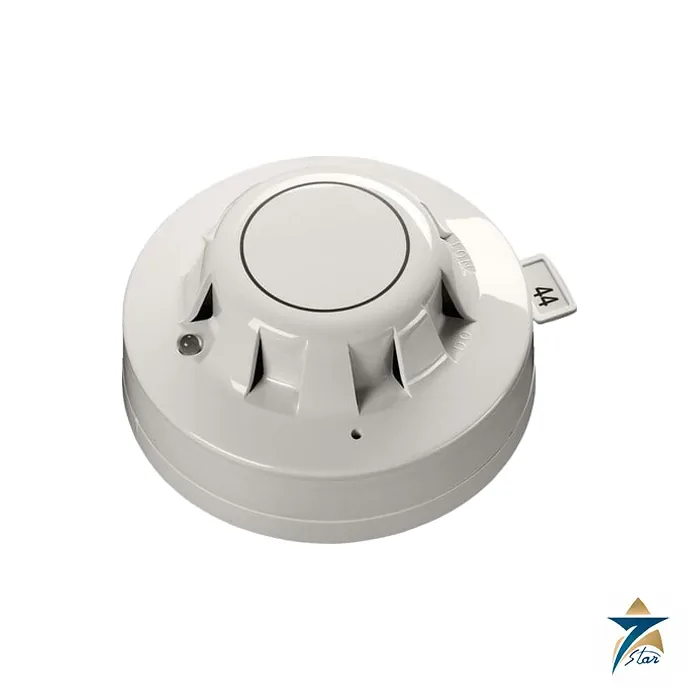
The Apollo 55000-600 is the XP95 analogue addressable optical smoke detector from Apollo Fire Detectors, one of the most widely installed point smoke detectors in intelligent fire alarm systems. It works on the forward light-scatter principle and, according to Apollo, responds well to slow-burning and smouldering fires, which makes it well suited to escape routes, offices, control rooms, accommodation blocks and general building areas. The Apollo 55000-600 communicates digitally with XP95, Discovery and CoreProtocol® compatible control panels, reporting an analogue value that the panel uses for alarm decisions, pre-alarm warnings and contamination monitoring.
Seven Star LLC supplies the Apollo 55000-600 and associated XP95 devices to fire and gas contractors, facility managers and EPC teams in the Sultanate of Oman and across the GCC. With engineering support in Muscat, we help customers match detectors, bases and ancillaries to the loop protocol of their existing panel, whether the job is a new building, a plant expansion or a like-for-like replacement during maintenance.
Detection Principle
Inside the Apollo 55000-600, a printed circuit board carries a light-proof labyrinth chamber with an integral gauze on one side and the address capture, signal processing and communication electronics on the other. A GaAs infrared light-emitting diode, mounted in a collimator, is arranged at an obtuse angle to a silicon PIN photo-diode fitted with a daylight-blocking filter. The emitter sends a burst of collimated light once every second. In clean air the photo-diode receives no light directly, because of the angular arrangement and a dual mask. When smoke enters the chamber, particles scatter light onto the photo-diode in an amount related to the smoke characteristics and density.
The photo-diode signal is processed by an optical ASIC and passed to the A/D converter of the communications ASIC, ready for transmission when the panel interrogates the device. Apollo states that the Apollo 55000-600 is calibrated to give an analogue value of 25±7 counts in clean air, rising with smoke density, and that a count of 55 corresponds to the EN 54 alarm sensitivity level. The nominal response threshold is 0.12 dB/m measured in accordance with EN 54-7. Because the decision is made at the panel using a continuous analogue value, the system can distinguish a slowly contaminating head from a real fire and can raise maintenance warnings before false alarms occur.
Engineering Design of the Apollo 55000-600
The Apollo 55000-600 uses the same outer case as the XP95 ionisation detector and is recognised by its indicator LED, which is clear in standby and red in alarm. The housing is white flame-retardant polycarbonate with nickel-plated stainless steel terminals, measuring 100 mm in diameter and 42 mm in height and weighing 105 g. The Apollo 55000-600 plugs into an XP95 mounting base and is connected to a two-wire, polarity-insensitive loop that carries both data and a 17 to 28 V DC supply through terminals L1 and L2.
A drive point is provided for a remote LED indicator between the +R and −R terminals. Apollo specifies that the indicator must be a standard high-efficiency red LED; no series resistor is required because current is limited inside the detector. The typical quiescent current is 340 µA, with a power-up surge of 1 mA for one second and an alarm LED current of 4 mA. These low figures matter when engineers calculate loop loading and battery standby capacity for a large addressable loop.
Key Features
The Apollo 55000-600 brings together the features that fire engineers typically look for in an addressable optical head.
- Forward light-scatter detection that responds well to slow-burning and smouldering fires.
- Nominal response threshold of 0.12 dB/m, measured in accordance with EN 54-7.
- Digital communication compatible with XP95, Discovery and CoreProtocol panels.
- Analogue output of 25±7 counts in clean air, allowing pre-alarm and drift monitoring at the panel.
- Two-wire, polarity-insensitive loop connection with a 17 to 28 V DC supply range.
- Low quiescent current of 340 µA for efficient loop and battery design.
- Remote LED drive output for indicators outside locked rooms or ceiling voids.
- Unaffected by wind and atmospheric pressure, with an operating temperature of −20 to +60 °C.
Industrial Applications
In Oman and the GCC the Apollo 55000-600 is commonly specified for commercial and institutional buildings, hotels, hospitals, schools and residential towers where an addressable XP95 or Discovery loop is already the standard. In industrial facilities it is used in administration buildings, control rooms, switchgear and MCC rooms, laboratories and warehouses at refineries, power stations, desalination plants and logistics hubs in the Sohar and Salalah free zones, where smouldering cable or electrical fires are a realistic risk. As general engineering guidance, optical heads are less suited to areas with steam, dust or exhaust fumes, where a heat or multi-sensor detector is usually preferred.
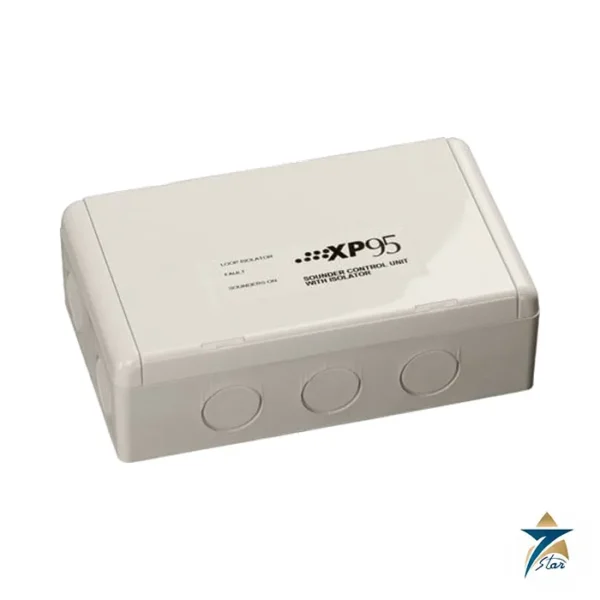
For complete systems, the Apollo 55000-600 works alongside other loop devices such as the Apollo XP95 sounder control unit. Where a project calls for very early warning in data halls or clean rooms, an aspirating system such as the Xtralis VESDA VLI aspirating smoke detector may be combined with point detection, and for C-TEC CAST-based installations the C-TEC CP416 addressable optical smoke detector is the equivalent head. Seven Star LLC supplies these products for projects in Muscat and throughout the region, and can support protocol checks before ordering.
Technical Specifications
The data below for the Apollo 55000-600 is taken from the Apollo product data sheet PP2610/2021/Issue 2. Specifications are typical at 24 V, 25 °C and 50 % RH.
| Parameter |
Specification |
| Model |
Apollo XP95 Optical Smoke Detector, part no. 55000-600 |
| Related part numbers |
55000-620 (optical smoke detector), 55000-660 (optical smoke detector, black) |
| Detection principle |
Photo-electric detection of light scattered in a forward direction by smoke particles |
| Sensor / emitter |
Silicon PIN photo-diode / GaAs infrared LED |
| Sampling frequency |
Once per second |
| Sensitivity |
Nominal response threshold 0.12 dB/m (EN 54-7) |
| Digital communication |
XP95, Discovery and CoreProtocol compatible |
| Supply wiring / voltage |
Two-wire, polarity insensitive / 17 V to 28 V DC |
| Quiescent current |
340 µA |
| Power-up surge current |
1 mA for 1 second |
| Alarm LED current / remote LED current |
4 mA / 5 mA maximum |
| Operating temperature |
−20 °C to +60 °C |
| Storage temperature |
−30 °C to +80 °C |
| Humidity |
0 % to 95 % RH, no condensation or icing |
| Compliance (55000-600) |
CPR, LPCB |
| Dimensions / weight |
100 mm diameter × 42 mm height / 105 g |
| Materials |
White flame-retardant polycarbonate housing; nickel-plated stainless steel terminals |
Selection and Maintenance Notes for the Apollo 55000-600
When ordering the Apollo 55000-600, confirm the panel protocol and the base type used on site, and note the compliance requirement of the project: the data sheet lists CPR and LPCB for the 55000-600, while the 55000-620 variant carries additional approvals such as VdS. As general practice, smoke detectors should be tested and cleaned at the intervals defined by the local code and the system designer, and the analogue values reported by an addressable panel are a useful tool to identify heads that are becoming contaminated before they cause unwanted alarms.
How to Order
To request a formal quotation for the Apollo 55000-600, send the quantity, base type and panel protocol to the Seven Star LLC fire and gas team. We offer engineering support in Muscat, can provide the manufacturer data sheet for your submittal, and help fire contractors and facility owners across Oman and the GCC keep their addressable systems running.












Reviews
There are no reviews yet.