- Automation & ControlView all 1,927 products
- AC Drives
- PLC & I/O Cards
- Industrial Communications
- Vibration Monitoring
- Automation Accessories
- Controllers & Data Acquisition
- Isolator & Barrier
- CCTV & Security
- Safety Switches & Guard Locking
- Encoders
- HMI Displays
- Motor Soft Starters
- Industrial Computers
- Servo Drives
- Pneumatic Cylinders
- Machine Vision
- Automation Software
- Robotics
















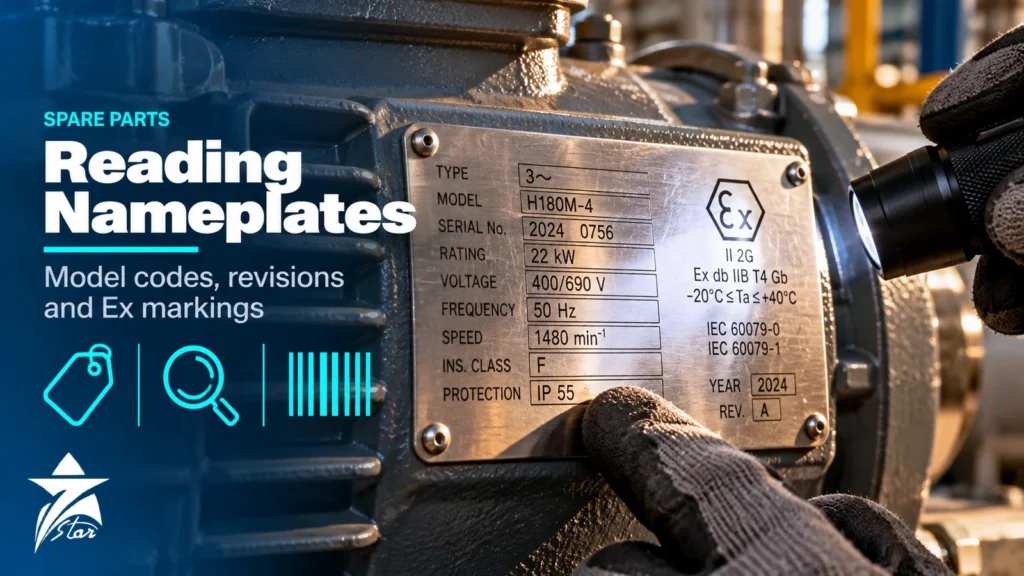
When an instrument fails, a motor burns out or a valve needs a spare, the nameplate is usually the only reliable link between the item in the field and the documentation that describes it. Yet nameplates are routinely misread: a serial number is quoted as a part number, a model code is cut short, an Ex marking is ignored, or a revision letter is missed and the replacement does not fit or does not talk to the system. Reading equipment nameplates correctly is a basic skill that saves days of back-and-forth with suppliers. This guide explains the fields you will find, how model codes are structured, how to interpret revisions, approvals and protection ratings, how to identify a replacement when the original is obsolete, and how to record nameplate data so anyone can act on it.
Model Number, Part Number, Serial Number and Tag: Not the Same Thing
Most identification errors start with confusing these four numbers:
- Model number or model code: describes what the product is and how it is configured. Two identical units have the same model code.
- Part number, order code or catalogue number: the number used to order the item. For simple products it equals the model number; for configured instruments it may be a separate short code that maps to a full configuration.
- Serial number: unique to the individual unit. It does not describe the product, but the manufacturer can often use it to retrieve the original configuration, build date and test records.
- Tag number: the plant’s own identifier for the installed location, such as PT-1203. It means nothing to the manufacturer, but it links the item to your data sheet and loop drawing.
Many companies also hold an internal material or stock code in their maintenance system. Never send only that code to a supplier; send the manufacturer’s model or part number.
Reading Equipment Nameplates: What a Typical Plate Contains
| Field | What it tells you | Why it matters for replacement |
|---|---|---|
| Manufacturer and address | Who made it and sometimes where | Brand ownership may have changed; production site may affect certificates |
| Model or order code | Product family and configured options | Determines exact form, fit and function |
| Serial number | Individual unit identity | Lets the manufacturer retrieve the as-built configuration |
| Date or date code | Year (and sometimes week) of manufacture | Indicates likely revision and obsolescence status |
| Hardware or firmware revision | Design level of the unit | Affects compatibility with racks, software and drivers |
| Ratings | Range, pressure, voltage, current, power, temperature | Must match or exceed the service |
| Materials | Wetted parts, body, trim, seals | Critical for corrosion and sour service |
| Approvals and markings | Ex marking, certificate numbers, CE or other conformity marks | Hazardous area and legal compliance |
| Protection degree | IP code or NEMA enclosure type | Suitability for dust, water and wash-down |
| Tag | Plant location | Links to data sheets and drawings |
How Model Codes Are Structured
Configured products such as transmitters, flow meters, analyzers, valves and actuators use model codes built from a base model followed by option fields. Each position or group of characters selects one option: measurement range, process connection, wetted material, fill fluid, output protocol, housing material, cable entry, hazardous area approval, display, and additional options often appended at the end as two-character codes. The structure is defined in the manufacturer’s product data sheet or ordering information table.
Practical rules when reading a model code:
- Copy every character, including dashes, slashes and trailing option codes; a missing last group can remove an approval or a calibration option.
- Watch for easily confused characters: 0 and O, 1 and I, 5 and S, 8 and B. Compare with the ordering table, where only one reading will be valid.
- Decode the code against the data sheet for the same product generation; option codes are sometimes reused differently in newer generations.
- If the plate shows both a short order code and a long configuration code, record both.
Our Rosemount 3051 guide walks through a real transmitter model code as an example of how much each character controls.
Revisions, Series and Firmware
Two units with the same model code can still differ. Manufacturers update designs without changing the base model and record the change as a revision letter, series number, hardware version or firmware version. This matters most for electronics: a replacement I/O card, monitor module or drive control board with a different revision may need a newer configuration tool, different firmware in the controller, or may not be accepted in an older chassis. Mechanical parts change too, for example seal designs, actuator mounting patterns or flange drillings.
- Record hardware revision and firmware version wherever shown, on the label, on a sticker or in the device’s own diagnostics.
- When buying a replacement for a running system, state whether the same revision is required or whether a later revision is acceptable.
- Check the manufacturer’s compatibility notes before mixing revisions in a redundant pair or a safety system.
Reading Hazardous Area Markings
Equipment for explosive atmospheres carries a marking that must be matched, not just copied. A typical IECEx or ATEX gas marking such as Ex db IIC T4 Gb breaks down as follows:
- Ex db: the type of protection, here flameproof enclosure; others include eb (increased safety), ia or ib (intrinsic safety) and nA or ec (non-sparking types for Zone 2).
- IIC: the gas group; IIC equipment is suitable for IIA and IIB atmospheres as well.
- T4: the temperature class, meaning maximum surface temperature does not exceed 135 °C.
- Gb: the equipment protection level, suitable for Zone 1 (and Zone 2).
ATEX equipment also shows the CE mark, the Ex hexagon symbol and a group and category such as II 2G. The certificate number identifies the certifying body and year; a suffix X means specific conditions of use apply, listed in the certificate, and a suffix U indicates an Ex component that is not complete equipment on its own. A replacement must have equal or better protection for the zone, gas group and temperature class of the location. For background, read our guide to hazardous area classification and Ex equipment.
Ingress Protection and Enclosure Ratings
The IP code under IEC 60529 has two digits: the first for solids and dust (6 means dust-tight), the second for water (5 for water jets, 6 for powerful water jets, 7 for temporary immersion, 8 for continuous immersion under conditions agreed by the manufacturer). IP66 and IP67 are not interchangeable; a product rated for immersion has not necessarily been tested against powerful jets, and some products carry both ratings. North American equipment may show NEMA enclosure types instead, such as Type 4X for corrosion-resistant, watertight enclosures; NEMA types and IP codes are not exact equivalents.
Nameplates on Common Equipment Types
Electric motors
Motor plates built to IEC 60034-1 list rated power, voltage and connection (for example star or delta), current, frequency, speed, power factor, duty type (S1 for continuous duty), insulation class, ambient temperature, IP code, frame size and mounting, and often the efficiency class under IEC 60034-30-1. Bearing designations for drive and non-drive end are frequently stamped too, which helps when ordering bearings. Replacement electric motors must match frame size, shaft and mounting as well as electrical data.
Valves and pressure equipment
Valve bodies carry cast or stamped markings for manufacturer, size, pressure class, body material and flow direction, while an attached plate gives the model, trim material, actuator data and serial number. Safety relief valves carry set pressure, capacity, size and code stamp data; never order a relief valve or its spare parts without the full nameplate.
Bearings and mechanical components
Bearings carry their designation on the ring. The base number gives type and dimensions, while prefixes and suffixes define seals, shields, internal clearance, cage material and precision; dropping a suffix such as a clearance code can cause premature failure. Our bearings and power transmission range is identified by full designation, so send everything printed on the ring or the original box.
When the Original Is Obsolete: Finding a Replacement
A nameplate from a discontinued product still holds everything needed to find a successor:
- Confirm obsolescence status with the manufacturer or its published product notices; many publish a recommended successor.
- Compare form (dimensions, mounting, connections), fit (interfaces, signals, power) and function (range, accuracy, approvals) between old and new.
- Check whether wiring, configuration software, mounting adapters or brackets change.
- For hazardous area or safety-related equipment, verify the new certification and update the loop or SIL documentation as required.
- Where no successor exists, consider an equivalent from another manufacturer configured from the original nameplate data and the process data sheet.
Damaged, Painted or Missing Nameplates
Desert sun fades printed labels, coastal salt corrodes stamped plates, and maintenance painting covers them. When a plate is hard to read, photograph it with low-angle light to bring out embossed characters, check for a second label inside the terminal cover or on the electronics, and look for the serial number in device diagnostics or in the maintenance system history. If the plate is gone, record dimensions, connections, wiring and process conditions, and the supplier or manufacturer can often identify the item from those data and photographs. Protect replacement plates from UV and paint over-spray at the next maintenance window.
Common Mistakes When Reading Equipment Nameplates
- Sending the serial number or the plant stock code instead of the model or part number.
- Truncating long model codes or skipping the option codes at the end.
- Ignoring the revision or firmware level for electronic modules.
- Copying the Ex marking from a different variant of the same model.
- Assuming IP66 and IP67 are equivalent.
- Ordering a bearing without its suffixes or a motor without its frame and mounting data.
Nameplate Data Capture Checklist
- Clear, square-on photo of the whole nameplate, plus a wider photo showing the installed item.
- Manufacturer, full model code and any short order code.
- Serial number, date code, hardware revision and firmware version.
- Ratings, materials and process connection.
- Ex marking and certificate number, IP or NEMA rating.
- Plant tag number and parent equipment for spare parts.
- Notes on anything unreadable or missing.
Sourcing Replacements from Nameplate Data Through Seven Star LLC
Seven Star LLC supplies instruments, motors, valves, bearings, automation modules and spare parts on request for plants and contractors in Oman and the GCC. Send us the nameplate and we help with identification, selection and cross-checking part numbers and successors; availability and lead time are confirmed at quotation.
Have a nameplate photo and no idea what to order? Send us the photo, the serial number and where the item is installed, and we will identify the item or its successor and send you a clear quotation.
Frequently asked questions
What is the difference between a model number and a serial number?
A model number describes the product and its configuration and is shared by all identical units. A serial number identifies one individual unit. Suppliers need the model or part number to quote, but the serial number helps the manufacturer retrieve the original configuration.
What does Ex db IIC T4 Gb mean on a nameplate?
Ex db is flameproof protection, IIC is the gas group covering the most easily ignited gases such as hydrogen, T4 means maximum surface temperature of 135 °C, and Gb is the protection level suitable for Zone 1. A replacement must offer equal or better protection for the location.
What does the X at the end of an Ex certificate number mean?
A suffix X means there are specific conditions of use that must be followed, listed in the certificate. A suffix U indicates an Ex component, which is certified for incorporation into other equipment rather than for use on its own.
Is IP67 better than IP66?
Not necessarily. IP66 covers powerful water jets, while IP67 covers temporary immersion; they are different tests. A product needs both ratings marked if it must withstand both conditions.
Why does the revision level matter if the model code is the same?
Manufacturers update hardware and firmware without changing the base model. For electronic modules, a different revision can require new configuration software or firmware and may not be compatible with an older chassis or redundant partner.
What should I do if the nameplate is unreadable?
Photograph it with low-angle light, look for secondary labels inside covers or on electronics, and check device diagnostics or maintenance records for the serial number. If nothing remains, record dimensions, connections and process data so the item can be identified or an equivalent configured.
Was this guide helpful?One click helps us write better guides for engineers.
Thank you! Glad it helped. Need this equipment for your project? Request a quotation
Thank you. We will use this to improve the guide.