- Automation & ControlView all 3,015 products
- Automation Accessories
- AC Drives
- PLC & I/O Cards
- Industrial Communications
- Vibration Monitoring
- Isolator & Barrier
- Controllers & Data Acquisition
- Safety Switches & Guard Locking
- Motor Soft Starters
- CCTV & Security
- Encoders
- Pneumatic Cylinders
- HMI Displays
- Servo Drives
- Industrial Computers
- Machine Vision
- Automation Software
- Robotics
















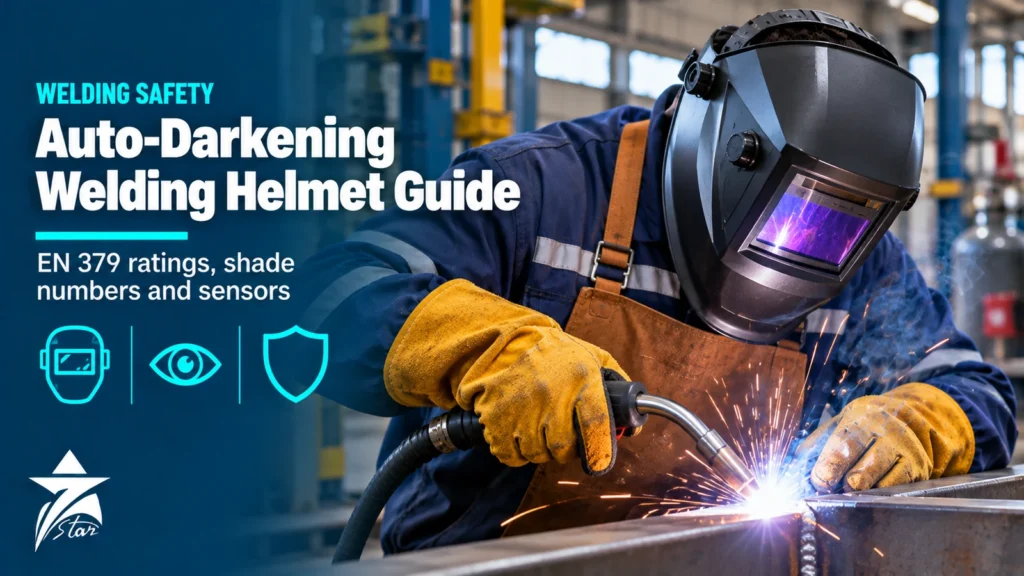
A welding arc produces intense visible light, ultraviolet and infrared radiation that can burn the cornea and damage the retina in seconds. A passive helmet with a fixed dark lens protects the eyes, but the welder must flip it down blind after positioning the electrode, which causes poor starts, neck strain and frequent exposure when the helmet is lifted. An auto-darkening welding helmet solves this with a filter that stays light until the arc strikes and then darkens in a fraction of a millisecond. This guide explains the standards, ratings and features that separate a good filter from a poor one, and how to match the helmet to the welding process and the fume risk on your site.
How an Auto-Darkening Welding Helmet Works
The auto-darkening filter, often called the ADF or cassette, is a sandwich of polarising films and liquid crystal cells. Arc sensors on the front of the cassette detect the flash of the arc and send a signal to the electronics, which apply a voltage across the liquid crystal layers. The crystals rotate and block most of the visible light, taking the lens from its light state, usually shade 3 or 4, to the selected dark shade. When the arc stops, the filter returns to the light state after a delay set by the welder.
An important point that is often misunderstood: the ultraviolet and infrared protection is permanent. It comes from fixed interference and absorption layers in the cassette and is present whether the filter is light, dark or even if the battery has failed. Only the visible light transmission changes. That is why a quality filter is safe to look through in the light state while the arc is not running.
Standards for an Auto-Darkening Welding Helmet
| Standard | What it covers |
|---|---|
| EN 379 | Automatic welding filters: shade, switching time, optical class and angle dependence |
| EN 175 | Welding helmet shell and face shield: heat, spatter and impact resistance |
| EN 166 | General eye and face protection, including mechanical impact marking |
| EN 169 | Passive welding filters and shade recommendations |
| EN 12941 | Powered air purifying respirators with helmets or hoods, classes TH1 to TH3 |
| EN 14594 | Continuous flow supplied air breathing apparatus |
| ANSI Z87.1 and CSA Z94.3 | North American eye and face protection requirements |
Reading the EN 379 Optical Class: 1/1/1/2 Explained
Every EN 379 filter is marked with four numbers, for example 1/1/1/2. Each number is a class from 1 (best) to 3, and together they describe how clearly the welder can see through the lens.
| Position | Property | What a good rating means |
|---|---|---|
| First | Optical class | Low distortion, so the weld pool looks sharp and undistorted |
| Second | Diffusion of light | Fewer scratches and impurities in the filter, giving a clearer image |
| Third | Variation in luminous transmittance | Even shade across the whole lens, without light or dark patches |
| Fourth | Angle dependence | The shade stays consistent when looking through the edge of the lens |
A filter rated 1/1/1/1 is the top of the scale and gives a clear view even when welding out of position. A rating of 1/1/1/2 is very common in quality professional helmets. Filters with class 2 or 3 in the first positions are acceptable for occasional work but cause more eye fatigue over a full shift.
Selecting the Right Shade Number by Process
The dark shade of an auto-darkening welding helmet must be matched to the process and the current. Too light a shade lets excessive visible light through; too dark a shade makes the weld pool hard to see, so welders lean closer and breathe more fume. The table below gives typical starting ranges based on the EN 169 and ISO 4063 guidance. Start with a darker setting and reduce it until the pool is clearly visible.
| Process | Current range | Typical dark shade |
|---|---|---|
| MMA stick welding | 40 to 80 A | 9 to 10 |
| MMA stick welding | 80 to 175 A | 10 to 11 |
| MMA stick welding | 175 to 400 A | 11 to 13 |
| MIG and MAG on steel | 80 to 200 A | 10 to 12 |
| MIG and MAG on steel | 200 to 400 A | 12 to 13 |
| TIG welding | 5 to 50 A | 8 to 10 |
| TIG welding | 50 to 250 A | 10 to 12 |
| Plasma cutting | up to 150 A | 10 to 12 |
| Gouging with carbon arc | 200 A and above | 13 to 14 |
Low current TIG work deserves special attention. The arc is quiet and low in intensity, so the filter must be sensitive enough to detect it and the helmet should offer shades down to 5 or 8. Our overview of welding process selection explains how each process differs in arc intensity, spatter and fume.
Sensors, Sensitivity, Delay and Switching Time
- Number of sensors: two sensors suit bench work in open positions; four sensors are better for pipe welding and out of position work, where one or two sensors can be blocked by the workpiece or the welder arm.
- Switching time: quality filters darken in about 0.1 ms or faster. EN 379 also tests switching time at low and high temperatures, which matters in hot Omani workshops.
- Sensitivity: adjusts how much light triggers the filter. Increase it for low current TIG; reduce it if other welders nearby cause false triggering.
- Delay: sets how long the filter stays dark after the arc stops. A longer delay protects against the glow of hot metal after high current welding.
- Grind mode: holds the filter in the light state so the same helmet can be used for grinding without darkening from sparks.
- Power: most filters combine solar cells with replaceable lithium coin batteries. Check battery availability and the low battery warning before buying.
Viewing Area, Weight and Comfort
A larger viewing area improves situational awareness and reduces head movement, but it adds weight and cost. On a professional auto-darkening welding helmet, typical cassettes range from about 50 by 100 mm to over 100 by 70 mm, and panoramic designs extend the view to the sides. Weight matters for a full shift: a helmet of around 500 g feels very different from one approaching 700 g. Look for a headgear with several adjustment points, a sweatband that can be replaced and a balanced centre of gravity.
Flip up and slide up designs allow the welder to inspect the weld, grind or move around the workshop with a clear impact rated visor in place, without removing the helmet. This is useful on fabrication sites where helmets must be worn together with a safety helmet or where the task changes often between welding and grinding.
Welding Fume and Respiratory Protection
In 2017 the International Agency for Research on Cancer classified welding fume as carcinogenic to humans. Stainless steel welding adds hexavalent chromium and nickel, and many consumables release manganese. Local exhaust ventilation, such as fume extraction torches and extraction arms, is the first line of defence, but many tasks still require respiratory protection inside the helmet.
| Option | How it works | Best for |
|---|---|---|
| Disposable or half mask under the helmet | Filtering facepiece or half mask with P2 or P3 filters | Short tasks and low fume levels |
| Powered air purifying respirator | Battery blower draws air through a particle filter and feeds it to the helmet | Long shifts, stainless and galvanised steel, hot climates |
| Supplied air system | Breathable compressed air fed to the helmet through a hose | Confined spaces and very high fume or gas levels |
A powered air purifying respirator certified to EN 12941 class TH3 offers the highest protection level in that standard and also blows cooling air across the face, which many welders appreciate in summer. Our guide to respiratory protection for industrial work explains protection factors and fit testing in more detail.
Choosing an Auto-Darkening Welding Helmet for Your Team
- Match the shade range and sensitivity to your main processes, especially if low current TIG is used.
- Choose an optical class of 1/1/1/2 or better for full shift welders.
- Select four sensors for pipe welding, shipyards and structural work out of position.
- Check compatibility with a safety helmet or a powered air respirator if the site requires them.
- Confirm that spare outer and inner cover lenses, batteries and sweatbands are available locally.
- Look for EN 379, EN 175 and EN 166 marking on the cassette and shell.
Care and Maintenance
Replace the outer cover lens as soon as spatter or scratches reduce visibility, since a damaged cover lens makes even the best filter look poor. Clean the cassette only with a soft cloth and mild cleaner, never solvents. Store the auto-darkening welding helmet away from direct sunlight when not in use to protect the electronics, and test the filter regularly against a spark or a lighter flame to confirm it darkens. Replace the cassette if it cracks, flickers or fails to switch.
Selected Welding Helmets and Respirators in Our Catalog
The table below lists a selection of helmets and respiratory units from our catalog.
| Product | Type | Typical use |
|---|---|---|
| Optrel panoramaxx 2.5 | Panoramic automatic helmet | Full shift fabrication |
| Optrel sphereX clt | Lightweight automatic helmet | All position welding |
| Optrel helix clt | Slide-up automatic helmet | Welding and grinding |
| 3M Speedglas 9100 | Automatic welding helmet | Industrial welding |
| 3M Speedglas G5-01 | Heavy-duty flip-up helmet | Heavy fabrication |
| Miller Digital Elite | Digital automatic helmet | MIG, TIG and stick |
| Miller T94 | Automatic helmet with wide view | Production welding |
| Optrel e3000X PAPR | Powered air respirator blower | Fume protection |
| Optrel suppliedair Comfort | Supplied-air respiratory unit | Confined spaces |
| Tegera 7788 | EN 12477 Type B welding gloves | TIG and fine work |
Browse more in our welding category. To get a quotation, send the welding processes, current range, quantity and any respirator requirement through our quote request form or to [email protected].
Sourcing Welding Helmets in Oman Through Seven Star LLC
Seven Star LLC is an independent supplier in Oman of welding helmets, powered air respirators, supplied air units, welding gloves, fume extraction torches and welding equipment. We quote products from manufacturers such as Optrel, 3M Speedglas, Miller, DINSE, Bernard and Tegera, together with spare cover lenses, batteries and filters. Shade range, optical class, respirator class and certification are confirmed against the manufacturer data at quotation.
Frequently asked questions
What does the EN 379 rating 1/1/1/2 mean on a welding helmet?
The four numbers are classes for optical quality, diffusion of light, variation in luminous transmittance and angle dependence. Class 1 is best and class 3 is lowest, so 1/1/1/2 means excellent clarity with slightly more shade variation when looking through the edge of the lens.
Is an auto-darkening welding helmet safe if the battery fails?
Yes. The ultraviolet and infrared protection comes from permanent layers in the filter and does not depend on power. Only the visible light darkening needs power, so a failed battery means the lens will not darken and must be replaced or recharged before welding.
Which shade should I use for MIG welding?
For MIG and MAG welding on steel, shades 10 to 12 suit currents of about 80 to 200 A, and shades 12 to 13 suit higher currents. Start darker and reduce the shade until the weld pool is clearly visible.
How many arc sensors does a welding helmet need?
Two sensors are adequate for bench welding in open positions. Four sensors are recommended for pipe, structural and out of position work, where the workpiece can block some sensors from the arc.
When should welders use a powered air respirator?
A powered air purifying respirator is recommended for long shifts, stainless steel and galvanised steel welding, and work where local exhaust ventilation cannot keep fume levels low enough. Class TH3 to EN 12941 gives the highest protection in that standard.
Who supplies auto-darkening welding helmets in Oman?
Seven Star LLC is an independent supplier in Oman that quotes automatic welding helmets, powered air respirators and spare parts from manufacturers such as Optrel, 3M Speedglas and Miller. Send your requirements through the quote request form or to [email protected].
Was this guide helpful?One click helps us write better guides for engineers.
Thank you! Glad it helped. Need this equipment for your project? Request a quotation
Thank you. We will use this to improve the guide.