LR-X100: what this LR-X series sensor is and how its code reads
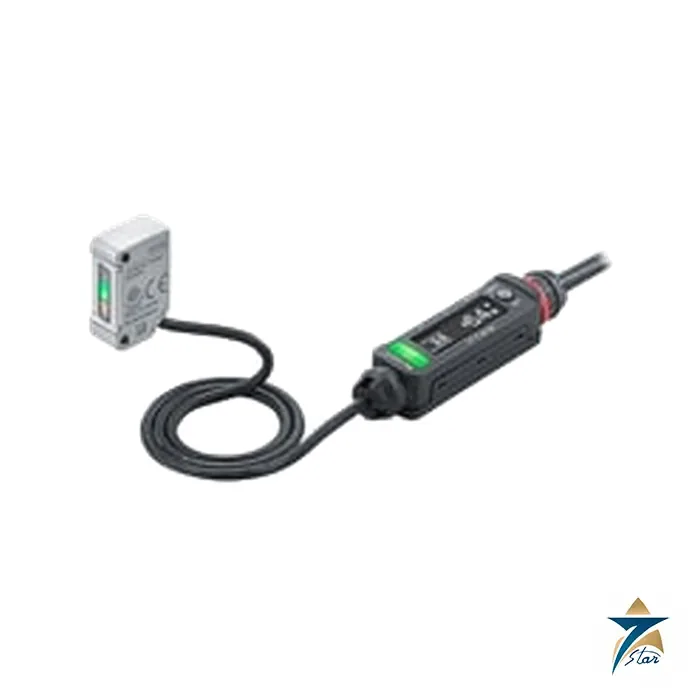
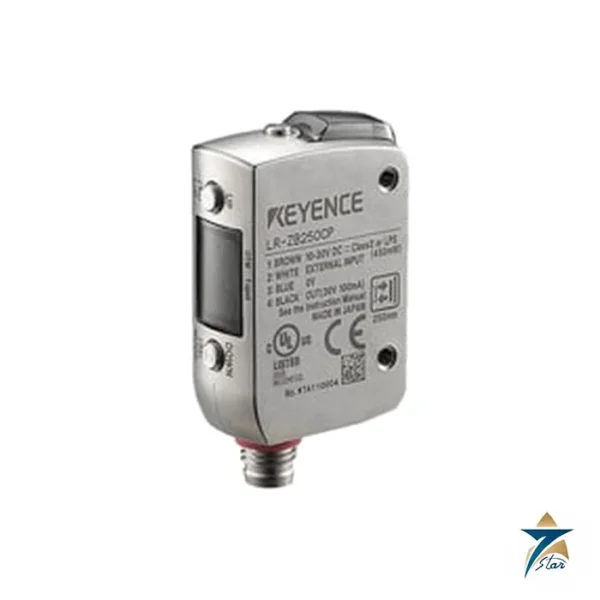
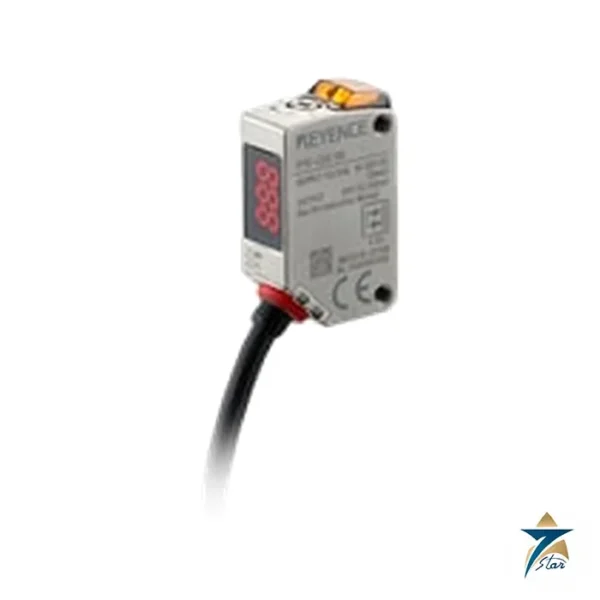
LR-X100 is a Keyence LR-X series product, listed by the maker as: Standard Model, Cable Type, 100mm range. The LR-X series is a compact green-laser distance-based sensor family. It judges position by the angle of the returned spot instead of by brightness, so it can see dark, shiny or coloured targets that confuse conventional reflective photoelectric sensors. Seven Star LLC supplies LR-X100 in Oman and the GCC as an independent supplier in Muscat, not affiliated with the manufacturer.
LR-X marks the compact laser series and 100 the 100 mm range class. The datasheet gives a detecting distance of 25.0 to 100.0 mm for the cable-type standard model.
LR-X100 uses a green laser, which gives a small, sharp spot and good performance on difficult colours. With a standard detectable deviation of 1.0 mm and 0.1 mm display resolution, it can discriminate small height differences at short range, which suits compact machines.
LR-X100 technical specifications
| Parameter |
Specification |
| Manufacturer / part number |
Keyence / LR-X100 |
| Product description |
Standard Model, Cable Type, 100mm range |
| Type |
Cable Type |
| Detecting Distance |
25.0 to 100.0 mm |
| Standard Detectable Deviation |
1.0 mm |
| Display Resolution |
0.1 mm |
| Spot Size |
Approx. 0.3 mm × 2 mm (at a detecting distance of 100 mm ) |
| Response Time |
500 µs /1 ms/3 ms/10 ms/200 ms Selectable |
| Light Source |
Type: Green laser (505 nm) |
| Laser Class |
Class 1 Laser Product (IEC60825-1, FDA (CDRH), Part1040.10 ) |
| IO-Link |
Specification v1.1/COM2 (38.4 kbps) |
| Functions |
Timer Function: Timer OFF/Off-delay/On-delay/One-shot/On-Off delay/On-delay One-shot |
| I/O |
Control Output: NPN open collector/PNP open collector, N.O./N.C selectable. 30 VDC or lower, 50 mA or lower, Residual voltage 2 V or lower |
| External Input |
External Set/Laser OFF/Zero Shift/Hold Reset/Gyro Alert RST selectable Short circuit current – NPN: 1 mA or lower, PNP: 2 mA or lower Input time 3 ms or more ON, 20 ms or more OFF (25 ms or more ON, 25 ms or more OFF when External Set is selected only) |
| Protection Circuit |
Protection against reverse power connection, protection against output overcurrent, protection against output surge, protection against reverse output connection |
| Power supply |
Power voltage: 16 to 30 VDC (including 10% ripple (P-P) or less), class 2 |
| Power consumption |
During normal operation: 970 mW (38 mA or lower at 24 V, 53 mA or lower at 16 V) (Excluding Load Current) ECO ON/ALL: 821 mW (32 mA or lower at 24 V, 44 mA or lower at 16 V) (Excluding Load Current) |
| Environmental resistance |
Enclosure rating: IP65/IP67 (IEC60529) |
| Ambient light |
Incandescent lamp: 16000 lux or less Sunlight: 16000 lux or less |
| Ambient temperature |
-10°C to +50°C (no freezing) |
| Relative humidity |
35 to 85% RH (no condensation) |
| Vibration resistance |
10 to 500 Hz; Power Spectral Density: 0.816 G²/Hz for X, Y and Z axes |
| Shock resistance |
1000 m/s² (100G) 6 times each for X, Y, and Z axes |
| Material |
Head Case: SUS316L; Head Lens Cover: PSU Head Gasket: FKM (lens cover), EVM (cable) Cable: PVC Amplifier Case: PBT; Amplifier Display, Indicator: PAR; Amplifier Gasket: NBR; Button: POM |
| Weight |
Approx. 90 g |
Values in the table are taken from the maker’s model page for LR-X100. Treat them as nominal and confirm the exact conditions in the instruction manual before final design.
How the sensing principle behind LR-X100 works
A distance-based (triangulation) sensor projects a laser spot onto the target and images the reflection on a position-sensitive element. As the target moves nearer or farther, the spot lands in a different place, and the electronics convert that position into a distance. Because the decision depends on position rather than on how much light returns, the colour and gloss of the target matter much less than for intensity-based sensors.
The detectable distance is a window, not a single point, and the table gives the range and the standard detectable deviation for the model. Settings such as response time, hold and zero-shift let you tailor the same hardware to fast presence checks or to slower, steadier height monitoring.
Where LR-X100 fits: related LR-X series parts
LR-X sensors work as standalone switching sensors or, with an IO-Link-capable amplifier, as networked devices. The amplifier-separate head versions pair with the LR-XN amplifier family, while the standard versions carry the amplifier inside the housing.
The LR-X series range includes the following part numbers, which are listed for cross-reference: LR-X50, LR-X100, LR-X250, the C and CG connector versions, LR-XH50, LR-XH100, LR-XH250 and the amplifier units LR-XN11N, LR-XN12N, LR-XN11P, LR-XN12P, LR-XN11C and LR-XN10. Whether a particular combination is compatible should be confirmed from the maker’s documents. Closely related models from the same family that you may also want to compare include LR-XH250.
Selecting LR-X100: ordering checklist
- Detecting distance window versus the real stand-off distance.
- Standard detectable deviation versus the thinnest step you must resolve.
- Cable type versus M8 connector, and the head-only versus built-in amplifier style.
- Output polarity and whether IO-Link is required by your control system.
- Ambient light, mounting orientation and the laser class stated in the table.
- Whether the target is glossy or very dark.
For LR-X100 specifically, confirm the output type, the connection style and the rated distance shown in the table above against the real installation drawing before placing an order.
Installing and maintaining LR-X100
Mount the sensor square to the target and fix the stand-off distance inside the stated window, using the display or an analog check to fine-tune. Keep the laser-warning label legible on the housing and follow the laser class information in the instruction manual.
For maintenance wipe the lens window, make sure the stainless body is not mechanically stressed, and keep a spare of the same range code, because the ranges are not interchangeable. After replacement, re-teach the zero or set-point positions.
Typical applications of LR-X100 in Oman and the GCC
In the GCC these laser sensors are used on packaging lines to check product height, on conveyors to detect dark or glossy parts, and in assembly stations for position verification. Their small spot and fixed distance window make them suitable for tight machine spaces where larger sensors do not fit.
Compact machines with short stand-off distances, such as pick stations and fill-level checks, benefit from the 100 mm class. Extra heat, dust and humidity are normal in the region, so check the ambient temperature and enclosure rows in the table against the real mounting location, including direct sunlight on outdoor skids.
LR-X series models compared with LR-X100
The table lists the LR-X series models in our current range with the maker’s own description, to help you see how LR-X100 differs from its neighbours.
| Model |
Maker description |
| LR-X100 |
Standard Model, Cable Type, 100mm range |
| LR-XH250 |
Separate Amplifier Model, Sensor Head, 250mm range, 2m Cable |
Information to send with your LR-X100 RFQ
- Exact part number: LR-X100 (and quantity, including any matching transmitter, receiver, reflector or head).
- Output polarity required by your PLC input card (NPN or PNP).
- Cable length or connector type and the mounting method.
- Ambient conditions: temperature, washdown, dust and direct sunlight.
- Project reference, delivery location in Oman or the GCC and required lead time.
- Any related items needed, such as brackets, cables, reflectors or a mating amplifier.
Documents and quotation
Send us the part number LR-X100 and we will confirm available documents, including the maker’s datasheet and instruction manual where we can provide them. Prices are quoted per request and are not shown on this page.
Seven Star LLC is an independent supplier in Muscat serving Oman and the GCC. We are not affiliated with the manufacturer, and we quote against your RFQ with delivery and lead time confirmed in the quotation.






















Reviews
There are no reviews yet.