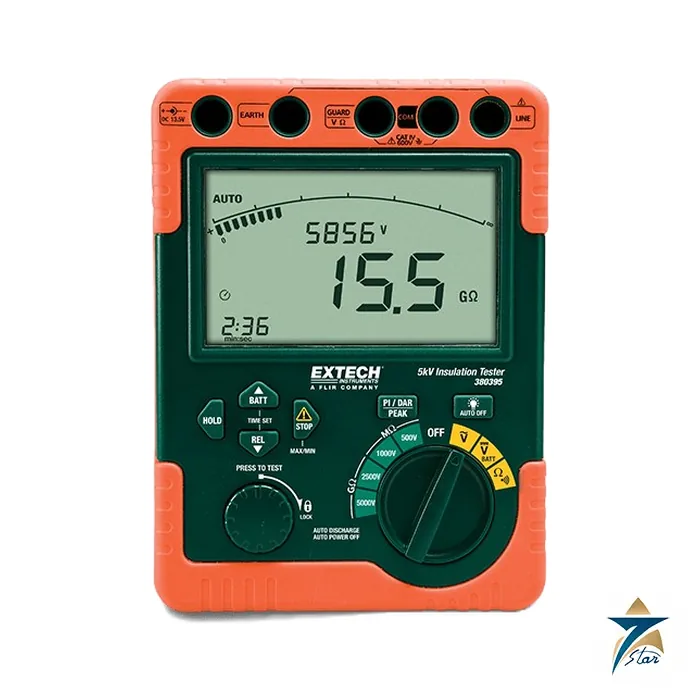
Extech 380395 5 kV digital insulation resistance tester
The Extech 380395 is a battery-powered insulation resistance tester for maintenance engineers who need to prove the condition of motor windings, cables, transformers and switchgear at up to 5 kV. It generates fixed test voltages of 500 V, 1000 V, 2500 V and 5000 V and reads insulation resistance up to 60 GΩ on an auto-ranging 6000-count display with a bargraph and backlight. The 380395 is the 120 V-market version of the model; the 220 V version with a European plug carries the part number 380396.
Beyond the spot reading, the 380395 calculates the polarization index (PI) and the dielectric absorption ratio (DAR), offers a programmable timed test of 1 to 15 minutes, and also works as a basic AC/DC voltmeter to 600 V and a low-resistance and continuity meter. Everything is packed with the leads, eight C cells, an AC adaptor and a heavy-duty carrying case.
Technical specifications of the 380395
| Parameter |
Specification |
| Manufacturer / part number |
Extech / 380395 (120 V version; 380396 is the 220 V European-plug version) |
| Insulation test voltages |
500 V, 1000 V, 2500 V, 5000 V |
| Insulation resistance ranges |
0 to 6 MΩ, 0 to 60 MΩ, 0 to 600 MΩ, 0 to 6 GΩ, 0 to 60 GΩ (auto-ranging) |
| Insulation accuracy |
±2.5% of reading |
| AC/DC voltage |
0 to 600 V, ±1% of reading, with Max/Min, Peak and Relative functions |
| Resistance / continuity |
0 to 600 Ω, ±1.5% of reading; continuity buzzer below 50 Ω |
| Output |
Open-circuit voltage +20%/-0% of the selected setting; rated current 1 to 1.2 mA; short-circuit current above 200 mA |
| Display |
6000-count LCD with analog bargraph and selectable backlight |
| Timer |
1 to 15 minutes in 1-minute steps |
| Safety rating |
IEC 61010-1 and IEC 61010-031, CAT IV 600 V, pollution degree 2 |
| Power |
Eight 1.5 V C cells or 13.5 V, 1 A AC adaptor; fuse 500 mA/600 V ceramic fast-blow |
| Operating conditions |
0 to 40 °C, below 80% RH, up to 2000 m altitude |
| Dimensions / weight |
198 x 148 x 86 mm (7.8 x 5.8 x 3.4 in) / approx. 1.44 kg with batteries |
The accuracy and range figures above come from the datasheet; the output and environmental details come from the user manual.
How the 380395 measures insulation
An insulation test is a simple application of Ohm’s law at high voltage: the 380395 puts a stable DC voltage across the insulation, measures the very small leakage current that flows, and displays the ratio as resistance. The rated current of 1 to 1.2 mA at each voltage step means the instrument can hold its output on healthy insulation but will sag on damaged or wet insulation, which is itself useful information. The instrument drives positive voltage from the EARTH terminal and negative from the LINE terminal, and it refuses to start the test if it sees more than 30 V on the circuit, sounding a warning instead.
Surface leakage across a dirty cable end can hide the true bulk resistance. The tester has a GUARD terminal, and the manual describes winding a bare wire around the cable insulation and connecting it to the guard so the surface current is diverted away from the measuring circuit. After the test, the stored charge in a capacitive load is discharged through the instrument and the falling voltage can be watched on the bargraph.
PI, DAR and timed tests with the 380395
Trending is where a 5 kV tester earns its keep. A single reading depends on temperature and humidity, but time-based ratios largely cancel those effects.
- Polarization index is the resistance after 10 minutes divided by the resistance after 1 minute. The display shows PASS when the ratio is above 1 and FAIL below 1, but the acceptance limit for a machine should come from the applicable standard or the owner’s procedure.
- Dielectric absorption ratio is the 1-minute reading divided by the 30-second reading and gives a quicker answer for equipment that cannot be tested for 10 minutes. An open circuit is flagged as OPEN.
- Timed test lets the operator set 1 to 15 minutes and lock the test, so the technician can record results at fixed times without holding the button.
Where the 380395 fits and related models
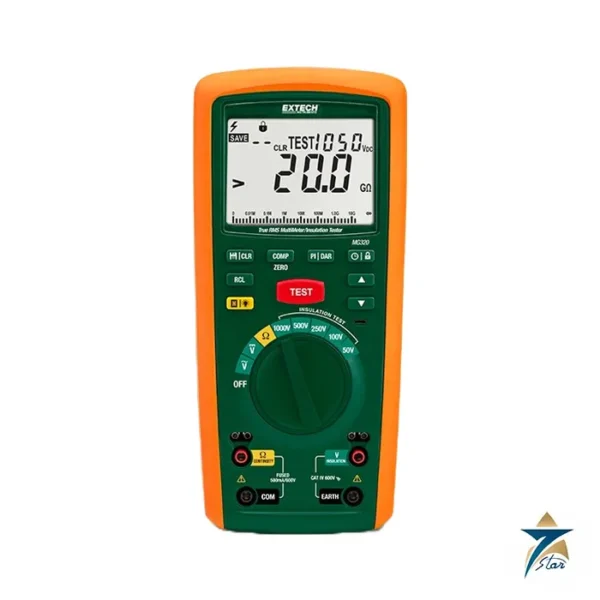
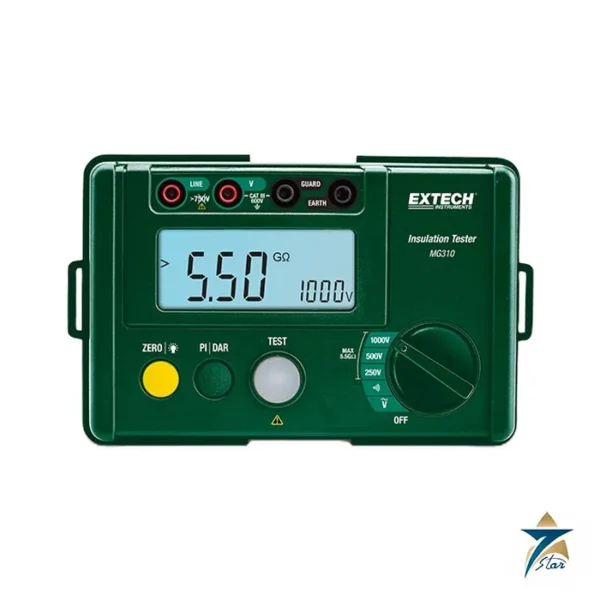
The 380395 sits between compact 1 kV testers such as the Extech MG310 and MG320 and the 10 kV class represented by the Extech MG500. Choose a 1 kV instrument for 400 V and 690 V motors and low-voltage cables; move to the 380395 when you maintain 3.3 kV and 6.6 kV motors, MV cables or generator stator windings where 2500 V or 5000 V test voltages are normal practice. The 220 V version, 380396, is identical in function and is chosen when the supply for the AC adaptor is 220 V with European plug.
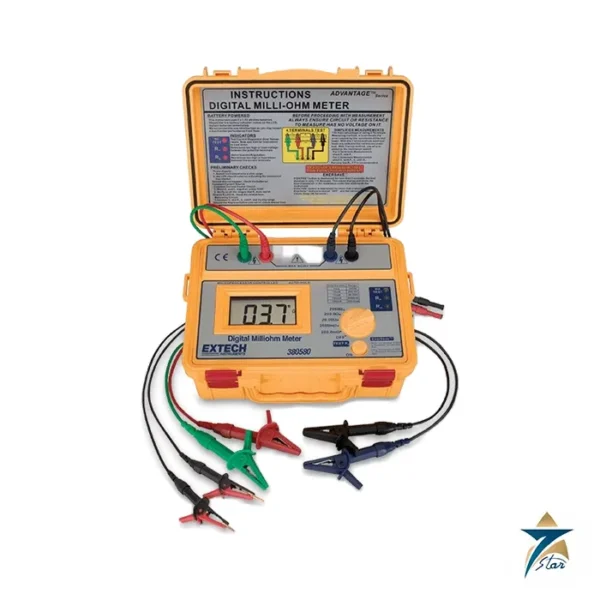
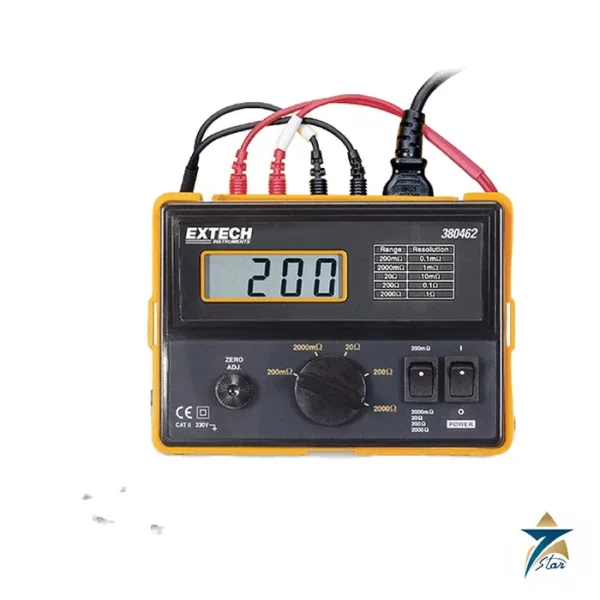
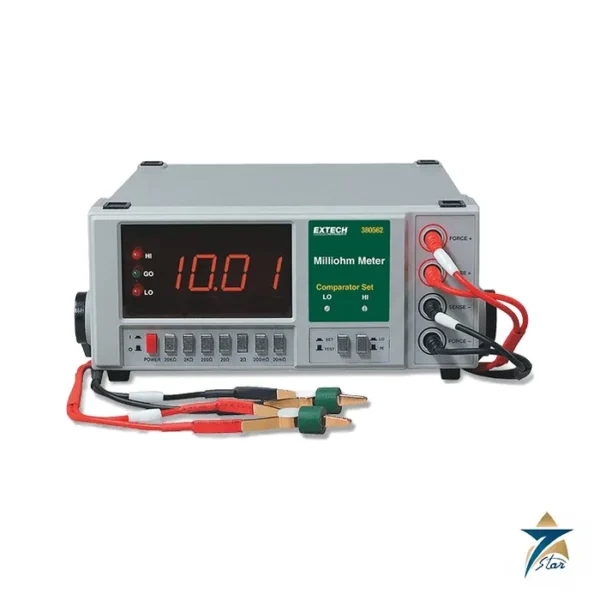
For winding-resistance and bonding checks that need milliohm resolution, pair it with a Kelvin-type milliohm meter such as the Extech 380460 or 380562, because the low-resistance range of an insulation tester is only a continuity aid.
Selection checklist for the 380395
- Match the test voltage to the equipment rating: a common rule of thumb is a test voltage at or above the working voltage, but follow the applicable standard or your plant procedure.
- Confirm that 60 GΩ is enough headroom; for very dry, clean HV insulation you may need a higher-range instrument.
- Decide whether PI and DAR trending, a timed test, and a voltmeter function are needed in one case.
- Check the supply: the 380395 is the 120 V adaptor version, 380396 is the 220 V version.
- Consider consumables: eight C cells for field work and spare test-lead sets for heavy-use teams.
Safe use, commissioning and maintenance of the 380395
This tester can output up to 5 kV, so the usual safety discipline applies. De-energize and lock out the equipment, verify it is dead, wear insulated gloves, keep fingers behind the lead guards, and never touch the circuit during or immediately after a test. The manual notes that the circuit must be allowed to discharge fully while the leads stay connected.
- Inspect the leads and the case before every job and replace damaged leads with the supplied type.
- Connect the black lead to EARTH and the red lead to LINE, select the voltage, then press and hold the PRESS TO TEST knob or turn it to the lock position.
- Use the battery check position before travelling to site; a reading of 12 V or more indicates healthy cells.
- Wipe the case with a damp cloth and mild detergent only, keep the terminals clean and dry, and remove the batteries for long storage.
- Have calibration and repair carried out by qualified personnel only.
Typical applications of the 380395 in Oman and the GCC
In oil and gas facilities and petrochemical plants, 3.3 kV and 6.6 kV pump and compressor motors are tested at shutdowns, and trending PI values from one outage to the next shows whether windings are drying out or absorbing moisture. Power stations and substations use the 2500 V and 5000 V steps on cables, bushings and transformer windings. In desalination plants, high humidity and salt-laden air make cable terminations prone to surface leakage, which is where the guard terminal helps. Coastal heat and dust mean the instrument should be kept in its case between jobs and allowed to reach ambient temperature before use.
Insulation tester comparison around the 380395
| Model |
Test voltages |
Maximum range |
Typical use |
| Extech MG310 |
250/500/1000 V |
5.5 GΩ |
Compact 1 kV tester with PI/DAR |
| Extech MG320 |
50 to 1000 V |
20 GΩ |
1 kV tester with true RMS multimeter, comparator and logging |
| Extech 380395 |
500/1000/2500/5000 V |
60 GΩ |
5 kV tester, PI/DAR, timer, voltmeter |
| Extech MG500 |
500 V to 10 kV |
500 GΩ |
10 kV tester for large machines and HV cable |
Information to send with an RFQ for the 380395
- Part number 380395 and the required quantity
- Voltage class of the equipment to be tested and the standard or procedure you follow
- Supply version required: 120 V adaptor (380395) or 220 V European plug (380396)
- Spare leads, batteries or a calibration certificate if needed
- Delivery location in Oman or the GCC and the required lead time
- Whether calibration documentation or a traceable calibration certificate is required
Documents and quotation
A datasheet for the Extech 380395 is attached on this page. It lists the test voltages, ranges and accuracy; the user manual covers the PI and DAR procedures.
Send us the part number 380395, the quantity and the delivery location in Oman or the GCC, and we will reply with availability and a quotation. Seven Star LLC is an independent supplier in Muscat and is not affiliated with the manufacturer.
Other Models in the Extech Insulation Testers Range
Seven Star LLC supplies models from the Extech Insulation Testers range in Oman and the GCC. Compare the related models below and request a quote for the one that matches your application.























Reviews
There are no reviews yet.