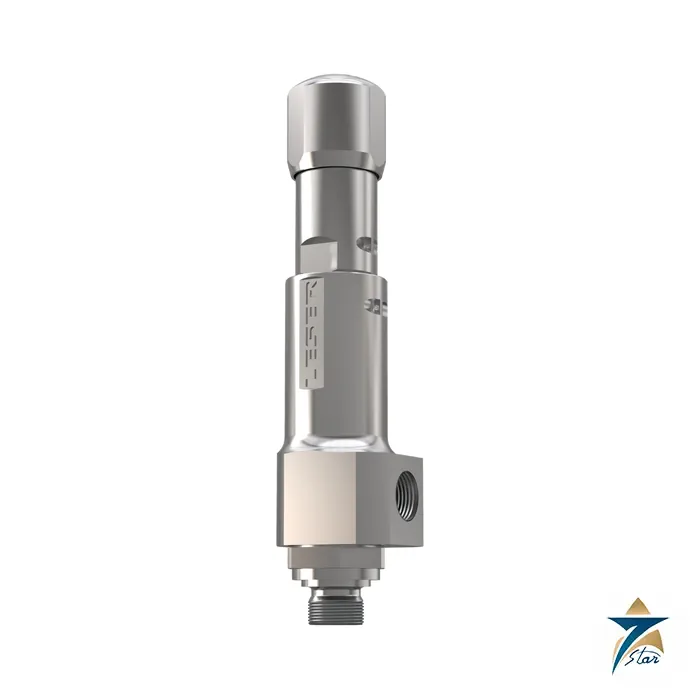
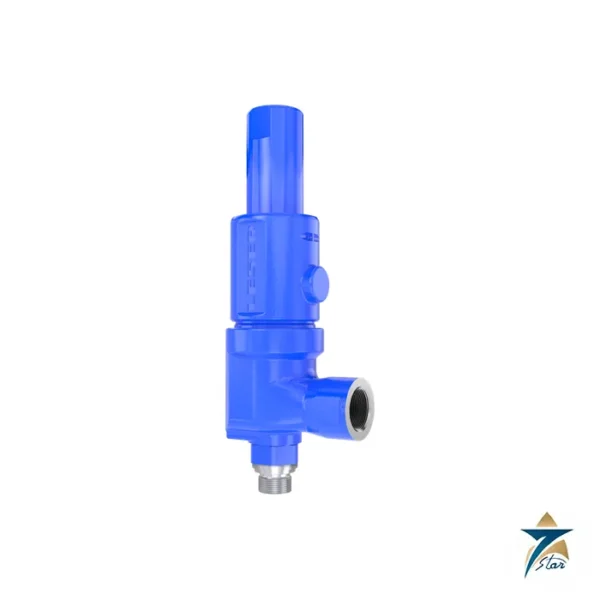
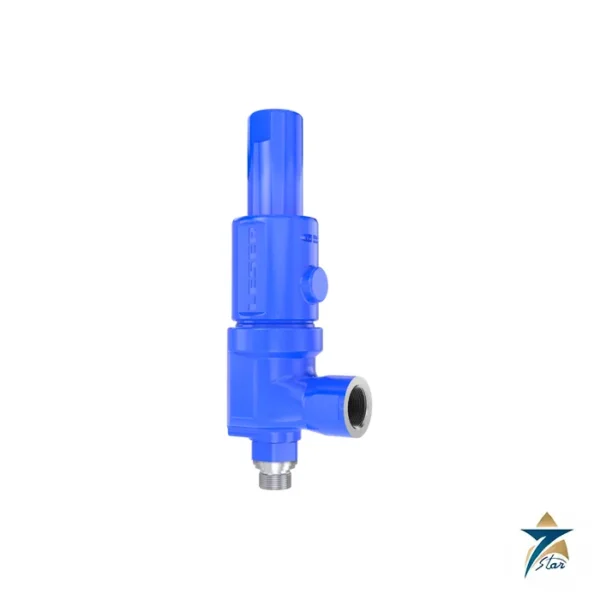
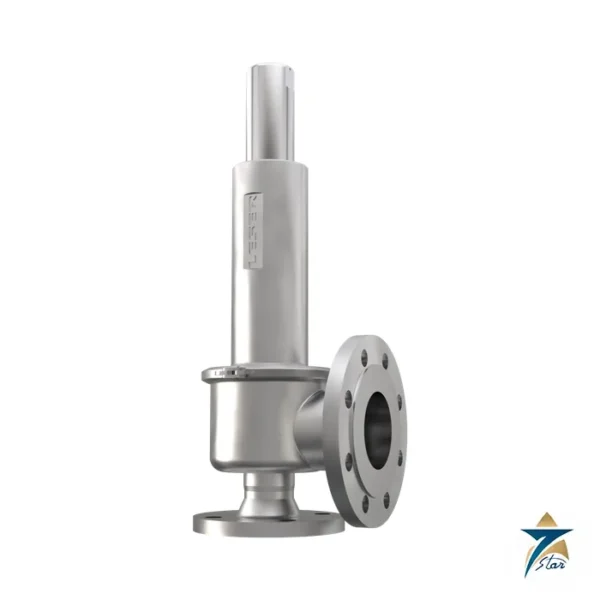
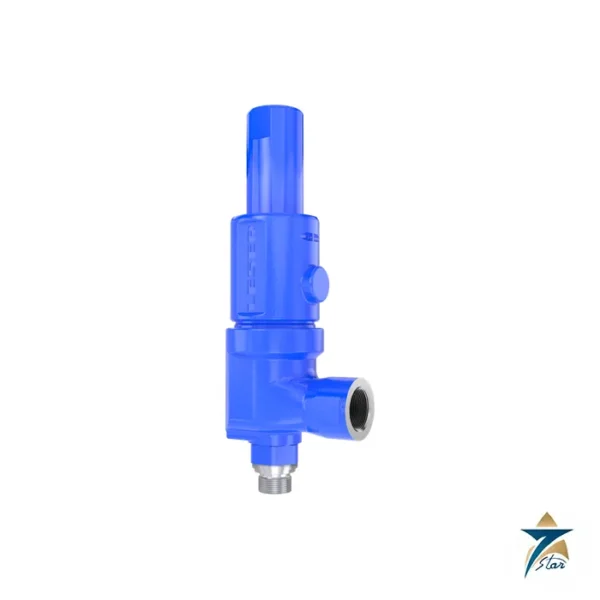
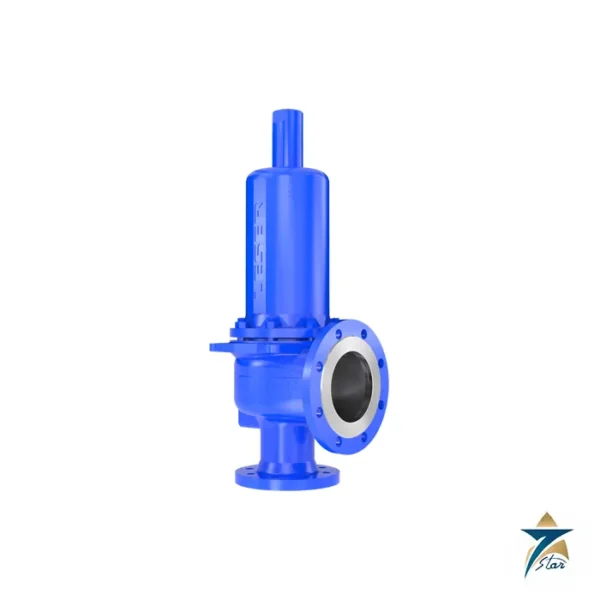
LESER Type 438 O-ring disc safety valve for small capacities
The LESER Type 438 is a spring-loaded safety relief valve from the Compact Performance range, built for small relief capacities where the valve must stay tight close to its set pressure. Its distinguishing feature is a disc that carries a soft-seal O-ring, which gives better tightness than a plain metal-to-metal seat. Seven Star LLC supplies the Type 438 in Oman and the GCC as an independent supplier in Muscat, and this page explains what the type designation means, how the valve is built and what an enquiry needs to contain.
The valve has an actual orifice of 10 mm, which is an area of 78.5 mm² (0.394 in. and 0.122 in²). The set pressure window is wide for a small valve, from 5 barg up to 180 barg (72.5 to 2,611 psig), and it is covered by two body designs: the conventional design and a long version. Threaded connections in G, Rc/R or NPT as well as flanged connections to DIN and ASME are available, and the vessel side can be male or female thread.
| Parameter |
Specification |
| Manufacturer / part number |
LESER Type 438 (article series 4383 and 4384) |
| Product line |
Compact Performance, spring-loaded, small capacity |
| Seat design |
Disc with soft-seal O-ring (NBR, CR, EPDM, FKM or FFKM) |
| Actual orifice |
d0 = 10 mm; A0 = 78.5 mm² (0.394 in.; 0.122 in²) |
| Set pressure, conventional design |
5 to 93 barg (72.5 to 1,349 psig) with 1.4104 body; 5 to 68 barg (72.5 to 986 psig) with 1.4404 / 316L body |
| Set pressure, long version |
93 to 180 barg (1,349 to 2,611 psig) with 1.4104 body; 68 to 180 barg (986 to 2,611 psig) with 1.4404 / 316L body |
| Temperature range |
−45 to +150 °C (−49 to +302 °F), limited by the soft-seal material; the catalogue values apply to EPDM |
| Body materials |
Type 4383: 1.4104 (430) or 1.4404; Type 4384: 1.4404 (316L) |
| Cap and lifting options |
Cap H2, pull button H3 (4383 only), packed lifting knob H4 |
| Net weight (threaded) |
1.2 to 2.1 kg depending on connection size and version |
Reading the Type 438 designation and the two body materials
Within the Type 438 family the fourth digit separates the body material. Type 4383 uses a chrome-steel body (1.4104, grade 430) and is the economical choice, but LESER states that it should not be chosen when a stainless-steel valve is demanded by the process medium. Type 4384 uses 1.4404 (316L) throughout the pressure-bearing parts and is the version to specify for corrosive or hygienic duty. The spindle, spring plate and adjusting screw follow the same logic: chrome or 420-grade parts on 4383, 316L parts on 4384.
The disc itself is stainless steel (1.4404 / SA 479 316L) and holds the soft-seal O-ring. The O-ring is selected by a letter code: N for NBR, K for chloroprene (CR), D for EPDM, L for FKM and C for FFKM. In the article tables these codes correspond to option numbers J30, J21, J22, J23 and J20. For long-version valves above 120 barg, and for FFKM above 40 barg, the catalogue calls for a 90 Shore O-ring.
Conventional design and long version
The conventional design is the compact standard. The long version adds a taller body with an axial needle bearing on the spring plate, which helps the adjusting screw and spring carry the higher spring load needed at set pressures above 93 barg (68 barg in 316L). Because the spring is stronger, installation height grows by about 20 mm, from roughly 209 to 230 mm for a G1/2 inlet in the metric tables.
How the O-ring disc seat works
In a conventional metal-seat valve the leakage rate rises as operating pressure approaches the set pressure, because the spring force and the pressure under the disc become nearly equal. The Type 438 seals with an elastomer ring that is compressed against the nozzle edge. The ring deforms to follow small imperfections on the sealing surface, so the valve can hold bubble-tight conditions at a higher percentage of the set pressure. At the set pressure the disc lifts and the O-ring is released from the seat; as the pressure falls the spring pushes the disc back and the ring reseats.
This makes the type attractive for expensive, toxic or hazardous media, and for systems where a persistent weep would trigger alarms in the vent line. The trade-off is the temperature limit: the elastomer, not the steel, decides how hot the valve can be, and compatibility with the process fluid must be checked material by material.
- Gas, steam and liquid service are all covered by the certified capacity data.
- Soft-seal valves should not be treated as a substitute for correct sizing; capacity is still based on the certified coefficient of discharge.
- After a lift, the O-ring and nozzle should be inspected before the valve is returned to service.
Certified capacity and approvals for Type 438
The catalogue lists the following discharge coefficients for the 10 mm orifice. Under PED and EN ISO 4126-1 the coefficient Kdr is 0.40 for steam and gas and 0.33 for liquid; the AD 2000-Merkblatt A2 values are identical. Under ASME Section VIII Division 1 the original rated slopes are 2.55 lb/hr/psia for steam, 0.904 SCFM/psia for gas and 1.49 GPM√psid for liquid, equivalent to K of about 0.406 for steam and gas and 0.322 for liquid.
| Approval |
Coefficient / note |
| EN ISO 4126-1 / PED |
Kdr 0.40 (steam, gas); 0.33 (liquid) |
| AD 2000-Merkblatt A2 |
αw 0.40 (steam, gas); 0.33 (liquid) |
| ASME Sec. VIII Div. 1 |
K 0.406 (steam, gas); 0.322 (liquid), from rated slopes |
| Other approvals listed |
CRN (Canada), AQSIQ (China), EAC (Eurasian Customs Union) |
| Marine classification societies listed |
BV, DNV GL, Lloyd’s Register EMEA, RINA, U.S. Coast Guard |
The approval numbers on the certificate change over time, so the number that applies to the valve you receive must be taken from the current certificate rather than from a catalogue.
Connections, dimensions and installation of the Type 438
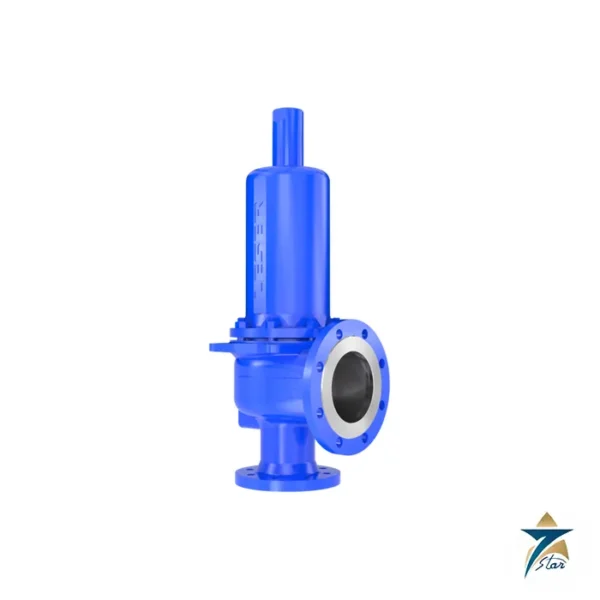
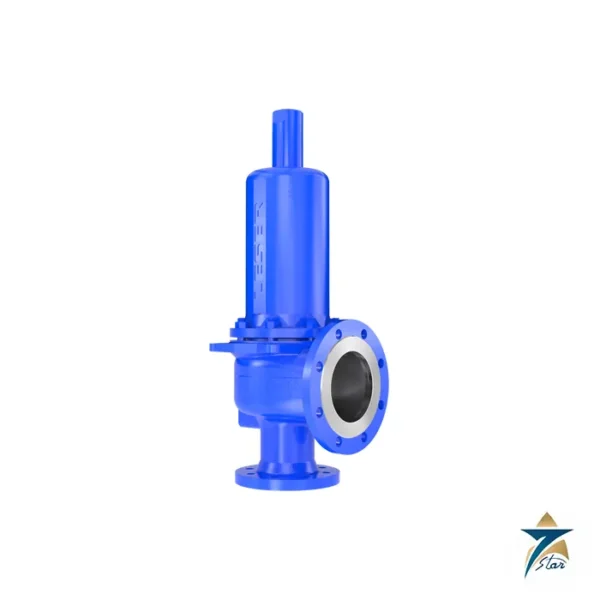
Threaded valves are offered with inlet threads of 3/8 in., 1/2 in., 3/4 in. and 1 in. (G, R or NPT; the female inlet series starts at 1/2 in.). In the conventional design the center-to-face dimension on the inlet is 46 mm for the 1/2 in. female thread and 56 mm for 3/4 in. and 1 in., while the outlet is 30 mm or 37 mm depending on the outlet body size. Net weight runs from 1.2 kg to 2.1 kg for threaded versions. Flanged versions use an inlet flange and an outlet flange, with DIN EN 1092-1 and ASME B16.5 ratings.
Install the valve vertically with the spindle upright, on a short inlet line whose pressure loss stays below the usual 3 percent guideline. The outlet needs a discharge line sized so that back pressure stays inside what the type and your set pressure allow. For liquid or toxic media, route the outlet to a safe collection point rather than into the atmosphere. Allow clearance above the cap for the lifting device and, for the long version, the extra height.
Selection checklist for a Type 438 safety valve
- Required relieving capacity and the medium (steam, gas or liquid) at relieving conditions.
- Set pressure and allowable overpressure, so you can confirm the 4383 or 4384 pressure window and whether the long version is needed.
- Body material: 1.4104 only for non-corrosive service, 1.4404 for stainless duty.
- O-ring material code (N, K, D, L or C) against the medium and the maximum temperature.
- Inlet and outlet connection: thread standard and size, or flange standard and rating.
- Cap or lifting device: H2 cap, H3 pull button or H4 packed lifting knob.
- Back pressure, if the outlet is not discharging to atmosphere.
- Documents needed with the delivery: test certificate type and any marine or regional approval.
Leaving the O-ring code out of an enquiry is the most common reason a quotation needs to be revised, because the seat seal sets both the temperature limit and the chemical resistance.
Applications in Oman and the GCC
A 10 mm orifice valve with a wide set-pressure window finds work wherever a small capacity must be protected: skid-mounted gas conditioning, instrument air receivers, hydraulic and lube-oil circuits, sample conditioning cabinets, thermal expansion protection on liquid lines and chemical injection packages. In the oil and gas sector this means wellhead and pipeline chemical dosing skids, and in power and desalination plants it means dosing, compressed-air and utility lines. The 316L version is the sensible choice near the coast, where humid salt-laden air attacks plain chrome steel, and the O-ring option lets the same valve be adapted to hydrocarbons, water or amine-type dosing chemicals.
High ambient temperatures in the Gulf do not usually threaten the steel, but they do raise the temperature of exposed small valves and of the fluid in sun-heated lines, so the elastomer rating should be checked against the real maximum, not the design average.
Related LESER Compact Performance types
The Type 437 shares the same orifice and threaded or flanged body concept but uses a metal seat, which suits higher temperatures. Type 439 uses a vulcanized soft seal on the disc for low set pressures, and the Type 459 and Type 462 cover medium capacities with metal seat and O-ring seat respectively. The high-pressure HDD variants of the 459 and 462 extend into the 250 to 850 barg and 250 to 350 barg ranges. Choosing between 437, 438 and 439 is mostly a question of set pressure, temperature and the tightness required.
| Type |
Distinguishing feature |
| Type 437 |
Metal seat, set pressure 0.1 to 365 bar |
| Type 438 |
O-ring disc, set pressure 5 to 180 bar |
| Type 439 |
Vulcanized soft seal, set pressure 0.1 to 16 bar |
| Type 459 / 462 |
Medium capacity, metal seat or O-ring disc |
Information to send with a Type 438 RFQ
- Medium, state (gas, steam, liquid), molecular weight or density, and operating and relieving temperature.
- Required capacity and the standard it must be calculated to (EN ISO 4126 or ASME VIII).
- Set pressure, back pressure and whether it is constant or superimposed.
- Body material, O-ring code, connection types and cap option.
- Quantity, delivery site and required certificates.
Documents and quotation
A LESER Compact Performance catalogue covering the Type 438 is attached to this page and gives the full dimension and article-number tables referred to above. Please send the data from the checklist and we will confirm the exact article, lead time and documents to match your set pressure and medium.



























Reviews
There are no reviews yet.