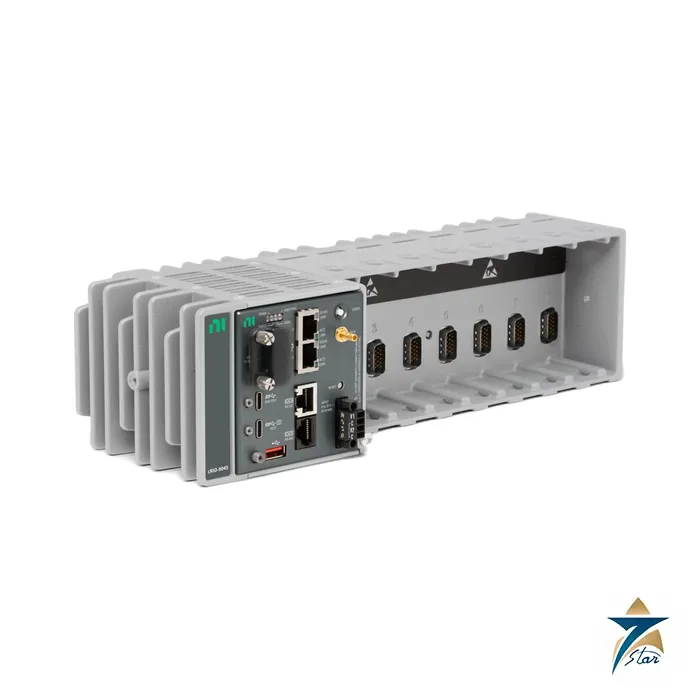
cRIO-9045 CompactRIO controller with 8 slots and Kintex-7 FPGA
The National Instruments cRIO-9045 is a CompactRIO controller that combines a real-time processor, a reconfigurable FPGA and an 8-slot chassis for C Series I/O modules in one unit. It uses a 1.30 GHz dual-core Intel Atom processor and a Kintex-7 70T FPGA, with 2 GB of DRAM and 4 GB of storage. An SD card slot is provided for data logging.
The part number follows NI’s controller naming and has no code that needs decoding: cRIO identifies the CompactRIO family and 9045 the model. Programming uses LabVIEW with the Real-Time and FPGA modules, together with NI-DAQmx for some measurement tasks.
cRIO-9045 technical specifications
| Parameter |
Specification |
| Manufacturer / part number |
National Instruments cRIO-9045 |
| Processor |
1.30 GHz dual-core Intel Atom |
| FPGA |
Kintex-7 70T, programmable with the LabVIEW FPGA Module |
| Memory |
2 GB DRAM; 4 GB storage |
| Removable storage |
SD card slot for data logging |
| I/O slots |
8 C Series module slots |
| Network |
Two Gigabit Ethernet ports; TSN support (IEEE 802.1AS hardware synchronization) |
| Serial and USB |
RS232, RS485, USB 3.1, USB 2.0 |
| Vision |
GigE Vision supported |
| Operating temperature |
−20 °C to 55 °C |
| Software |
LabVIEW Professional, LabVIEW Real-Time Module, LabVIEW FPGA Module; NI-DAQmx |
How the cRIO-9045 architecture works
A CompactRIO system divides tasks among three layers. The Intel Atom processor runs the real-time operating system and handles supervisory logic, communications, file logging and network services. The Kintex-7 FPGA sits between the processor and the I/O slots and executes custom logic at hardware speed, which is useful for deterministic control loops, high-speed triggering, custom protocols and pulse generation. The C Series modules condition and convert the field signals.
The controller supports time-sensitive networking, so multiple devices on a TSN-enabled network can share a common time base through IEEE 802.1AS hardware synchronization. This matters for distributed measurement and motion applications where timestamps must align across nodes.
Connectivity and storage
Two Gigabit Ethernet ports let you separate an I/O or fieldbus network from a supervisory network. RS232 and RS485 ports allow direct connection to serial instruments such as meters and analysers. The SD card slot supports local logging that continues if the network is interrupted, which is practical for unattended sites.
Real-time versus FPGA programming
Decide early which functions belong on the processor and which on the FPGA. Supervisory logic, alarm handling, communications and data storage fit the real-time side, where development is quicker and libraries are plentiful. Tight loops, fast event capture and custom timing belong on the FPGA, where compile times are longer but behaviour is deterministic. Keeping the split clear makes commissioning, testing and later modification much easier for the team that maintains the system.
Choosing modules for the cRIO-9045 chassis
All eight slots accept C Series modules, so typical configurations mix analogue inputs, thermocouple inputs, digital inputs and outputs, and analogue outputs. Examples already common on projects are the NI-9208 for current inputs, the NI-9213 for thermocouples, the NI-9472 for sourcing digital outputs and the NI-9265 for current outputs.
When planning slot allocation, group modules by signal type and keep sensitive analogue modules away from noisy digital outputs if the layout allows. Check the manufacturer’s module specifications for any restrictions on the chassis or on specific slots, and for power budget.
Selecting and ordering the cRIO-9045
- Count the I/O points and confirm they fit in eight slots with spare capacity.
- Decide the software licences needed: LabVIEW Professional, Real-Time Module and FPGA Module.
- Confirm the operating temperature and cabinet ventilation against the −20 °C to 55 °C range.
- Plan network layout, TSN needs and the use of RS485 or RS232 devices.
- Specify the power supply and mounting accessories; the manufacturer lists the IEC power cord accessories separately.
Installation and maintenance of the cRIO-9045
Mount the controller in a ventilated cabinet with the clearance the manufacturer specifies, and fit modules while the chassis is powered down unless the module documentation says otherwise. Label each slot and record the module serial numbers for spares planning. After first power-up, install the matching real-time operating system and driver versions, then deploy the application.
Back up the application and configuration files on a regular schedule. Use the SD card for local logs and rotate files so the card does not fill up. When replacing a controller, keep the same software versions to avoid compatibility issues.
Typical applications of the cRIO-9045 in Oman and the GCC
A controller of this class is used for condition-monitoring, machine control, test stands, power-system monitoring and skid-mounted control packages. In Oman and the GCC it is found in laboratories, research and university facilities, equipment manufacturers’ test benches, and oil and gas or utility sites where a flexible monitoring and control unit is needed. The wide operating temperature range helps in non-air-conditioned equipment rooms, but keep the unit out of direct sun and heat sources.
Seven Star LLC supplies National Instruments hardware in Oman and the GCC as an independent supplier in Muscat.
cRIO-9045 in the C Series ecosystem
| Module |
Function |
Typical use with the controller |
| NI-9208 |
16-channel current input |
4-20 mA transmitters |
| NI-9213 |
16-channel thermocouple input |
Temperature monitoring |
| NI-9472 |
8-channel sourcing digital output |
Relays and indicators |
| NI-9265 |
4-channel current output |
Valve and drive references |
Information to send with an RFQ for the cRIO-9045
- Quantity and any required accessories such as power cords.
- List of C Series modules to be installed.
- Software licences and versions required.
- Network and serial devices to be connected.
- Delivery location and timeline.
Related National Instruments products: NI cRIO-9053 CompactRIO Real-Time Controller and National Instruments cRIO-9035 CompactRIO Controller.
Documents and quotation
Send us the part number cRIO-9045 and we will confirm which documents are available and the delivery position.
The manufacturer lists a certifications resource separately; we do not state approvals here, so please ask for the document that applies to your project.
























Reviews
There are no reviews yet.