Compact automated closed-cup flash point with a touch screen
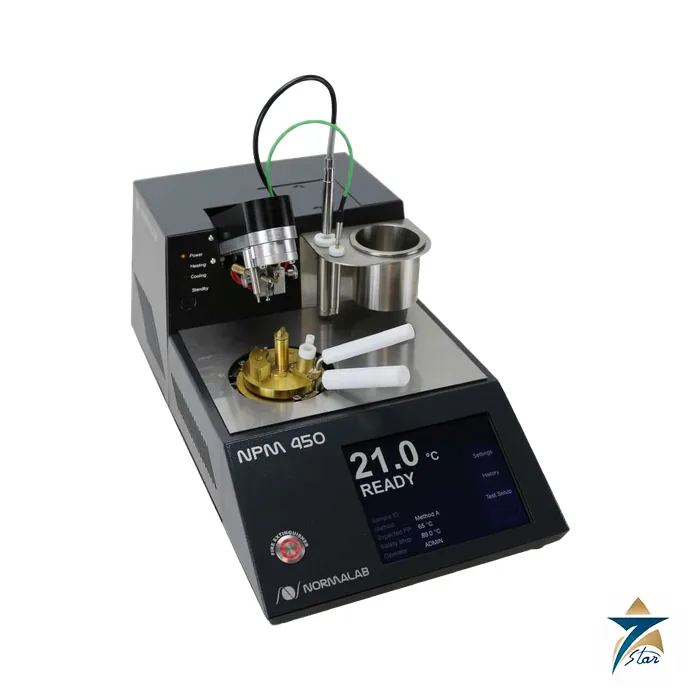
The Normalab NPM 450 is an automated Pensky-Martens closed-cup flash point tester. Normalab calls it an efficient and compact unit: the sample cup, probe and thermocouple holder stand sit under a 6.4 inch capacitive touch screen, and the instrument can be operated with one hand. It combines electric and gas ignition in one system, relights the gas flame automatically if it is blown out, and detects the flash with a thermocouple, which makes it suitable for the heavier and viscous samples that need pre-heating and stirring before the test starts.
Technical specifications
| Parameter |
Specification |
| Manufacturer / model |
Normalab NPM 450 |
| Order number |
60400 |
| Flash point range |
0 to 410 °C |
| Heating rate |
0 to 15 °C/min |
| Safety stop |
0 to 30 °C above the expected flash point |
| Stirring speed |
50 to 300 RPM (± 3 RPM) |
| Ignition |
Electric and gas; electric ignition regulated and monitored |
| Flash detection |
Thermocouple |
| Cooling |
Integrated forced air; rapid cooling of the heating block by air turbine |
| Fire detection |
Ionization; illuminated extinguisher push button |
| Automatic fire extinguisher |
Integrated, nitrogen network or optional bottle |
| Connectivity |
4 USB, 1 RS232C or LIMS, 2 LAN, 1 VGA |
| Software and storage |
Windows 8 operating system; 32 GB SSD; reports to PDF, e-mail, LIMS, Excel, Word |
| Power, size, weight |
AC 110/240 V, 50/60 Hz, 4 A; 260 x 460 x 185 mm; 12 kg |
| Utilities |
Propane/butane 20 to 40 mbar; nitrogen 4 to 12 bar |
Standards, methods and safety
The brochure cites ASTM D93, IP 34, ISO 2719, NF M07019, DIN 51758 and GBT 261, covering petroleum products from 40 to 370 °C and biodiesel from 60 to 190 °C. The product page also lists ASTM D8175, ISO 15267 and ISO 2719. Standard methods A, B and C are built in, methods are user programmable, barometric correction is integrated and the unit offers heavy-sample preheating with automatic stirring start.
Protection includes gas flame detection, over-temperature protection, a built-in gas leak detector and hydrocarbon detection. An automatic nitrogen extinguisher is available as an option, smothering a fire by reducing the oxygen content around the cup. Access levels for operator, supervisor and maintenance can be set in the software, and results can be exported over USB, LIMS, PDF or e-mail.
Delivery contents and ordering
The unit is delivered with a cup (P/N 40346) and lid (60447), a Pt 100 probe (60453), a detection thermocouple cable (60448) and an electric ignitor (60480). A ticket printer and the automatic nitrogen extinguisher are listed options. The thermocouple cable is also stocked as a separate item: see the Normalab 60448 thermal detection thermocouple.
In a Pensky-Martens test the sample is heated in a closed brass cup at a controlled rate while it is stirred, and an ignition source is dipped into the vapour space at set temperature intervals. The flash point is the lowest cup temperature at which the vapour ignites, corrected to standard barometric pressure. Heavy and viscous samples are tested with preheating and automatic stirring start so that the specimen is homogeneous when the test begins. The three methods (A, B and C) differ in sample type, heating rate and stirring, so the chosen method must match the product specification.
Key features of the NPM 450
- Dual ignition in one instrument: laboratories can switch between electric and gas ignition depending on the method or customer requirement, without a second tester.
- Automatic gas relight: if the pilot flame is extinguished, it is relit automatically, which avoids interrupted tests.
- Thermocouple flash detection: the flash is detected objectively by temperature rise rather than by operator observation, improving repeatability between operators.
- Fast cooling: the air turbine cools the heating block quickly between tests, which raises the number of samples a laboratory can run per shift.
- Layered safety: ionization fire detection, gas leak and hydrocarbon detection, over-temperature protection and the optional nitrogen extinguisher reduce risk in unattended operation.
- Data handling: results can be stored on the SSD and exported to LIMS, PDF, e-mail or office formats, supporting traceable reporting.
Choosing the right method
Method A of ASTM D93 is used for distillate fuels, new and in-use lubricating oils and other homogeneous petroleum liquids. Method B covers residual fuel oils, cutback residua, used lubricating oils and liquids that tend to form a surface film or contain suspended solids; it uses a lower stirring speed. Method C applies to biodiesel. The correct method is normally stated in the product specification or the contract, so check it before testing. When a sample is expected to have a low flash point, the expected value entered in the software controls when ignition attempts start, and an accurate estimate saves time while keeping the test within the standard.
Installation and laboratory setup
- Place the instrument in a draft-free location, preferably in a fume hood or ventilated bench, because drafts can affect the flame and the flash detection.
- Connect propane or butane at 20 to 40 mbar for gas ignition, and nitrogen at 4 to 12 bar if the network extinguisher is used.
- Connect the instrument to a properly earthed mains supply within its rated voltage range.
- Clean the cup, lid and stirrer after each test to remove residues that can bias the next result.
- Verify performance regularly with a certified reference material and record the results as part of the laboratory quality system.
Use in Oman and GCC laboratories
Flash point testing is a routine requirement in refinery, terminal, marine fuel, power plant and lubricant laboratories across the GCC. Fuel oils and residual fuels handled in the region often need Method B, while diesel, jet fuel blending components and biodiesel blends use Methods A and C. High laboratory temperatures can affect low flash point samples, so samples should be stored cool and kept closed until testing, in line with the standard. A stable gas supply and the nitrogen extinguisher option are particularly useful where testing runs over long shifts.
What to include in your RFQ
- Order number 60400 and the quantity required
- Methods and standards you need to run, including biodiesel if relevant
- Whether gas ignition, the nitrogen extinguisher option or the ticket printer are needed
- Spare parts such as additional cups, lids, probes or thermocouple cables
- Mains voltage, plug type and any requirement for installation or training
Documents and quotation
The Normalab brochure is linked here. Seven Star LLC, an independent supplier in Muscat, quotes it with its liquid analytical systems range. Before ordering, confirm the gas supply pressure, the nitrogen connection or bottle, the mains plug type and the methods (A, B, C or biodiesel) you will run.








Reviews
There are no reviews yet.