A two-stage regulator for steady delivery pressure
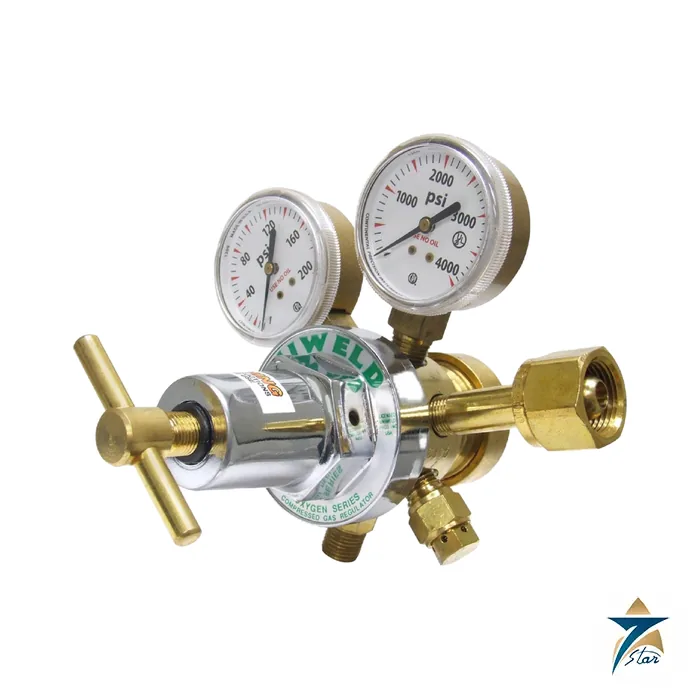
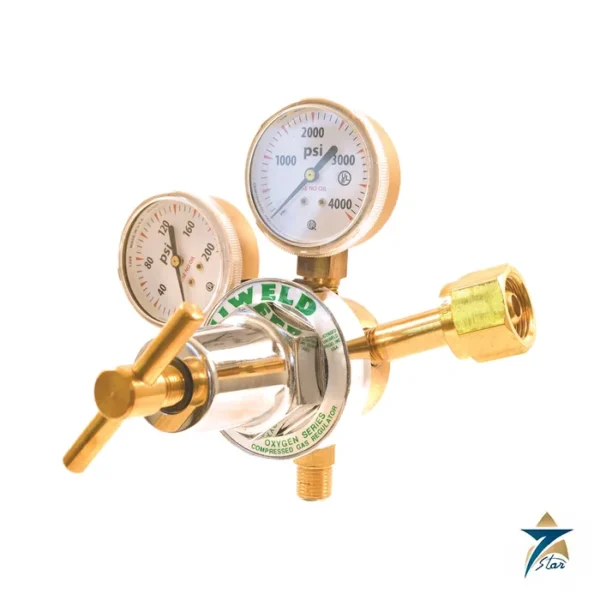
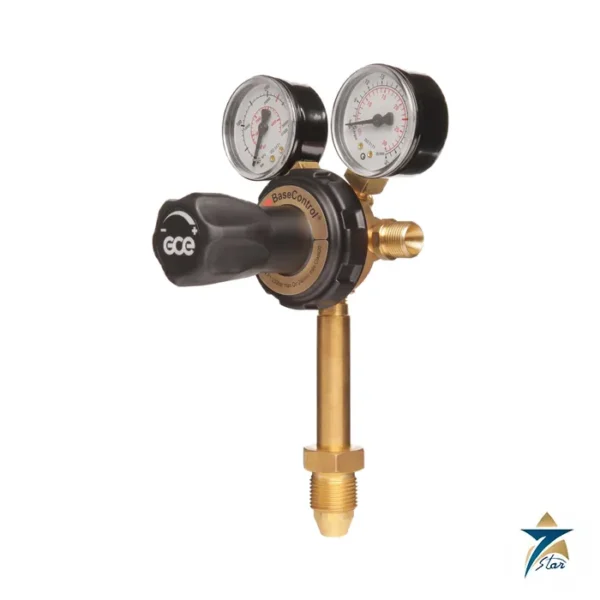
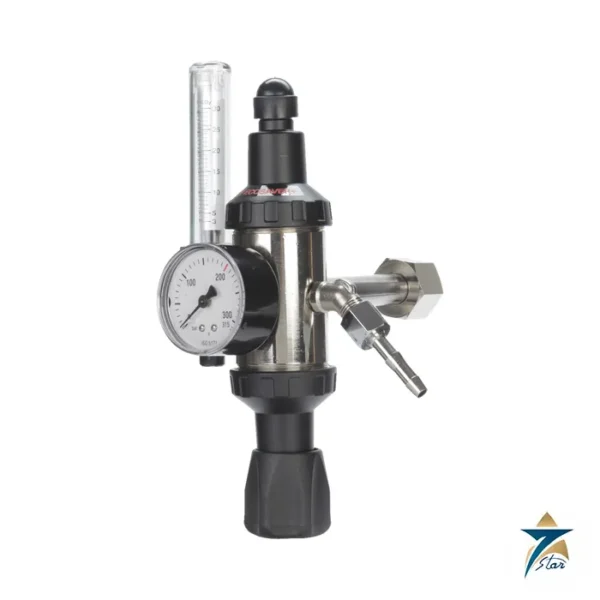
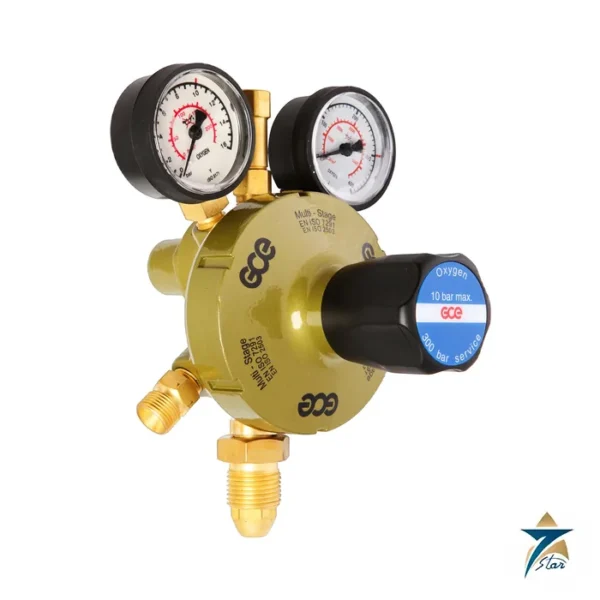
The Uniweld RHT80 series is the two-stage version of the line, for work where delivery pressure must stay steady as cylinder pressure falls. Uniweld says delivery pressure remains constant until the cylinder is nearly depleted. The RHT8010 series has a machined brass body, a polished chrome bonnet, easy-to-read 2 in single-scale gauges, a 1 5/8 in tri-layered reinforced neoprene diaphragm in the first stage and a 2 in diaphragm in the second stage.
A heavy-duty mechanical stem-type seat and nozzle assembly and a Delrin bushing give smooth flow adjustment. A porous metal inlet filter (except CO2 models) and a fine mesh screen protect the seat. Other pressure scales and inlet connections are available on request.
Technical specifications
| Parameter |
Specification |
| Manufacturer / series |
Uniweld / RHT80 series (RHT8010), two stage |
| Body |
Machined brass |
| Bonnet |
Polished chrome |
| Gauges |
2 in single-scale gauges |
| First-stage diaphragm |
1 5/8 in tri-layered reinforced neoprene |
| Second-stage diaphragm |
2 in tri-layered reinforced neoprene |
| Seat and nozzle |
Heavy-duty mechanical stem type |
| Adjustment bushing |
Delrin |
| Inlet filtration |
Porous metal inlet filter (except CO2) and fine mesh screen |
| Gauge codes |
G4S (200 psi), G7S (4000 psi), G2S (30 psi), G1S (400 psi), G5S (60 psi), G3S (3000 psi) |
Part numbers by gas
Uniweld lists the series by gas, CGA inlet connection, outlet thread and delivery range. Replacement gauges are listed by gauge code on the manufacturer page.
| Part # |
Gas |
CGA inlet |
Outlet connection |
Delivery psig |
Gauges |
| RHT8010 |
Oxygen |
540 B (RH) |
9/16 in-18 M |
5-125 |
G4S; G7S |
| RHT8011 |
Acetylene |
510 B (LH) |
9/16 in-18 M |
2-15 |
G2S; G1S |
| RHT8011-1 |
Acetylene |
300 B (LH) |
9/16 in-18 M |
2-15 |
G2S; G1S |
| RHT8011-CND |
Acetylene |
410 B (LH) |
9/16 in-18 M |
2-15 |
G2S; G1S |
| RHT8012 |
LPG and all fuel gas |
510 B (LH) |
9/16 in-18 M |
2-40 |
G5S; G1S |
| RHT8013 |
Carbon dioxide |
320 |
5/8 in-18 (RH) F |
5-125 |
G4S; G3S |
| RHT8014 |
Argon |
580 |
5/8 in-18 (RH) F |
5-125 |
G4S; G7S |
| RHT8015 |
Nitrogen |
580 |
5/8 in-18 (RH) F |
5-125 |
G4S; G7S |
| RHT8015A-1 |
Nitrogen |
580 |
1/4 in flare M |
5-125 |
G4S; G7S |
| RHT8016 |
Helium |
580 |
5/8 in-18 (RH) F |
5-125 |
G4S; G7S |
| RHT8017 |
Hydrogen |
350 B (LH) |
9/16 in-18 M |
5-125 |
G4S; G7S |
| RHT8018 |
Air |
346 |
9/16 in-18 (RH) M |
5-125 |
G4S; G7S |
| RHT8018A-1 |
Air |
346 |
1/4 in flare M |
5-125 |
G4S; G7S |
| RHT8018-2 |
Air |
346 |
5/8 in-18 (LH) F |
5-125 |
G4S; G7S |
Using the regulator safely
The manufacturer instructions cover cylinder handling, connection and adjustment for all Uniweld regulators. Cylinders are secured upright, the valve outlet is inspected and cracked briefly while standing to one side, and the regulator is turned off before the cylinder valve is opened slowly. The instructions say that acetylene must not be used above 15 psig, that regulator relief devices protect the regulator only, and that downstream equipment needs its own relief device. Hoses are blown out at 5 psig before connection, oxygen uses a green hose with right-hand threads, and fuel gas uses a red hose with left-hand threads.
Choose a two-stage regulator for machine cutting, long runs or precise shielding-gas flow, and a single-stage regulator such as the Uniweld RUH82 for routine hand work.
How the Uniweld RHT80 regulator works
A cylinder holds gas at high pressure, which falls as the gas is used. A regulator brings the pressure down to a safe working value. A two-stage regulator does this in two steps. The first stage lowers the pressure to a middle value, and the second stage sets the final delivery pressure. Because the second stage sees a steady input, the delivery pressure stays constant until the cylinder is nearly empty.
Where the RHT80 is used
- Oxygen and fuel gas welding and cutting
- Inert gas shielding with argon
- Nitrogen, helium and hydrogen supply
- Carbon dioxide and air supply
- Laboratory and workshop gas lines
Selection checklist for the RHT80
- Gas type
- CGA inlet connection for that gas
- Outlet thread
- Delivery pressure range
- Gauge scales for inlet and outlet
- Cylinder pressure
- Single-stage or two-stage need
- Part number for the gas
Installation, commissioning and maintenance notes for the RHT80
Check that the regulator is made for the gas. Make sure the fittings are clean and free of oil and grease, especially for oxygen. Fit the regulator to the cylinder valve and tighten the nut. Stand to the side and open the cylinder valve slowly. Check the joint for leaks, set the delivery pressure and close the cylinder valve after use.
Requesting a quotation for the Uniweld RHT80
Please send the gas, the part number, the delivery pressure and the quantity. Seven Star LLC serves industrial customers in Oman and the GCC and replies with a quotation based on the information provided.
RHT80 body and bonnet
The body is machined brass and the bonnet is polished chrome.
RHT80 diaphragms
The first stage has a 1 5/8 inch diaphragm and the second stage has a 2 inch diaphragm. Both are reinforced neoprene.
RHT80 gauges
The 2 inch single-scale gauges have codes such as G4S for 200 psi and G7S for 4000 psi.
RHT80 seat and nozzle
A heavy-duty mechanical stem-type seat and nozzle with a Delrin bushing gives smooth adjustment.
RHT80 inlet filter
A porous metal inlet filter and a fine mesh screen protect the seat. The CO2 models have no porous filter.
RHT80 oxygen model
The RHT8010 is for oxygen with a CGA 540 inlet and delivery from 5 to 125 psig.
RHT80 fuel gas models
The RHT8011 is for acetylene and the RHT8012 is for LPG and all fuel gas.
Regulator records for the RHT80
Record the gas, the set pressure and the date of any leak test.
Choosing the right RHT80 part number
Choose the part number by gas first, then check the CGA inlet and the delivery range.
Documents and quotation
The Uniweld operating instructions for regulators (all models) are attached under Datasheets & Documents; they are the manufacturer document for this series and are not a model-specific datasheet. See related equipment in our Oxy-Fuel Cutting Equipment category.
For a quotation, send the part number, gas, inlet standard and quantity.





Reviews
There are no reviews yet.