- Automation & ControlView all 2,131 products
- Automation Accessories
- AC Drives
- PLC & I/O Cards
- Industrial Communications
- Vibration Monitoring
- Controllers & Data Acquisition
- Isolator & Barrier
- CCTV & Security
- Safety Switches & Guard Locking
- Encoders
- HMI Displays
- Pneumatic Cylinders
- Motor Soft Starters
- Industrial Computers
- Servo Drives
- Machine Vision
- Automation Software
- Robotics
















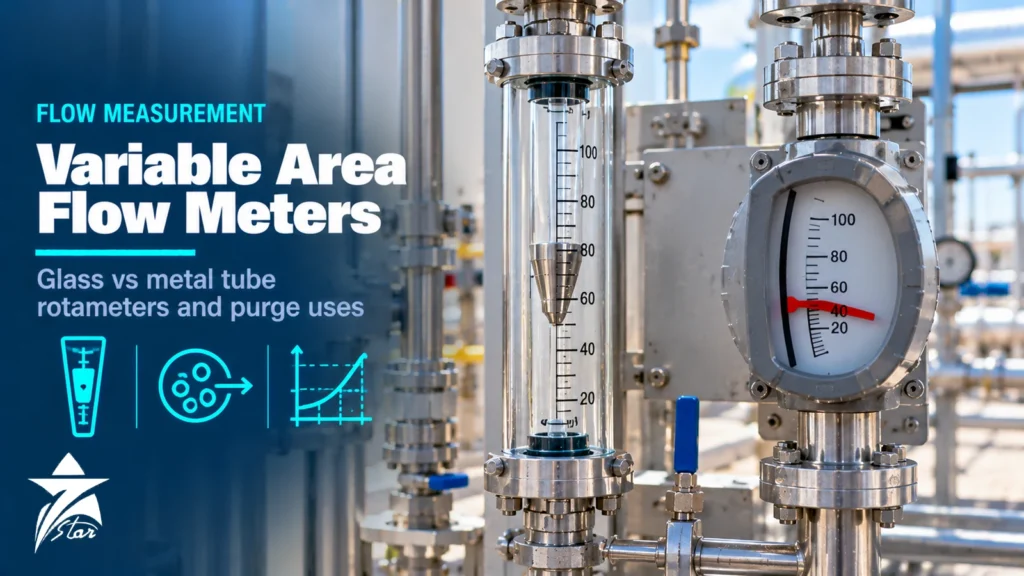
A variable area flow meter, usually called a rotameter, is one of the simplest flow instruments in any plant: a float rises in a tapered tube until the upward force of the flow balances its weight, and the flow is read from a scale. It needs no power for local indication, has a low pressure loss, works on very low flows of gas and liquid, and is still the default choice for purge lines, analyzer sample systems, chemical dosing and utility gases. It is also limited: it must be mounted vertically, it reads correctly only for the fluid and conditions it was calibrated for, and glass versions have strict pressure and safety limits. This guide explains how the meter works, how glass, plastic and metal tube designs compare, where purge meters fit, how accuracy is specified, how to correct for different fluids and how to install and select one.
How a Variable Area Flow Meter Works
The meter has a vertical tube whose bore widens towards the top, and a float inside it. Fluid enters at the bottom and flows up through the annular gap between float and tube wall. Three forces act on the float:
- Its weight, acting downwards.
- Buoyancy, acting upwards, which depends on the fluid density.
- Drag from the flow through the annular gap, acting upwards.
As flow increases, the float rises to where the gap is larger, so the velocity and pressure drop across the float stay roughly constant. The float height is therefore proportional to flow, which is why rotameter scales are close to linear. Because the pressure difference across the float is almost constant, the meter is sometimes described as a constant differential pressure device, in contrast to an orifice plate where the area is fixed and the pressure drop changes.
Float shape affects viscosity sensitivity. Floats with a sharp edge at the reading point are designed to reduce the effect of viscosity changes, while simple ball floats are used in small purge meters where cost and simplicity matter more.
Glass, Plastic and Metal Tube Designs
| Feature | Glass tube | Plastic tube | Metal tube |
|---|---|---|---|
| Typical tube material | Borosilicate glass | Acrylic, polysulfone or similar | Stainless steel, sometimes PTFE lined |
| Reading | Direct view of float against scale | Direct view of float | External indicator driven by magnetic coupling |
| Pressure and temperature | Low; set by tube size and design | Lowest; mainly water and air at ambient conditions | Much higher; suitable for steam and hot or high pressure service |
| Fluids | Clean, transparent liquids and gases | Water, air, mild chemicals compatible with the plastic | Opaque, hazardous, toxic or flammable fluids, steam |
| Electrical outputs | Usually none, sometimes limit contacts on the scale | Usually none | 4–20 mA, HART and other protocols, limit switches |
| Typical use | Laboratories, purge panels, analyzer systems, utilities | Water treatment dosing, cooling water, simple air lines | Process lines, chemical injection, boiler and steam systems |
Glass tube meters show the float directly, so dirt, bubbles and float sticking are visible. Their limit is mechanical: a broken tube releases the fluid. Many manufacturers fit shields or armoured housings, but for hazardous or high-pressure duty a metal tube meter is the safer choice.
Metal tube meters follow the float position with a magnet in or on the float, coupled to an external indicator. Electronic versions add a transmitter or alarm switches, often with NAMUR-type inductive limit switches for use in hazardous areas. If you need to send the reading to a PLC or DCS, check the output and hazardous area approvals early.
Purge and Low Flow Applications
Low flows are where rotameters are hardest to replace. Small meters with integral needle valves are used to set and display flows from a few millilitres per minute upwards. Typical duties:
- Bubbler level measurement, where a small constant gas flow escapes from a dip tube and the back pressure indicates level.
- Instrument purges that keep impulse lines, diaphragm seals or sensor windows free of process deposits.
- Analyzer sample and bypass flows, where each stream needs a stable, visible flow; see our process gas analyzer guide.
- Pressurised enclosures, where a protective gas purge must be maintained.
- Laboratory and test rigs, including gas blending and carrier gas lines.
A purge flow set with a needle valve drifts when upstream or downstream pressure changes. Adding a differential pressure regulator across the needle valve keeps the flow constant. Upstream supply pressure is normally controlled with a separate pressure regulator from the regulators range.
Points to watch on low flow meters:
- The needle valve position (inlet or outlet) changes whether the tube operates at supply pressure or near atmospheric pressure, which affects gas calibration.
- Small floats stick easily; filter the supply and keep tubes clean.
- Check that the scale is in the units and reference conditions you use, for example normal or standard litres per hour.
Accuracy and Rangeability
Variable area meter accuracy is commonly specified according to VDI/VDE 3513 sheet 2. The specification gives an accuracy class, for example 1.6 or 2.5, together with a limit value qG, often 50% of full scale:
- Above qG, the permissible error is the class value as a percentage of the actual reading.
- Below qG, the permissible error is a fixed amount in flow units, equal to the class percentage of the qG flow.
So a meter of class 1.6 with qG at 50% is within ±1.6% of reading in the upper half of the scale, and within a fixed error equal to 0.8% of full scale below it. In practice this means the meter should be selected so that normal flow sits in the upper half of the scale.
Rangeability is typically around 10:1. Some manufacturers specify a range such as 8% to 100% of full scale. Calibrated metal tube meters with transmitters usually reach better accuracy than uncalibrated glass purge meters, which are often treated as indicators rather than measuring instruments. When accurate totals or tighter control are required, compare other technologies in our guide on how to choose the right flow meter.
Correcting for Density, Pressure and Temperature
A rotameter scale is valid only for the fluid and conditions stated on it. When conditions change, the reading must be corrected or the scale replaced.
Gases. For a gas meter, the corrected flow is the indicated flow multiplied by the square root of the ratio of the calibration gas density to the actual gas density, both at the operating pressure and temperature at the float. Higher pressure means higher density, so a meter calibrated for air at atmospheric pressure reads high when operated at elevated pressure, and the corrected actual flow is lower than indicated.
Liquids. For liquids the float density enters the correction:
Q2 = Q1 × sqrt[ (ρf − ρ2) × ρ1 / ((ρf − ρ1) × ρ2) ]
where Q1 is the indicated flow on a scale calibrated for liquid density ρ1, ρ2 is the actual liquid density and ρf is the float density.
Viscosity. Corrections assume similar viscosity. If the new fluid is much more viscous, the float drag changes and the simple formula no longer applies; request a meter calibrated or scaled for the actual fluid.
Installation Guidelines
- Mount the meter vertically with flow upwards, unless the design is specifically rated for horizontal or downward flow.
- Keep the meter free of pipe stress; support the connecting lines independently.
- Fit isolation valves and, where the process cannot be stopped, a bypass so the meter can be removed for cleaning.
- Install a filter upstream of small meters and purge panels.
- Avoid magnetic fields and ferromagnetic particles near metal tube meters with magnetic coupling.
- For gas service, avoid pulsating flow from reciprocating compressors and solenoid valves close to the meter, which makes the float bounce.
- Read the float at the reference edge stated by the manufacturer, usually the widest part or the top edge.
Common Problems and Fixes
- Float stuck or reading erratically: dirt, deposits or a bent guide rod; clean the tube and float and filter the supply.
- Reading too high or too low: wrong fluid, pressure or temperature for the scale; apply the correction or obtain the correct scale.
- Float bouncing: pulsating flow or two-phase flow; add damping, relocate or change the float type.
- Condensation or fogging in glass tubes: cold fluid in humid air, common in GCC summer conditions; consider a metal tube meter.
- No signal from transmitter: check the magnetic coupling, transmitter configuration and the limit switch amplifier on intrinsically safe loops.
Variable Area Meters Compared With Other Low Flow Options
Thermal mass flow controllers measure gas mass flow directly and offer electronic control, but need power and clean, dry gas. Small Coriolis meters measure mass flow and density of liquids and gases with high accuracy at a higher cost. Electromagnetic meters need conductive liquids and become difficult at very small sizes. For simple indication and setting of low flows, the rotameter remains the most practical option. For switching only, flow switches from the flow indicators and switches category may be enough.
Selection Checklist
- Fluid name, density at operating conditions, viscosity and whether it is clean, opaque or hazardous
- Minimum, normal and maximum flow, with units and reference conditions for gases
- Operating and design pressure and temperature
- Tube type: glass, plastic or metal
- Float and wetted material compatibility
- Integral needle valve, inlet or outlet position, and need for a constant flow regulator
- Local indication only, or 4–20 mA/HART output and limit switches
- Hazardous area classification and required approvals
- Connection type and size, panel or line mounting
- Required accuracy class and calibration certificate
Variable Area Flowmeters We Supply
These examples cover glass tube and metal tube designs.
| Product | Type | Where it fits |
|---|---|---|
| ABB Glass Tube Variable Area Flowmeter FGM1190 | Glass tube variable area flowmeter | Clean, low-pressure liquids and gases. |
| Brooks Instrument Sho-Rate 1250 and 1255 Glass Tube Flowmeter | Glass tube flowmeter | Low flows of gases and liquids. |
| KROHNE H250 M40 Variable Area Flowmeter | Metal tube variable area flowmeter | Higher pressure and temperature, opaque fluids. |
| Brooks Instrument MT3809G Metal Tube Variable Area Flow Meter | Metal tube variable area flow meter | Process flows. |
| ABB Armored variable area purgemeter FAM3200 | Armored purgemeter | Purge flows. |
| KOBOLD BGN All-Metal Variable Area Flow Meter, up to 350 °C | All-metal variable area flow meter | Hot service up to 350 °C. |
Send the fluid, flow range, pressure, temperature and connections through our quote request form.
Sourcing Variable Area Flow Meters Through Seven Star LLC
Seven Star LLC supplies glass, plastic and metal tube variable area flow meters, purge meters with needle valves, constant flow regulators and spare tubes, floats and scales on request. Manufacturers such as ABB, KROHNE, Yokogawa (Rota), Brooks Instrument and Kobold make widely used ranges. We help with selection and cross-checking part numbers, including matching replacement tubes and scales for installed meters; availability and lead time are confirmed at quotation. Browse the flowmeters category for current items.
Send us the nameplate photo or datasheet of your existing meter, or your fluid, flow range, pressure and temperature, and we will reply with a quotation for a suitable variable area flow meter.
Frequently asked questions
What is the difference between a rotameter and a variable area flow meter?
They are the same device family. Rotameter is the common name for a variable area flow meter with a float in a tapered tube; the name comes from early floats with slanted notches that made them rotate. Today the term is used for both glass tube and metal tube designs.
How accurate is a variable area flow meter?
Accuracy depends on design and calibration. Manufacturers usually state it as an accuracy class to VDI/VDE 3513 sheet 2, such as class 1.6 or 2.5, with a limit value qG, often 50% of full scale. Above qG the error is a percentage of the reading; below it the error is fixed in flow units. Small purge meters are typically less accurate than calibrated metal tube meters.
Can a rotameter be used for a different gas or liquid?
Yes, with a correction, provided the float and tube suit the new fluid. For gases, the reading is corrected with a square-root ratio of densities at operating conditions. For liquids, the float density also enters the correction. Large viscosity changes can make the correction invalid, and a new scale or recalibration is then the better option.
Does a rotameter need straight pipe runs?
Variable area meters are much less sensitive to upstream disturbances than most other flow meters, and manufacturers often require little or no straight run. They must, however, be installed vertically with flow upwards, unless a spring-loaded design rated for other orientations is used.
When should I use a metal tube rotameter instead of glass?
Use metal tubes for higher pressure and temperature, for hazardous, toxic or flammable fluids where breakage would be dangerous, for opaque liquids and for steam. Metal tube meters also accept transmitters and limit switches, so the flow can be sent to a control system.
What is a purge rotameter?
A purge rotameter is a small meter, usually with an integral needle valve, used to set and indicate very low flows of gas or liquid. Typical duties are bubbler level systems, instrument and analyzer purges, and pressurised enclosure purges. A differential pressure regulator can be added to keep the flow constant when upstream or downstream pressure changes.
Was this guide helpful?One click helps us write better guides for engineers.
Thank you! Glad it helped. Need this equipment for your project? Request a quotation
Thank you. We will use this to improve the guide.