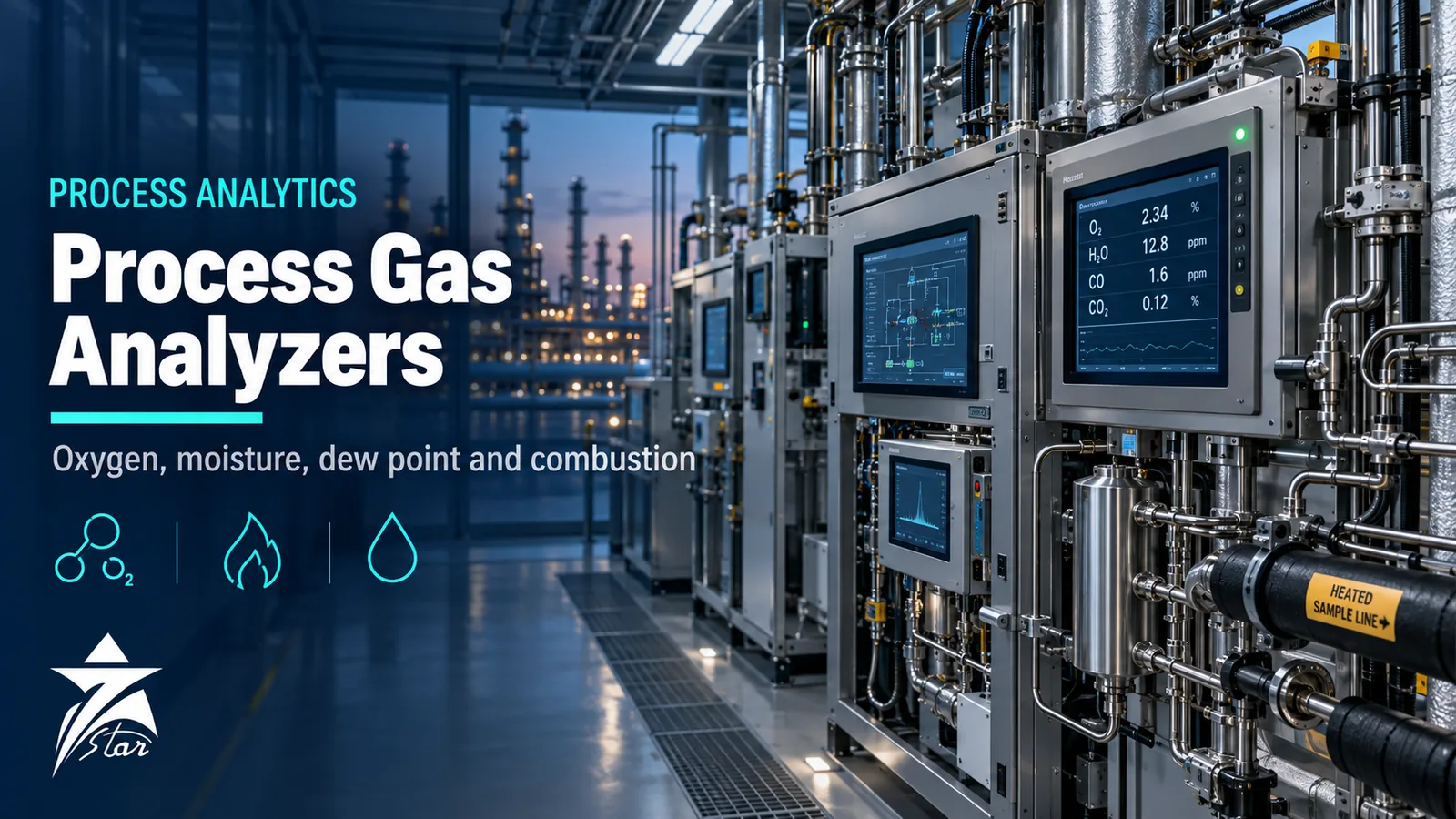
Process Gas Analyzers for Refineries and Gas Plants: Oxygen, Moisture, Dew Point and Combustion Measurement Explained
Temperature, pressure, flow and level tell operators how a process is running. A process gas analyzer tells them what the process is actually making, burning or shipping. That makes analyzers central to product quality, energy efficiency, emissions compliance and safety, and it also makes them the most maintenance-intensive instruments on many sites.
This guide explains the main measurement technologies used in refineries, gas processing plants and petrochemical units, where each one fits, and why the sample system usually matters more than the analyzer itself. Examples come from the Servomex and BARTEC ranges supplied by Seven Star LLC.
Where Analyzers Earn Their Keep
| Application | What is measured | Why it matters |
|---|---|---|
| Fired heaters and boilers | Excess oxygen, CO, methane | Combustion efficiency, fuel savings, safe light-off |
| Inert gas blanketing and purging | Oxygen in nitrogen | Prevents flammable atmospheres in tanks and vessels |
| High-purity gases | Trace and ultra-trace oxygen | Product specification for industrial gases and feedstocks |
| Natural gas processing and sales | Water dew point, hydrocarbon dew point | Pipeline and sales gas specifications, hydrate and liquid dropout prevention |
| Crude and product quality | Vapour pressure, salt content | Storage safety, blending, desalter performance, corrosion control |
| Stack emissions | O2, CO, CO2, NOx, SO2 | Environmental compliance and reporting |
Oxygen Measurement: Four Technologies, Four Different Jobs
Oxygen is the most widely measured process gas, and there is no single best way to measure it. The right technology depends on concentration range, background gas, temperature and whether combustibles are present.
Paramagnetic
Oxygen is strongly attracted to a magnetic field, while most other common gases are not. Paramagnetic analyzers exploit this property to measure oxygen accurately from percentage levels, with good stability and no consumable sensor. They are widely used for process oxygen, inerting and purity measurements. The Servomex SERVOTOUGH OxyExact 2200 is designed for this type of process service, including hazardous-area installations.
Zirconia
A heated zirconium oxide cell produces a signal related to the ratio of oxygen on either side of the cell. Zirconia sensors respond quickly, work at high temperature and are the traditional choice for in-situ combustion oxygen in flue gas. Because the cell runs hot, combustible gases in the sample react with oxygen at the sensor, so zirconia is generally unsuitable where significant hydrocarbons or hydrogen are present in the measured gas.
Tunable diode laser (TDL)
TDL analyzers pass a laser beam tuned to a specific absorption line of the target gas across a process duct or stack. They measure in situ, without extracting a sample, and respond very quickly. For fired heaters, TDL systems such as the Servomex SERVOTOUGH Laser 3 Plus Combustion can measure oxygen together with CO or methane, which supports both efficiency optimisation and burner management safety during start-up.
Trace and ultra-trace oxygen
When oxygen must be measured in parts per million or parts per billion, for example in high-purity nitrogen, argon or hydrogen, specialised sensors are required. The Servomex SERVOPRO NanoTrace DF-550E is designed for ultra-trace oxygen in high-purity gases, where leaks in fittings and sample tubing can easily add more oxygen than the process contains.
| Technology | Typical range | Strengths | Watch out for |
|---|---|---|---|
| Paramagnetic | Percent levels | Accurate, stable, no consumable sensor | Extractive sampling; sensitive to vibration and flow disturbances |
| Zirconia | ppm to percent, hot gas | Fast, in-situ, high temperature | Combustibles react at the cell and bias the reading |
| TDL | ppm to percent, in-situ | No sampling, very fast, multi-gas options | Optical path alignment, dust and window purging |
| Trace/ultra-trace sensors | ppb to ppm | Very low detection limits | Sample system leaks and purge time dominate accuracy |
Moisture and Hydrocarbon Dew Point in Natural Gas
Gas leaving a processing plant must meet water and hydrocarbon dew point specifications. Water above specification can form hydrates and corrosive liquids in pipelines; heavy hydrocarbons above specification can condense as liquids in pipelines and burners.
- Water dew point and trace moisture analyzers confirm that dehydration units, such as glycol contactors or molecular sieve beds, are performing. The BARTEC HYGROPHIL F 5674 process trace moisture analyzer is designed for this type of duty.
- Hydrocarbon dew point analyzers measure the temperature at which hydrocarbon liquids begin to condense. The BARTEC Hygrophil HCDT-5985-72 is built for online hydrocarbon dew point measurement, supporting control of dew point conditioning units and demonstrating sales gas compliance.
Water and hydrocarbon dew point are different measurements answering different questions. A plant that meets one specification can still fail the other, which is why many gas treatment facilities measure both.
Crude and Product Quality Analyzers
Liquid quality analyzers are often grouped with gas analyzers because they are installed in the same analyzer houses and maintained by the same technicians.
- Vapour pressure. Online vapour pressure analyzers such as the BARTEC Benke RVP-4 help control stabilisation, blending and storage of crude oil and light products, where excessive vapour pressure creates losses and safety risks.
- Salt in crude. Salt content drives corrosion and fouling in crude distillation units. The BARTEC P-600 Salt in Crude Analyzer gives continuous feedback on desalter performance instead of relying on periodic laboratory samples.
Emissions and Multi-Component Analysis
Stack monitoring requires measuring several components at once to meet environmental permits. Multigas analyzers such as the Servomex SERVOPRO 4900 are designed for continuous emissions monitoring, combining oxygen with gases such as CO, CO2, NOx and SO2 in one platform. Photometric process analyzers like the SERVOTOUGH SpectraExact 2500 cover other process streams where infrared or ultraviolet absorption is the right measurement principle.
The Sample System Decides the Result
Industry experience consistently shows that most analyzer problems are sample system problems. An analyzer can only report what arrives at the sensor. Good sample system design covers:
- Representative sample point. Take the sample where the stream is well mixed, away from dead legs, and with the probe designed for the phase and flow conditions.
- Transport time. Long sample lines add delay. Use fast loops or bypass flows so the analyzer sees gas that left the process seconds ago, not minutes ago.
- Phase control. Heated and insulated sample lines prevent condensation where dew point or heavy hydrocarbons are involved. Letting a sample cool below its dew point changes its composition before it reaches the analyzer.
- Filtration and pressure reduction. Remove particles and liquids without removing the components you want to measure, and reduce pressure in a way that does not cause condensation.
- Leak-tight construction. For trace oxygen and moisture, every fitting is a potential source of error. Use appropriate tubing, fittings and purge procedures.
- Safe return or venting. Route sample returns to the process, flare or a safe location in line with the site’s hazardous-area and environmental requirements.
Analyzer Houses in Oman’s Climate
Many analyzers in Oman are installed in analyzer houses or shelters that must control temperature for both the electronics and the sample conditioning. Summer heat, direct solar gain and dust place real demands on HVAC systems and filters. A failed shelter air conditioner can take an entire bank of analyzers out of specification within hours. Including HVAC maintenance, filter replacement and temperature alarms in the analyzer maintenance plan is as important as calibrating the analyzers themselves.
Selection Checklist
- Define the measured component, range and required accuracy.
- List the full background composition, including combustibles, corrosives, water and particulates.
- Confirm process pressure, temperature and phase at the sample point.
- Decide between in-situ and extractive measurement.
- Confirm hazardous-area classification and the operator’s certification requirements.
- Specify calibration gas requirements and frequency.
- Design or review the sample system together with the analyzer, not afterwards.
- Plan maintenance access, spares and the shelter environment.
Sourcing Analyzers and Spares Through Seven Star LLC
Seven Star LLC supplies process gas analyzers, crude quality analyzers and analyzer spares from Servomex, BARTEC and other manufacturers to refining, gas processing and petrochemical customers in Oman. Browse our gas analyzer systems or send us your analyzer datasheet for a technical review.
Share your stream composition and measurement requirement with Seven Star LLC, and our team will recommend the analyzer technology and sample system approach before you place an order.
Need a Quotation for Your Project?
- Genuine OEM products
- Supply across Oman & the GCC
- Formal quotation from our sales team
Free, no-obligation quotation · takes about 1 minute
Other enquiries: [email protected] · WhatsApp
More Blog