- Automation & ControlView all 2,093 products
- AC Drives
- Automation Accessories
- PLC & I/O Cards
- Industrial Communications
- Vibration Monitoring
- Controllers & Data Acquisition
- Isolator & Barrier
- CCTV & Security
- Safety Switches & Guard Locking
- Encoders
- HMI Displays
- Pneumatic Cylinders
- Motor Soft Starters
- Industrial Computers
- Servo Drives
- Machine Vision
- Automation Software
- Robotics





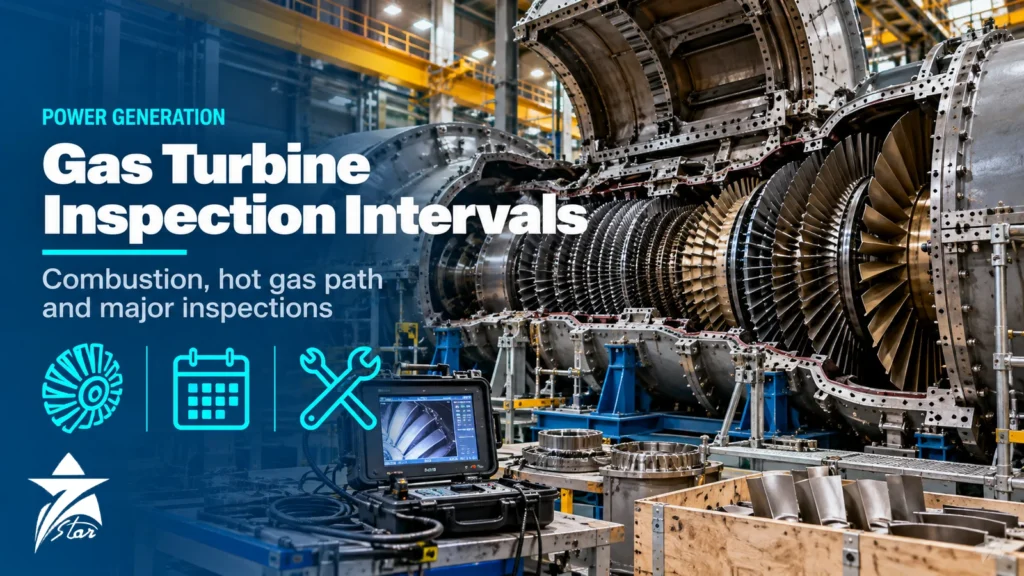
A heavy-duty gas turbine can run for years between major overhauls, but only if the outages are planned around how the machine is actually operated and the parts are ready before the casing is opened. Gas turbine inspection intervals are not fixed calendar dates: they depend on fired hours, starts, trips, load profile, fuel and injection, and every OEM sets its own rules. This guide explains the three classic inspection levels, how operating factors stretch or shorten them, how to plan spare parts and rotable sets, and what Gulf conditions do to hot section and compressor life.
Why Intervals Are Counted in Hours and Starts
Hot gas path parts are damaged by two different mechanisms. Continuous operation at high firing temperature causes creep, oxidation and coating loss, which accumulate with fired hours. Every start, shutdown and load change heats and cools the parts unevenly, causing thermal-mechanical fatigue and cracking, which accumulate with cycles. A base-load unit in a combined cycle plant is therefore limited by hours, while a peaking unit that starts daily is limited by starts.
OEM maintenance documents, such as the GE reference GER-3620 on heavy-duty gas turbine operating and maintenance considerations, handle this by defining factored fired hours and factored starts. Actual hours and starts are multiplied by maintenance factors for the operating conditions, and the inspection is due when either count reaches its limit, whichever comes first.
The Three Inspection Levels
Combustion inspection
The shortest outage. It covers fuel nozzles, combustion liners, transition pieces, crossfire tubes, flame detectors, spark plugs or igniters, and the first-stage turbine nozzle as seen by borescope. On modern dry low NOx systems the combustion hardware is complex and often replaced as a pre-repaired set so the unit returns quickly while the removed set goes for repair.
Hot gas path inspection
Includes everything in the combustion inspection plus removal of the turbine casing upper half to inspect and usually replace turbine nozzles (stationary vanes), buckets or blades (rotating), and shrouds. Coating condition, cracking, tip rubs, cooling hole blockage and foreign object damage are assessed, and parts are dispositioned as reuse, repair or scrap.
Major inspection
A full opening of the unit: compressor, combustion and turbine sections, bearings, seals, couplings and often the inlet and exhaust systems. Rotor condition is assessed, clearances recorded and the unit is essentially returned to a reference condition. Separately, OEMs set a rotor life limit expressed in factored starts and factored hours, after which a rotor inspection or life extension assessment is required.
Typical Gas Turbine Inspection Intervals and What Changes Them
Exact intervals depend on the model, combustion system, upgrade package and OEM or service provider. For many heavy-duty frames operating at base load on natural gas, published OEM guidance places the intervals in the ranges below. Treat these as typical orientation only and use the values in your own unit’s maintenance documentation.
| Inspection | Typical scope | Typical basis (heavy-duty, gas, base load) | Main limiting factor |
|---|---|---|---|
| Combustion | Fuel nozzles, liners, transition pieces, igniters, flame detectors | In the order of 8,000–12,000 factored fired hours, or a starts limit | Combustion hardware wear and cracking |
| Hot gas path | Combustion scope plus turbine nozzles, buckets, shrouds | In the order of 24,000 factored fired hours, or a starts limit | Creep, oxidation, coating loss, thermal fatigue |
| Major | Whole unit including compressor, rotor, bearings | In the order of 48,000 factored fired hours, or a starts limit | Accumulated condition of all sections |
Factors that increase the maintenance factor, and so shorten the real interval, include:
- Peak firing: operating above base load firing temperature accelerates hot section damage; OEM guidance gives examples where a peak-load maintenance factor of 2 halves the effective interval.
- Fuel: distillate and especially residual or crude oil increase deposits and corrosion compared with natural gas.
- Water or steam injection: used for NOx control or power augmentation, it raises heat transfer to hot parts.
- Trips from load: a trip at high load imposes a severe thermal transient and is counted as several equivalent starts.
- Fast starts and fast loading: increase thermal gradients compared with normal starts.
- Contaminants: sodium, potassium, vanadium and lead in fuel, air or injection water attack coatings and base metal.
Heavy-Duty Frames vs Aeroderivatives
The three-level inspection model described above belongs to heavy-duty industrial frames, which are maintained in place with the casing opened on site. Aeroderivative gas turbines, derived from aircraft engines and common on offshore platforms, compressor stations and fast-start peaking plants, follow a different philosophy. Their maintenance is usually based on modules: the gas generator or its hot section is removed as a unit and exchanged with a lease or spare module, then overhauled in a repair shop while the package returns to service. Inspection limits are still tied to hours and cycles, but the planning question becomes module availability and shop turnaround rather than on-site outage duration. Light industrial turbines in mechanical drive service often sit between these two approaches. Whichever type you operate, the maintenance manual for your specific model sets the counting rules, and those rules should be built into the plant’s maintenance management system.
Gulf Operating Conditions
Units in the GCC face fine dust and sandstorms, high summer temperatures, coastal humidity and salt-laden air. Each affects maintenance.
- Inlet filtration: multi-stage filters, often with weather hoods, coalescing pre-filters and high-efficiency final filters, keep dust and salt out of the compressor. Rising inlet differential pressure costs output, and pulse-cleaned cartridge systems help during dust events. Stock enough filter elements for at least one full change-out before summer.
- Compressor fouling and erosion: deposits reduce airflow and efficiency; online and offline water washing restore performance, while erosion of early compressor stages is a wear item to inspect.
- Hot corrosion: salt ingested with inlet air combines with sulfur from fuel and attacks hot section coatings; coastal sites should monitor inlet air and fuel contaminants.
- Inlet cooling: evaporative coolers, foggers and chillers restore summer output but introduce water quality and carry-over risks for the compressor.
Planning Spare Parts Around the Outage Cycle
Spare parts planning for gas turbines works in three layers. Each needs a different procurement approach and a different lead time assumption, which is why planning starts well before the outage date.
- Capital and rotable parts: complete sets of combustion hardware, turbine nozzles, buckets and shrouds, sometimes a spare rotor. Owners often hold one rotable set per inspection type so the removed set can be repaired between outages. Repair shops and OEMs set limits on how many repair cycles a part can take.
- Outage consumables: gaskets, seals, bolting, locking plates, thermocouples, igniters, flame detectors, borescope plugs, filters and lubricants. These are low cost but frequently delay restart when missing.
- Operational spares: controls and instrumentation, fuel valves and servo valves, sensors, starting system components, lube oil and hydraulic system parts, and auxiliary motors and pumps needed to keep the unit available between outages.
For older frames and control platforms, some components are no longer produced; our guide to sourcing obsolete automation parts for legacy PLC and DCS systems covers how to approach that side. Vibration and position probes that protect the unit, discussed in our article on API 670 machinery protection systems, should be included in the spares review because a failed probe can block restart.
Building the Outage Timeline
Work backwards from the planned outage date. Freeze the scope early using factored counts and borescope findings, then confirm which rotable sets are ready and which parts must be ordered new. Long-lead items such as hot section hardware, special bolting and control components should be identified first, because their lead times usually decide when orders must be placed. Consumables kits, inlet filters and instrumentation spares can follow, but should arrive and be checked against part numbers well before teardown. Finally, agree with the service provider which findings would trigger extra scope, so the decision on contingency parts is made before the unit is opened rather than during the outage.
Data to Collect Before Requesting Parts
- Unit model, serial number and any upgrade or combustion system package installed.
- Fired hours, starts and trips since the last inspection of each type, plus the operating profile.
- Fuel types used and any water or steam injection.
- Previous inspection reports and part disposition records, including repair cycles on rotable sets.
- Part numbers from the parts list or removed hardware, with revision letters, since parts are often superseded.
- Required outage window and whether parts must arrive before teardown or can follow inspection findings.
Condition Monitoring Between Inspections
Intervals are a planning baseline, not a guarantee of condition. Exhaust temperature spread across the thermocouple array can reveal a failing combustor or fuel nozzle. Combustion dynamics monitoring on dry low NOx units detects pressure pulsations that crack liners and transition pieces. Borescope inspections through dedicated ports let engineers check hot section parts without disassembly. Vibration trends, compressor efficiency, inlet and exhaust pressure drop, and lube oil analysis complete the picture. Findings from these sources can bring an inspection forward or support a case to extend it within OEM limits.
Common Mistakes in Planning Gas Turbine Inspection Intervals
- Counting actual hours only and ignoring starts, trips and peak operation, so the hot section is overdue when the outage arrives.
- Ordering parts after the unit is opened, extending a planned outage by the full lead time.
- Assuming a removed rotable set can be repaired again without checking its repair history.
- Mixing part revisions in one stage without confirming compatibility.
- Under-stocking inlet filters and consumables for summer dust seasons.
Outage Readiness Checklist
- Factored hours and factored starts calculated with current maintenance factors.
- Inspection type and scope agreed with the service provider.
- Rotable set status confirmed: repaired, inspected and ready.
- Consumables kit complete for the inspection type.
- Instrumentation spares checked: thermocouples, flame detectors, vibration probes.
- Inlet filters and water wash supplies available.
- Borescope and previous inspection findings reviewed for likely extra scope.
Gas Turbine Products We Supply
These examples cover spare parts and monitoring.
| Product | Type | Where it fits |
|---|---|---|
| Nuovo Pignone PGT25 Gas Turbine Spare Parts (Hot Gas Path and Rotating Components) | Gas turbine spare parts | Hot gas path and rotating parts. |
| DURAG D-GT 800 UV Flame Sensor for Gas Turbines | UV flame sensor for gas turbines | Flame detection. |
| ABB Uvisor SF810 Safe Flame Scanner | Flame scanner | Burner flame monitoring. |
Send the turbine model and the part numbers through our quote request form.
Sourcing Gas Turbine Spare Parts Through Seven Star LLC
Seven Star LLC supplies gas turbine parts and related motor, pump and turbine components, including instrumentation, filters and outage consumables, on request for power, oil and gas and industrial operators in Oman and the GCC. We help with cross-checking part numbers and revisions against your parts lists; availability and lead time are confirmed at quotation.
Send your turbine model and serial number, the parts list or nameplate details, or your RFQ, and we will review the items ahead of your next outage.
Frequently asked questions
What are the main gas turbine inspection types?
Heavy-duty gas turbines typically follow three levels: combustion inspection, hot gas path inspection and major inspection. Each has a wider scope than the one before, from combustion hardware to turbine nozzles and buckets to the full unit including the compressor and rotor. Exact scope and intervals are set by the OEM for each model.
What are factored fired hours and factored starts?
They are actual hours and starts multiplied by maintenance factors that reflect how severe the operation was, for example peak firing, liquid fuel, steam or water injection, and trips. An inspection is due when either the factored hours or the factored starts reach the OEM limit, whichever comes first.
How often is a hot gas path inspection needed?
For many heavy-duty units on natural gas at base load, OEM guidance places it in the order of 24,000 factored fired hours, with a separate starts limit. Peaking units, liquid fuel or frequent trips reach the limit sooner. Always use the interval in your own unit's maintenance documentation.
Why does a trip count as more than one start?
A trip from high load cools hot section parts very quickly, creating a larger thermal gradient than a normal shutdown. OEM methods therefore count it as several equivalent starts, with the factor increasing with the load at which the trip occurred.
What is a rotable spare set?
It is a complete set of parts for one inspection type, such as combustion hardware or first-stage nozzles and buckets, that is installed during an outage while the removed set is sent for repair. The repaired set then becomes the spare for the next outage, which shortens downtime. Each part has a limited number of repair cycles.
How do dust and heat in the Gulf affect gas turbine maintenance?
Dust loads inlet filters and fouls or erodes the compressor, reducing output and requiring more water washing and filter changes. Salt-laden coastal air contributes to hot corrosion of coatings, and high ambient temperature reduces output, often leading operators to add inlet cooling with its own water quality requirements.
Was this guide helpful?One click helps us write better guides for engineers.
Thank you! Glad it helped. Need this equipment for your project? Request a quotation
Thank you. We will use this to improve the guide.