- Automation & ControlView all 3,119 products
- Automation Accessories
- AC Drives
- PLC & I/O Cards
- Industrial Communications
- Vibration Monitoring
- Isolator & Barrier
- Controllers & Data Acquisition
- Safety Switches & Guard Locking
- Encoders
- Motor Soft Starters
- CCTV & Security
- Pneumatic Cylinders
- HMI Displays
- Servo Drives
- Industrial Computers
- Machine Vision
- Automation Software
- Robotics
















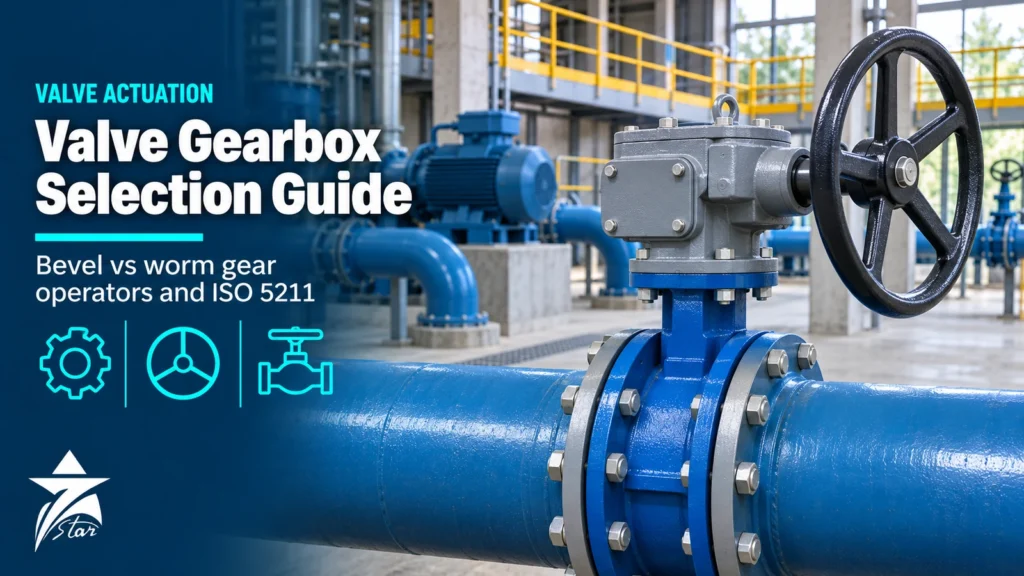
Large valves need far more torque than an operator can apply directly with a lever or a small handwheel. A 600 mm butterfly valve on a water main, a high pressure ball valve on a pipeline or a large gate valve in a pump station may require thousands of newton metres to open and close. A valve gearbox, also called a gear operator, multiplies the input torque from a handwheel or an actuator so the valve can be operated safely and smoothly. Selecting the wrong gearbox leads to valves that cannot be moved by hand, damaged gears, broken stems or actuators that trip on torque. This guide explains the main gearbox types, how to size them and the mounting and environmental details to specify.
Why a Valve Gearbox Is Needed
- To reduce the force needed at the handwheel to a level a person can apply safely.
- To allow a smaller, lower cost electric actuator to operate a large valve.
- To convert the motion of a multi-turn actuator into the 90 degree movement of a quarter-turn valve.
- To provide self-locking so the valve holds its position against flow forces.
- To slow the closing speed and reduce the risk of water hammer in long pipelines.
- To change the input direction, for example a side mounted handwheel or a chain wheel on an elevated valve.
Valve Gearbox Types Compared
| Gearbox type | Output motion | Typical valves | Key features |
|---|---|---|---|
| Worm gear, part-turn | 90 degrees, sometimes adjustable | Butterfly, ball, plug and damper valves | High ratios, self-locking, end stops, position indicator |
| Bevel gear | Multi-turn, input at 90 degrees to output | Gate, globe and knife gate valves | Ratios typically from about 1:1 to 8:1 per stage |
| Spur gear | Multi-turn, input parallel to output | Gate and penstock valves | Compact offset arrangements, often used with actuators |
| Planetary | Multi-turn, coaxial input and output | Gate valves and high torque multi-turn duty | Compact design for high torque in line with the stem |
| Heavy duty worm, multi-turn | Multi-turn | Large gate valves, sluice gates | High reduction in a single stage |
Worm Gear Operators for Quarter-Turn Valves
A part-turn worm gearbox is the standard gear operator for butterfly and ball valves. A worm shaft driven by the handwheel turns a worm wheel segment connected to the valve shaft. Ratios from about 30:1 to several hundred to one are common, so many handwheel turns produce a 90 degree movement. Because worm gears with a low lead angle are self-locking, the valve stays in position when the handwheel is released, which is important for butterfly valves where the flow tends to rotate the disc. Mechanical end stops limit the travel at open and closed and must be set correctly so the valve seats without overloading. For triple offset butterfly valves, which seat on torque rather than position, follow the valve manufacturer setting procedure. Our guide to triple offset butterfly valves explains why seating differs between valve designs.
Bevel and Spur Gearboxes for Multi-Turn Valves
Gate and globe valves need many turns of the stem to travel from open to closed. Bevel gearboxes change the input direction by 90 degrees and reduce the handwheel torque, which also allows a side mounted handwheel where the stem extends upwards. For rising stem valves the gearbox must transmit thrust as well as torque, so it is supplied with a thrust base and stem nut, and a stem protection tube covers the rising stem above the gearbox. When combined with an electric actuator, the gearbox reduces the actuator size but increases the operating time, which must be checked against the process requirements. The electric valve actuator selection guide explains how actuators and gearboxes are combined.
Sizing a Valve Gearbox: Torque, Ratio and Efficiency
Gearbox sizing starts with the valve torque data, which should come from the valve manufacturer. For quarter-turn valves this includes breakaway, running and seating torques at the maximum differential pressure. Apply the safety margin required by the project, commonly 25 to 50 percent depending on service and valve type, then select a gearbox whose rated output torque exceeds the result. Our article on pneumatic actuator sizing and torque margins discusses margins in more detail.
The input torque needed at the handwheel is calculated as follows:
- Required input torque = valve torque with margin divided by the gearbox ratio and the gearbox efficiency.
- The product of ratio and efficiency is often given as a single value called the mechanical advantage or factor.
- Worm gears typically have efficiencies of roughly 25 to 50 percent, while bevel and spur gears are much higher, often above 90 percent per stage.
- Number of handwheel turns = valve turns, or a quarter turn, multiplied by the ratio.
| Example | Value |
|---|---|
| Valve seating torque with margin | 2,000 Nm |
| Worm gearbox ratio | 60:1 |
| Gearbox efficiency | 35 percent, factor about 21 |
| Required input torque | about 95 Nm |
| Handwheel diameter for 95 Nm at 400 N rim force | about 475 mm |
| Handwheel turns for 90 degrees | 15 turns |
Handwheel Rimpull Limits
Rimpull is the tangential force the operator applies at the rim of the handwheel. Standards and project specifications limit it so valves can be operated without injury. EN 12570 gives guidance on maximum rim forces for industrial valves, and many oil and gas specifications set limits around 350 to 450 N for normal operation, with higher values sometimes accepted for breakaway only. If the calculated force is too high, increase the ratio, choose a more efficient gearbox type or increase the handwheel diameter, keeping in mind that very large handwheels are difficult to use in congested areas. Always state the required maximum rimpull on the gearbox specification.
Mounting a Valve Gearbox to ISO 5211 and ISO 5210
Standard mounting interfaces allow gearboxes and actuators from different manufacturers to fit the same valve. ISO 5211 defines flanges for part-turn devices, such as F07, F10, F12, F14, F16, F25 and larger, together with the output drive types. ISO 5210 defines flanges and thrust bases for multi-turn devices.
- Flange size: the bolt circle and spigot must match the valve top flange or a mounting bracket.
- Drive type: square, double D, keyed bore or spline. The insert or bushing is often supplied unbored or bored to suit the valve shaft.
- Shaft dimensions: diameter, key size and engagement length.
- Mounting position: the orientation of the handwheel relative to the pipeline, usually stated as a position code.
- For multi-turn valves: thrust base type, stem diameter, thread and lead, and whether the stem rises or not.
Environment, Sealing and Special Options
- Ingress protection of IP67 or IP68 for outdoor and flooded pits, with temporary or permanent submersion depths stated.
- Buried service versions with extension spindles and surface boxes for water network valves.
- Chain wheels for valves mounted out of reach, with chain guides and appropriate chain lengths.
- Corrosion protection paint systems for coastal and offshore sites, and stainless steel shafts and fasteners.
- Low or high temperature lubricants for extreme climates.
- Position indicators, limit switches, padlocking devices and key interlocks for operational safety.
- Ignition hazard assessment for non electrical equipment where the gearbox is installed in a hazardous area and the project requests it.
Common Gear Operator Selection Mistakes
- Sizing from the valve size alone instead of actual torque data at maximum differential pressure.
- Ignoring gearbox efficiency, which makes the handwheel much harder to turn than expected.
- Incorrectly set end stops that overload seats or leave butterfly valves partly open.
- Specifying a non self-locking gearbox on a valve subject to flow induced torque.
- Ordering the wrong flange or drive bushing, which delays installation.
- Neglecting sealing for pits and buried service, leading to water ingress and seized gears.
Maintenance of Gear Operators
Gearboxes are often filled with grease for life, but they still need periodic checks. Inspect for water ingress, corrosion, damaged seals and loose mounting bolts, and operate valves that stay in one position for long periods through part of their stroke to prevent seizing. Confirm that end stops and position indicators still match the actual valve position after maintenance on the valve or the actuator.
Selected Valve Gearboxes and Manual Operators in Our Catalog
The table below lists a selection of gear operators and manual override options from our catalog.
| Product | Type | Typical use |
|---|---|---|
| AUMA GHE 07.1 | Part-turn worm gearbox, 250 Nm | Small butterfly and ball valves |
| AUMA GHE 12.1 | Part-turn worm gearbox, 1,000 Nm | Manual quarter-turn valves |
| AUMA GS 63.3 | Part-turn worm gearbox, 1,000 Nm | Actuated quarter-turn valves |
| AUMA GS 100.3 | Part-turn worm gearbox, 4,000 Nm | Large butterfly valves |
| AUMA GS 250.3 | Part-turn worm gearbox, 56,000 Nm | Pipeline ball valves |
| AUMA GK 10.2 | Bevel gearbox, 120 Nm | Small gate valves |
| AUMA GK 25.2 | Bevel gearbox, 2,000 Nm | Gate and globe valves |
| AUMA GST 25.1 | Spur gearbox, 2,000 Nm | Offset multi-turn drives |
| AUMA GP 30.1 | Planetary gearbox, 2,500 Nm | Coaxial multi-turn duty |
| AUMA GHT 500.3 | Heavy duty multi-turn gearbox | Large gate valves and penstocks |
| Masoneilan Model 20 and 2R | Handwheels | Control valve manual override |
| Masoneilan CM and DM | Handwheels and hydraulic handjack | Actuator manual override |
Browse more in our valve gearboxes category. To get a quotation, send the valve type, size, torque or thrust data, flange and drive details, required rimpull and environment through our quote request form or to [email protected].
Sourcing a Valve Gearbox in Oman Through Seven Star LLC
Seven Star LLC is an independent supplier in Oman of part-turn worm gearboxes, bevel, spur and planetary gearboxes, heavy duty multi-turn gearboxes and manual override handwheels for industrial and water valves. We quote products from manufacturers such as AUMA and Masoneilan, together with mounting kits and accessories. Torque rating, ratio, flange size, drive bushing and sealing are confirmed against the manufacturer data at quotation.
Frequently asked questions
What is the difference between a worm and a bevel valve gearbox?
A worm gearbox converts many handwheel turns into a 90 degree movement and is used on butterfly, ball and plug valves. A bevel gearbox is used on multi-turn valves such as gate and globe valves, changing the input direction by 90 degrees and reducing the handwheel torque.
How do I calculate the handwheel torque for a gear operator?
Divide the valve torque, including the safety margin, by the gearbox ratio multiplied by its efficiency. The result is the input torque, which divided by the handwheel radius gives the rim force.
What is rimpull?
Rimpull is the force applied tangentially at the rim of a handwheel. Projects limit it, often to around 350 to 450 N for normal operation, so valves can be operated safely by one person.
Why are worm gearboxes self-locking?
Worm gears with a low lead angle cannot be driven backwards by the output shaft because friction prevents it. This holds butterfly and ball valves in position against flow forces.
What does ISO 5211 define?
ISO 5211 defines the mounting flanges and drive types for part-turn actuators and gearboxes, so that devices from different manufacturers can be mounted on the same valve top flange.
Who supplies valve gearboxes in Oman?
Seven Star LLC is an independent supplier in Oman that quotes worm, bevel, spur and planetary gearboxes and manual overrides from manufacturers such as AUMA and Masoneilan. Send your requirements through the quote request form or to [email protected].
Was this guide helpful?One click helps us write better guides for engineers.
Thank you! Glad it helped. Need this equipment for your project? Request a quotation
Thank you. We will use this to improve the guide.