- Automation & ControlView all 2,221 products
- Automation Accessories
- AC Drives
- PLC & I/O Cards
- Industrial Communications
- Vibration Monitoring
- Controllers & Data Acquisition
- Isolator & Barrier
- CCTV & Security
- Safety Switches & Guard Locking
- Encoders
- Motor Soft Starters
- HMI Displays
- Pneumatic Cylinders
- Industrial Computers
- Servo Drives
- Machine Vision
- Automation Software
- Robotics
















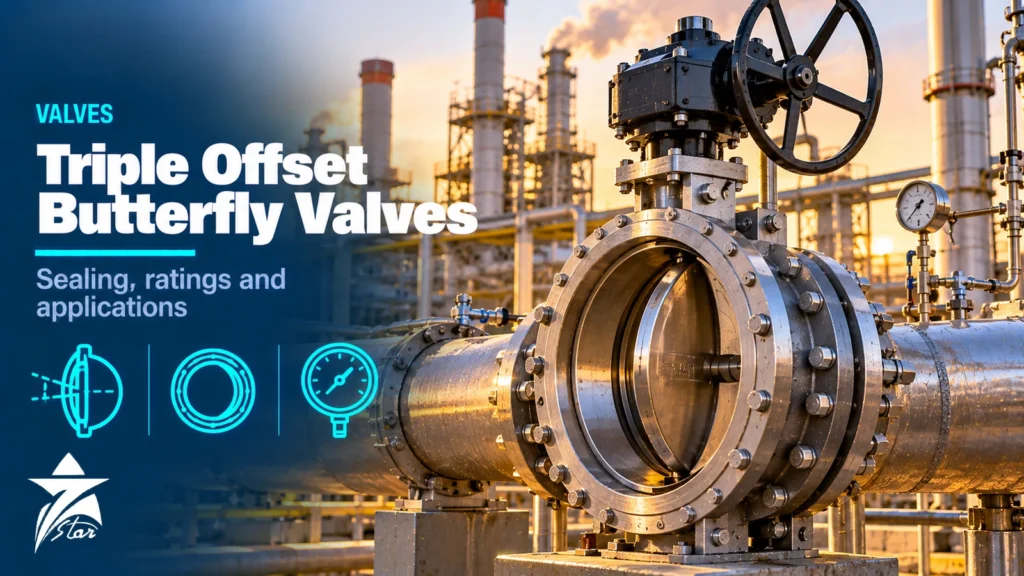
Three butterfly valves can share the same DN 300 Class 150 flange dimensions and still behave completely differently: one seals on a rubber liner, one on a PTFE ring, and one on a metal cone that never rubs until the last degree of closure. Choosing between them is the difference between a valve that lasts for decades and one that leaks after its first thermal cycle. A triple offset butterfly valve is often specified by default for hot or critical service, but it is not always the right answer. This guide explains the geometry of concentric, double offset and triple offset designs, how each one seals, where each one belongs, and what to check on datasheets, actuators and installation.
What an Offset Actually Is
Every butterfly valve has a disc that rotates on a shaft inside a short body. The design family is named after how many geometric offsets separate the shaft, the disc sealing face and the seat. API 609 groups butterfly valves into Category A, which are rated on manufacturer cold working pressure and usually have a concentric disc and seat, and Category B, which have an offset seat and are rated by ASME pressure class. The offsets are cumulative:
- First offset: the shaft sits behind the plane of the seat, so the seal around the disc edge is continuous and not interrupted by shaft holes.
- Second offset: the shaft is moved off the pipe and valve centreline. This creates a cam action, so the disc swings away from the seat within the first few degrees of opening instead of rubbing through the whole stroke.
- Third offset: the axis of the conical seat is inclined relative to the pipe centreline. The disc and seat then form matching elliptical cones that only touch at final closure, allowing metal-to-metal sealing without friction during travel.
A concentric valve has none of these offsets, a double offset valve has the first two, and a triple offset valve has all three.
Concentric (Zero Offset) Butterfly Valves
In a concentric valve, the shaft passes through the centre of the disc and the centre of the bore. The disc edge presses into a resilient liner, typically EPDM, NBR or FKM, sometimes PTFE-faced, and the seal depends on interference between the two. Because the disc rubs the liner across a large part of the stroke, the seat wears with every cycle and seating torque is high relative to valve size.
The strengths are low cost, simple construction and isolation of the body from the fluid when the liner covers the body bore. That makes concentric valves the standard for water distribution, cooling water, HVAC, desalination brine and seawater lines, fire water systems and many chemical duties at low pressure. Limits come from the elastomer: temperature, chemical compatibility and pressure class are all lower than for offset designs, and the liner can be pulled or damaged by high-velocity flow or vacuum if it is not properly bonded or locked into the body.
Double Offset (High Performance) Butterfly Valves
Double offset valves, often called high performance butterfly valves, move the shaft behind the seat and off centre. The cam effect lifts the disc away from the seat quickly, so wear concentrates in the last few degrees of closure. Seats are usually PTFE, reinforced PTFE or other polymers, retained in the body by a ring, and fire-safe versions add a metal backup seat that takes over if the soft seat burns away.
Double offset valves cover higher pressure classes than concentric valves, typically up to Class 300 or Class 600 depending on size and manufacturer, and handle hydrocarbons, solvents, low-pressure steam, vacuum and general process isolation. They also throttle better than concentric valves because the soft seat is not continuously loaded. Their limit is the seat polymer: at elevated temperature or with abrasive particles, the soft seat deforms or erodes, and the valve starts to pass.
Triple Offset Butterfly Valves
The third offset turns the seal into a cone-in-cone contact. The disc carries either a solid metal seal ring or a laminated ring of alternating stainless steel and graphite layers, and the body has a hard-faced metal seat, commonly with Stellite-type overlay. Because the cones only meet at final closure, there is no rubbing during travel, and the valve is torque-seated: the actuator pushes the disc into the seat to create the seal, rather than stopping at a fixed position.
This design tolerates high temperatures, thermal cycling, and cryogenic service that would destroy polymer seats, and it is inherently fire-safe because there is no soft material to burn. Triple offset valves are used for steam isolation, hot oil, refinery and petrochemical block valves, gas isolation, sulphur and FCC service, cryogenic and LNG duties, and as a compact, lighter replacement for large gate valves. They are generally bidirectional but have a preferred sealing direction, and their shut-off performance depends heavily on correct actuator torque settings.
Comparison Table: Concentric vs Double Offset vs Triple Offset
Values below are typical ranges for general guidance; ratings vary by manufacturer, size and seat material, so always confirm on the specific datasheet.
| Feature | Concentric | Double offset | Triple offset |
|---|---|---|---|
| Offsets | None | Shaft behind seat, shaft off centre | Two shaft offsets plus inclined seat cone |
| Seat type | Resilient liner (EPDM, NBR, FKM, PTFE-faced) | Polymer (PTFE, RPTFE), optional metal fire-safe backup | Metal or laminated metal/graphite |
| Seat contact during stroke | Rubbing over much of the stroke | Only near closure | None until final closure |
| Seating method | Position (interference) | Position | Torque-seated |
| Typical pressure rating | Cold working pressure, low classes | Up to Class 300 or 600 | Class 150 up to Class 900 and higher in some designs |
| Temperature capability | Limited by elastomer | Limited by polymer seat | High temperature and cryogenic designs available |
| Fire-safe | No | With metal backup seat | Inherent |
| Relative cost | Lowest | Medium | Highest |
| Typical services | Water, seawater, HVAC, fire water | Hydrocarbons, chemicals, vacuum, utilities | Steam, hot oil, gas, refinery isolation, cryogenic |
Body Styles: Wafer, Lug and Double Flanged
Offset type and body style are independent choices, and the body style has its own consequences:
- Wafer: clamped between two pipe flanges by through-bolts. Lightest and cheapest, but the line cannot be opened on one side without disturbing the valve, and long through-bolts can relax with thermal cycling.
- Lug: threaded lugs let each flange bolt to the valve independently, so the valve can isolate a downstream section removed for maintenance. Check the manufacturer’s rating for dead-end service, which may be lower than in-line rating.
- Double flanged: integral flanges for large sizes, higher classes and services where piping loads are significant. Most large triple offset valves are supplied this way or with butt-weld ends.
Selection Criteria
Work through these questions in order; the first one that rules out a design usually settles the choice:
- Temperature: if the process exceeds the safe limit of elastomers and polymers, or cycles between hot and cold, only metal-seated triple offset designs remain.
- Fire-safe requirement: hydrocarbon isolation often requires fire-type testing such as API 607; concentric valves usually cannot meet it.
- Pressure class: above the cold working pressure range of resilient-seated valves, move to Category B offset designs.
- Shut-off requirement: specify the leakage standard and rate (for example API 598 or ISO 5208) and confirm it for both flow directions if reverse pressure is possible.
- Fluid: abrasive slurries attack soft seats and liners; clean water favours low-cost concentric designs; seawater needs compatible disc, shaft and body materials.
- Function: for continuous throttling, check whether the specific design is rated for control duty and review its characteristic; see our control valve selection and sizing guide for sizing checks.
- Life-cycle cost: a triple offset valve costs more, but on steam or hot hydrocarbon service a cheaper soft-seated valve that needs frequent replacement rarely wins.
Actuation and Torque: Where Many Problems Start
Butterfly valves are quarter-turn, so they pair naturally with pneumatic rack and pinion or scotch yoke actuators and with electric part-turn actuators. The torque profile differs by design. Concentric valves need high breakaway and end-to-close torque because of liner interference. Double offset valves need less seating torque but still have a peak near closure. Triple offset valves need a defined seating torque to make the metal cones seal; if the actuator stops on position or limit switch instead of torque, the valve will pass even though the indicator shows closed.
When sizing actuators, use the valve manufacturer’s torque data for the actual differential pressure, add the safety factor required by your specification, and check that the actuator stops are set to match the valve’s closed position. For electric actuators on triple offset valves, confirm torque-seating capability and settings; our electric valve actuator selection guide covers part-turn sizing in more detail.
Installation Practices
- Check flow direction or preferred pressure direction on offset valves and install accordingly; reversing a triple offset valve can reduce its shut-off capability in that direction.
- Keep the disc slightly open while tightening flange bolts so liners and seats are not pinched, then cycle the valve before pressurising.
- Use gaskets compatible with the valve design; some concentric valves with integral liner faces are installed without separate gaskets, as the manufacturer instructs.
- Confirm the disc clears adjacent pipe bore, lined pipe, check valves and reducers throughout its swing.
- Where the fluid carries solids, mount the shaft horizontally where the manufacturer allows, so solids do not collect around the lower shaft bearing.
- Avoid installing directly downstream of elbows, pumps or control valves where uneven velocity profiles cause flutter and unbalanced torque.
Common Failures and Troubleshooting
- Concentric valve leaking after months: liner wear, swelling from incompatible fluid or chemical attack; check elastomer compatibility and operating temperature.
- Double offset valve passing: soft seat deformation from overtemperature or debris trapped during closure; consider a metal seat if temperature is the cause.
- Triple offset valve passing: insufficient seating torque, wrong actuator stop settings, damaged laminated seal ring, or installation against the preferred direction.
- Shaft packing leaks: adjust or replace packing; repeated leakage may indicate shaft misalignment or bearing wear.
- Erratic control: operating too close to the closed position, oversized valve or turbulence from upstream fittings.
GCC Service Conditions
In Oman and across the GCC, butterfly valves are widely used on seawater intake, brine discharge and cooling water lines in desalination and power plants. Here, the real decision is materials: rubber-lined bodies with discs in duplex or super duplex stainless steel or nickel-aluminium bronze are common, and the shaft must not create a galvanic couple with the disc. On hydrocarbon and gas plants, offset designs must meet sour service requirements under NACE MR0175 / ISO 15156 where H2S is present. Outdoor actuators and liners face high metal temperatures under direct sun and fine dust, so specify actuator temperature ratings, enclosure protection and hazardous area certification accordingly.
Butterfly Valve Specification Checklist
- Offset design: concentric, double offset or triple offset
- API 609 category or alternative design standard
- Size, pressure class or cold working pressure, design temperature range
- Body style: wafer, lug (with dead-end rating) or double flanged
- Disc, shaft, seat and liner materials checked against fluid and temperature
- Leakage standard and rate, including reverse direction if required
- Fire-safe and fugitive emission requirements
- Actuator type, torque data and safety factor, torque-seating where needed
- Sour service, seawater or hazardous area requirements
- Nameplate data of the existing valve if this is a replacement
Butterfly Valves We Supply
These examples cover triple offset and double offset (high performance) designs, so you can compare the two families discussed above.
| Product | Type | Where it fits |
|---|---|---|
| Masoneilan 33000 Series Triple Offset Butterfly Valve | Triple offset butterfly valve | Tight shut-off at high temperature and pressure. |
| Masoneilan 34005 Series Triple Offset Butterfly Valve | Triple offset butterfly valve | Isolation and control in demanding services. |
| Bray Tri Lok Triple Offset Butterfly Valve | Triple offset butterfly valve | Hydrocarbon and steam isolation. |
| Flowserve Durco TX3 Triple Offset Butterfly Valve | Triple offset butterfly valve | Chemical and process isolation. |
| Fisher 8560 High Performance Butterfly Valve | High performance butterfly valve | Control and on-off service at moderate temperature. |
| Keystone K-LOK Series 36/37 High Performance Butterfly Valve | High performance butterfly valve | Water, utility and process lines. |
| Masoneilan 33000 Series Triple Offset Butterfly Valve Seal Kit | Triple offset seal kit | Overhaul of existing triple offset valves. |
Send the size, pressure class, end connection, medium, temperature, shut-off class and actuation through our quote request form.
Sourcing Butterfly Valves Through Seven Star LLC
Seven Star LLC supplies concentric, double offset and triple offset butterfly valves within its fittings and valves range on request, as well as control valves and valve actuators from established manufacturers. We help with selection and cross-checking part numbers and model codes for replacements. Availability and lead time are confirmed at quotation.
Send us your butterfly valve datasheet, nameplate photo or RFQ with size, class, materials and service conditions, and we will prepare a matched quotation.
Frequently asked questions
What is the third offset in a triple offset butterfly valve?
The third offset is the inclination of the conical seat axis relative to the pipe centreline. Together with the two shaft offsets, it makes the disc and seat meet only at final closure, so the metal seal does not rub during travel.
Is a triple offset butterfly valve zero leakage?
Many designs are tested to tight leakage rates under standards such as API 598, but performance depends on the design, size, test standard and correct actuator seating torque. Always state the required leakage standard and rate in the specification and confirm it on the datasheet.
Can a concentric butterfly valve be used on steam?
Generally no. Resilient liners in concentric valves are limited by elastomer temperature and degrade with steam and thermal cycling. Metal-seated triple offset or other metal-seated designs are normally selected for steam isolation.
What is the difference between position-seated and torque-seated valves?
A position-seated valve seals when the disc reaches a fixed closed position, as in concentric and double offset designs. A torque-seated valve, like a triple offset valve, seals when the actuator applies a defined torque that presses the metal seal into the seat.
Are triple offset butterfly valves bidirectional?
Most are designed to seal in both directions, but they usually have a preferred direction with better shut-off. Check the manufacturer's rating for reverse pressure and install the valve according to its flow or pressure arrow.
What does API 609 Category A and Category B mean?
Category A valves are rated on the manufacturer's cold working pressure and usually have a concentric disc and seat. Category B valves have an offset seat and are rated by ASME pressure class and pressure–temperature limits.
Was this guide helpful?One click helps us write better guides for engineers.
Thank you! Glad it helped. Need this equipment for your project? Request a quotation
Thank you. We will use this to improve the guide.