- Automation & ControlView all 2,900 products
- Automation Accessories
- AC Drives
- PLC & I/O Cards
- Industrial Communications
- Vibration Monitoring
- Controllers & Data Acquisition
- Isolator & Barrier
- Safety Switches & Guard Locking
- Motor Soft Starters
- CCTV & Security
- Encoders
- Pneumatic Cylinders
- HMI Displays
- Servo Drives
- Industrial Computers
- Machine Vision
- Automation Software
- Robotics
















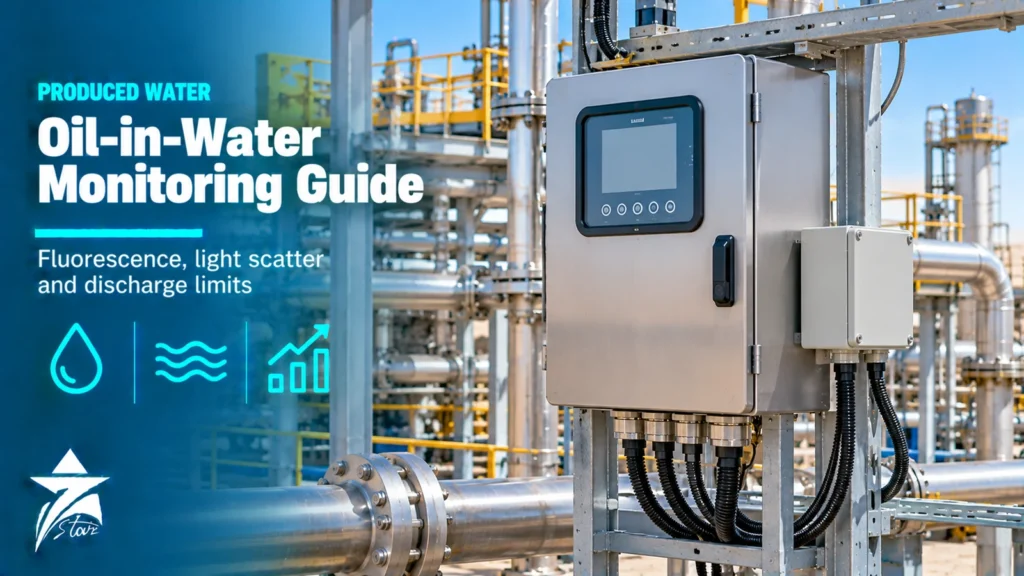
Produced water is the largest waste stream on most oil fields, and in mature fields it can be many times the volume of the oil produced. Before it is reinjected, sent to disposal wells or discharged, operators must know how much dispersed and dissolved oil it still carries. An online oil in water monitor gives that answer continuously, warns of separator upsets and protects reinjection wells and the environment. This guide explains the main measurement principles, how they compare with laboratory reference methods, the discharge limits often quoted, and how to install, calibrate and maintain an analyser so its readings can be trusted.
Why Oil in Water Is Measured
- Discharge compliance: regulators set limits for oil content in water released to sea, surface or evaporation ponds.
- Reinjection and disposal well protection: oil and solids plug the formation face and reduce injectivity, which raises pumping pressure and cost.
- Separator performance: a rising reading points to an upset in three-phase separators, hydrocyclones, flotation units or skim tanks before it becomes a spill.
- Drain and cooling water: open and closed drains, condensate and cooling water returns are checked for hydrocarbon leaks from exchangers.
- Marine bilge water: ships use 15 ppm bilge alarms with oily water separators to meet MARPOL Annex I.
Dispersed vs Dissolved Oil
Oil in produced water exists in two main forms. Dispersed oil is made of small droplets, usually from a few microns to a few hundred microns, that can be removed by gravity separation, hydrocyclones or flotation. Dissolved oil includes aromatic compounds such as benzene, toluene, ethylbenzene and xylenes (BTEX), phenols and some naphthenic acids that stay in solution and are not removed by separation. Different measurement methods respond differently to these two fractions, which is the main reason two instruments can give different numbers on the same sample.
Laboratory Reference Methods
Every online reading must be compared against an accepted laboratory method, because “oil in water” is defined by the method used to measure it.
| Method | Principle | Notes |
|---|---|---|
| ISO 9377-2 | Solvent extraction, GC-FID, hydrocarbons C10 to C40 | Basis of the OSPAR reference method; does not include volatile BTEX |
| EPA 1664 | n-hexane extraction, gravimetric (HEM / SGT-HEM) | Common US method; loses light ends on evaporation |
| ASTM D7678 | Cyclohexane extraction, mid-infrared (laser) measurement | Solvent-friendly alternative to the old Freon IR methods |
| Older IR methods | Freon or tetrachloroethylene extraction, IR absorbance | Phased out in many regions due to solvent restrictions |
Results from different reference methods are not interchangeable. When a permit gives a limit, confirm which method the limit is based on, and use the same method to correlate the online analyser.
How an Oil in Water Monitor Measures
Online analysers use optical, acoustic or imaging techniques. None of them measures oil directly in the way a laboratory extraction does; each measures a property that correlates with oil concentration under stable conditions.
| Technique | What it detects | Strengths | Limitations |
|---|---|---|---|
| UV fluorescence | Aromatic compounds that fluoresce under UV light | Very sensitive at low ppm; little effect from most solids | Response depends on crude composition; needs site correlation |
| Light scatter / turbidity | Droplets and particles scattering light | Simple, robust, fast | Cannot separate oil from sand, scale or gas bubbles |
| Ultrasonic | Reflections from droplets and particles | Works in dark or opaque water; can estimate oil and solids | Calibration needs representative samples |
| Image analysis | Camera images of droplets and particles | Gives droplet size and counts; separates oil from solids and gas by shape | Higher cost; window fouling must be managed |
| Laser or IR absorption | Hydrocarbon absorbance after extraction | Closest to lab methods | Usually batch or at-line, needs solvent |
UV Fluorescence Oil in Water Monitor Designs
Fluorescence is the most common principle for produced water and drains. The analyser excites the sample with ultraviolet light and measures the light emitted by aromatic molecules at a longer wavelength. Because aromatic content varies between crudes and condensates, the instrument is calibrated against reference samples from the site. Changes in crude source, chemical injection or water chemistry can shift this correlation, so periodic comparison with laboratory results is needed. Fluorescence responds to both dispersed and dissolved aromatics, so it may read higher than an extraction method that excludes volatiles.
Light Scatter, Ultrasonic and Imaging Analysers
Scatter and turbidity-based instruments are fast and simple but see all particles, so sand, iron sulphide, scale and gas bubbles add to the reading. They work best on clean streams where oil is the main dispersed phase. Ultrasonic analysers measure reflections from droplets and particles and are useful in dark or opaque water. Image-based analysers photograph droplets in a flow cell and classify them by shape and size, which helps separate oil from solids and bubbles and gives droplet size data for optimising hydrocyclones and flotation. Our water quality analyzer guide covers turbidity and other water measurements in more detail.
Typical Discharge Limits
Limits depend on the regulator, the discharge route and the permit. Commonly quoted values include:
- OSPAR (North-East Atlantic offshore): 30 mg/L dispersed oil as a monthly average, measured with the OSPAR reference method.
- MARPOL Annex I (ships): 15 ppm for discharge of oily bilge water through approved separators and alarms.
- Onshore discharge and reuse: set by the national environmental authority and the facility permit, often much lower for irrigation or surface discharge.
In Oman, discharge and reuse limits are set by the Environment Authority and the operating permit. Always confirm the limit, the averaging period and the reference method with the permit before setting analyser alarms.
Oil in Water Monitor Installation and Sampling
Most measurement errors come from sampling rather than the analyser. Oil droplets rise, solids settle and gas comes out of solution, so the sample must represent the bulk stream.
- Take the sample from a vertical pipe section with upward flow, or from the side of a horizontal pipe, away from bends, pumps and chemical injection points.
- Use an isokinetic or well-mixed sample probe, and keep the sample line short with enough velocity to prevent droplet separation.
- Avoid pressure reduction across small orifices that shear droplets into finer sizes or release gas bubbles.
- Fit a grab sample point next to the analyser take-off so laboratory samples match exactly what the analyser sees.
- Return the sample to the process or a closed drain, never to an open area.
Our sample conditioning system design guide explains transport lag, filtration and pressure reduction for analyser sample systems.
Calibration and Correlation With the Laboratory
An online analyser is only as good as its correlation with the reference method. A practical programme includes:
- Initial correlation using grab samples collected across the normal operating range, analysed by the same laboratory method used for compliance.
- Regular verification, often weekly or monthly, comparing the analyser reading with a laboratory result taken at the same moment.
- Re-correlation after a change of crude source, separator chemicals, demulsifier or water treatment programme.
- Zero checks with clean water and span checks with reference standards where the analyser design allows.
- Records of every comparison, which auditors often request to support compliance reports.
Oil in Water Monitor Maintenance and Common Problems
| Problem | Likely cause | Action |
|---|---|---|
| Reading drifts upward slowly | Oil or scale film on optical windows | Clean windows; check auto-clean wiper or ultrasonic cleaner |
| Sudden spikes | Gas bubbles or solids slugs in sample | Check sample point, pressure and degassing |
| Reading lower than lab | Droplets separating in a long or slow sample line | Shorten line, raise velocity, check probe position |
| Reading higher than lab | Dissolved aromatics or chemicals that fluoresce | Re-correlate; review chemical injection points |
| Unstable after crude change | Different aromatic content | Repeat correlation with new grab samples |
Choosing an Oil in Water Monitor for Oman Fields
Many Oman oil fields produce large volumes of water, much of which is reinjected for pressure support or sent to deep disposal wells, and some is treated in large constructed wetland schemes. An oil in water monitor in this service faces high temperature, salinity, sand and hydrogen sulphide in some fields. When selecting one, confirm the measuring range, the expected solids and gas content, the hazardous area classification, the sample temperature and pressure, and the cleaning method. For separator control a fast fluorescence or imaging unit is usual, while drain and cooling water monitoring often uses simpler fluorescence or scatter instruments with alarm outputs. Our interface level measurement guide covers the separator measurements that work alongside these analysers.
Selected Analysers in Our Catalogue
The table lists examples of oil, turbidity and related water analysers we can quote.
| Product | Type | Typical use |
|---|---|---|
| Applied Analytics OIW-100 | Online UV fluorescence analyser | Produced water and drains |
| Galvanic Monitek Ultrasonic Oil and TSS | Ultrasonic oil and solids analyser | Opaque or dirty water streams |
| Sitelab UVF-Trilogy | Portable UV fluorescence analyser | Field and laboratory oil screening |
| Swan AMI Turbiwell | Non-contact turbidity analyser | Treated water and condensate |
| Endress+Hauser Turbimax CUS51D | Turbidity and solids sensor | Water treatment and effluent |
| Hach BioTector B3500ul | Online TOC analyser | Organic load in treated water |
| Endress+Hauser Liquiline CM444R | Multi-channel transmitter | Analyser signal handling |
| Hanna HI83414 | Benchtop turbidity and chlorine meter | Laboratory checks |
Browse more in our liquid analytics category. To get a quotation, send the measuring range, water type, expected solids and gas, sample temperature and pressure, hazardous area classification and required outputs through our quote request form or to [email protected].
Sourcing Oil in Water Analysers in Oman Through Seven Star LLC
Seven Star LLC is an independent supplier in Oman of online and portable oil in water analysers, turbidity and TOC analysers, sample conditioning components and laboratory water test equipment for oil and gas, utility and industrial projects. We quote products from manufacturers such as Applied Analytics, Galvanic, Sitelab, Swan, Endress+Hauser, Hach and Hanna Instruments. Ranges, certification, sample system requirements and lead time are confirmed against the manufacturer data at quotation.
Frequently asked questions
What does an oil in water monitor measure?
It measures a property that correlates with oil concentration, such as UV fluorescence of aromatic compounds, light scatter from droplets, ultrasonic reflections or droplet images. Readings are correlated with a laboratory reference method so they can be reported in mg/L or ppm.
Which is better, fluorescence or light scatter?
Fluorescence is more sensitive and less affected by most solids, making it common for produced water and drains. Light scatter is simpler and fast but cannot tell oil from sand, scale or gas bubbles, so it suits cleaner streams.
Why does my analyser disagree with the laboratory?
Common causes are sampling differences, droplets separating in the sample line, dissolved aromatics that fluoresce but are excluded by the lab method, and changes in crude composition. Check the sample point and repeat the correlation with matched grab samples.
What is the OSPAR limit for oil in produced water?
OSPAR sets 30 mg/L dispersed oil as a monthly average for offshore produced water discharges in the North-East Atlantic, measured with a method based on ISO 9377-2. Local limits elsewhere are set by the national regulator and the facility permit.
How often should an online oil analyser be verified?
Many operators compare the analyser with a laboratory sample weekly or monthly, and re-correlate after changes in crude source, chemicals or treatment. Optical windows should be inspected and cleaned according to the manufacturer schedule.
Who supplies oil in water monitors in Oman?
Seven Star LLC is an independent supplier in Oman that quotes online and portable oil in water analysers and related water quality instruments from leading manufacturers. Send your requirements through the quote request form or to [email protected].
Was this guide helpful?One click helps us write better guides for engineers.
Thank you! Glad it helped. Need this equipment for your project? Request a quotation
Thank you. We will use this to improve the guide.