- Automation & ControlView all 3,125 products
- Automation Accessories
- AC Drives
- PLC & I/O Cards
- Industrial Communications
- Vibration Monitoring
- Isolator & Barrier
- Controllers & Data Acquisition
- Safety Switches & Guard Locking
- Encoders
- Motor Soft Starters
- CCTV & Security
- Pneumatic Cylinders
- HMI Displays
- Servo Drives
- Industrial Computers
- Machine Vision
- Automation Software
- Robotics
Brand: Autonics
Autonics TC4Y-14R 72×36 PID Temperature Controller, 1 Alarm
Description
Overview
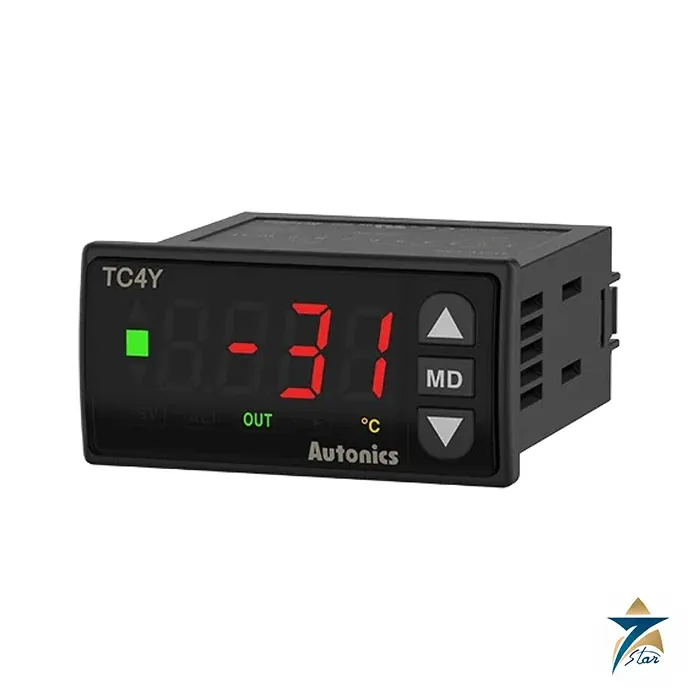
Panels with little height call for the Autonics TC4Y-14R. It is the low, wide 72 x 36 mm member of the TC series: a single-display PID temperature controller with one alarm relay, a control relay plus SSR drive output, and a 100 to 240 V AC supply. Seven Star LLC is an independent supplier serving Oman and the GCC. The numbers below are from the TC series instruction manual.
At only 36 mm high, a row of these controllers can be stacked in a door or a rack so that each heating zone gets its own unit. In heating furnaces, plastic processing and food equipment the compact size keeps the cost and size of the panel down.
Code breakdown for TC4Y-14R
| Item | Data |
|---|---|
| TC | Single display PID temperature controller family |
| 4 | Four-digit display |
| Y | DIN W 72 x H 36 mm size; bolts fasten it to the panel |
| 1 | One alarm output |
| 4 | 100 to 240 V AC 50/60 Hz supply |
| R | Control output: relay plus SSR drive |
Autonics TC4Y-14R specification summary
| Item | Data |
|---|---|
| Power | 100 to 240 V AC, 90 to 110 percent of rating, 5 VA or less |
| Sampling | 100 ms |
| Sensor inputs | K, J, L thermocouples; Cu50 and DPt100 RTD |
| Relay output | 250 V AC 3 A or 30 V DC 3 A, 1a |
| SSR drive | 12 V DC plus or minus 2 V, 20 mA maximum |
| Alarm | One relay, 250 V AC 1 A, 1a |
| Control | ON/OFF, P, PI, PD, PID |
| Hysteresis | 1 to 100 (0.1 to 50.0) |
| Memory | About 10 years, non-volatile |
| Dielectric strength | 2,000 V AC for 1 min to the case |
| Noise immunity | Plus or minus 2 kV, 1 microsecond pulse |
| Ambient temperature | -10 to 50 C |
| Humidity | 35 to 85 percent RH |
| Weight | About 85 g, 174 g with packing |
What fits in a 36 mm high front
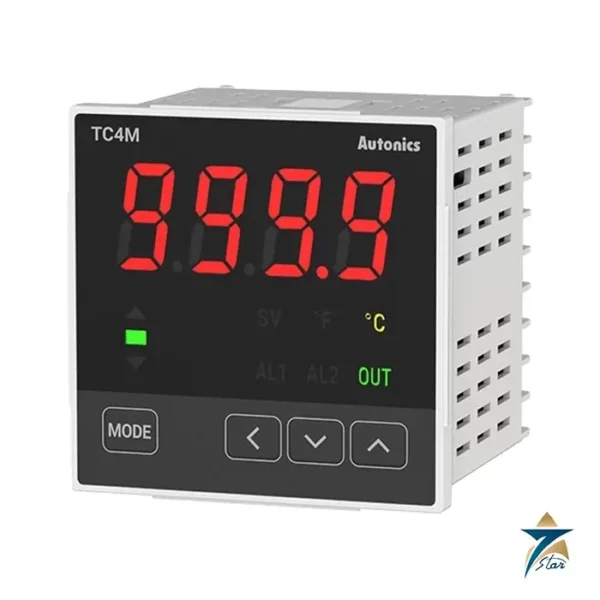
The controller has a four-digit red process display, an indicator for the setpoint, units and alarm, and the three-LED deviation indicator: an up arrow when the process is more than 2 degrees above the setpoint, a square when within plus or minus 2 degrees, and a down arrow when more than 2 degrees below. The keys are the mode key and three keys for setting values. The layout is the same as in the larger models, but the manual’s table of weight shows how much smaller it is: about 85 g, compared with about 133 g for the 72 x 72 mm unit.
The Y housing is fastened with bolts rather than the push-on bracket of other sizes; the installation figure of the manual shows a crosshead screwdriver for it.
How TC4Y-14R differs from other TC4 variants
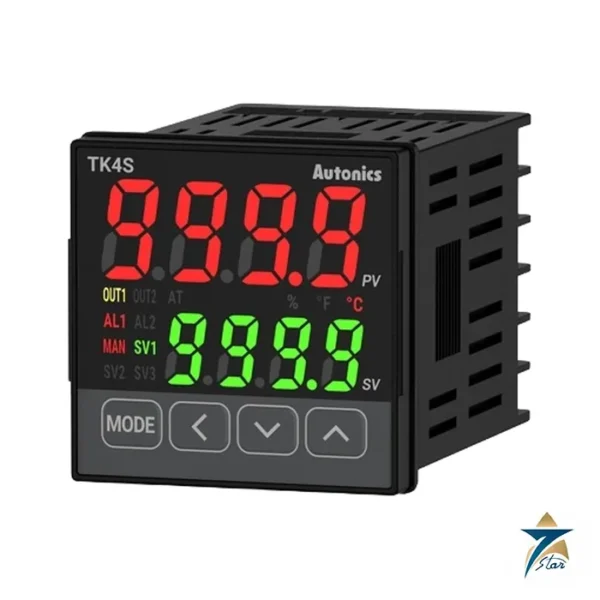
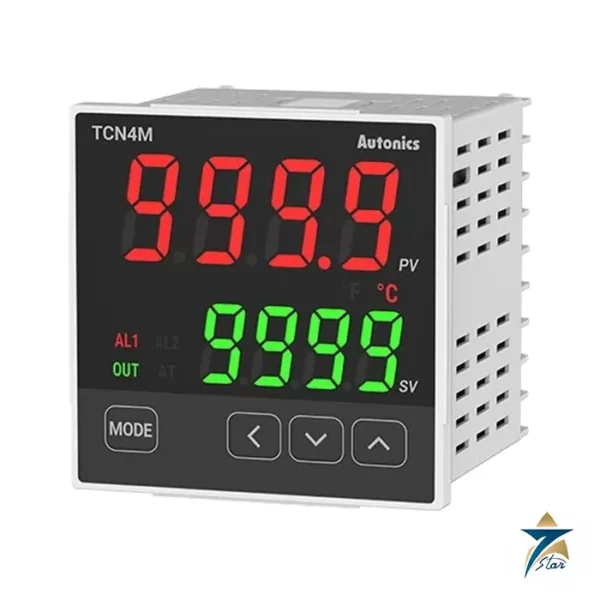
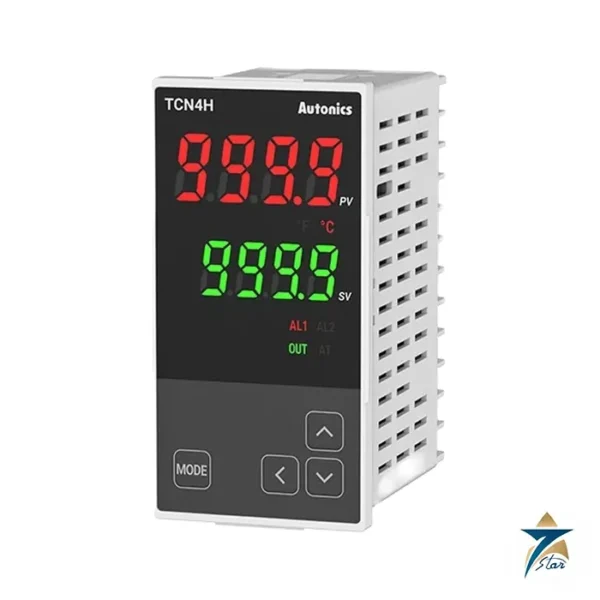
The TC4S is a 48 x 48 mm unit, the TC4M is 72 x 72 mm, the TC4W is 96 x 48 mm, the TC4H is 48 x 96 mm and the TC4L is 96 x 96 mm. The third character selects the number of alarms: N for none, 1 for one alarm, 2 for two alarms. This TC4Y-14R has one alarm, so a unit with 24 V supply or two alarms needs another code. If you need the setpoint on a second display, the TCN series is the dual display alternative.
Wiring and mounting Autonics TC4Y-14R
For the Autonics TC4Y-14R, use crimp terminals according to the manual: wire ferrules, fork lugs or round lugs, with a width between 3.0 mm and 5.8 mm. Wire a three-wire RTD with leads of the same thickness and length. For a thermocouple, use compensating cable all the way to the terminals, and observe polarity.
Fit a power switch or breaker near the controller, so the unit can be disconnected. If power and signal wires run together, add a line filter or varistor on the power side and use shielded wire for the sensor.
Why a slim controller helps
A common panel layout for multi-zone heating puts the controllers in a row, one per zone. With the Autonics TC4Y-14R the whole row needs half the height of the same row built from 72 x 72 mm controllers, so six zones fit in a strip only 216 mm tall. This matters for extruder barrels, hot-runner moulds, sealing jaws and oven zones, where the number of zones grows with machine size but the panel does not. A second advantage is that each unit runs its own PID loop, so a failure of one controller affects only one zone and the others continue.
Standardising on one controller across a plant also reduces the spares that must be held. Because the TC family shares the same inputs, outputs and parameters, a technician who knows one model can set up any other, and a spare TC4Y-14R on the shelf covers every machine with the same cut-out. The parameter list is also the same, which shortens training and helps when you write start-up procedures for the maintenance team.
Keep a written copy of the tuned values for every zone. If a controller is replaced, the new unit comes with factory defaults, and re-entering the stored proportional band, integral time, derivative time and alarm settings restores the previous behaviour in a few minutes without repeating auto-tuning on a hot machine.
Fault display
OPEN flashes when the sensor is broken or not connected. HHHH or LLLL flash when the process value is above or below the input range. Take note that with HHHH or LLLL the control output may still operate, because the controller treats the reading as the highest or lowest value and acts accordingly, which for a heater could mean full output. This is another reason to fit an independent over-temperature device.
Applications in Oman and the GCC
Typical uses are heat-sealing machines, packaging ovens, dryers, small heated tanks, laboratory equipment and the individual zones of extruders. In Gulf plants the slim format also suits retrofit of old analogue controllers that were housed in 72 x 36 mm cut-outs. Keep the panel cool: the ambient limit of 50 C is easily exceeded in an unventilated enclosure in summer.
Related items you may also need: Autonics E40S6-2500-6-L-5 Rotary Encoder Incremental | Autonics PR18-8DN M18 Inductive Proximity Sensor 8 mm | Yokogawa UT35A / UT32A Digital Indicating Controller | All Autonics products.
Documents and quotation
The TC series instruction manual is attached as a datasheet. Send an RFQ for TC4Y-14R to Seven Star LLC with quantity and delivery location and we will confirm availability and lead time for Oman and the GCC.
Other Models in the TC4 Range
Seven Star LLC supplies models from the TC4 range in Oman and the GCC. Compare the related models below and request a quote for the one that matches your application.
| Model | Category | |
|---|---|---|
| Autonics TC4M-24R 72×72 PID Temperature Controller, 2 Alarms | Controllers & Data Acquisition | View details |
| Autonics TC4Y-14R 72×36 PID Temperature Controller, 1 Alarm | Controllers & Data Acquisition | You are viewing this model |
Datasheets & Documents
- Datasheet Autonics TC4Y-14R 72x36 PID Temperature Controller, 1 Alarm Datasheet Download
Reviews (0)
How would you rate this product? Cancel reply
About brand
Autonics is a South Korean maker of sensors and controllers, founded in 1977 as a small engineering business making controllers for looms. It took the Autonics name in 1988 and opened a new corporate headquarters in Busan in 2014. Autonics makes proximity and photoelectric sensors, rotary encoders, temperature controllers, counters, timers and stepper motor systems, with factories in Busan and Yangsan.
Seven Star LLC lists the Autonics E40S6-2500-6-L-5 incremental rotary encoder and supplies Autonics sensors and control devices in Oman and the GCC.
Autonics company profile
| Founded | 1977, South Korea |
|---|---|
| Current name | Autonics, since 1988 |
| Headquarters | Busan, South Korea |
| Factories | Busan and Yangsan |
| Product families | E40 and E50 rotary encoders, PR proximity sensors, BJ photoelectric sensors, TK temperature controllers |
Milestones
- 1977: The company is founded.
- 1988: Renamed Autonics Corporation.
- 2014: Opens its Busan headquarters.
Reading the Autonics E40S encoder code
E40S is the 40 mm diameter shaft-type incremental encoder, and the 6 that follows is the 6 mm shaft. 2500 is the resolution in pulses per revolution. The next 6 means six output signals: A, B and Z with their inverted signals. L is a line driver output and the final 5 is a 5 V DC supply. The same 40 mm body is made in hollow shaft form as the E40H and E40HB series.
Where Autonics encoders are used
Servo and spindle feedback, conveyor length measurement, packaging and printing machines.
Ordering Autonics encoders: what we need
Send the complete model string from the label. If it is worn off, give the body and shaft diameter, pulses per revolution, output type, supply voltage and cable or connector style.
Facts checked against Autonics corporate profiles, October 2026.
Browse Autonics products by category: Encoders.
FAQ
Questions about the Autonics TC4Y-14R 72×36 PID Temperature Controller,
Answers from our engineering team on installation, compatibility and integration.
01What size is Autonics TC4Y-14R?
The Y size is DIN W 72 x H 36 mm, a low, wide panel format fastened with bolts, and it weighs about 85 g.
02How many alarms does the TC4Y-14R have?
It has one alarm output, a relay rated 250 V AC 1 A; the digit 1 in the code marks the single alarm.
03What supply voltage does the TC4Y-14R use?
The digit 4 means 100 to 240 V AC at 50/60 Hz with a permissible range of 90 to 110 percent and consumption of 5 VA or less.
04What happens when the sensor of TC4Y-14R breaks?
The display flashes OPEN; with out-of-range readings HHHH or LLLL appear and the output may act as if the input is at its limit.
05Which sensors work with the TC4Y-14R?
K, J and L thermocouples and Cu50 and DPt100 RTDs, with the range chosen in the input parameter.


Reviews
There are no reviews yet.