Brand:

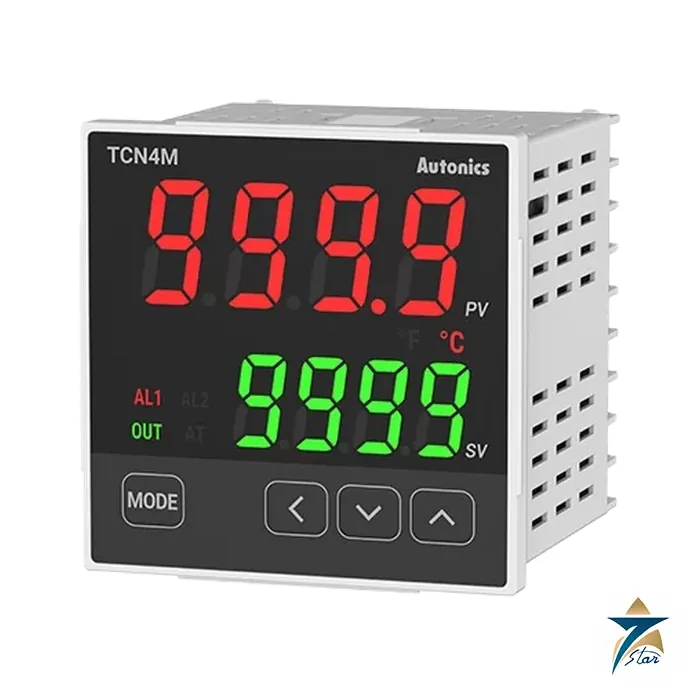
Autonics TCN4M-24R 72×72 Dual Display PID Temperature Controller

Description

Overview

Process value and setpoint at the same time: that is what the dual display of the Autonics TCN4M-24R provides. This economical PID temperature controller, in the square 72 x 72 mm DIN format, shows PV in red digits and SV in green digits, drives a relay and an SSR output, offers two alarm relays and runs from 100 to 240 V AC. Seven Star LLC is an independent supplier serving Oman and the GCC. The data below is from the TCN series instruction manual.

The extra display makes commissioning and daily operation easier because the operator sees both numbers without pressing a key, and a drifting process is noticed at once.

Understanding TCN4M-24R

  • TCN: dual display PID temperature controller series
  • 4: four-digit display
  • M: DIN 72 x 72 mm
  • 2: option output, alarm 1 and alarm 2
  • 4: 100 to 240 V AC 50/60 Hz supply (2 would be 24 V AC or 24 to 48 V DC)
  • R: control output relay plus SSR drive
  • No suffix: bolt terminal wiring; P would mean connector plug connection

Specifications of Autonics TCN4M-24R

Item Data
Display Two rows of 7-segment LEDs, PV red, SV green
Supply 100 to 240 V AC 50/60 Hz, 90 to 110 percent, 5 VA or less
Sampling period 100 ms
Inputs Thermocouples K, J, L, T, R, S; RTD Cu50 and DPt100
Relay output 250 V AC 3 A, 30 V DC 3 A, 1a
SSR drive 12 V DC plus or minus 2 V, 20 mA or less
Alarm relays 250 V AC 1 A, 1a each
Control ON/OFF, P, PI, PD, PID, heating or cooling
Hysteresis 1 to 100 (0.1 to 50.0)
Proportional band 0.1 to 999.9
Integral / derivative 0 to 9,999 s
Control cycle 0.5 to 120.0 s
Relay life 5,000,000 mechanical; 200,000 electrical
Dielectric strength 2,000 V AC, one minute, live part to case
Noise immunity Plus or minus 2 kV, 1 microsecond
Ambient temperature -10 to 50 C
Weight About 133 g, 203 g packed

Wider sensor choice

The TCN family adds T, R and S thermocouples to the K, J and L types that the single-display TC series reads. R and S are platinum thermocouples used in high-temperature furnaces and glass processes, and T is a copper-constantan type used at low temperatures. Together with Cu50 and DPt100 RTDs they cover most plant needs. The exact range of each type is in the Input Type and Using Range table of the product manual, which is the place to check before you choose the sensor.

For RTD sensors, use three leads of equal thickness and length. For thermocouples, use the matching compensating wire up to the controller terminals and observe polarity.

TCN4M-24R versus other TCN controllers

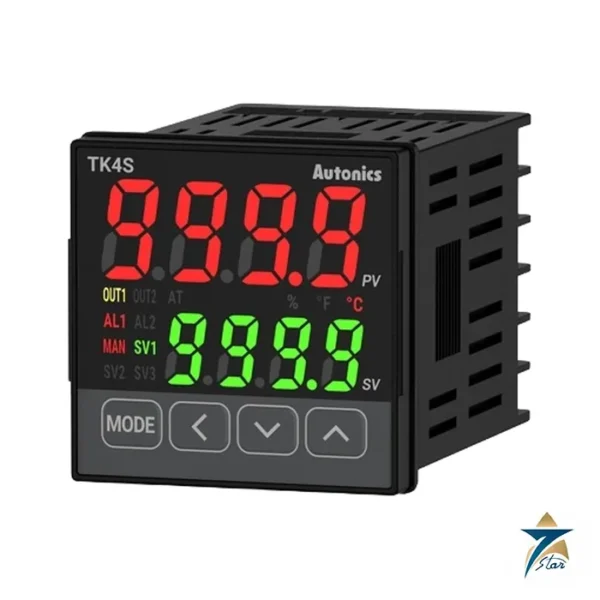
The TCN4S is 48 x 48 mm and weighs about 100 g, the TCN4H is 48 x 96 mm at about 124 g, and the TCN4L is 96 x 96 mm at about 179 g. This 72 x 72 mm TCN4M weighs about 133 g. Codes with a 2 in the supply position take 24 V AC or 24 to 48 V DC and have lower dielectric strength of 1,000 V AC. The P suffix replaces screw terminals with a connector plug, which helps when units are swapped often.

Mounting and connecting the Autonics TCN4M-24R

Insert the Autonics TCN4M-24R in the panel cut-out and push the bracket with a flathead screwdriver until it grips. Wire with ferrules, fork lugs or round lugs of the shape in the manual, choosing the lug dimensions from the table in the manual for each terminal group. A power switch or breaker must be within easy reach of the operator. Keep the sensor cable separated from power lines or add a line filter.

Outputs are the relay for the main load, the SSR drive for an external solid state relay and two alarm relays. All are on the rear terminals.

Setting up the loop

After mounting, use the three arrow keys and the mode key to enter the input type, the temperature unit and the alarm modes. With the Autonics TCN4M-24R the SV display in green shows the value being edited while the red PV display shows the parameter name, which makes menu navigation clearer than on a single-display unit. Start with auto-tuning at a setpoint near the normal working temperature, so that the P, I and D values reflect the real thermal behaviour of the load; tuning at a very different temperature gives a poor result.

The control cycle matters as much as the PID values. A relay output should use a long cycle, such as 10 to 20 seconds, to protect the contact, while an SSR drive can use a cycle of one second or less. Hysteresis only applies in ON/OFF mode, where it sets the width of the band between switching on and switching off and prevents rapid chatter at the setpoint.

Once the process is stable, record the tuned values in the commissioning file. The parameters are stored in non-volatile semiconductor memory for about 10 years, so power loss does not erase them, yet having a printed copy shortens replacement after a failure.

Errors on the display

OPEN means the sensor is disconnected, so check the wiring. HHHH means the process value is above the input range and LLLL below it. When such an error occurs the control output may still be operated as if the maximum or minimum value was present, which on a heater could mean full power. Add an independent limit device for heating processes that could be dangerous.

Applications in Oman and the GCC

Dual display controllers are used on ovens, kilns, heated tanks, dosing skids and process test stands. For high-temperature work with R or S thermocouples, check the available range in the manual. The relay output suits small loads directly, and the SSR drive suits fast cycling of heaters. Keep the panel below 50 C in summer by ventilation or shading.

Related items you may also need: Autonics E40S6-2500-6-L-5 Rotary Encoder Incremental | Autonics PR18-8DN M18 Inductive Proximity Sensor 8 mm | DEIF PPU 300 Marine Paralleling and Protection Unit | All Autonics products.

Documents and quotation

The TCN series instruction manual is attached as a datasheet. Send an RFQ for TCN4M-24R to Seven Star LLC with quantity and delivery location and we will confirm availability and lead time for Oman and the GCC.

Datasheets & Documents
  • PDF Datasheet Autonics TCN4M-24R 72x72 Dual Display PID Temperature Controller Datasheet Download
Reviews (0)

Reviews

There are no reviews yet.

How would you rate this product?

It takes about 10 seconds — just tap a star. Your email is never published.

About brand

Autonics is a South Korean maker of sensors and controllers, founded in 1977 as a small engineering business making controllers for looms. It took the Autonics name in 1988 and opened a new corporate headquarters in Busan in 2014. Autonics makes proximity and photoelectric sensors, rotary encoders, temperature controllers, counters, timers and stepper motor systems, with factories in Busan and Yangsan.
Seven Star LLC lists the Autonics E40S6-2500-6-L-5 incremental rotary encoder and supplies Autonics sensors and control devices in Oman and the GCC.

Autonics company profile

Founded 1977, South Korea
Current name Autonics, since 1988
Headquarters Busan, South Korea
Factories Busan and Yangsan
Product families E40 and E50 rotary encoders, PR proximity sensors, BJ photoelectric sensors, TK temperature controllers

Milestones

  • 1977: The company is founded.
  • 1988: Renamed Autonics Corporation.
  • 2014: Opens its Busan headquarters.

Reading the Autonics E40S encoder code

E40S is the 40 mm diameter shaft-type incremental encoder, and the 6 that follows is the 6 mm shaft. 2500 is the resolution in pulses per revolution. The next 6 means six output signals: A, B and Z with their inverted signals. L is a line driver output and the final 5 is a 5 V DC supply. The same 40 mm body is made in hollow shaft form as the E40H and E40HB series.

Where Autonics encoders are used

Servo and spindle feedback, conveyor length measurement, packaging and printing machines.

Ordering Autonics encoders: what we need

Send the complete model string from the label. If it is worn off, give the body and shaft diameter, pulses per revolution, output type, supply voltage and cable or connector style.

Facts checked against Autonics corporate profiles, October 2026.

FAQ

Questions about the Autonics TCN4M-24R 72×72 Dual Display PID

Answers from our engineering team on installation, compatibility and integration.

01What is the difference between TCN4M-24R and TC4M-24R?
The TCN is a dual display controller that shows PV and SV together and accepts T, R and S thermocouples as well; the TC shows one value.
02What size is Autonics TCN4M-24R?
The M size is DIN 72 x 72 mm, and the unit weighs about 133 g without packing.
03Which outputs does the TCN4M-24R have?
A 250 V AC 3 A relay, a 12 V DC SSR drive at up to 20 mA and two alarm relays of 250 V AC 1 A.
04Which supply does TCN4M-24R use?
The 4 in the code selects 100 to 240 V AC at 50/60 Hz; the 2 option would be 24 V AC or 24 to 48 V DC.
05How often does the TCN4M-24R sample the input?
The sampling period is 100 ms, and the control cycle can be set between 0.5 and 120 seconds.