- Automation & ControlView all 3,107 products
- Automation Accessories
- AC Drives
- PLC & I/O Cards
- Industrial Communications
- Vibration Monitoring
- Isolator & Barrier
- Controllers & Data Acquisition
- Safety Switches & Guard Locking
- Encoders
- Motor Soft Starters
- CCTV & Security
- Pneumatic Cylinders
- HMI Displays
- Servo Drives
- Industrial Computers
- Machine Vision
- Automation Software
- Robotics
Brand: Autonics
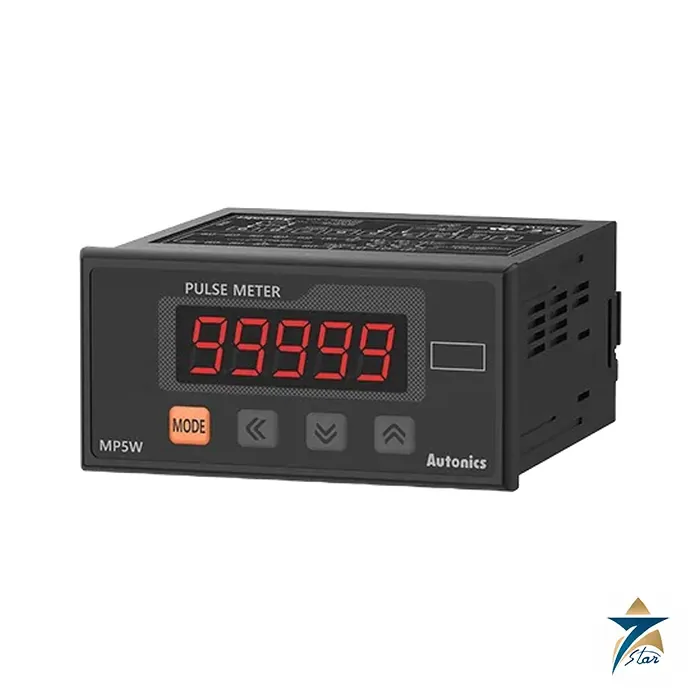
Autonics MP5W-4N 96 x 48 mm Digital Pulse Meter
Description
Overview
A panel-mounted pulse meter earns its place when operators must read speed, flow rate, frequency or a running total at a glance, and the Autonics MP5W-4N does that on a bright five-digit display. It is the DIN 96 x 48 mm member of the MP5 family, powered from 100 to 240 V AC, and the trailing N in the code identifies the indicator version, which has no comparative outputs. Think of it as a precise, configurable display head: it takes pulses from a proximity switch, encoder or flow sensor, applies a scaling factor and shows the result in engineering units. Seven Star LLC is an independent supplier serving Oman and the GCC.
Decoding Autonics MP5W-4N
The ordering table of the instruction manual defines each position. MP5 is the product line, and the letter W selects the largest of the three frame sizes, W 96 by H 48 mm, the others being S at 48 x 48 mm and Y at 72 x 36 mm. The number 4 picks the supply, 100 to 240 V AC at 50 or 60 Hz, whereas a 2 would give 24 V AC or 24 to 48 V DC. The last letter N means indicator only, with no relay, no open-collector comparative outputs and no communications. Siblings such as MP5W-4A add relay outputs, and codes with 4 or 8 in the last digit add current transmission or RS485 to the same housing, so match the output letter carefully to your project.
What the Autonics MP5W-4N measures
The input stage accepts voltage pulses, non-voltage contact signals and open-collector sensors. The manual lists solid state input at up to 50 kHz for narrow pulses of at least 10 microseconds, a second solid state range at up to 5 kHz, and contact input up to 45 Hz. A 4.5 to 24 V level counts as high and 0 to 1 V as low, with an input impedance of 3.9 kilohm for the voltage input. Sixteen operation modes, numbered F1 to F16, turn those pulses into frequency, rotation speed, passing speed, period, pulse width, totals and other values, and the display range runs from minus 19999 to 99999 with prescale factors between 0.0001 x 10 to the minus 9 and 9.9999 x 10 to the ninth.
Specification summary for Autonics MP5W-4N
| Parameter | Manual data |
|---|---|
| Frame size | DIN W 96 x H 48 mm, panel cut-out 92 x 45 mm |
| Supply | 100 to 240 V AC, 50 or 60 Hz, permissible range 90 to 110 percent |
| Power consumption | 15 VA or less |
| Display | 7-segment LED, zero blanking, minus 19999 to 99999 |
| Prescale | 0.0001 x 10 to the minus 9 up to 9.9999 x 10 to the ninth |
| Display cycle | OFF, 0.05, 0.5, 1, 2, 4 or 8 seconds |
| Input frequency | Solid state 1: 50 kHz; solid state 2: 5 kHz; contact: 45 Hz |
| Sensor power | 12 V DC plus or minus 10 percent, 80 mA external supply |
| Memory retention | 100,000 write operations, non-volatile semiconductor memory |
| Insulation | 100 megohm or more at 500 V DC |
| Dielectric strength | 3000 V AC for 1 minute, live part to case |
| Noise immunity | plus or minus 2 kV square wave |
| Ambient conditions | minus 10 to plus 50 degrees C; 35 to 85 percent RH |
| Protection | IP54 on the front, IEC |
How Autonics MP5W-4N differs from other MP5 variants
Against the 48 x 48 mm MP5S, the Autonics MP5W-4N has a larger frame and a larger power budget, up to 15 VA compared with 7.5 VA. The MP5Y at 72 x 36 mm draws up to 9 VA. Within the W frame the key difference is the output letter. The N version here is a pure indicator. The 1 and 2 variants add five open-collector comparative outputs, 4 adds a 4 to 20 mA or 0 to 20 mA process value transmission with 0.3 percent accuracy, and 8 or 9 adds Modbus RTU over RS485. The supply digit also separates the 24 V versions from this 100 to 240 V AC unit.
Typical uses in Oman and the GCC
Pulse meters are widely fitted on rotating equipment and metering skids. A display in front of a pump panel can show shaft speed from a proximity switch, while a flow counter on a chemical dosing line can show litres per minute from a turbine meter pulse output. In bottling and packaging plants it shows line speed or the number of pieces passed, and in water utilities it is often placed next to an impeller flow sensor on a pump station. Because the frame is a standard DIN cut-out, replacement in an existing board is straightforward.
Panel installation and wiring
Cut the opening to the stated size, push the unit in from the front and secure it with the two mounting brackets. Keep signal cable away from power cables, use shielded cable on the input, and follow the manual’s advice to fit a line filter or varistor where the supply is noisy. The power supply connections and the input terminals are on a screw terminal block, and an optional terminal protection cover can be ordered separately. Remember the manual’s rule that the unit is meant for installation in a panel. Install a switch or breaker close by so the supply can be disconnected.
Setup and care
The parameters are arranged in groups that are reached with the MODE key, and the settings can also be handled from a PC with the manufacturer’s free DAQMaster software when a communications model is used. After entering the operation mode, input type, decimal point and prescale, test the display with a known pulse source. Wipe the bezel with a dry cloth only, check the terminal screws after commissioning and keep the unit in the temperature range given above.
Choosing and ordering Autonics MP5W-4N
Confirm the supply voltage, the sensor type and the need for outputs. If your plant needs alarms or a process signal in addition to the display, quote the matching output variant instead of this indicator. State Autonics MP5W-4N in your enquiry and add details of the sensor so that the right prescale can be advised.
Related items you may also need: Autonics E40S6-2500-6-L-5 Rotary Encoder Incremental | Yokogawa UT55A-000-10-00 Digital Indicating Controller | NI cRIO-9045 CompactRIO Controller | 8-Slot, Kintex-7 FPGA | All Autonics products.
Documents and quotation
The instruction manual for the MP5 series is attached and covers ordering codes, wiring, parameters and dimensions. To request a quotation send your RFQ with Autonics MP5W-4N, quantity and delivery location in Oman or the GCC.
Datasheets & Documents
- Datasheet Autonics MP5W-4N 96 x 48 mm Digital Pulse Meter Datasheet Download
Reviews (0)
How would you rate this product? Cancel reply
About brand
Autonics is a South Korean maker of sensors and controllers, founded in 1977 as a small engineering business making controllers for looms. It took the Autonics name in 1988 and opened a new corporate headquarters in Busan in 2014. Autonics makes proximity and photoelectric sensors, rotary encoders, temperature controllers, counters, timers and stepper motor systems, with factories in Busan and Yangsan.
Seven Star LLC lists the Autonics E40S6-2500-6-L-5 incremental rotary encoder and supplies Autonics sensors and control devices in Oman and the GCC.
Autonics company profile
| Founded | 1977, South Korea |
|---|---|
| Current name | Autonics, since 1988 |
| Headquarters | Busan, South Korea |
| Factories | Busan and Yangsan |
| Product families | E40 and E50 rotary encoders, PR proximity sensors, BJ photoelectric sensors, TK temperature controllers |
Milestones
- 1977: The company is founded.
- 1988: Renamed Autonics Corporation.
- 2014: Opens its Busan headquarters.
Reading the Autonics E40S encoder code
E40S is the 40 mm diameter shaft-type incremental encoder, and the 6 that follows is the 6 mm shaft. 2500 is the resolution in pulses per revolution. The next 6 means six output signals: A, B and Z with their inverted signals. L is a line driver output and the final 5 is a 5 V DC supply. The same 40 mm body is made in hollow shaft form as the E40H and E40HB series.
Where Autonics encoders are used
Servo and spindle feedback, conveyor length measurement, packaging and printing machines.
Ordering Autonics encoders: what we need
Send the complete model string from the label. If it is worn off, give the body and shaft diameter, pulses per revolution, output type, supply voltage and cable or connector style.
Facts checked against Autonics corporate profiles, October 2026.
Browse Autonics products by category: Encoders.
FAQ
Questions about the Autonics MP5W-4N 96 x 48 mm Digital Pulse Meter
Answers from our engineering team on installation, compatibility and integration.
01What supply voltage does the Autonics MP5W-4N use?
The 4 in the code selects 100 to 240 V AC at 50 or 60 Hz, with a permissible range of 90 to 110 percent of the rated voltage.
02Does the MP5W-4N have relay or transistor outputs?
No. The N at the end of the code means an indicator version without comparative outputs; output versions carry other letters or digits.
03What size is the panel cut-out for the MP5W-4N?
The manual gives the W series panel cut-out as 92 x 45 mm for the DIN W 96 x H 48 mm frame.
04What is the maximum input frequency of the MP5W-4N?
Solid state input is rated up to 50 kHz with a minimum pulse width of 10 microseconds, with a second range up to 5 kHz and contact input to 45 Hz.
05What display range does the MP5W-4N offer?
It shows minus 19999 to 99999 on a 7-segment LED display with zero blanking, scaled with a prescale factor from 0.0001 x 10 to the minus 9 to 9.9999 x 10 to the ninth.


Reviews
There are no reviews yet.