Two guide rods and a plate: a non-rotating pusher
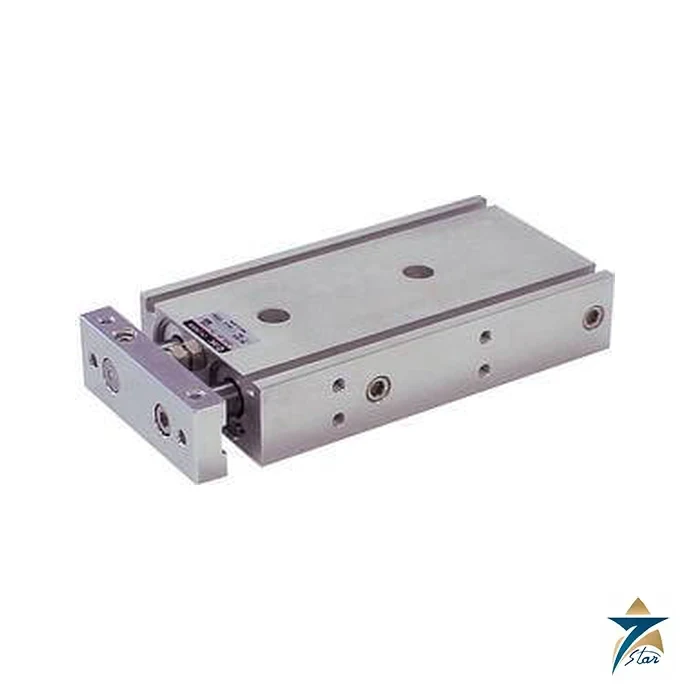
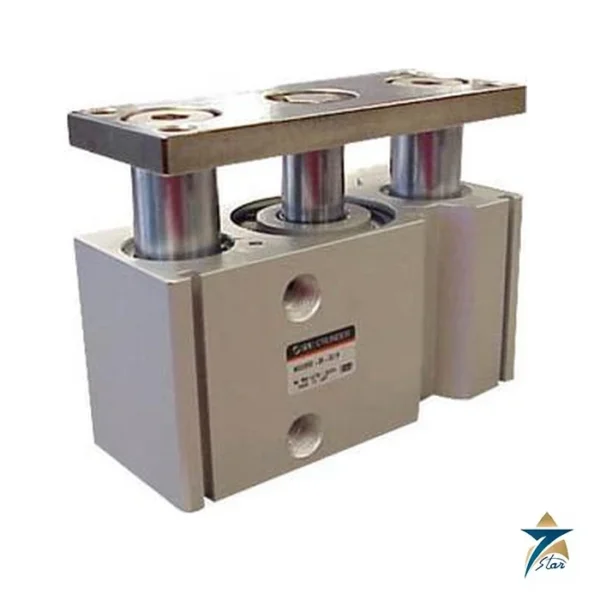
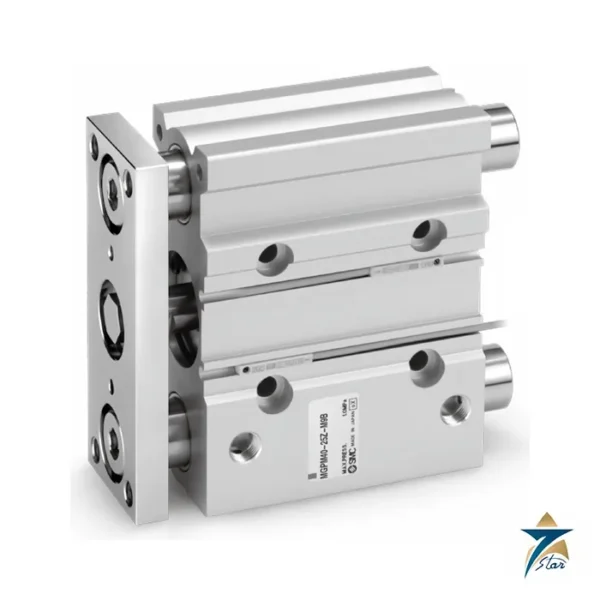
CXSM20-100 is a basic-type dual rod cylinder from the SMC CXS series, in the slide-bearing version. Two piston rods run side by side and are joined by a front plate, so the output cannot rotate and the plate takes side loads that a single-rod cylinder would not tolerate. It is a compact way to push, lift or clamp a tool where a guided straight motion is required.
The code CXS M 20 – 100 reads: M is slide bearing (L is ball bushing bearing, with the same dimensions), 20 is the 20 mm bore and 100 is the stroke in mm. The thread-type letter is omitted, so ports are M thread (M5 x 0.8) for 6 to 20 mm bores; the 25 and 32 mm bores use Rc 1/8 and can take NPT or G letters. No auto switch is specified, but the cylinder has a built-in magnet.
Technical specifications
| Parameter |
Specification |
| Series / type |
CXS dual rod cylinder, basic type, slide bearing (CXSM) |
| Bore size / rod diameter |
20 mm / 10 mm (rod diameter per piston area table) |
| Stroke |
100 mm (a standard stroke for the 20 mm bore; longer strokes are available as the -XB11 long stroke made-to-order type) |
| Fluid |
Air, non-lube |
| Proof pressure / maximum operating pressure |
1.05 MPa / 0.7 MPa |
| Minimum operating pressure |
0.05 MPa |
| Ambient and fluid temperature |
-10 to 60 deg C (no freezing) |
| Piston speed |
30 to 700 mm/s (20 mm bore) |
| Cushion |
Rubber bumper |
| Stroke adjustable range |
0 to -5 mm compared with the standard stroke |
| Allowable kinetic energy |
0.17 J |
| Piston area |
628 mm2 OUT, 471 mm2 IN; theoretical output at 0.5 MPa 314 N OUT, 236 N IN |
| Port size |
M5 x 0.8 |
| Weight |
0.74 kg for CXSM20 at 100 mm stroke (catalogue weight table) |
The kinetic energy limit decides the load
Because the cushion is a rubber bumper, the catalogue limits the energy the cylinder can absorb at the stroke end to 0.17 J for the 20 mm bore. Moving mass and speed must be selected so that the kinetic energy (half the mass multiplied by the speed squared) stays below that, and above 400 mm/s or for heavier loads the manufacturer model-selection graphs for the mounting orientation (vertical or horizontal) must be used.
In practice, a 1 kg load at 400 mm/s carries about 0.08 J, so it is within the figure; the same mass at 700 mm/s carries 0.245 J and is not. These are derived values from the general formula, not catalogue statements.
Mounting notes
The front plate carries the load, and the dimension drawings in the catalogue show the mounting holes on the body and plate. Stroke adjustment of 0 to -5 mm below the nominal stroke is available. Fit the speed controllers on the exhaust side and keep the load centre close to the plate, since the overhang of the guide rods shortens bearing life when the load is far out on the plate. The slide-bearing version is the economical choice; the ball-bushing version CXSL20-100 gives lower friction and the same dimensions, according to the catalogue.
Piston-speed minimum of 30 mm/s means the cylinder is not suitable for very slow feed without a low-speed variant; check the made-to-order list in the catalogue for options.
Documents and quotation
The SMC CXS catalogue linked at the end of this page has the how-to-order page, specifications, weights, model selection graphs and dimensions. Please confirm bearing type, stroke, thread and auto-switch needs before ordering. More cylinders are under Pneumatic Cylinders. Seven Star LLC is an independent supplier and quotes the exact code on request.
How the CXSM20-100 Dual Rod Cylinder Works
The CXS body contains two parallel bores, each with its own piston and rod. Air supplied to the head side drives both pistons together, and the plate bolted across the two rod ends moves as a single guided output. Because the two rods are fixed to one plate, the output cannot turn about its axis, which is why the CXS series is used without an external guide. In the CXSM version the rods run in slide bearings; the CXSL version uses ball bushing bearings with the same mounting dimensions.
Rubber bumpers absorb the impact at the stroke ends, and a bumper bolt on the retracted (IN) end allows the stroke to be shortened by 0 to 5 mm. A magnet is built into the piston as standard, so auto switches can be fitted later without changing the cylinder. The cylinder has two supply ports for each direction, so the unused port in each pair is plugged according to the installation.
CXSM20-100 Selection & Ordering Guide
| Code element |
Options in the CXS basic type |
In CXSM20-100 |
| Bearing type |
M slide bearing / L ball bushing bearing |
M |
| Bore size |
6, 10, 15, 20, 25, 32 mm |
20 mm |
| Thread type |
Nil M thread (Ø6 to Ø20); Rc 1/8, TN NPT 1/8, TF G 1/8 (Ø25, Ø32) |
Nil (M5 x 0.8) |
| Stroke |
Standard strokes per bore |
100 mm |
| Auto switch |
Nil without switch (built-in magnet) or e.g. D-Y59A, D-Y7P, D-Y7BW solid state, D-Z73, D-Z76, D-Z80 reed |
None |
| Number of switches |
Nil 2 pcs, S 1 pc, n pcs |
– |
Made-to-order versions in the catalogue include -XB6 heat resistant (–10 to 150°C), -XB9 low speed (10 to 50 mm/s), -XB13 low speed (5 to 50 mm/s), -XB19 high speed, -XC22 fluororubber seals, -XC85 food-grade grease and -X593 without plate. With auto switches the code becomes, for example, CXSM20-100-Y7BW. Our team can help confirm the correct ordering code, switch model and lead length for your machine.
Installation & Maintenance
- Mount the body on a flat surface (SMC reference flatness 0.05 mm or less); the cylinder can be mounted from three directions.
- Keep the piston rods retracted while mounting so the sliding surfaces are not scratched.
- Plug the unused supply ports; for the 10 to 20 mm bores the plug part number is CXS20-08-28749A.
- After adjusting the stroke, tighten the hexagon nut on the bumper bolt, and never run the cylinder with the bumper bolt removed. The replacement bumper for 20 and 25 mm bores is CXS20-34A.
- Never operate the cylinder with its plate removed, do not use it as a stopper, and do not operate it in a pressurised environment.
- Keep hands clear of the plate and housing while the cylinder is under air.
Typical Applications in Oman & the GCC
The CXSM20-100 suits light pushing, lifting, transfer and clamping on packaging, bottling, food processing and assembly lines in Oman and across the GCC, where a compact guided stroke is needed without adding external linear guides. In hot and dusty plant areas, the slide-bearing CXSM type is a straightforward choice, while the ball-bushing CXSL type suits applications needing lower sliding resistance.
Why Source from Seven Star LLC
Seven Star LLC supplies SMC cylinders and pneumatic components across Oman and the GCC. Send us the bore, stroke and switch requirement and request a quote; our team can help confirm the correct ordering code.




Reviews
There are no reviews yet.