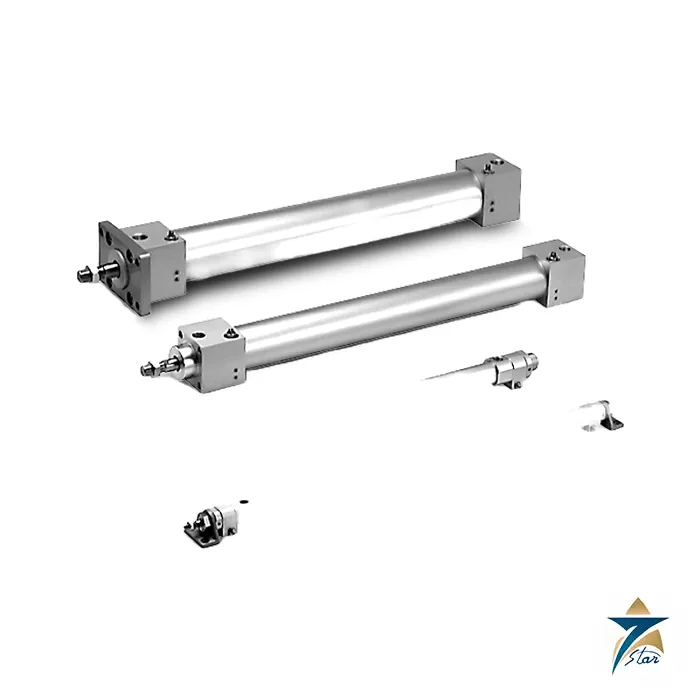
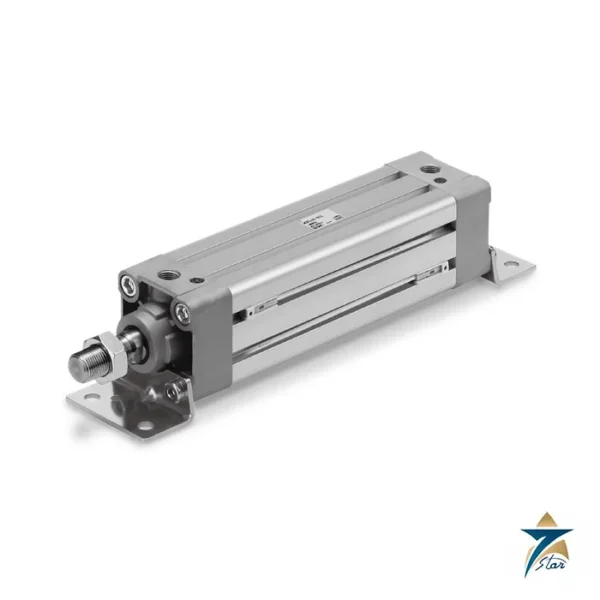
A heavy-duty round-body cylinder with air cushion
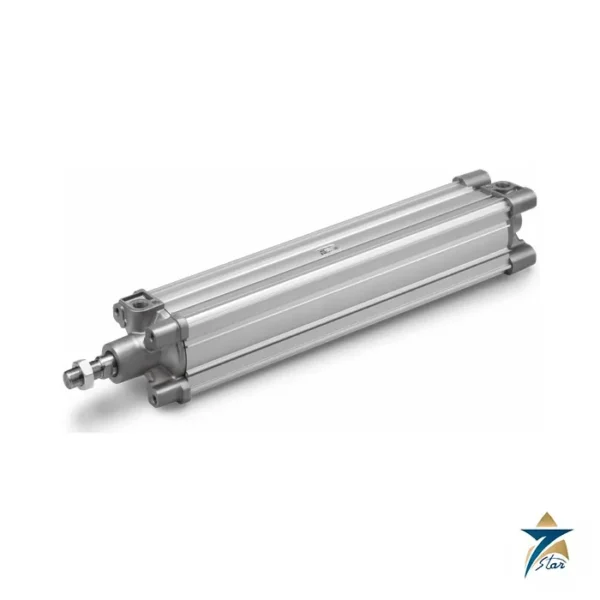
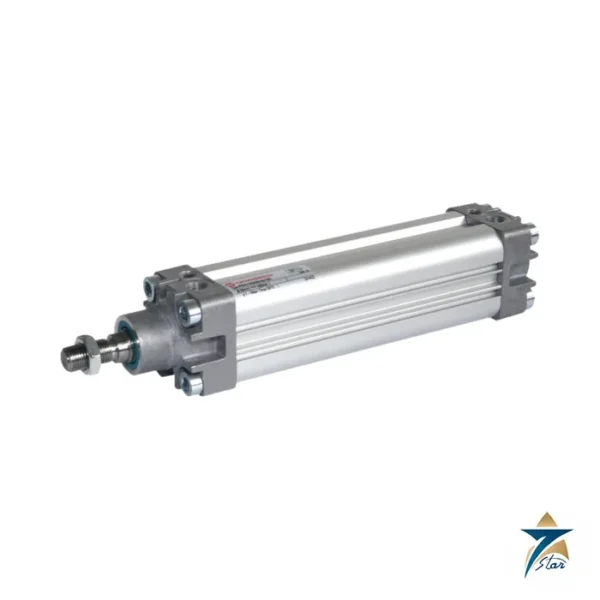
RHCB32-100 is a double-acting, single-rod air cylinder from the SMC RHC high power cylinder series. It has a round tube and air cushions at both ends, and the catalogue gives it a high maximum energy absorption, so it is used where a fast, heavy load has to be stopped at the end of the stroke, for instance in handling and transfer machinery.
The code reads RHC (series), B (basic mounting; L is axial foot, F rod-side flange, G head-side flange), 32 (the 32 mm bore) and 100 (the 100 mm stroke). No thread letter is added, so the ports are Rc; TN would give NPT.
Technical specifications
| Parameter |
Specification |
| Series / type |
RHC high power cylinder, double acting, single rod, basic type |
| Bore size / rod diameter |
32 mm / 12 mm |
| Stroke |
100 mm; standard stroke for the 32 mm bore is up to 1000 mm |
| Fluid |
Air (non-lube) |
| Proof pressure / maximum operating pressure |
1.5 MPa / 1.0 MPa |
| Minimum operating pressure |
0.05 MPa |
| Ambient and fluid temperature |
-10 to 60 deg C (no freezing) |
| Piston speed |
50 to 3000 mm/s |
| Cushion / maximum energy absorption |
Air cushion / 21 J for the 32 mm bore |
| Theoretical output at 0.5 MPa |
402 N OUT, 346 N IN (catalogue table) |
| Weight |
Basic type 2.04 kg at 500 mm stroke, plus 0.09 kg per 50 mm; about 1.32 kg at 100 mm stroke (derived by linear calculation) |
What the cushion rating means
The air cushion absorbs the energy of the moving mass near the end of the stroke, and the catalogue lists the maximum energy it can take: 21 J for the 32 mm bore. The energy of the load is half the mass times the speed squared, so a 5 kg load at 1 m/s carries 2.5 J, well inside the rating. The catalogue also states a minimum recommended stroke of 250 mm for its cushion data, because shorter strokes may not give the full cushioning effect; for a 100 mm stroke the cushion capability must be confirmed from the catalogue before the speed is raised.
The wide piston speed range of 50 to 3000 mm/s makes the RHC suited to fast machines, but speed in combination with the load must always remain within the energy limit.
Mounting and options
Basic, axial foot, rod-side flange and head-side flange mounting are listed, with foot and flange brackets ordered under their own part numbers (for example RHC-L032 and RHC-F032 for the 32 mm bore; two foot brackets are needed for one cylinder). Made-to-order versions include a special port location, stainless-steel parts and a water-resistant lubrication option, according to the catalogue.
Auto switches can be mounted for position sensing, and the catalogue lists the available models in its how-to-order table.
Checking the application before ordering
The RHCB32-100 is chosen when a load has to move quickly and stop cleanly at the end of a 100 mm stroke. To confirm that it suits the job, collect four pieces of information: the mass being moved, including any fixture or tooling on the rod end; the target piston speed; the orientation of the stroke (horizontal, vertical up or vertical down); and the supply pressure actually available at the machine, not only the compressor setting. With these, the kinetic energy at the end of the stroke can be compared with the 21 J cushion figure given above, and the required force can be compared with the theoretical output table. A vertical load or a side load on the rod changes the picture, so mention it in the enquiry; an external guide may be needed to keep side load off the rod and bushing.
Installation and first adjustment
Mount the cylinder so that the rod moves in line with the load, and check the alignment through the whole stroke before the rod end is tightened. Any misalignment shows up later as uneven wear on the rod seal and bushing. Blow out the supply pipes before connecting them, so that swarf and thread sealant do not reach the cylinder, and use fittings that match the Rc port thread. Flow controls in meter-out arrangement are the usual way to set the speed.
Setting the cushion
Start with the cushion needles closed far enough to give a soft stop, run the cylinder at reduced speed, and then raise the speed step by step while opening or closing the needles until the piston reaches the end smoothly without bouncing back or striking hard. Adjust both ends separately, because the load and pressure conditions are rarely identical in the two directions. Lock the setting once it is correct and record it for maintenance staff.
Air quality and Omani plant conditions
The cylinder is listed for non-lube air, so it does not need an oiler. If oil is introduced once, however, it should be kept up, because it washes out the original grease. Clean, dry air matters more in Oman than in many places: high humidity on the coast can bring condensate into the lines, and fine dust in desert and quarry plants finds its way to the rod. A filter and a drain close to the machine, and regular wiping of the piston rod, help the seals reach a normal service life. Keep the operating temperature inside the -10 to 60 deg C range quoted above, which can mean shading cylinders mounted outdoors in summer.
Routine maintenance
Check periodically for air leaking past the rod seal, scoring on the rod, loose mounting bolts and a change in the cushioning behaviour. A cylinder that starts to strike hard at the end of the stroke may have a worn cushion seal or a changed load, and should be examined before damage spreads to the head covers or the machine.
Documents and quotation
The SMC RHC catalogue PDF below has the how-to-order page, specification, force and weight tables and dimensions. Please confirm mounting, stroke, thread and switch needs before ordering. More cylinders are listed under Pneumatic Cylinders. Seven Star LLC is an independent supplier and quotes the exact code on request.




Reviews
There are no reviews yet.