Entry-level manual distillation for ASTM D86 routine testing
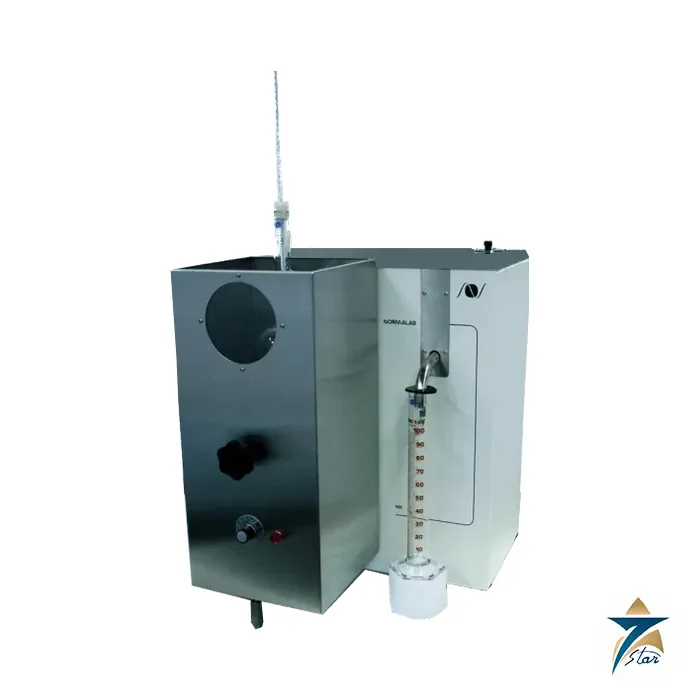
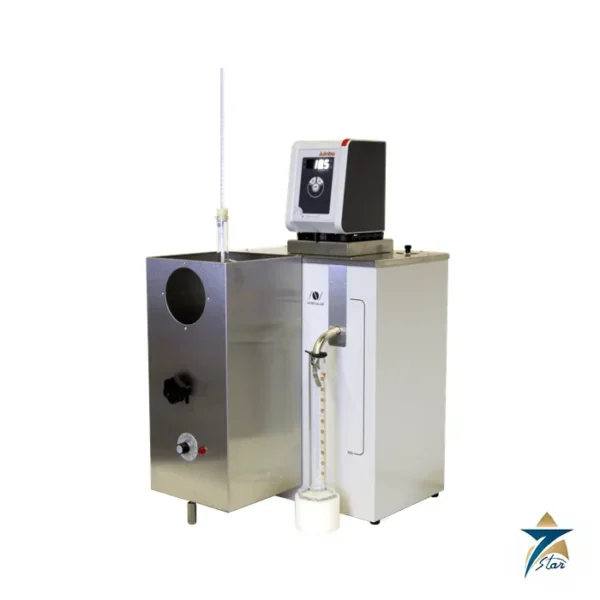
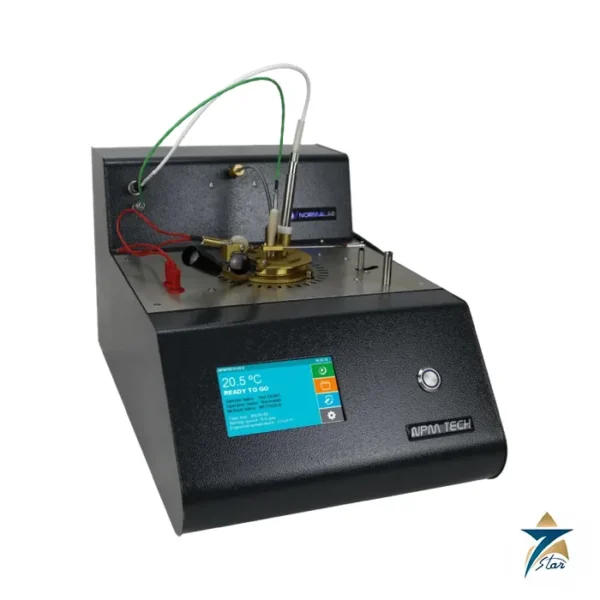
The Normalab NDI Basic is the manual member of Normalab’s atmospheric distillation family. It is an electrically heated batch distillation unit delivered with the glassware and accessories needed to run an ASTM D86 test, so a laboratory can start boiling-range work without sourcing the flask, receiver, thermometers and heater plates separately. The operator controls heating and records the temperature and volume readings by hand.
Technical specifications
| Parameter |
Specification |
| Manufacturer / model |
Normalab NDI Basic |
| Order number |
941228 |
| Heating |
Electric heating element |
| Temperature range |
Ambient to 400 °C |
| Cooling of heating compartment |
Compressed air, 2 bar maximum, at end of test |
| Connections |
Drain cock of the condenser bath; 2 teats (input/output) for the cooling coil; 1 pipe for compressed air |
| Safety |
Earth leakage circuit breaker |
| Power supply |
230 V, 50 Hz, 6 A |
| Dimensions (W x D x H) |
380 x 490 x 510 mm |
| Weight |
21 kg |
| Bath fluid |
10 L water/glycol 50/50 mixture for the condensing bath |
Standards and application range
Normalab lists ASTM D86, D850 and D1078, ISO 3405, IP 123 and IP 195 and related methods. The scope in the brochure covers natural, motor and aviation gasolines, aviation turbine fuels, special boiling point spirits, naphthas, white spirits, kerosines, gas oils and distillate fuel oils. Testing gasoline and other volatile samples needs a condenser temperature below ambient, so the brochure states that a cryostat of 7 to 10 L working from -15 to 60 °C (reference 23206) is required below ambient temperature.
A manual unit is a sensible choice for laboratories with a small distillation workload, for training, or as a back-up to an automated analyzer. If the test must be logged electronically or run unattended, look at the semi-automatic NDI Classic or the NDI 450 instead.
In a D86 test a measured 100 mL sample is heated in a flask at a rate set by the method while the vapour is condensed and collected in a graduated receiver. Temperature is recorded against recovered volume, from the initial boiling point through the percent-recovered points to the final boiling point or dry point, and the test also reports recovery, residue and loss. The sample group (decided by vapour pressure and boiling range) fixes the flask, heater plate, condenser temperature and heating rate, which is why the group must be known before the glassware kit is chosen.
Scope of delivery
- Graduated receiver 100 mL (PN 19425) and distillation flask 125 mL (PN 24019)
- Ceran boards 50 mm and 100 mm (PN 20348, 20349)
- ASTM 7C and 8C thermometers (PN 11494, 11495), without certificate; calibration on request
- Bag of pumice (PN 60514), condenser cleaning cable (PN 40009), 5 mL graduated cylinder (PN 12609EC)
Listed options on the product page: cryostat for group 1 and 2 analysis, glass cooling bath and a 200 mL distilling flask.
Running a manual D86 test well
With a manual unit the quality of the result depends on the operator following the method closely. The key controls are the heating rate from the start of heating to the initial boiling point, the time from initial boiling point to 5% recovered, and the uniform average condensation rate of 4 to 5 mL per minute during the main part of the distillation, as specified in ASTM D86. Readings of temperature and receiver volume are taken at each required percentage, and the barometric pressure is recorded so that temperatures can be corrected to standard pressure. Practice and a consistent routine make a manual unit capable of results that satisfy the method precision for routine quality control.
Choosing the condenser bath temperature
The sample group defines the condenser and receiver temperatures. Volatile groups such as gasoline need a cold condenser bath, which is why the cryostat option is listed for group 1 and 2 analysis. Heavier products such as kerosene, diesel and gas oil (group 4) use a warmer condenser, and for these the cryostat may not be necessary if ambient conditions allow the required bath temperature to be held.
Laboratory set-up and safety
- Install the unit in a fume hood or a well-ventilated area, because petroleum vapours are flammable and harmful.
- Provide a 230 V, 50 Hz supply with protective earth; the earth leakage circuit breaker on the unit does not replace correct building wiring.
- Connect clean, dry compressed air at no more than 2 bar for cooling the heating compartment at the end of each test.
- Fill the condenser bath with the 50/50 water/glycol mixture and check the level and condition regularly.
- Inspect glassware for cracks or star marks before each run and replace damaged flasks immediately.
- Have thermometers verified or calibrated at the interval set by the laboratory quality system.
Applications in Oman and the GCC
Refinery quality-control laboratories, fuel import terminals, depot and blending facilities, power-plant fuel receipt testing, independent inspection laboratories and university or training laboratories all use D86 distillation to confirm that gasoline, jet fuel, kerosene and diesel meet specification. In hot regions laboratories should control room temperature, because high ambient temperatures make it harder to hold the receiver and condenser temperatures required for volatile samples without the cryostat.
Manual, semi-automatic or automatic?
A manual unit has the lowest purchase cost and the simplest maintenance, with no software, sensors or level followers to service. The trade-off is operator time: each test needs continuous attention, and results are recorded by hand. Laboratories that run several D86 tests every shift, or that need electronic data transfer to a LIMS, usually justify an automated analyzer, while keeping a manual unit as a reference or back-up instrument.
RFQ checklist
- Order number 941228 and quantity.
- Product groups to be tested.
- Cryostat, glass cooling bath or 200 mL flask options.
- Thermometer certificates or calibration requirements.
- Spare glassware and consumables for the first year.
Documents and quotation
The manufacturer’s brochure is linked on this page. Seven Star LLC, an independent supplier in Muscat, quotes the unit with the rest of its liquid analytical systems. No photograph of sufficient resolution was available from the manufacturer at the time of listing. Confirm the sample groups, cryostat need and thermometer certificates before ordering.











Reviews
There are no reviews yet.