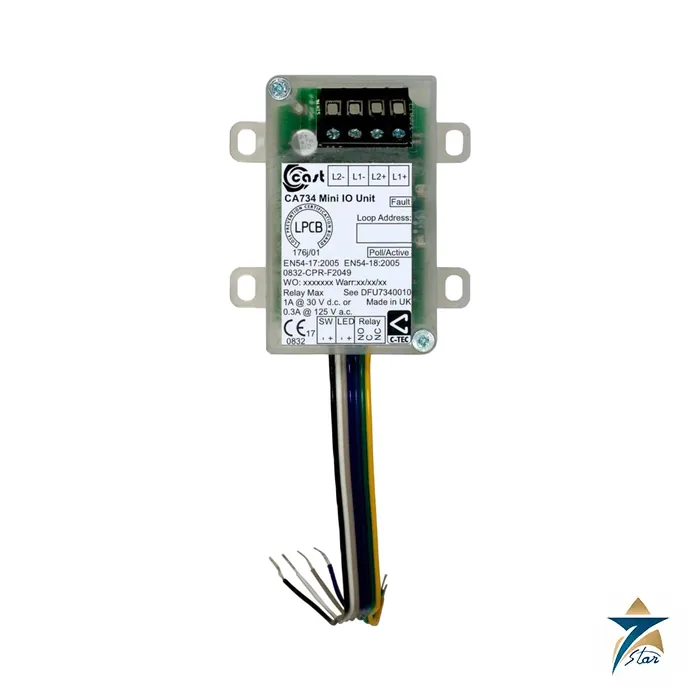
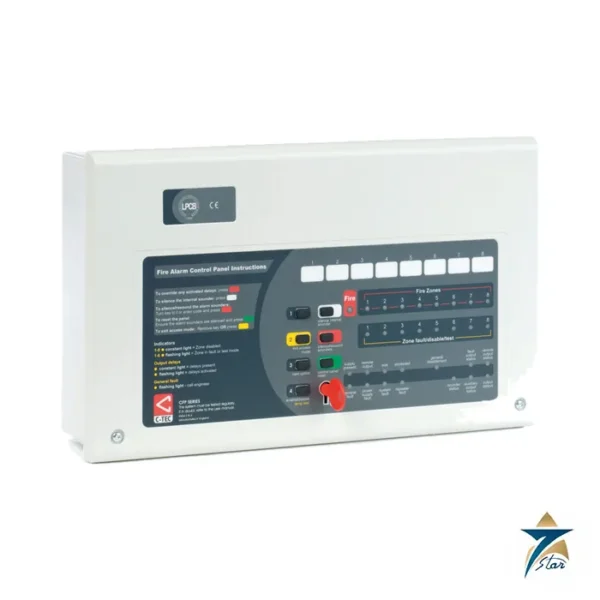
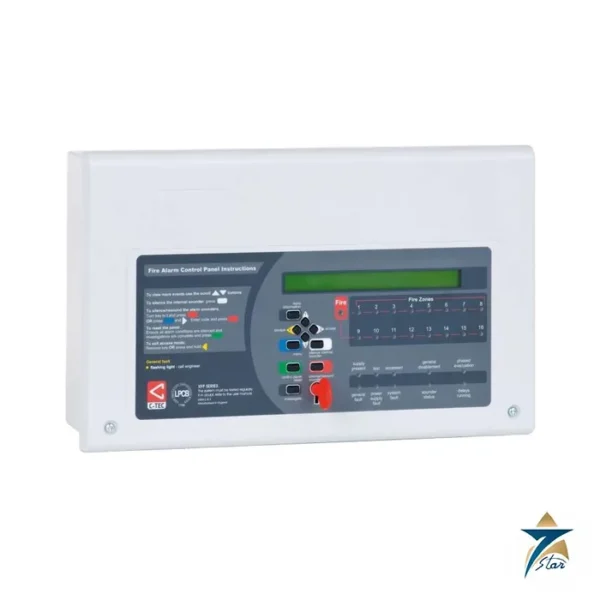
The C-TEC CA734 is a loop-powered CAST mini IO module with one monitored switch input and one changeover relay output. It lets a CAST addressable fire panel read the state of a switch or contact and switch a relay, for example to start or stop a fan, release a door or report the status of a valve, and it is compatible with C-TEC’s CAST ZFP and XFP panels and other CAST-compatible panels.
Technical specifications
| Parameter |
Specification |
| Part number |
CA734 CAST mini IO module |
| Function |
Loop powered module with 1 monitored switch input and 1 changeover relay output; fire LED output |
| Standards |
EN54-18:2005 (input/output devices); EN54-17:2005 (short-circuit isolator) |
| Certificates |
LPCB 176j/01; CPR 2831-CPR-F2049; UKCA 0832-UKCA-CPR-F0790; DoP0000059 |
| Protocol |
CAST (C-TEC); compatible with CAST ZFP/XFP panels and other CAST compatible panels |
| Operating voltage |
22 to 40 V DC, loop powered |
| Currents |
Quiescent 1 mA typical; active 5.7 mA typical, 6.7 mA maximum; fault 5.3 mA typical, 6.3 mA maximum |
| Input |
Single monitored normally-open switch, triggered by a 470R trigger resistor with 6k8 end-of-line resistor |
| Output |
1 single-pole changeover relay (C/NO/NC), non-monitored, 1 A at 30 V DC or 0.3 A at 125 V AC; single 2-wire fire LED drive output |
| Reported input levels |
Normal, fire, short-circuit fault and open-circuit fault |
| Indicators |
Red LED (relay active and polling), yellow LED (monitored input fault) |
| Supplied with |
7 way ribbon cable (150 mm), 7 way terminal block, trigger resistor and end-of-line resistor |
| Enclosure |
Clear ABS polycarbonate, 65 x 60 x 20 mm, 47 g, IP40; also designed to fit a single gang back box |
| Environment |
-10 to +55 degC; maximum 95 percent RH non-condensing |
What the module does
The module is programmed and addressed through the fire panel or with the CAST handheld programmer (CAPROG). The input is a single monitored normally-open switch with a 470 ohm trigger resistor and a 6k8 end-of-line resistor, which lets the panel report four levels: normal, fire, short-circuit fault and open-circuit fault. The panel can command the output to two levels, active and normal. A two-wire fire LED output is available for a remote indicator, and a bi-directional on-board short-circuit isolator is fitted, so a loop fault is contained. The red LED shows relay activity and polling and the yellow LED shows a monitored-input fault.
Installation points
The enclosure may be surface fixed using the four fixing holes, with suitable screws not supplied, or mounted inside a secondary unit such as a single gang back box; its compact size suits equipment with limited space. Cables to the seven-way terminal block must be less than 3 metres long. The relay is not monitored and is rated for 1 A at 30 V DC or 0.3 A at 125 V AC, so higher loads need an external interposing relay. The instructions note that in exposed environments the module may be subject to mechanical shocks, and that anti-glitch protection should ensure a changeover of the relay contacts of up to one second does not activate connected equipment. Installation must follow local and national regulations.
Where one input and one relay is the right fit
The CA734 is a point device: it handles one monitored contact and one relay at a single location. That makes it a good match for jobs such as a fire damper or smoke vent that needs both a command and a position report, a door holder that must release on alarm, a sprinkler valve monitor switch, or a plant interlock that shuts an air handling unit. Because it fits in a single gang back box or inside a small piece of equipment, it can sit right at the controlled item instead of in a remote panel, which shortens the wiring to the field contact.
Where several functions are grouped at one place, for example a plant room with a number of fans and dampers, count the IO points first; several CA734 modules on the loop each take an address, so the loop address capacity and the loop current budget of the panel should be checked at the design stage using the quiescent and active currents in the table.
Commissioning the module on a CAST loop
- Address the module with the panel or the CAPROG handheld programmer before connecting it to the loop, and record the address against its location on the zone chart.
- Fit the 6k8 end-of-line resistor at the far end of the switch circuit and the 470R trigger resistor in series with the normally-open contact, as shown in the installation instruction.
- With the panel running, operate the field contact and check that the panel shows a fire input, then open and short the input wiring to confirm the open-circuit and short-circuit faults are reported.
- Command the output from the panel and check that the red LED and the connected equipment respond as expected, then return it to normal.
Fault finding
A yellow LED usually means the input circuit is not seeing the expected resistance; check for a missing or wrong end-of-line resistor, a loose terminal or damaged cable to the contact. If the panel reports the module as missing, confirm the address, the loop polarity and the loop voltage at the module, which must sit within the 22 to 40 V DC range. If the relay switches but the plant item does not respond, measure the load current; anything above the relay rating needs an interposing relay, and a relay that has been overloaded should be replaced rather than reused.
Application notes for Oman and the GCC
The module is rated IP40 and for -10 to +55 degC with non-condensing humidity, so in Oman it belongs inside conditioned or sheltered spaces. Roof plant rooms, car park ceilings and outdoor equipment cabinets can exceed these conditions in summer, and coastal buildings can see condensation when cool, air-conditioned areas meet humid outside air. In such locations, mount the module in a suitable protective enclosure or move it to a sheltered position and run the field wiring out to the device. Fine dust entering an open back box can also bridge terminals over time, so close up back boxes properly after commissioning.
Documents and quotation
The linked file is the one-page C-TEC CA734 installation instruction (DFU7340010) and the certificates and declarations of performance can be downloaded from the manufacturer’s website. Before ordering confirm the panel protocol, the number of IO points needed, the load the relay will switch and the approvals required; browse other fire and gas logic controllers. Seven Star LLC, an independent supplier in Muscat, will prepare a quotation from your project requirements.







Reviews
There are no reviews yet.