Overview
The SEL-751 Feeder Protection Relay from Schweitzer Engineering Laboratories is a compact, panel-mounted relay for radial and looped distribution circuits in industrial plants and utility substations. It combines time-overcurrent, directional overcurrent, voltage, frequency and reclosing functions with fault location, event analysis and a wide choice of communications protocols in one industrial package. Depending on the options ordered, the relay can also detect arc-flash events, high-impedance faults from downed conductors, broken conductors and intermittent ground faults on compensated networks.
Seven Star LLC supplies the SEL-751 to utilities, oil and gas operators, EPC contractors and switchgear builders across Oman and the GCC, with engineering support in Muscat. Typical requests come from 11 kV and 33 kV distribution feeders, plant incomers and motor control centre feeders where one relay must cover overcurrent, earth fault and breaker control.
Operating Principle
The relay samples phase and neutral currents from conventional 1 A or 5 A current transformers, from a sensitive 200 mA neutral input, or from Rogowski coil and low-power current transformer sensors on the low-energy analog (LEA) models. From these samples it calculates phase, negative-sequence and residual quantities that drive instantaneous (50) and inverse-time (51) elements with IEC and US curves. When voltage inputs are fitted, the SEL-751 adds directional control (67), over- and undervoltage, frequency, rate-of-change-of-frequency, vector shift for islanding detection, load encroachment and directional power elements. Best Choice Ground Directional Element logic selects the most suitable polarizing method automatically, which removes many directional settings from the engineering effort.
Optional elements extend this core of the SEL-751. Arc-flash protection combines fiber-optic light detection on four or eight channels with fast overcurrent supervision, so the relay trips on light plus current rather than light alone. Arc Sense technology analyses current signatures to detect high-impedance faults that are too small for overcurrent elements, such as a conductor lying on dry ground or reinforced concrete. Zero-sequence directional logic covers ungrounded, impedance-grounded and Petersen coil-grounded systems, where conventional earth fault detection is difficult.
Engineering Design of the SEL-751
The SEL-751 is built as a slot-based relay. The Slot Z card defines the analog inputs: four current inputs only, four currents with three 300 Vac voltage inputs, or LEA versions with 8 Vac voltage sensor inputs. Slot E can add synchronism-check and station battery voltage inputs together with four arc-flash detector channels. Further slots accept digital and analog I/O cards, a 10-input internal RTD card and communications cards, and the latest version supports as many as four I/O modules, each with 21 programmable inputs or 12 electromechanical outputs.
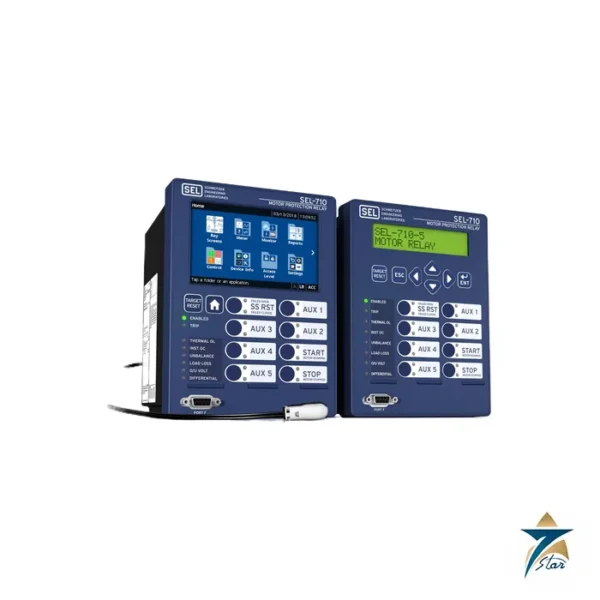
Two front-panel options are offered: a two-line display with four programmable pushbuttons, or a five-inch, 800 × 480 color touchscreen with eight pushbuttons, each pushbutton carrying two tricolor LEDs. The touchscreen shows bay screens, meter values, monitoring data and reports, so operators can trip, close and check status at the panel. Settings and logic are built in ACSELERATOR QuickSet SEL-5030 software, and an integrated, password-protected web server lets engineers view settings, download event reports and upgrade firmware over Ethernet.
Key Features
The SEL-751 brings the following capabilities to distribution and plant feeder protection:
- Phase, negative-sequence, residual and neutral overcurrent elements, with optional directional control for looped networks and parallel feeders.
- Autoreclosing with synchronism and voltage checks, plus breaker failure protection and cold-load pickup logic.
- Optional four- or eight-channel arc-flash detection that pairs light sensing with high-speed overcurrent supervision for fast, secure tripping.
- High-impedance fault detection with Arc Sense technology and broken conductor detection on wye-connected systems to reduce fire and public safety hazards.
- Intermittent ground fault detection and zero-sequence directional elements for ungrounded, impedance-grounded and Petersen coil-grounded networks.
- Second- and fifth-harmonic blocking for inrush security, together with total harmonic distortion elements and harmonic metering.
- Built-in metering, load profile, breaker wear monitoring, Sequential Events Recorder and oscillographic event reports for commissioning and post-fault analysis.
- Impedance-based fault location and faulted phase indication to shorten line patrol and repair times.
Communications and Integration
Every unit includes front and rear EIA-232 ports, Modbus RTU, MIRRORED BITS relay-to-relay communications, IRIG-B time input and IEEE C37.118 synchrophasors. Optional single or dual Ethernet ports, copper or fiber, add IEC 61850 Edition 2.1, DNP3 serial and LAN/WAN, Modbus TCP/IP, EtherNet/IP, IEC 60870-5-103 and SNTP or IEEE 1588 PTP time synchronisation. For network redundancy the SEL-751 supports the IEC 62439-3 Parallel Redundancy Protocol (PRP) and High-availability Seamless Redundancy (HSR), and Rapid Spanning Tree Protocol (RSTP). This lets the relay report to a substation automation system, a plant DCS or a SCADA RTU without protocol converters.
Industrial Applications
In Oman, the SEL-751 suits primary and secondary distribution substations, oil field power networks, process plant switchboards and desalination and water pumping stations where feeders must be protected and monitored remotely. Its ATEX and UL Class I, Division 2 hazardous-location certification and its –40 to +85 °C IEC performance rating make the SEL-751 suitable for gas plants, tank farms and outdoor kiosks exposed to high ambient temperatures in the interior and in the Duqm, Sohar and Salalah industrial zones.
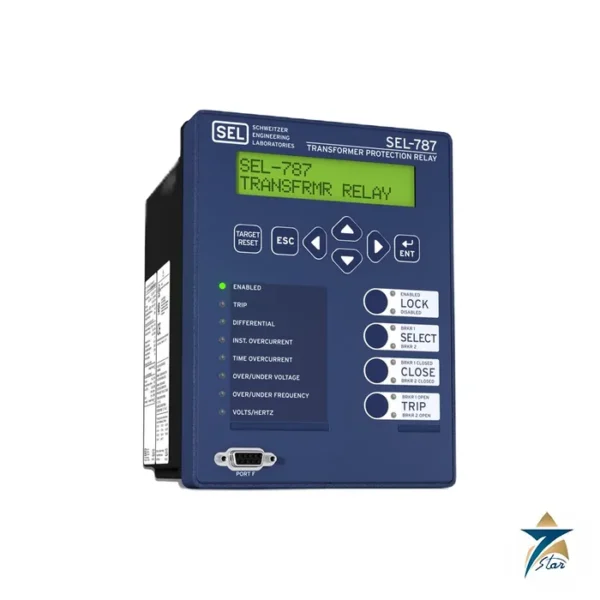
Utility engineers use the high-impedance fault and broken conductor options on overhead lines, while industrial users usually specify arc-flash detection inside metal-clad switchgear to cut incident energy during maintenance. Seven Star LLC can match the SEL-751 model option string to the CT and VT secondaries, auxiliary supply, I/O count and protocol used at the site, and supply related SEL relays for transformer and motor feeders on the same switchboard.
For test and commissioning of feeder relays, see the Megger SMRT410 multi-phase relay test system.
Technical Specifications
Key SEL-751 specifications, taken from the SEL-751 data sheet (2026 edition), are listed below. Final values depend on the ordered model.
| Parameter |
Specification |
| Model |
SEL-751 Feeder Protection Relay |
| Current inputs |
1 A or 5 A phase and neutral; 200 mA sensitive neutral option; Rogowski coil or LPCT inputs (LEA models) |
| Voltage inputs |
300 Vac phase-to-neutral rated, or LEA voltage sensor inputs rated 8 Vac |
| Protection |
50/51 phase, ground, neutral and negative-sequence; 67 directional; 27/59; 81 and 81R; 78VS vector shift; 79 reclosing; breaker failure |
| Options |
Arc-flash detection (4 or 8 channels), HIF detection with Arc Sense technology, broken conductor detection, synchronism check |
| Power supply |
110–240 Vac / 110–250 Vdc (high voltage) or 24–48 Vdc (low voltage) |
| Output contacts |
Form A, B and C; standard and fast hybrid high-current interrupting outputs |
| Display |
2 × 16 character LCD or 5-inch 800 × 480 color touchscreen |
| Protocols |
Modbus RTU and TCP/IP, DNP3, IEC 61850 Ed. 2.1, IEC 60870-5-103, EtherNet/IP, PRP, HSR, RSTP, IEEE 1588 PTP, IEEE C37.118 |
| Operating temperature |
–40 to +85 °C (IEC performance rating) |
| Enclosure |
IP65 when enclosed in panel |
| Certifications |
UL Listed; UL Class I, Div. 2 hazardous locations; ATEX; CE; designed under ISO 9001 |
How to Order
To request an SEL-751 quotation, send Seven Star LLC the model option table string or a description of the CT and VT ratings, auxiliary supply, display type, I/O, arc-flash and communications requirements. Our Muscat team will confirm the configuration, check lead time and delivery to sites in Oman and the GCC, and provide the SEL data sheet for your submittal. For comparison with other feeder relays on our site, see the ABB REF542plus feeder protection and control relay, the Schneider Electric MiCOM P139 feeder protection relay and the Schneider Electric Sepam Series 20 protection relay.





























Reviews
There are no reviews yet.