- Automation & ControlView all 1,920 products
- AC Drives
- PLC & I/O Cards
- Industrial Communications
- Vibration Monitoring
- Automation Accessories
- Controllers & Data Acquisition
- Isolator & Barrier
- CCTV & Security
- Safety Switches & Guard Locking
- Encoders
- HMI Displays
- Industrial Computers
- Motor Soft Starters
- Servo Drives
- Pneumatic Cylinders
- Machine Vision
- Automation Software
- Robotics
















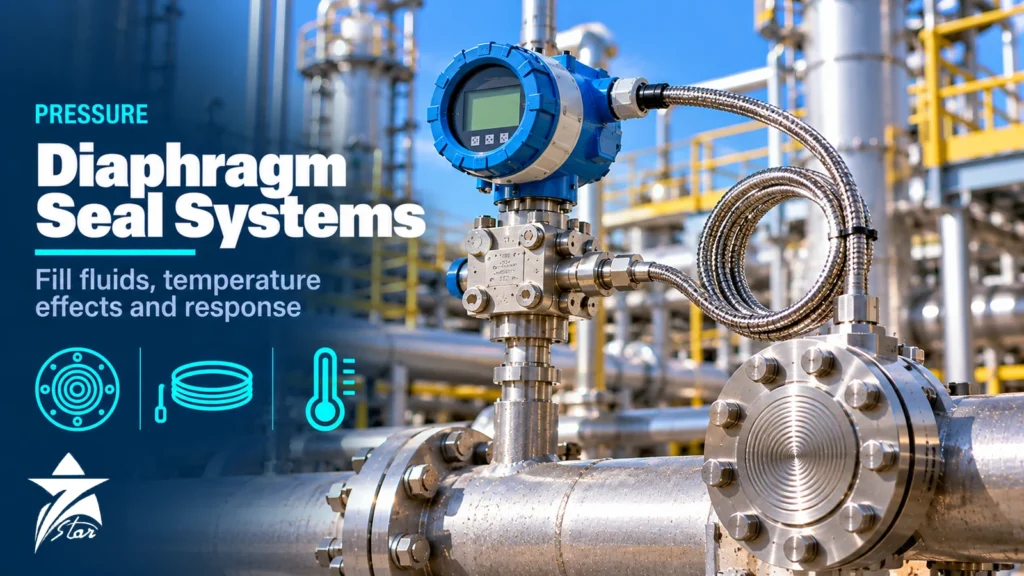
A diaphragm seal lets a pressure or DP transmitter measure processes that would destroy, plug or freeze a normal connection: hot polymers, slurries, acids, sanitary products and toxic fluids. The seal transmits pressure through a thin metal diaphragm and a sealed fill fluid, sometimes over several metres of capillary. That isolation has a price. The fill fluid expands with temperature, the capillary slows the response, and a poorly chosen system can add more error than the transmitter itself. This guide explains how seal systems work, how to select the fill fluid and diaphragm material, what drives temperature error and response time, and when you should avoid a seal altogether.
How a Diaphragm Seal System Works
A seal system has four parts: the seal body that connects to the process, a flexible diaphragm welded to it, a fill fluid that occupies the space behind the diaphragm, and either a direct connection or a capillary leading to the transmitter’s sensing diaphragm. Process pressure deflects the seal diaphragm very slightly, the incompressible fill transmits the pressure, and the transmitter measures it.
The system works only if it is completely free of air. Manufacturers evacuate the system and fill it under high vacuum, then seal it permanently. Any gas bubble left inside behaves like a spring, causing errors that change with pressure and temperature. That is why seal assemblies are ordered as complete, factory-filled units.
Seal Types
Choose the seal body to suit the process connection and the cleaning or flushing needs.
- Flanged flush seals: the most common for level and pressure on vessels, with ASME or EN flange connections and a diaphragm flush with the flange face.
- Extended diaphragm seals: the diaphragm projects through the nozzle so it sits flush with the inside of the vessel wall, avoiding a dead pocket where solids can collect.
- Threaded and in-line seals: compact units for pipe connections, used with gauges and transmitters on smaller lines.
- Flow-through (saddle or in-line) seals: the process flows across the diaphragm, which keeps it clean in slurries and viscous fluids.
- Sanitary seals: hygienic clamp or threaded connections for food, beverage and pharmaceutical plants.
- Seals with flushing rings: a ring between seal and process flange with ports for flushing, venting or calibration checks.
Pressure gauges use the same seal concepts; our pressure gauge selection guide covers gauge-side choices.
Fill Fluid Selection
The fill fluid must stay liquid, stable and compatible over the full temperature and pressure range, and must be safe if the diaphragm ever leaks into the process. The ranges below are typical values from published manufacturer tables; limits differ between vendors, and maximum temperatures are lower under vacuum.
| Fill fluid | Typical temperature range (atmospheric or positive pressure) | Typical use | Limitations |
|---|---|---|---|
| General-purpose silicone (DC200 type) | About −40 °C to about 205 °C | Default for most process and level applications | Not for oxygen or strong oxidisers |
| High-temperature silicone (DC704 type) | About 0 °C to about 315 °C (capillary systems) | Hot oils, polymers, heat transfer fluids | Viscous at low ambient, so slow in cold weather |
| Food-grade oil (Neobee M-20 type) | About −15 °C to about 205 °C | Food, beverage, pharmaceutical | Narrower low-temperature range |
| Inert halocarbon | About −45 °C to 160–200 °C depending on grade | Oxygen, chlorine, strong oxidisers | High density increases head effects; higher cost |
| Glycerin/water or propylene glycol mixes | Narrow, moderate range | Some hygienic and low-cost applications | Limited temperature range, not for vacuum |
Two further properties matter. Thermal expansion coefficient determines temperature error: lower is better. Viscosity determines response time, and viscosity of most fills rises sharply as temperature falls. A fill that is perfect at 40 °C may be noticeably slow on a cold desert night in winter.
Diaphragm Materials
The diaphragm is thin, so material choice is a corrosion decision first and a mechanical decision second.
- 316L stainless steel: standard for non-corrosive services, but vulnerable to chlorides in warm water.
- Hastelloy C-276: wide resistance to chlorides, sour service and many acids.
- Monel 400: used in hydrofluoric acid and some seawater applications.
- Titanium: strong chloride and seawater resistance, common in desalination and brine service.
- Tantalum: hydrochloric acid and other aggressive acids, at a significant cost premium.
- Coatings: PTFE or similar coatings reduce sticking of viscous media; gold plating is offered by several manufacturers to limit hydrogen permeation in hydrogen-rich service.
For sour (H2S) service, confirm that wetted materials meet the requirements of NACE MR0175/ISO 15156 as specified for your project.
Temperature Effects: Where the Error Comes From
Seal temperature error has three sources, and understanding them is the key to a good specification.
Fill expansion against diaphragm stiffness
When the fill warms it expands. The seal diaphragm must flex outward to make room, and because the diaphragm has stiffness, a small back-pressure builds up. The transmitter reads that pressure as process pressure. The effect grows with fill volume (longer capillaries, larger capillary bore), with diaphragm stiffness (smaller diameter seals) and with the fill’s expansion coefficient.
Head effect in vertical capillaries
When a capillary runs vertically, its fill fluid adds a head equal to the vertical height times the fill density. As temperature changes, fill density changes and so does that head. For a DP level system with seals several metres apart, this can be the dominant error.
Process temperature at the seal
Hot process heats the seal and the first section of capillary, expanding the fill locally. Most manufacturers state separate coefficients for ambient and process temperature effects. Ask for a calculated total error at your real conditions; the major manufacturers offer seal system calculation tools for this.
To keep temperature error small:
- Use the largest practical diaphragm diameter; larger diaphragms are far less stiff.
- Keep capillaries short and route both sides of a DP system together.
- Choose a fill with a low expansion coefficient that still meets the temperature range.
- Avoid small calibrated spans; the same absolute error is a bigger percentage of a small span.
- Consider direct-mount or tuned arrangements instead of two long capillaries.
Response Time
A seal system responds more slowly than a direct connection because the fill must flow through the capillary to move the transmitter’s sensing diaphragm. Response time increases with capillary length, decreases with larger capillary bore, and rises with fill viscosity, so a high-temperature fill in cold ambient conditions is the slowest combination. For level control and most pressure monitoring a delay of a few seconds is irrelevant; for fast pressure control or compressor protection it may not be acceptable. If response matters, state it on the datasheet so the supplier can select capillary bore and fill accordingly.
When to Use a Diaphragm Seal
A seal is justified when the process would otherwise damage or disable a normal impulse connection:
- Corrosive media that would attack the transmitter’s isolating diaphragm or impulse tubing.
- Viscous, crystallising, polymerising or solids-laden fluids that plug impulse lines.
- Process temperatures above the transmitter’s rated limit, where the seal and capillary move the electronics away from the heat.
- Hygienic processes that require cleanable, crevice-free connections.
- Toxic or hazardous fluids where every impulse-line fitting is a potential leak point.
- Wet legs that would evaporate, freeze or need heat tracing.
When a Seal Is the Wrong Choice
Seals are sometimes specified out of habit. Avoid or question them in these cases:
- Clean, non-corrosive fluids at moderate temperature where short impulse lines work well.
- Very low pressure or DP spans in locations with large ambient temperature swings.
- Deep vacuum at high temperature, unless the seal manufacturer has confirmed the fill and design.
- Fast control loops where capillary lag would degrade performance.
For a broader view of transmitter types, including multivariable and DP options, see our pressure transmitter selection guide and the Rosemount 3051 model guide, which explains how level transmitters with integral seals are coded.
Installation Practice
Most seal failures are mechanical and happen during installation or maintenance.
- Never lift the assembly by the capillary and never bend it tighter than the manufacturer’s minimum bend radius.
- Protect the diaphragm face until the moment of installation; a scratch or dent changes its stiffness permanently.
- Use a gasket with an inside diameter that does not press on the diaphragm.
- Support capillaries along their length and keep them away from hot surfaces and moving equipment.
- In vacuum service, mount the transmitter at or below the lower seal, as most manufacturers recommend.
- Coil excess capillary horizontally and keep both legs of a DP system in the same thermal environment.
GCC Conditions
Oman and the GCC combine high ambient temperature with intense sunshine. A capillary exposed on a vessel wall in summer can sit well above the 45–50 °C air temperature, and one side heating faster than the other creates a daily zero swing. Shade capillaries, fit transmitter sunshades, and give the supplier your real maximum ambient and solar exposure so the error can be calculated. Desalination and seawater cooling systems need chloride-resistant diaphragms, and sour crude or gas service brings H2S material requirements and, in hydrogen-rich streams, permeation concerns. Coastal sites also benefit from stainless capillary armour rather than PVC-coated types that degrade under UV.
Troubleshooting
- Zero shifts with time of day: temperature effect; check shading, routing and fill choice.
- Very slow or no response: crushed capillary, plugged flushing ring, or highly viscous fill in cold conditions.
- Reading stuck regardless of process: loss of fill fluid or a ruptured diaphragm; replace the assembly.
- Slow upward zero drift over months in hydrogen service: possible hydrogen permeation; consider gold-plated diaphragms.
- Offset after maintenance: diaphragm damaged or gasket pressing on it during reinstallation.
Specification Checklist
- Measurement type (gauge, absolute, DP), range and required accuracy.
- Process medium, operating and design pressure and temperature, including vacuum conditions.
- Ambient temperature range and solar exposure.
- Process connection: flange size, rating and facing, or threaded/sanitary type; flush or extended diaphragm.
- Diaphragm and wetted material, coatings and sour service requirements.
- Capillary length, armour type, and mounting arrangement (direct, balanced, tuned).
- Fill fluid preference or restrictions (food grade, oxygen service).
- Required response time and existing make and model for replacements.
Diaphragm Seals We Supply
These examples cover seals for gauges and transmitters.
| Product | Type | Where it fits |
|---|---|---|
| WIKA 990.27 Diaphragm Seal | Diaphragm seal | Protecting gauges and transmitters. |
| WIKA 990.10 Threaded Diaphragm Seal for Pressure Gauges | Threaded diaphragm seal | Pressure gauges in corrosive service. |
| Rosemount 1199 Diaphragm Seal System | Diaphragm seal system | Pressure and level transmitters. |
| ABB 266DRH / 2600T Differential Pressure Transmitter with Remote Seal | DP transmitter with remote seals | Level in closed vessels. |
| Honeywell STR82D-21CS000-00000000 SmartLine Remote Seal Pressure Transmitter | Remote seal pressure transmitter | Process pressure. |
Send the process connection, temperature, pressure range, medium and fill fluid needs through our quote request form.
Sourcing Diaphragm Seal Systems Through Seven Star LLC
Seven Star LLC supplies diaphragm seal assemblies, remote-seal transmitters and gauges on request for plants in Oman and the GCC, from manufacturers such as Emerson, Endress+Hauser, WIKA and Yokogawa. We help with selection and cross-checking model codes and part numbers; availability and lead time are confirmed at quotation. See our pressure instrumentation and level instrumentation categories.
Send us the transmitter datasheet, a photo of the existing nameplate and seal tag, or your RFQ with process and ambient conditions, and we will prepare a matched quotation.
Frequently asked questions
What fill fluid should I use in a diaphragm seal?
General-purpose silicone is the usual default for moderate temperatures. High-temperature silicone grades suit hot service but become viscous at low ambient temperatures, food-grade oils such as Neobee M-20 suit hygienic plants, and inert halocarbon fills are used for oxygen, chlorine and strong oxidisers. Always check the limits in the seal manufacturer's own table, because the same fluid name carries different limits between vendors and under vacuum.
Why does my remote seal transmitter drift with ambient temperature?
The fill fluid expands as it warms and the diaphragm resists that expansion, which creates a small pressure that the transmitter reads as process pressure. Changes in fill density also alter the head of fluid in vertical capillary runs. The error is larger with small diaphragms, long capillaries, stiff diaphragms and low calibrated spans.
How long can a capillary be?
Manufacturers offer capillaries from well under a metre to many metres, but every extra metre adds fill volume, temperature error and response delay. Use the shortest length that reaches a safe, accessible transmitter location, and consider a direct-mount seal or an electronic remote sensor system when long runs would be needed.
Can diaphragm seals be used in vacuum service?
Yes, provided the system is designed for it. The fill fluid must be rated for vacuum at the operating temperature, the seal must be filled under high vacuum by the manufacturer, and the transmitter is normally mounted at or below the lower seal so the fill stays pressurised. Larger diaphragms and short capillaries also help.
Which diaphragm material is best for seawater or chlorides?
Standard 316L stainless steel is vulnerable to pitting and crevice corrosion in warm seawater and chloride-rich brines. Hastelloy C-276, titanium or tantalum are common upgrades depending on chemistry and temperature, and the choice should be confirmed against the manufacturer's corrosion guidance for the exact medium.
Can a damaged diaphragm seal be repaired on site?
Generally no. The seal and capillary are filled and sealed under vacuum at the factory, so a dented diaphragm or a leak that has lost fill fluid normally means factory refilling or replacing the assembly. Opening the system on site lets air in and ruins accuracy and response.
Was this guide helpful?One click helps us write better guides for engineers.
Thank you! Glad it helped. Need this equipment for your project? Request a quotation
Thank you. We will use this to improve the guide.