- Automation & ControlView all 2,931 products
- Automation Accessories
- AC Drives
- PLC & I/O Cards
- Industrial Communications
- Vibration Monitoring
- Controllers & Data Acquisition
- Isolator & Barrier
- Safety Switches & Guard Locking
- Motor Soft Starters
- CCTV & Security
- Encoders
- Pneumatic Cylinders
- HMI Displays
- Servo Drives
- Industrial Computers
- Machine Vision
- Automation Software
- Robotics
















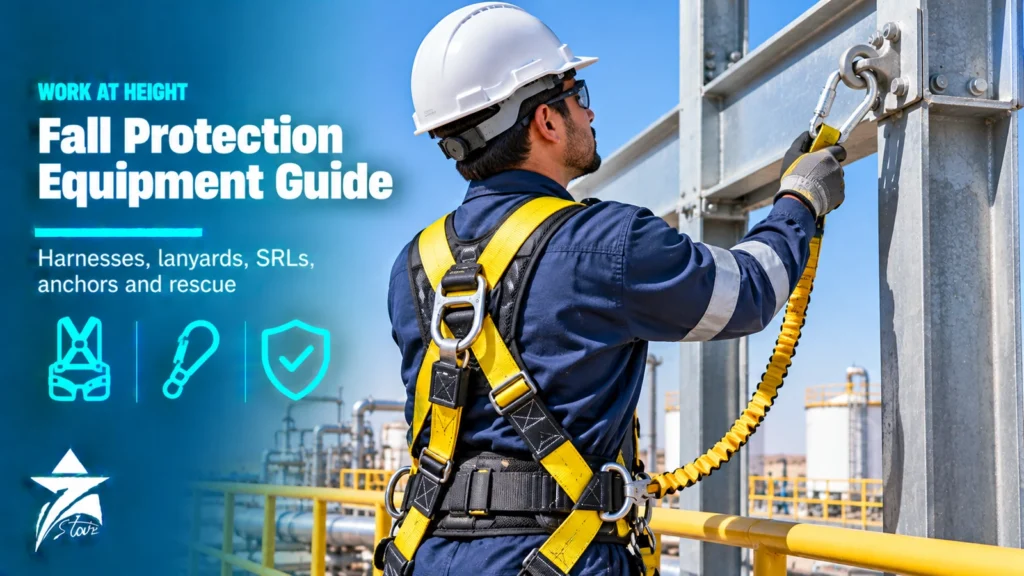
Falls from height remain one of the leading causes of serious injury on construction sites, plants, tank farms, telecom towers and offshore installations. Personal fall protection equipment is the last line of defence when a fall cannot be prevented by design, guardrails or work platforms. Choosing it correctly means understanding how each component works, how far a worker will fall before being stopped, and how a suspended worker will be rescued. This guide explains the main types of fall protection equipment, the European standards behind them, clearance calculations, inspection and rescue planning.
The Hierarchy of Fall Protection
Personal equipment is not the first choice. Good practice and most regulations follow a hierarchy:
- Avoid work at height where possible, for example by assembling at ground level or using extended tools.
- Collective prevention: guardrails, scaffolds, mobile elevating work platforms and fixed platforms that protect everyone without user action.
- Personal fall restraint: a harness and lanyard that physically prevent the worker from reaching the edge.
- Personal fall arrest: a system that stops a fall after it has started and limits the forces on the body.
- Rescue: a planned method of recovering a worker suspended in a harness.
Fall restraint is preferable to fall arrest because the worker never falls. Fall arrest is used when restraint is not practical, for example on structures where the worker must reach the edge.
Components of a Fall Arrest System
Every personal fall arrest system has three parts, sometimes called the ABC of fall protection: an anchor, a body support (the full body harness) and a connecting device (lanyard, self-retracting lifeline or guided type fall arrester). All three must be compatible and rated for the application.
| Component | Function | Main European standard |
|---|---|---|
| Full body harness | Distributes arrest forces and keeps the body upright | EN 361 |
| Work positioning belt or harness | Supports the worker while hands are free | EN 358, EN 813 for sit harnesses |
| Energy absorbing lanyard | Connects harness to anchor and limits arrest force | EN 354, EN 355 |
| Self-retracting lifeline (SRL) | Retractable line that locks during a fall | EN 360 |
| Guided type fall arrester | Travels on a rigid rail or flexible line | EN 353-1, EN 353-2 |
| Anchor devices | Provide a secure point of attachment | EN 795 |
| Connectors and karabiners | Join components with locking gates | EN 362 |
| Rescue and descent devices | Lower or raise a suspended person | EN 341, EN 1496 |
Full Body Harnesses
A full body harness to EN 361 has a dorsal (rear) D-ring between the shoulder blades for fall arrest, and often a sternal or front attachment for ladder systems and rescue. Harnesses for work positioning add side D-rings and a waist belt, while rope access and tower harnesses add a ventral attachment and a sit section for long periods in suspension. Fit matters: leg straps should be snug, the chest strap at mid-chest and the dorsal D-ring centred between the shoulder blades. A loose harness lets the body slip during a fall and increases the risk of injury.
In hot climates such as Oman, comfort affects compliance. Padded, breathable harnesses with quick-connect buckles are worn more consistently than basic models, and lighter materials reduce fatigue on long shifts.
Lanyards, Energy Absorbers and Self-Retracting Lifelines
An energy absorbing lanyard limits the arrest force on the body to 6 kN under EN 355, by tearing a stitched webbing pack or deforming a material. The total length including absorber and connectors is limited to 2 m. Twin-leg (Y) lanyards allow 100 percent tie-off while moving between anchors.
Self-retracting lifelines extend and retract with the worker and lock within a short distance when a fall starts, similar to a car seat belt. They reduce free fall distance and required clearance compared with a lanyard. Models with webbing or wire rope lines are available, and some include an integrated rescue winch. Where an SRL may be used horizontally over an edge, an edge-tested model is needed, because a standard line can be cut by a sharp edge during a fall.
Anchor Points and Lifelines
An anchor must withstand the forces of a fall. EN 795 covers several anchor types:
- Type A: fixed structural anchors bolted or welded to the structure.
- Type B: transportable temporary anchors such as tripods, door bars and anchor straps.
- Type C: horizontal flexible lifelines with a travelling attachment.
- Type D: horizontal rigid rails.
- Type E: deadweight anchors for flat roofs.
Beam clamps and sliding trolleys provide mobile anchors on steel beams, while temporary horizontal lifelines allow movement along a structure. Anchors should ideally be above the worker to reduce free fall and swing fall, and their capacity and the structure supporting them must be confirmed by a competent person.
Calculating Fall Clearance
A fall arrest system only works if the worker stops before hitting the ground or an obstruction. Clearance is calculated below the anchor and includes:
| Element | Typical value to consider |
|---|---|
| Lanyard length or SRL locking distance | Up to 2 m for a lanyard; usually much less for an SRL |
| Energy absorber deployment | Up to about 1.75 m under EN 355 |
| Harness stretch and D-ring movement | Around 0.3 to 0.5 m |
| Height of the D-ring above the feet | About 1.5 m for an average worker |
| Safety margin | At least 1 m |
With a 2 m energy absorbing lanyard anchored at foot level, the required clearance can easily exceed 6 m. If the available clearance is less, use a higher anchor, a shorter connection or an SRL. Swing fall also needs to be considered when the anchor is not directly above the worker.
Rescue Planning for Fall Protection Equipment Users
A suspended worker must be rescued quickly. Hanging motionless in a harness can cause suspension intolerance, where blood pools in the legs and the person can lose consciousness. A rescue plan should be in place before work begins and should not rely on the emergency services alone. Options include:
- Self-rescue devices built into the harness or lanyard.
- Assisted rescue using a pre-rigged rescue kit or descender, allowing a colleague to lower the casualty from above.
- SRLs with integrated rescue winches that raise the worker back to the platform.
- Tripods and davit systems for confined spaces and vertical entries.
- Mobile elevating work platforms where they can reach the casualty safely.
Trained rescuers, equipment staged at the work location and regular practice are as important as the equipment itself. Where confined space work is involved, combine fall protection with gas testing, as described in our portable gas detector guide, and with suitable breathing equipment from our respiratory protection guide.
Inspection, Storage and Service Life
All fall protection equipment requires three levels of checking:
- Pre-use checks by the user before every use: webbing cuts, burns, abrasion, stitching, buckles, connectors, indicators and labels.
- Detailed inspections by a competent person at regular intervals, commonly every six months, or more often in harsh conditions.
- Interim inspections where the environment is aggressive, for example near chemicals, abrasive work, or strong sunlight.
Any component that has arrested a fall must be withdrawn from service. Textile products degrade with ultraviolet exposure, heat and chemicals, which is significant in Oman where equipment is often left in direct sun. Store harnesses and lanyards in a cool, dry, shaded place, and follow the manufacturer service life and serviceability instructions. SRLs normally need periodic servicing by the manufacturer or an approved service centre. Keep an inspection register with the serial number of each item.
Selecting Fall Protection Equipment for the Task
| Task | Typical equipment |
|---|---|
| Roof and edge work with restraint | Harness, adjustable restraint lanyard, anchor or lifeline |
| Steel erection and pipe racks | Harness, twin-leg energy absorbing lanyard, beam anchors or trolleys |
| Tank tops and vessels | Harness, SRL, temporary anchors, rescue kit |
| Ladder and tower climbing | Harness with front attachment, guided type fall arrester on rail or rope |
| Work positioning on poles and structures | Harness with side D-rings, positioning lanyard plus fall arrest backup |
| Confined space entry | Harness, tripod or davit, SRL with rescue winch |
| Rope access | Rope access harness, descender, back-up device, connectors |
Selection should be based on a risk assessment covering the anchor location, clearance, edges, environment, worker weight including tools, and the rescue method. Fall protection equipment from different manufacturers should only be combined when compatibility is confirmed in the instructions.
Fall Protection Equipment in Our Catalogue
The table shows examples of harnesses, connecting devices, anchors and rescue equipment we can quote:
| Product | Type | Typical use |
|---|---|---|
| Petzl NEWTON | Full body harness | General fall arrest |
| Ridgegear RGH3 | Front and rear D harness | Fall arrest and ladder systems |
| Petzl VOLT | Tower work harness | Telecom and transmission towers |
| Ridgegear RGH17 | 5-point rope access harness | Rope access and positioning |
| Petzl ABSORBICA-Y MGO | Twin-leg energy absorbing lanyard | 100 percent tie-off on structures |
| Petzl GRILLON | Adjustable positioning lanyard | Work positioning and restraint |
| Ridgegear RGA3/EDGE | Edge-rated fall arrest block, 15 m wire | Leading edge and horizontal use |
| Ridgegear RGA4/EDGE | Fall arrest block with recovery winch | Fall arrest with rescue capability |
| Petzl ASAP LOCK | Mobile fall arrester for rope | Vertical lifeline systems |
| Ridgegear RGA22 | Sliding beam anchor trolley | Mobile anchor on steel beams |
| Ridgegear RGHL1 | Temporary horizontal lifeline kit | Movement along structures |
| Petzl I’D EVAC | Self-braking descender | Rescue lowering |
Browse more in our fall protection category. To get a quotation, send the product list, sizes, standards required and quantities through our quote request form or to [email protected].
Sourcing Fall Protection Equipment in Oman Through Seven Star LLC
Seven Star LLC is an independent supplier in Oman of harnesses, lanyards, self-retracting lifelines, anchors, lifelines, connectors and rescue devices for construction, oil and gas, utilities and telecom work. We quote products from manufacturers such as Petzl and Ridgegear, alongside gas detectors and respiratory protection for combined work at height and confined space tasks. Model codes, certifications and lead time are confirmed against the manufacturer data at quotation.
Frequently asked questions
What is the difference between fall restraint and fall arrest?
Fall restraint stops the worker reaching an edge, so no fall occurs. Fall arrest stops a fall after it has started and limits the forces on the body. Restraint is preferred where it is practical.
How much clearance does an energy absorbing lanyard need?
With a 2 m lanyard, energy absorber deployment, harness stretch, the height of the worker and a safety margin, the clearance below the anchor often exceeds 6 m. Where clearance is limited, use an SRL or a higher anchor.
How often should harnesses and lanyards be inspected?
Users should check them before every use, and a competent person should carry out a detailed inspection at regular intervals, commonly every six months, or more often in harsh conditions.
Can a harness be used again after a fall?
No. Any harness, lanyard or connector that has arrested a fall must be withdrawn from service. SRLs that have arrested a fall must be inspected or serviced according to the manufacturer instructions.
Why is a rescue plan needed for work at height?
A worker suspended in a harness can suffer suspension intolerance and must be recovered quickly. The rescue method and equipment should be planned and available before work starts.
Who supplies fall protection equipment in Oman?
Seven Star LLC is an independent supplier in Oman that quotes harnesses, lanyards, self-retracting lifelines, anchors and rescue equipment from leading manufacturers. Send your requirements through the quote request form or to [email protected].
Was this guide helpful?One click helps us write better guides for engineers.
Thank you! Glad it helped. Need this equipment for your project? Request a quotation
Thank you. We will use this to improve the guide.