- Automation & ControlView all 2,085 products
- AC Drives
- Automation Accessories
- PLC & I/O Cards
- Industrial Communications
- Vibration Monitoring
- Controllers & Data Acquisition
- Isolator & Barrier
- CCTV & Security
- Safety Switches & Guard Locking
- Encoders
- HMI Displays
- Motor Soft Starters
- Pneumatic Cylinders
- Industrial Computers
- Servo Drives
- Machine Vision
- Automation Software
- Robotics
















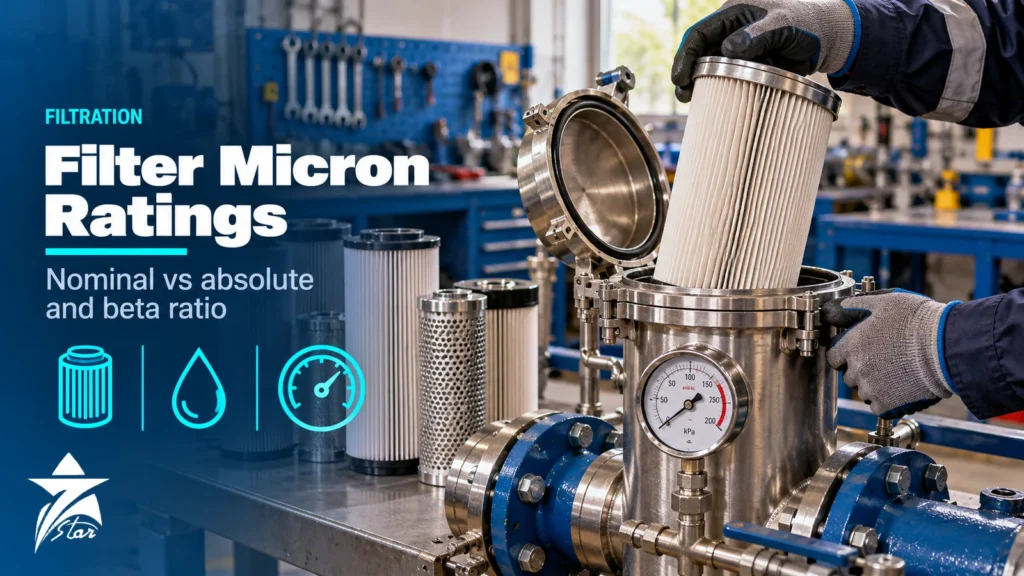
Two filter elements can both be labelled “10 micron” and perform completely differently: one may stop half the 10 µm particles, the other more than 99.9 percent. That gap is why a filter element micron rating means little without knowing how it was measured. This guide explains nominal and absolute ratings, the beta ratio defined by ISO 16889, the other ISO tests that describe element strength and pressure drop, how to choose element media and housings for hydraulic, lube, fuel, water and gas service, and how to use differential pressure to time change-outs instead of guessing.
Nominal vs Absolute Micron Ratings
A micron rating states a particle size, but the meaning depends on the efficiency attached to it.
- Nominal rating has no single standard definition. Manufacturers use it to describe an element that removes a stated percentage (often somewhere between 50 and 98 percent) of particles at the given size, under their own test conditions. Bag filters, string-wound and many depth cartridges are sold on nominal ratings.
- Absolute rating is meant to describe the size above which essentially all particles are retained. Because “all” is never measurable, reputable manufacturers back an absolute claim with a stated beta ratio or efficiency from a defined test, for example a high beta value at that size.
- Beta-rated elements quote efficiency at specific particle sizes from a multi-pass test, which is the only basis that allows fair comparison between suppliers in hydraulic and lube service.
When comparing quotations, ask for the test standard, the efficiency at the stated size and the test end-point pressure drop. A rating without those three facts is a marketing number.
The Beta Ratio and ISO 16889 Explained
ISO 16889 is the multi-pass test method for hydraulic filter elements. Test fluid contaminated with a standard test dust is circulated through the element while particle counters measure concentrations upstream and downstream at several particle sizes, and the test continues until a defined terminal differential pressure is reached. The beta ratio at size x is:
βx(c) = number of particles ≥ x µm upstream ÷ number of particles ≥ x µm downstream
The “(c)” means particle counters were calibrated to ISO 11171, the method that replaced older calibrations; ratings from the superseded ISO 4572 test are not directly comparable to ISO 16889 figures. Efficiency follows directly from beta as (1 − 1/β) × 100 percent:
| Beta ratio βx(c) | Capture efficiency at size x | Particles passing per 1,000 upstream |
|---|---|---|
| 2 | 50% | 500 |
| 10 | 90% | 100 |
| 20 | 95% | 50 |
| 75 | 98.7% | about 13 |
| 100 | 99% | 10 |
| 200 | 99.5% | 5 |
| 1,000 | 99.9% | 1 |
A rating written as β10(c) ≥ 1,000 therefore means at least 99.9 percent of particles 10 µm and larger are captured under test conditions. The test is run at steady flow; real systems with flow surges, cold starts and vibration will perform below laboratory values, which is one reason system designers aim for a finer element than the bare minimum.
Other ISO Tests That Describe an Element
Efficiency is only part of the picture. Element data sheets for hydraulic and lube service often refer to these companion standards:
- ISO 2941: collapse or burst pressure rating, the differential pressure the element survives without structural failure.
- ISO 2942: fabrication integrity, a bubble-point check that confirms the element has no manufacturing flaws or seal leaks.
- ISO 2943: material compatibility with the fluid.
- ISO 3724: flow fatigue, resistance to cyclic flow that flexes pleats.
- ISO 3968: differential pressure versus flow characteristics of the filter.
- Dirt-holding capacity, reported from the ISO 16889 test, which indicates service life for a given contamination load.
A cheap element with good beta values but low collapse rating is a liability in a system without a bypass valve; a collapsed element releases all its captured dirt at once.
Element Media and Construction Types
| Element type | Typical media | Rating basis | Common service |
|---|---|---|---|
| Pleated glass fibre | Resin-bonded microglass, often with wire mesh support | Beta-rated (ISO 16889) | Hydraulic, lube oil, turbine oil, fuel |
| Pleated cellulose | Treated paper | Nominal or beta at coarser sizes | Low-cost lube and fuel filtration |
| Wire mesh or sintered metal | Stainless steel woven mesh, sintered fibre or powder | Nominal or absolute by mesh opening | Suction strainers, high temperature, cleanable service |
| Melt-blown depth cartridge | Polypropylene graded density | Nominal | Water, chemicals, pre-filtration ahead of RO |
| Pleated membrane or polymer cartridge | Polypropylene, polyethersulfone, PTFE | Absolute or validated retention | Process water, chemicals, fine polishing |
| Bag filter | Felt or monofilament mesh | Nominal | High-flow, high-solids liquid service |
| Coalescer | Glass fibre layers | Efficiency at stated droplet or particle size | Gas, compressed air, fuel water separation |
Media also has to survive the fluid: water-glycol and phosphate ester fluids, hydrocarbons with aromatics, seawater, amines and hot oil all narrow the choice of media, binder, end caps and seal elastomers. Browse typical filtration elements by service to see how construction changes with application.
Choosing the Right Filter Element Micron Rating
Finer is not automatically better. A finer element costs more, loads faster and raises pressure drop. Choose the rating from the protected component, not from habit:
- Identify the most sensitive component (servo valve, proportional valve, journal bearing, injector, RO membrane, metering pump) and its manufacturer’s cleanliness or filtration requirement.
- Set a target cleanliness level for the fluid, for hydraulic and lube oils expressed as an ISO 4406 code.
- Select an element efficiency and position (pressure, return, off-line kidney loop, suction) that can hold the fluid at that target under the actual ingress rate.
- Check that the clean pressure drop, at the worst-case viscosity, is acceptable for the system.
- Size element area for an economical change-out interval, using dirt-holding capacity data.
Housing Selection
The housing must suit the pressure, temperature, fluid and maintenance regime as much as the element does. When specifying filter housings, define:
- Design pressure and temperature, plus the design code where applicable (pressure vessel codes for larger process housings).
- Connection size and type: threaded, flanged with rating class and facing, or manifold-mounted.
- Material: carbon steel for oils and hydrocarbons; stainless steel for water and chemicals; duplex or higher alloys, or lined construction, for seawater and chloride service.
- Element count, length and standard (single round, multi-round, bag), and whether the housing accepts elements from more than one manufacturer.
- Closure type: bolted cover, swing bolt or quick-opening, which affects change-out time and safety.
- Bypass valve and its setting (common on hydraulic housings), or no-bypass design with a high collapse-rated element for critical service.
- Duplex (switchable) arrangement for continuous operation, with a pressure balance line.
- Vents, drains, differential pressure indicator or transmitter connections and sample points.
- Seal materials compatible with fluid and temperature, and sour-service material requirements where H2S is present.
Differential Pressure: Sizing and Change-Out
Differential pressure (ΔP) across the housing is the practical health indicator of a filter. Three values matter:
- Clean ΔP: element plus housing loss at design flow with a new element. Through filter media it rises roughly in proportion to viscosity, so check it at the coldest start-up or highest-viscosity condition, not only at operating temperature.
- Change-out ΔP: the terminal value recommended by the manufacturer or set by the system design, at which the element is replaced.
- Bypass setting or collapse rating: the absolute limit, which the change-out point must stay well below.
A good design keeps clean ΔP low compared with the change-out value so the element can use its dirt-holding capacity. Visual pop-up indicators work for simple skids; in process plants a differential pressure gauge or transmitter wired to the control system allows trending and alarms, and a sudden drop in ΔP is as important as a rise because it can indicate a ruptured element or an open bypass.
GCC Service Conditions
Ambient conditions across Oman and the Gulf put specific loads on filtration. Fine desert dust enters reservoirs through breathers and seals, so desiccant or high-efficiency breathers often do as much for oil cleanliness as the main filter. High summer ambient temperatures and hot oil raise fluid temperature and can exceed limits of some seal materials and media binders. Seawater and brackish water service in desalination and cooling systems calls for corrosion-resistant housing materials and attention to galvanic contact between housing, element core and fasteners; cartridge pre-filtration ahead of reverse osmosis membranes is a critical step, and water quality monitoring, covered in our guide to water quality analyzers for desalination, shows whether the filtration is doing its job.
Common Filter Element Micron Rating Mistakes
- Comparing a nominal rating from one supplier with a beta rating from another.
- Replacing elements on a fixed calendar regardless of ΔP, either wasting elements or running in bypass.
- Fitting a non-original element that matches dimensions but not the seal design, letting fluid bypass around the element.
- Ignoring cold-start viscosity, so the bypass valve opens every morning.
- Selecting a finer element without increasing area, shortening life and raising ΔP.
- Failing to fill new elements or vent housings, causing air entrainment.
Filter Element Specification Checklist
- Fluid type, viscosity range and operating temperature range.
- Flow rate (normal and maximum) and system pressure.
- Required efficiency at size, with test standard (for example βx(c) per ISO 16889).
- Collapse or burst rating and whether a bypass valve is present.
- Element dimensions, end cap style, seal material and original part number.
- Housing design pressure, connections, materials and change-out arrangement.
- Change-out ΔP and indicator or transmitter requirements.
- Special requirements: sour service, food grade, seawater, hazardous area.
Filter Elements We Supply
These examples cover elements for gas, liquid and hydraulic filtration.
| Product | Type | Where it fits |
|---|---|---|
| Pall Ultipleat High Flow Series Filter Cartridges | High flow filter cartridges | Water and process liquids. |
| 3M Betapure NT-T Series Depth Filter Cartridge | Depth filter cartridge | Liquid filtration. |
| Pall Profile Coreless Filter Elements for Gas Filtration | Gas filter elements | Gas filtration. |
| Pall SepraSol Plus CS604LGH Liquid/Gas Coalescer Cartridge | Liquid/gas coalescer | Removing liquids from gas. |
| Bosch Rexroth R928006678 Hydraulic Filter Element | Hydraulic filter element | Hydraulic systems. |
Send the element part number, or the fluid, flow and micron rating, through our quote request form.
Sourcing Filter Elements and Housings Through Seven Star LLC
Seven Star LLC supplies filter elements, replacement cartridges, housings and complete filtration systems on request for oil and gas, power, desalination and manufacturing users in Oman and the GCC. We help with selection and cross-checking element part numbers and interchangeability, and availability and lead time are confirmed at quotation.
Need replacement elements or a new housing? Send us the element part number or a photo of the old element and housing nameplate, together with fluid, flow and pressure data, and we will prepare an accurate quotation.
Frequently asked questions
What does a beta ratio of 200 mean?
It means that, in the ISO 16889 multi-pass test, 200 particles at or above the stated size entered the filter for every one that passed through. That equals a capture efficiency of 99.5 percent at that particle size under test conditions.
Is a nominal 10 micron filter the same as an absolute 10 micron filter?
No. A nominal rating usually means a stated percentage of 10 µm particles is removed, which may be as low as half, under the manufacturer's own conditions. An absolute or beta-rated element is tested to capture a very high fraction of particles at that size. Always ask for efficiency and the test standard.
What does the (c) in β10(c) stand for?
It indicates the particle counters were calibrated according to ISO 11171, which is used with the ISO 16889 multi-pass test. Ratings from the older ISO 4572 method used a different calibration, so particle sizes are not directly comparable.
When should a filter element be changed?
Change it when differential pressure at normal flow and temperature reaches the terminal value set by the manufacturer or system design, before the bypass opens. Fixed calendar changes either waste elements or allow operation in bypass. A sudden drop in ΔP should also be investigated.
Why does filter pressure drop rise at start-up?
Pressure drop through filter media rises roughly in proportion to fluid viscosity, and cold oil is much more viscous. Elements and housings should be sized so the bypass valve does not open during cold starts.
Can I use a non-original replacement element in my housing?
Often yes, provided dimensions, seal design and material, collapse rating and efficiency at the required size match or exceed the original. A poor seal fit lets fluid bypass the media entirely, so check the seal arrangement as carefully as the micron rating.
Was this guide helpful?One click helps us write better guides for engineers.
Thank you! Glad it helped. Need this equipment for your project? Request a quotation
Thank you. We will use this to improve the guide.