- AC Drives
- Industrial Communications
- PLC & I/O Cards
- Vibration Monitoring
- Automation Accessories
- Controllers & Data Acquisition
- CCTV & Security
- Encoders
- Industrial Computers
- Safety Switches & Guard Locking
- HMI Displays
- Motor Soft Starters
- Isolator & Barrier
- Pneumatic Cylinders
- Servo Drives
- Automation Software
- Robotics
- Machine Vision
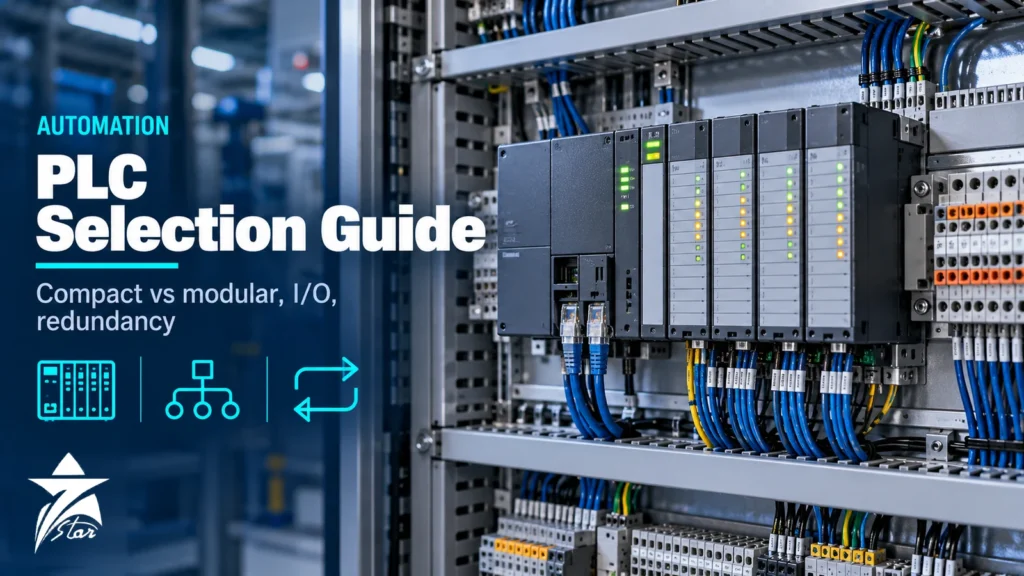
Choosing a programmable controller is rarely about raw processing speed. Most plant problems with PLCs come from the wrong form factor, too little spare I/O, a network that cannot reach the field devices, or a platform that goes out of production five years after start-up. This PLC selection guide walks through the decisions in the order an engineer should make them: defining the control task, choosing compact or modular hardware, counting and classifying I/O, deciding on redundancy, matching communications, checking environmental ratings for GCC sites, and judging the lifecycle of the platform before the purchase order is signed.
Start With the Control Task, Not the Catalogue
Write a one-page functional description before looking at any product. It should state what the controller must do, how fast, and what happens when it fails. A pump station sequencing three duty/standby pumps has very different needs from a packaging line with coordinated motion or a gas compressor skid with anti-surge control.
- Process type: discrete (interlocks, sequences), continuous (PID loops, ratio and cascade control), batch, or motion. Many applications mix all four.
- Scan time requirement: most process loops are comfortable with 50–250 ms task cycles; high-speed counting, cam switching or registration needs dedicated high-speed inputs or modules rather than a faster CPU.
- Consequence of failure: nuisance trip, lost production, environmental release or personnel hazard. This decides whether you need redundancy or a separate safety-rated system.
- Who maintains it: the in-house team’s existing software licences and skills are a real selection criterion, not a soft preference.
- Expected life: plant equipment in oil, gas and utilities often runs 15–25 years; the controller should be supportable for that period or have a clear migration path.
Compact vs Modular PLCs
A compact (brick) PLC combines power supply, CPU and a fixed set of I/O in one housing, with a limited number of expansion modules. A modular PLC uses a backplane or rail bus where the power supply, CPU, communication modules and I/O cards are selected individually. Between the two sit small modular controllers that accept a handful of plug-in modules and are often the best value for skid packages.
| Criterion | Compact PLC | Modular PLC |
|---|---|---|
| Typical I/O range | Tens to low hundreds of points | Hundreds to several thousand points, local plus remote I/O |
| Expansion | Limited number of add-on modules | Multiple racks, distributed I/O stations |
| Redundancy | Generally not available | CPU, power supply, network and I/O redundancy on higher-end families |
| Hot swap of I/O | Rarely | Common on process-oriented families |
| Communication options | One or two built-in ports | Dedicated modules for Ethernet protocols, PROFIBUS, Modbus, serial, HART |
| Footprint | Small, suits skid and machine panels | Larger panel, more heat to remove |
| Typical use | Machines, small pumping stations, packaged utilities | Process units, plant-wide control, large water and power systems |
The common mistake is buying a compact unit for a skid that later grows. If the I/O count is within 70 % of the compact unit’s maximum on day one, or if the project scope is still moving, a small modular platform is the safer choice.
Counting and Classifying I/O
Build an I/O list from the P&IDs and electrical drawings, then classify each point. The classification drives module selection far more than the total count does.
- Digital inputs: 24 V DC sinking or sourcing, 110/230 V AC, dry contacts, NAMUR proximity sensors (these need specific inputs or isolating amplifiers).
- Digital outputs: transistor outputs for low-current loads, relay outputs for mixed voltages, with attention to the current per channel and per group.
- Analog inputs: 4–20 mA (2-wire loop-powered or 4-wire), HART-enabled channels if you want device diagnostics, RTD and thermocouple inputs, voltage signals.
- Analog outputs: 4–20 mA to control valves and drives; check the maximum loop load the channel can drive.
- Special: high-speed counters, encoder inputs, pulse-train outputs, weighing modules, serial gateways.
Add spare capacity at two levels: installed spare channels (commonly 10–20 % per signal type, as set by the project specification) and empty slot or rack space for future cards. Decide on channel-to-channel isolation for analog signals that come from different power sources, and on whether field signals entering from hazardous areas need intrinsically safe barriers or galvanic isolators. These are usually mounted in the same panel and are available alongside controller hardware in our isolator and barrier range.
Processor Sizing: Memory, Scan and Tasks
Modern CPUs are rarely short of speed for process work, but memory and task structure still matter. Estimate program memory from a similar previous project, then add margin for future logic and for online changes, which on some platforms temporarily need extra memory. Check how many cyclic and event tasks the CPU supports, whether PID blocks are native and how many can run, and whether the CPU can log data or host a web server without loading the control scan.
Programming languages are standardised in IEC 61131-3: Ladder Diagram, Function Block Diagram, Structured Text and Sequential Function Chart are widely supported. Instruction List was deprecated in the 2013 edition, so avoid building new code around it. A platform that supports Structured Text and reusable function blocks makes large projects easier to test and maintain.
Redundancy: When It Is Worth the Cost
Redundancy multiplies hardware, panel space and engineering effort, so apply it where a controller fault would stop a critical process. There are several layers, and they are independent decisions.
- Power supply redundancy: two supplies fed from separate sources (for example UPS and normal supply). Cheap and almost always justified.
- CPU redundancy: hot-standby pairs with synchronised data and bumpless switchover. Check the switchover time against the process and whether outputs hold their state during it.
- Network redundancy: ring topologies using protocols such as MRP, DLR or PRP, or dual independent networks.
- I/O redundancy: duplicated input or output modules for critical signals, sometimes with redundant transmitters in the field.
Redundancy is about availability, not safety. A redundant PLC is not a safety instrumented system. Emergency shutdown and burner management functions belong in a safety-certified controller designed to IEC 61508/IEC 61511, as covered in our article on SIL levels and safety PLC architectures.
Communications and Integration
List every system the PLC must talk to: HMI and SCADA, the plant DCS, drives, analysers, metering skids, remote I/O, and corporate historians. Then choose a platform that supports those protocols natively rather than through third-party gateways wherever possible.
| Link | Typical protocols | Selection note |
|---|---|---|
| Controller to HMI/SCADA | Vendor Ethernet protocol, OPC UA, Modbus TCP | Native driver support in the SCADA package saves engineering time |
| Controller to remote I/O and drives | PROFINET, EtherNet/IP, EtherCAT, PROFIBUS DP | Usually dictated by the PLC family; check drive vendor support |
| Controller to DCS or third-party skid | Modbus TCP/RTU, OPC UA | Agree register maps and data types early |
| Field device diagnostics | HART over 4–20 mA, FOUNDATION Fieldbus, PROFIBUS PA | Needs HART-capable analog cards or multiplexers |
| Remote sites | DNP3, IEC 60870-5-104, MQTT | Often handled by an RTU or gateway rather than the main PLC |
For a deeper comparison of the field-level protocols see our guide to HART, FOUNDATION Fieldbus, PROFIBUS and Modbus. Industrial switches, gateways and media converters for the control network can be sourced with the controller from our industrial communications category.
Cybersecurity Built Into the Choice
IEC 62443 is the reference series for industrial automation security. When comparing platforms, check whether the CPU supports role-based user access, signed firmware, protection of the program against unauthorised download, the ability to disable unused services and ports, and secure protocols such as OPC UA with encryption. Ask whether the manufacturer publishes security advisories and patches for the product line. A controller that cannot be secured forces you to compensate with network segmentation and firewalls, which is good practice anyway but should not be the only layer.
Environmental and Hazardous Area Ratings for GCC Sites
Datasheet temperature limits refer to the air around the module inside the cabinet, not the outside air. In Oman and the wider GCC, a panel in an outdoor shelter or a poorly ventilated kiosk can see internal temperatures well above 50 °C in summer. Most standard PLC modules are rated to around 55 or 60 °C ambient when mounted horizontally, with derating for vertical mounting. Extended-temperature variants exist for many families.
- Do a cabinet heat-load calculation including the power supplies, I/O modules, drives and solar gain, then select ventilation, a heat exchanger or a panel air conditioner.
- For coastal and petrochemical sites, specify conformal-coated modules to protect against humidity, salt and corrosive gases such as H2S.
- Dust ingress is a problem in desert locations: use sealed enclosures with filtered or closed-loop cooling rather than open louvres.
- If the controller must sit in a Zone 2 or Class I Division 2 area, select modules with the corresponding certification and install them in a suitably rated enclosure; otherwise keep the PLC in a safe area and bring signals through barriers.
Lifecycle and Obsolescence Risk
Every PLC family moves through active, end-of-life announcement and discontinued phases. Before selecting, check the manufacturer’s lifecycle page for the CPU and the I/O families you plan to use. A newly launched family has the longest support horizon but may have early firmware issues; a family that has been on the market for a decade is mature but may be nearer to its end-of-life notice.
- Prefer platforms where the manufacturer has published a migration path from the previous generation, including I/O wiring adapters.
- Check whether the engineering software runs on current operating systems and whether licences are perpetual or subscription-based.
- Standardise on as few families as possible across the site to reduce spares and training.
- Record firmware versions at handover so replacement modules can be matched later.
If you are already running controllers that are past their active phase, our article on sourcing obsolete PLC and DCS parts explains how to keep them running while a replacement is planned.
Common PLC Selection Mistakes
- Selecting the CPU first and discovering later that the required I/O or network module does not exist for that family.
- Ignoring the operator interface: the PLC and the HMI panel should share a communication driver and, ideally, a tag database.
- Counting I/O without classifying it, then finding that NAMUR, thermocouple or HART channels need different cards.
- Leaving no installed spares or slot space, so the first modification requires a new rack.
- Assuming the outdoor ambient is the module ambient and skipping the heat-load calculation.
- Mixing safety and basic control functions in one standard controller to save cost.
- Specifying a platform that the site maintenance team has no software or training for.
PLC Selection and Specification Checklist
- Functional description, control philosophy and cause-and-effect where applicable
- Classified I/O list with signal types, voltages, isolation and hazardous-area requirements
- Installed spare percentage and spare slot or rack space
- Required scan or task times and any high-speed functions
- Redundancy level: power, CPU, network, I/O
- Protocols to HMI, SCADA, DCS, drives, analysers and remote sites
- Cybersecurity features required under the site’s IEC 62443 policy
- Panel location, ambient temperature, cooling method, coating and enclosure rating
- Preferred manufacturer or family, existing software licences and firmware standard
- Lifecycle status confirmed from the manufacturer’s published data
PLCs and I/O From Our Catalogue, Matched to This Guide
The table maps the selection steps above to real hardware we supply. Treat it as a starting point rather than a recommendation for your project: the right platform still depends on your I/O list, your network and the software your maintenance team already knows.
| Product | Type | Where it fits |
|---|---|---|
| Mitsubishi FX5U MELSEC iQ-F Compact PLC CPU Module | Compact PLC with built-in I/O | Small skids, pump sets and machines with a fixed I/O count and little need for expansion. |
| Schneider Electric Modicon M221 Compact PLC | Compact PLC | Simple packaged equipment and panels where a low-cost controller with Modbus is enough. |
| Siemens CPU 1515-2 PN SIMATIC S7-1500 Controller 6ES7515-2AN03-0AB0 | Modular controller | Process units and larger machines that need PROFINET, more memory and room for I/O growth. |
| Allen-Bradley 5069-L320ER CompactLogix 5380 Controller | Modular controller | Mid-size systems on EtherNet/IP, common on plants already standardised on Rockwell software. |
| Allen-Bradley 1756-L85E ControlLogix 5580 Programmable Automation Controller | Chassis-based controller | Large I/O counts and plant-wide control; the ControlLogix platform also offers redundant controller configurations. |
| ABB AC500-S Safety PLC – Safety Controller Family | Safety PLC | Safety functions that must be kept separate from basic process control, as discussed in the redundancy section. |
| Siemens SIMATIC ET 200SP Distributed I/O System | Distributed I/O | Remote I/O stations close to the field devices, which cut multicore cabling back to the control room. |
Not seeing your platform? We also source I/O cards, power supplies, communication modules and discontinued controllers for legacy systems. Send the part numbers or your I/O list through our quote request form and we will confirm availability and lead time.
Sourcing PLCs and I/O Cards Through Seven Star LLC
Seven Star LLC supplies PLC CPUs, I/O modules, communication cards and power supplies on request from manufacturers such as Siemens, Rockwell Automation, Schneider Electric, ABB, Mitsubishi Electric and Omron. Browse our PLC and I/O cards section, or send us your I/O list and we will help with selection and cross-checking part numbers. Availability and lead time are confirmed at quotation.
Planning a new control panel or expanding an existing PLC? Send your I/O list, the part numbers from the module labels or your RFQ to Seven Star LLC, and we will come back with a matched quotation.
Frequently asked questions
When should I choose a modular PLC instead of a compact PLC?
Choose modular when the I/O count is above what a compact unit handles comfortably, when you need redundancy, hot-swappable I/O or several communication modules, or when the scope may grow. A practical rule is that if day-one I/O already uses most of a compact unit's capacity, move to a small modular family.
How much spare I/O should a PLC have?
Project specifications commonly ask for 10–20 % installed spare channels of each signal type, plus free slot or rack space for future modules. Follow your company or client specification where one exists, and keep spares distributed across modules rather than concentrated on one card.
Is a redundant PLC the same as a safety PLC?
No. Redundancy improves availability by keeping control running after a hardware fault. A safety PLC is certified for use in safety instrumented functions under IEC 61508 and IEC 61511, with diagnostics and architectures designed to reach a target SIL. Some safety controllers are also redundant, but the two properties are separate.
Which PLC programming languages should a new project use?
IEC 61131-3 defines Ladder Diagram, Function Block Diagram, Structured Text and Sequential Function Chart as the main languages. Ladder suits interlocks and discrete logic, Function Block Diagram suits process control, Structured Text suits calculations and reusable code, and SFC suits sequences. Instruction List was deprecated in the 2013 edition and should be avoided for new work.
Can a standard PLC be installed in an outdoor panel in the Gulf?
Yes, if the panel is designed for it. The module ambient inside the cabinet must stay within the datasheet limit, so a heat-load calculation and suitable cooling are needed, and conformal-coated modules are recommended for humid, salty or H2S-bearing atmospheres. Extended-temperature module variants are available in many families.
What information do I need to get a PLC quotation?
Send the I/O list with signal types, required communication protocols, redundancy requirements, preferred manufacturer and family, and any existing part numbers. For replacement or expansion, the catalogue numbers and firmware versions from the module labels allow an exact match.
Was this guide helpful?One click helps us write better guides for engineers.
Thank you! Glad it helped. Need this equipment for your project? Request a quotation
Thank you. We will use this to improve the guide.