
- Vibration Monitoring
- Industrial Communications
- PLC & I/O Cards
- Automation Accessories
- Controllers & Data Acquisition
- AC Drives
- Industrial Computers
- Encoders
- Safety Switches & Guard Locking
- Isolator & Barrier
- Automation Software
- HMI Displays
- Motor Soft Starters
- Servo Drives
- CCTV & Security
- Robotics
- Pneumatic Cylinders
- Machine Vision
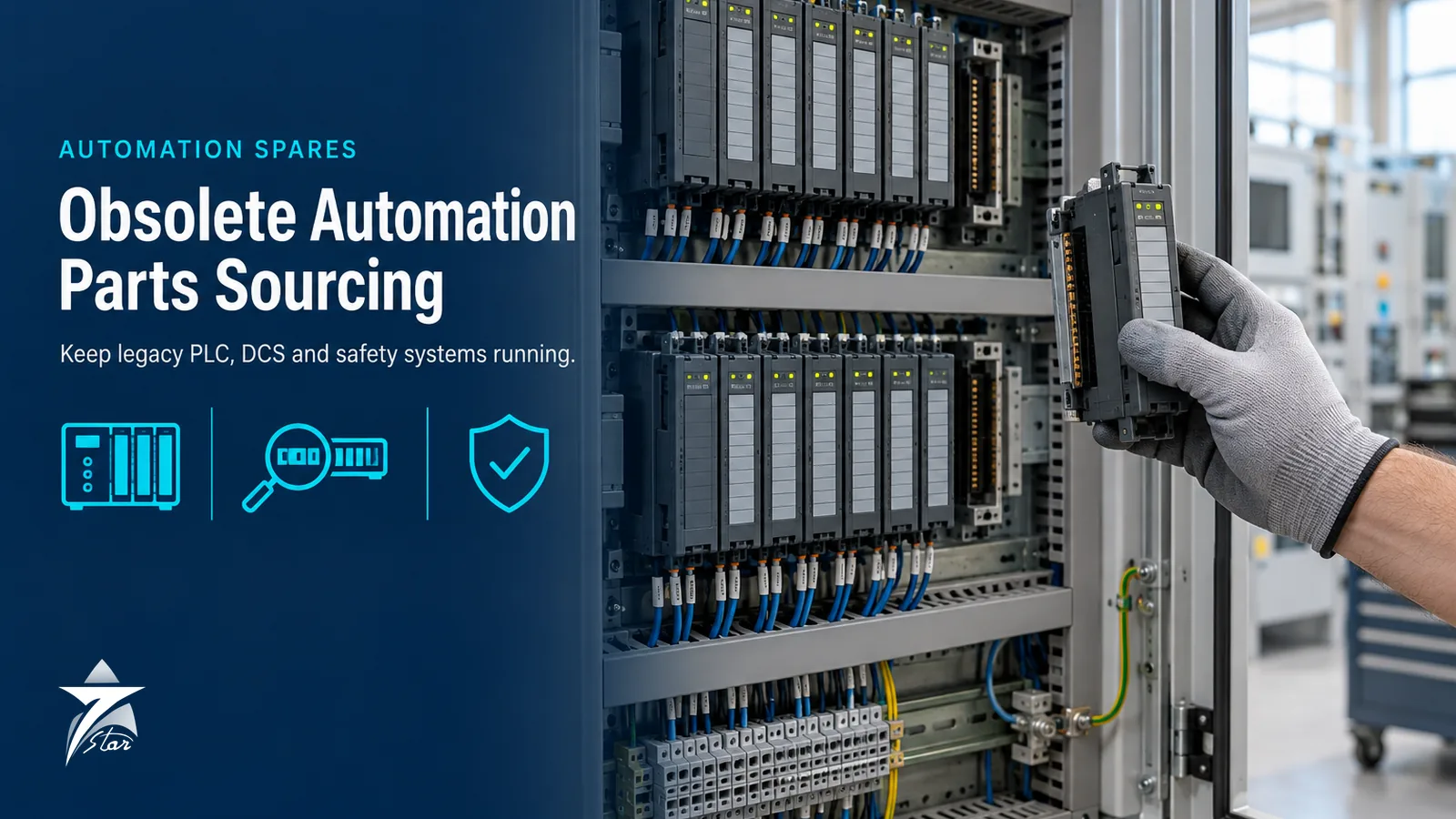
Sourcing Obsolete Automation Parts: Keeping Legacy PLC, DCS and Safety Systems Running Without Taking Unnecessary Risk
Many plants in Oman and the GCC run control and safety systems installed in the 1990s and 2000s. They work, they are certified, and the operators know them. The problem appears when a module fails and the manufacturer no longer sells it. Sourcing obsolete automation parts then becomes a balance between speed, cost and risk: a wrong revision, a counterfeit module or a power supply that has sat on a shelf for ten years can turn a minor failure into a trip or an unsafe condition.
This guide covers how to classify lifecycle risk, identify the exact part, compare new-surplus, refurbished and repaired-exchange supply, detect counterfeits, test before installation, store spares in a hot climate, and plan the migration that eventually ends the problem.
Lifecycle Stages and What They Mean
Manufacturers use different names, but the stages are broadly the same.
| Stage | Typical meaning | What the plant should do |
|---|---|---|
| Active | Fully sold and supported | Normal spares holding |
| Mature or limited | Still sold, successor available, end of sale planned | Review installed base and spares, start migration planning |
| End of sale or last-time buy | Final order window announced | Decide last-time buy quantities based on criticality and failure history |
| End of support, discontinued or obsolete | No new production; repair and technical support limited or ended | Secondary market sourcing, repair services, bridging or migration |
Check the manufacturer’s lifecycle status for each catalog number, not just the product family, because individual modules move through stages at different times. Rockwell Automation, for example, has moved much of the SLC 500 family to discontinued status; the status of a specific catalog number should be checked on the manufacturer’s lifecycle listing.
Why Plants Keep Legacy Systems
Keeping a legacy system running is often rational:
- The system is proven on the process, with years of tuning and known behaviour.
- Safety systems carry SIL validation, and changing the platform triggers a full re-validation under IEC 61511.
- Migration needs engineering, a shutdown window, operator retraining and new documentation.
- I/O wiring, marshalling and field devices may be in good condition.
The risk is that the decision to keep the system becomes a default rather than a managed choice. The answer is a criticality-based spares strategy combined with a planned migration date.
Build an Installed-Base Register
Before ranking risk, know what is installed. An installed-base register lists every controller, I/O module, communication module, power supply and engineering workstation, with part number, revision, firmware, quantity installed, spares held, storage location and lifecycle status. Most plants find surprises: spares recorded in the CMMS that are a different revision from the installed units, spares lent to another site and never returned, or modules that exist only as one unit in a running rack. Update the register after every replacement and review it at least annually against manufacturers’ lifecycle notices.
Rank the Risk Before You Buy
| Consequence of failure | Spare availability: good | Spare availability: limited | Spare availability: poor |
|---|---|---|---|
| Safety trip, loss of protection or production loss | Hold spares on site | Hold spares on site, add a repair source, start migration planning | Last-time buy or bridging solution now; migration in budget |
| Redundancy lost, no immediate production effect | Hold spares regionally | Hold one spare on site | Hold spares on site, plan migration |
| Non-critical monitoring or utilities | Buy on demand | Buy on demand, identify sources | Accept substitution or upgrade at failure |
Redundant controllers and power supplies mask failures: the plant keeps running on one side, but the next failure is a trip. Treat loss of redundancy on a critical system as urgent.
Identifying the Exact Part
Most supply errors come from incomplete identification. Record from the failed module, not from drawings, which are often out of date:
- Full catalog or part number including every suffix.
- Series, revision or hardware version letter.
- Firmware version, often on a label or readable through the engineering software.
- Serial number and date code.
- Any configuration jumpers, DIP switch settings or keying.
- Photographs of all labels, front and rear.
Examples from common legacy systems:
- Siemens APACS and QUADLOG: parts such as the QLCCM24AAN, QLSAMBAN, 39SAMCAN and 16413-15 must be matched not only by part number but by ROM or firmware version, which must be compatible with the rest of the system.
- Allen-Bradley SLC 500: modules such as the 1746-P2 power supply, the 1747-ASB remote I/O adapter and the 1746-NI16I analog input carry series letters and firmware revisions that affect compatibility. The SLC 500 overview summarises the family.
- Yokogawa CENTUM: I/O modules such as the ADV161-P50 digital input module are identified by model, suffix and style code; check compatibility with the system software release.
- HIMA H51q: safety system modules such as the F8650X central module must match the certified version list in the system’s safety documentation. Our article on safety instrumented systems and legacy ESD covers this further.
- Bently Nevada 3500: a module such as the 3500/22M TDI must match the I/O module type and be compatible with the configuration software version used on the rack.
For safety systems, any module replacement is a change under the management of change procedure of IEC 61511 unless the safety manual treats like-for-like replacement of a certified version as maintenance. Confirm the permitted versions before ordering.
New, New-Surplus, Refurbished and Repaired-Exchange
| Supply type | Definition | Advantages | Risks |
|---|---|---|---|
| New (factory) | From the manufacturer or its authorised channel, current production | Full traceability and support | Not available once production ends |
| New surplus | Unused, often in original packaging, from excess inventory | Unused components, often original seals | Shelf age, storage history unknown, capacitor ageing |
| Refurbished | Used, cleaned, inspected, tested and sometimes upgraded | Available after new supply ends | Quality depends on the refurbisher’s process and test capability |
| Repaired or exchange | Your failed unit repaired, or swapped for a repaired unit | Keeps your revision; can be quick | Root cause may not be addressed; repeat failures possible |
No category is automatically safe or unsafe. What matters is traceability, test evidence and the quality of the source.
Counterfeit and Grey-Market Risk
Obsolete parts attract counterfeits and relabelled units. Typical warning signs are labels with wrong fonts or misaligned printing, date codes inconsistent with the revision, mixed revisions within one lot, packaging that does not match the manufacturer’s style for that period, and prices far below the market. Inspection practices used in aerospace counterfeit-avoidance standards such as SAE AS5553 are a useful reference for higher-risk purchases.
Ask for:
- A certificate of conformity stating part number, revision and condition.
- Traceability to the source where available.
- Test reports showing what was tested and how.
- Photographs of the actual unit before shipment.
Testing Before Installation
Do not let the plant be the test bench. Where possible, test the spare in a test rack or offline system: power up, check diagnostics and LED status, verify firmware version, load the configuration, and exercise inputs and outputs with a calibrator. For redundant systems, install into the standby position first and check synchronisation before relying on it. For safety systems, follow the proof test and replacement procedure in the safety manual.
Storage in Oman’s Climate
Spares stored in hot, humid or dusty warehouses deteriorate before they are needed. A container warehouse at a remote site in summer can exceed 60 °C inside.
- Store electronics in a climate-controlled room within the manufacturer’s storage limits.
- Keep modules in sealed ESD bags with desiccant, and log humidity.
- Label each spare with part number, revision, firmware and test date.
- Electrolytic capacitors in power supplies and drives can degrade after long storage without voltage. Many manufacturers recommend reforming, which applies voltage gradually through a current-limited supply, after extended storage. Follow the manufacturer’s guidance before energising a long-stored unit at full voltage.
- Retest critical spares periodically, for example during planned shutdowns.
Last-Time Buys, Bridging and Migration
A last-time buy should be sized from installed quantity, observed failure rate, remaining planned life and lead time for migration, with margin for growth in failures as the base ages. Bridging solutions, such as gateways or interface modules that let new I/O or controllers work with old ones, can spread migration over several shutdowns. Plan migration as a project: front-end study, I/O reuse assessment, cutover strategy, and for safety systems, re-validation. Use the time that spares buy to do it properly rather than under pressure after a failure.
Cybersecurity of Legacy Systems
Older systems were not designed for current threats and often run unsupported operating systems on engineering stations. Segment them behind firewalls following IEC 62443 zone and conduit principles, control removable media, and restrict remote access. Treat engineering laptops and configuration backups as critical assets.
Common Mistakes
- Ordering by part number without revision or firmware version.
- Installing an untested spare directly into a running critical system.
- Energising a long-stored power supply without considering capacitor reforming.
- Storing spares in an uncontrolled warehouse.
- Treating loss of redundancy as a low-priority fault.
- Postponing migration planning until spares run out.
Obsolete Parts Sourcing Checklist
- Full part number, revision, firmware and serial number recorded from the failed unit.
- Lifecycle status confirmed with the manufacturer for each catalog number.
- Criticality and redundancy assessed; urgency defined.
- Supply type agreed: new surplus, refurbished or repaired-exchange.
- Certificate of conformity, test report and photographs requested.
- Incoming inspection for counterfeit indicators.
- Offline test and firmware check before installation.
- Management of change completed for safety systems.
- Storage conditions, labelling and retest schedule defined.
- Last-time buy quantities and migration plan reviewed annually.
Sourcing Obsolete Automation Parts Through Seven Star LLC
Seven Star LLC sources legacy and current automation parts, including PLC, DCS, safety system and machinery protection modules. Include photographs of the failed module’s labels with your enquiry so part number, revision and firmware can be matched before ordering. Browse the PLC and I/O category and send complete part numbers with revisions.
Send Seven Star LLC your full part numbers, revisions and photos of the failed module, and we will source the matching legacy part for your system.
Was this guide helpful?One click helps us write better guides for engineers.
Thank you! Glad it helped. Need this equipment for your project? Request a quotation
Thank you. We will use this to improve the guide.
Need a Quotation for Your Project?
Seven Star LLC supplies the industrial equipment covered in this article to customers across Oman and the GCC. Send us the part numbers, models or a short description with quantities, and our sales team will reply with a formal quotation.
- Genuine OEM products
- Supply across Oman & the GCC
- Formal quotation from our sales team
Free, no-obligation quotation · takes about 1 minute
Other enquiries: [email protected] · WhatsApp
More Blog





Frequently Asked Questions
An obsolete automation part is one the manufacturer no longer produces and, in many cases, no longer supports with repairs or technical help. Manufacturers use different terms such as discontinued, end of life or end of support. Plants then rely on surplus, refurbished or repaired units, or migrate to a current platform.
New surplus parts are unused units from excess inventory, often still in original packaging, but with unknown storage history and shelf age. Refurbished parts have been used, then cleaned, inspected, tested and sometimes upgraded. Both can be reliable when the source provides traceability and test evidence.
Warning signs include labels with incorrect fonts or alignment, date codes inconsistent with the revision, mismatched packaging and unusually low prices. Request a certificate of conformity, photographs of the actual unit and test reports before purchase. Test the module offline and check its firmware version before installing it.
Modules with the same part number can contain different firmware versions that behave differently or are incompatible with the controller or system software. In legacy systems such as Siemens APACS and QUADLOG or Allen-Bradley SLC 500, the firmware or series must be compatible with the rest of the system. For safety systems, only certified versions listed in the safety documentation may be used.
Power supplies and drives with electrolytic capacitors can degrade during long storage without voltage. Many manufacturers recommend reforming the capacitors by applying voltage gradually through a current-limited supply before full energisation. Follow the specific manufacturer's guidance for the unit and storage period.
Migration should be planned when spare availability is poor, failure rates are rising, support has ended or cybersecurity risks can no longer be managed. Spares and last-time buys should be used to buy time for an orderly migration, not to postpone it indefinitely. Safety systems also need full re-validation after migration.