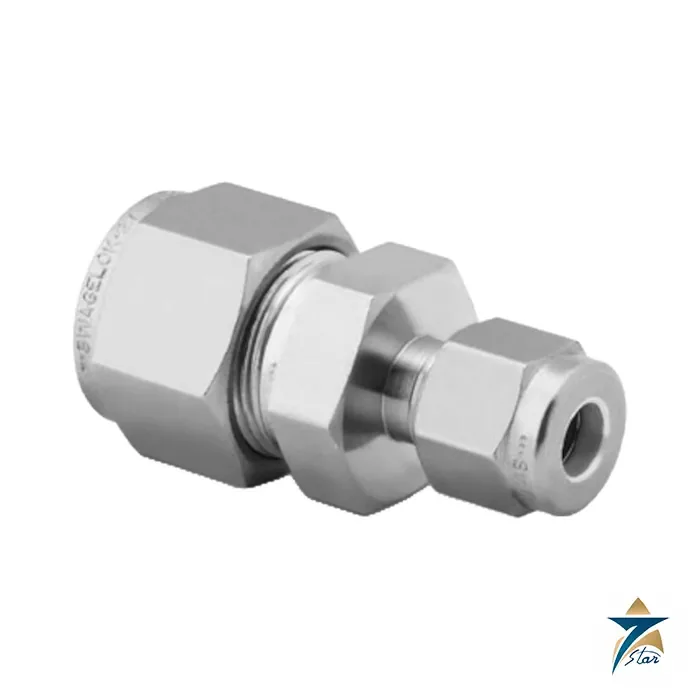
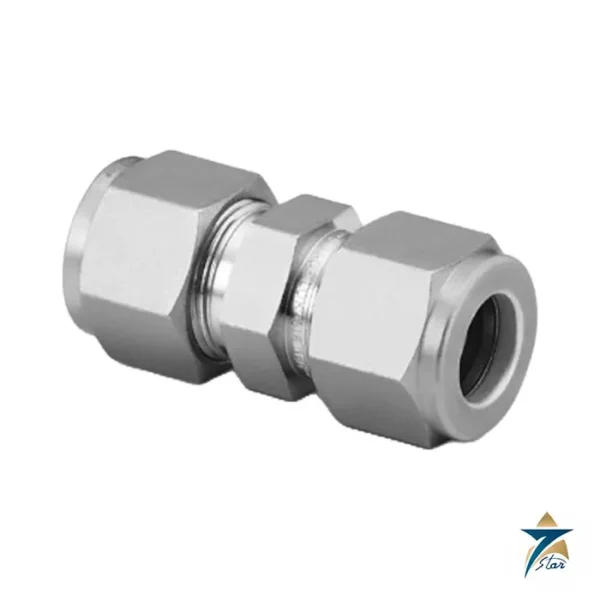
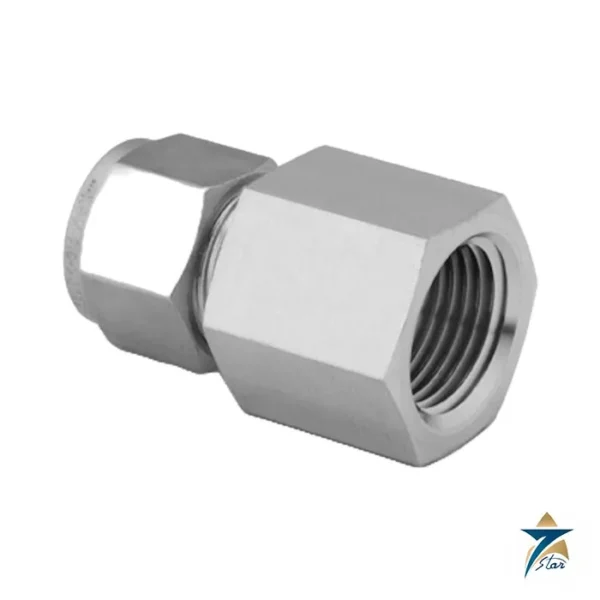
The Swagelok SS-810-6-4 steps a tube run down from 1/2 in. to 1/4 in. outside diameter in a single fitting. One side is a full 1/2 in. Swagelok end, the other a 1/4 in. end, so a main line can feed an instrument impulse line, a sample probe or a small valve without using a reducer plus a union.
Technical specifications
| Parameter |
Specification |
| Part number |
SS-810-6-4 |
| Description |
Reducing union, 1/2 in. tube OD x 1/4 in. tube OD |
| Body material |
316 stainless steel (bar stock) |
| Large end |
1/2 in. tube OD |
| Small end |
1/4 in. tube OD |
| Dimension A (overall length) |
1.85 in. |
| Dimension D (large nut) |
0.90 in. |
| Dimension Dx (small nut) |
0.60 in. |
| Dimension E (nominal opening) |
0.19 in. |
| Pressure basis |
Working pressure of the tubing on each end (Tubing Data MS-01-107) |
| Cleaning |
Standard cleaning and packaging SC-10 |
Reducing union versus reducer
Swagelok makes two different parts that reduce tube size. A reducing union, like this one, has a Swagelok nut and ferrule set on both ends. A reducer, such as SS-600-R-4, has a nut-and-ferrule end on one side and a plain tube stub on the other that slides into a larger fitting. Choose the union when both ends are tubing; choose the reducer when the small end must plug into an existing female port. The 0.19 in. nominal opening E on SS-810-6-4 is the smallest passage and fixes the flow restriction of the reduction.
Short overall length helps on instrument manifolds: the catalog dimension A is 1.85 in., shorter than the 2.02 in. of the straight 1/2 in. union SS-810-6.
Decoding and related parts
In SS-810-6-4 the SS block is 316 stainless, 810 is the larger 1/2 in. tube, 6 is the union and the trailing 4 is the 1/4 in. second tube. The catalog lists the same 1/2 in. body with 1/8 in. (6-2) and 3/8 in. (6-6) small ends, and larger bodies reduce to their own sizes. Quote the full code, including any trailing designator.
Because the two ends can carry different tubing, check each end against its own tubing rating. The weaker side governs, which is usually the 1/4 in. line in terms of wall, though thick-wall 1/4 in. tubing can be rated higher than thin-wall 1/2 in.
Installation
The tube connection is made by hand-tightening the nut on fully seated tube and then adding one and one-quarter turns. Use the Swagelok gauge for the tube size to confirm, support the body with a backing wrench, and never work on a fitting that is under pressure. The 1/4 in. end needs only one and one-quarter turns as well, since sizes from 1/4 in. up share the same pull-up rule; for 1/8 in. ends the catalog gives three-quarter turn.
Support the heavier 1/2 in. tube so its weight does not load the small end, and keep the reduction away from heavily vibrating equipment unless it is clamped.
Key features of the SS-810-6-4
- One-piece reduction: joins 1/2 in. and 1/4 in. tubing directly, removing one connection compared with a union plus reducer and therefore one potential leak path.
- 316 stainless steel body: a common choice for corrosive process fluids, sea-air exposure and instrument service.
- Two-ferrule grip on both ends: each end uses the Swagelok front and back ferrule design, which grips the tube and seals without welding or threading the tube itself.
- Remakeable joints: the connections can be disassembled and retightened during maintenance, following Swagelok’s reassembly instructions.
- Compact length: the short overall length suits crowded instrument racks and analyser panels.
Selecting the right reduction fitting
Before ordering, confirm three things. First, the tube outside diameters at both ends must be fractional inch sizes, 1/2 in. and 1/4 in.; metric tubing such as 12 mm or 6 mm needs a metric fitting and must not be mixed with fractional ferrules. Second, the tube material and hardness should be compatible with a stainless fitting; Swagelok recommends fully annealed seamless or welded-and-drawn stainless tubing for its tube fittings. Third, the wall thickness of each tube must be within the range Swagelok lists for that size so that the ferrules can grip properly and the system pressure rating is achieved.
If flow is a concern, remember that the small end and the bore of the fitting set the narrowest point of the line. For sample lines and impulse lines this is rarely a problem, but for utility air or larger process flows a reducing union may be better placed close to the consumer rather than at the header.
Material alternatives
Swagelok offers the same reducing union geometry in other materials through the prefix of the part number, for example brass or carbon steel bodies for less demanding service and special alloys for sour or highly corrosive media. Stainless 316 remains the default for most instrumentation in oil, gas and petrochemical plants. Tell us if the project specification calls for a different alloy so the matching part number can be quoted.
Good practice during make-up and inspection
Cut the tube square, deburr inside and outside, and insert it until it bottoms firmly in the fitting body on each side. Mark the nut before final tightening so that the turns can be counted, and use the Swagelok gap inspection gauge where available to confirm correct make-up on initial installation. Do not mix nuts and ferrules from different manufacturers, and do not reuse ferrules on a different fitting body.
Support the tubing near the fitting so that vibration and the weight of valves or instruments are not carried by the joint. On skids that are shipped by road across the region, temporary supports during transport help avoid loosened connections on arrival.
Applications in Oman and GCC plants
A 1/2 in. to 1/4 in. step is typical where a process connection or manifold feeds a pressure gauge, transmitter, sample cylinder or small needle valve. It appears on wellhead control panels, chemical injection skids, gas analyser shelters, instrument air distribution and hydraulic test benches. In coastal and desert environments, 316 stainless steel helps resist chloride-laden air and the temperature swings between day and night.
What to include in an RFQ
- Full part number SS-810-6-4 and quantity.
- Tube material, outside diameter and wall thickness on each side.
- Process medium, design pressure and temperature.
- Any material certificate or cleaning requirement in the project specification.
- Related items such as straight unions, reducers or spare ferrule sets.
Documents and quotation
Attached for download is the official Swagelok catalog MS-01-140, which carries the dimension and pressure-rating tables behind this page. Quote requests are handled against the exact code, so list SS-810-6-4, the quantity and your cleaning or packaging needs.
Related items: product category.






Reviews
There are no reviews yet.