- Automation & ControlView all 3,138 products
- Automation Accessories
- AC Drives
- PLC & I/O Cards
- Industrial Communications
- Vibration Monitoring
- Controllers & Data Acquisition
- Isolator & Barrier
- Safety Switches & Guard Locking
- Encoders
- Motor Soft Starters
- CCTV & Security
- Pneumatic Cylinders
- HMI Displays
- Servo Drives
- Industrial Computers
- Machine Vision
- Automation Software
- Robotics
















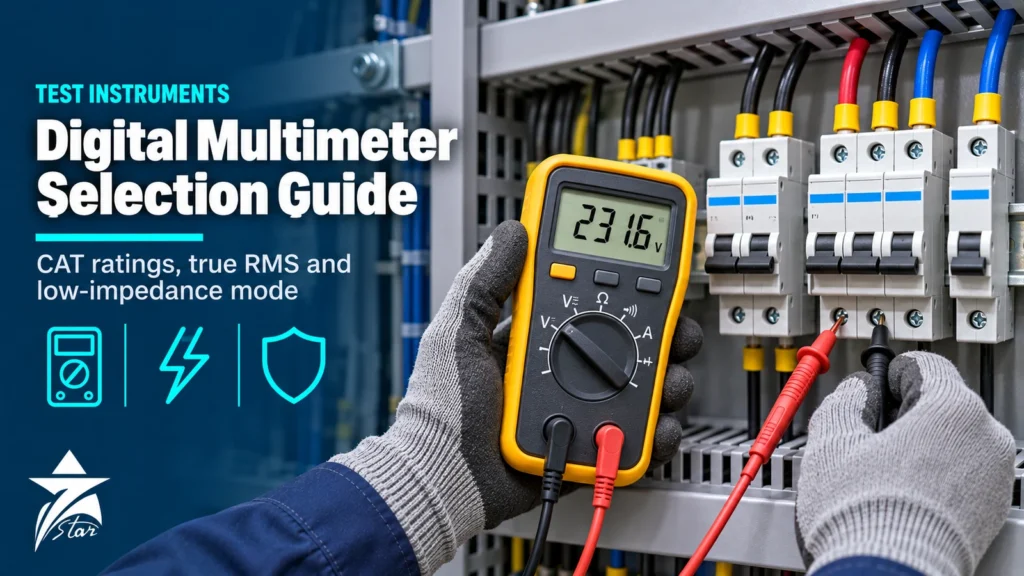
A digital multimeter is the first tool electricians, instrument technicians and maintenance engineers reach for when something stops working. It measures voltage, current, resistance and continuity, and many models add capacitance, frequency, temperature and diode tests. Because the same meter may be connected to a 24 V control circuit in the morning and a 400 V distribution board in the afternoon, the choice is not only about features but about safety. A meter with the wrong category rating, cheap leads or the wrong fuse can turn a routine measurement into an arc flash incident. This guide explains how to read safety ratings, why true RMS and low impedance modes matter in modern plants, and how to use a meter safely.
Measurement Categories: CAT II, CAT III and CAT IV
The safety standard IEC 61010-1, with IEC 61010-2-033 for hand held meters, defines measurement categories according to where the meter is used. The category describes the size of transient overvoltages the meter can withstand, which depends on how close the measurement point is to the power source. The closer to the supply, the higher the available fault energy and the higher the category required.
| Category | Location | Examples |
|---|---|---|
| CAT II | Circuits connected to wall sockets and plug in loads | Appliances, portable tools, socket outlets |
| CAT III | Fixed installation in buildings and plants | Distribution boards, MCCs, motors, busbars, fixed wiring |
| CAT IV | Origin of the installation, outdoors and utility side | Service entrance, main incomers, overhead lines, meters at the supply point |
The rating is always given with a voltage, such as CAT III 1000 V or CAT IV 600 V. A meter rated CAT III 1000 V and CAT IV 600 V is suitable for most industrial work. Check that the meter, test leads, probes and clips all carry an equal or higher rating, because the lowest rated part sets the limit for the whole measurement. Look for independent certification marks from a recognised test laboratory, since some low cost meters carry category markings that have not been independently verified.
True RMS and Why It Matters
Average responding meters measure the average of the rectified waveform and scale it as if the signal were a pure sine wave. On modern installations many currents and voltages are distorted by variable frequency drives, switch mode power supplies, LED lighting and UPS systems. On these non sinusoidal waveforms an average responding digital multimeter can read too low or too high, sometimes by 30 percent or more. A true RMS meter calculates the actual heating value of the waveform and gives the correct reading within its stated bandwidth and crest factor.
- Choose a true RMS meter for any work on drives, UPS, LED lighting, computers and electronic loads.
- Check the AC bandwidth, since measurements on drive outputs need a low pass filter or a dedicated VFD mode for meaningful readings.
- Look at the crest factor specification, which tells you how peaky a waveform the meter can handle accurately.
For more about drives and harmonics, see our article on VFD selection for hot climates.
Low Impedance Mode Against Ghost Voltages
A high impedance digital multimeter, typically around 10 megohms, places almost no load on the circuit. That is ideal for electronics, but in long cable runs it can show ghost voltages coupled capacitively from adjacent live conductors. A disconnected conductor may read 50 V or more even though it cannot deliver any current. Low impedance mode, often called LoZ, temporarily places a much lower impedance across the inputs, which drains the coupled voltage and shows whether a real supply is present. Use LoZ when checking for the presence or absence of voltage on control wiring and building circuits. Do not use LoZ on sensitive electronic circuits, because the low impedance can disturb or damage them.
Digital Multimeter Functions to Compare
| Function | Why it is useful | Typical users |
|---|---|---|
| AC and DC voltage | Basic checks of supplies and control circuits | All electricians and technicians |
| AC and DC current with fused inputs | Loop current and small load currents | Instrument technicians |
| Microamp range | Flame sensor currents in burners and boilers | HVAC and burner technicians |
| Resistance, continuity and diode | Cable continuity, coil and contact checks | All maintenance staff |
| Capacitance | Motor run capacitors and electronic components | HVAC and electronics |
| Frequency and duty cycle | Drive outputs, sensor signals and PWM | Automation technicians |
| Temperature with thermocouple probe | Quick surface and air measurements | HVAC and maintenance |
| Min, max, peak and logging | Capturing intermittent faults | Troubleshooting engineers |
| Wireless connection to apps | Remote reading and sharing results | Teams working in hazardous or confined spaces |
Instrument technicians who work on 4 to 20 mA loops often prefer a meter with a high resolution milliamp range or a dedicated process meter that can source and simulate loop current. For temperature work, our guide to RTD versus thermocouple sensors explains how to check sensors with a meter.
Accuracy, Resolution and Counts
Specifications are given as a percentage of reading plus a number of counts, for example plus or minus 0.05 percent plus 1 count on DC voltage. The count number, such as 6,000 or 50,000, defines the resolution: a 6,000 count meter shows up to 5.999 V on the 6 V range, while a 50,000 count meter shows 4.9999 V. Higher counts and better basic accuracy are valuable for calibration support and instrument work, but they matter less for basic electrical checks. Check the accuracy specification for each function and range, since AC current and high frequencies are usually less accurate than DC voltage.
Clamp Meters, Voltage Testers and Insulation Multimeters
- A clamp meter measures current without breaking the circuit and is the better choice for motor and feeder currents above about 10 A.
- A two pole voltage tester designed to the relevant standard, such as EN 61243-3, is the preferred tool for proving dead before work, not a multimeter set to the wrong range.
- An insulation multimeter combines a digital multimeter with an insulation resistance test, useful for motor and cable maintenance.
- A non contact voltage detector gives a quick indication but never replaces a proper test for absence of voltage.
Insulation testing of motors is described in our article on electric motor failure causes and condition checks.
Test Leads, Fuses and Input Protection
Many multimeter incidents start with the accessories. Use leads with shrouded connectors, finger guards and short exposed probe tips, ideally 4 mm or less for CAT III and CAT IV work. Replace leads with cracked insulation or damaged tips immediately. The current inputs must be protected by high rupturing capacity fuses with the voltage and breaking capacity specified by the manufacturer. Replacing them with ordinary glass fuses can cause the meter to explode if the leads are left in the current jack while measuring voltage. Some meters warn when the leads are in the wrong input, which is a useful feature.
Using a Digital Multimeter Safely
- Select a meter and leads rated for the measurement category and voltage of the circuit.
- Inspect the meter, leads and fuses before each use, and test the meter on a known live source before and after proving dead.
- Wear the personal protective equipment required by the arc flash assessment and site rules.
- Connect the neutral or ground lead first and remove it last.
- Keep fingers behind the probe guards and avoid working alone on high energy circuits.
- Never measure current by placing the leads across a voltage source.
- Follow lockout and permit to work procedures, and remember that a meter reading does not replace isolation.
Environment and Durability
Field meters in Oman face heat, dust and occasional drops. Check the operating temperature range, especially for meters left in vehicles, and choose a model with an ingress rating such as IP54 or IP67 for dusty or wet sites. A drop rating, protective holster, backlit display and long battery life all make a difference in daily use. For work in hazardous areas only intrinsically safe meters certified for the zone may be used.
Calibration of Test Instruments
Meters used for quality critical measurements, commissioning and acceptance testing should be calibrated at intervals defined by the site quality system, often once a year. Keep a calibration certificate for each meter, label it with the due date, and withdraw meters that are dropped or damaged until they have been checked.
Selected Multimeters and Testers in Our Catalog
The table below lists a selection of multimeters and related testers from our catalog.
| Product | Type | Typical use |
|---|---|---|
| Fluke 87V | Industrial true RMS meter | Drives, motors and plant troubleshooting |
| Fluke 289 | True RMS logging meter | Capturing intermittent faults |
| Fluke 177 | True RMS meter, CAT III 1000 V | General electrical maintenance |
| Fluke 117 | Electricians meter with VoltAlert and LoZ | Building and commercial electrical work |
| Fluke 116 | HVAC meter with temperature and microamps | Burner and HVAC service |
| Fluke 27 II | Rugged IP67 meter | Harsh outdoor sites |
| Extech EX530A | Heavy duty true RMS meter, 50,000 count | Industrial maintenance |
| Extech EX350 | True RMS meter with LoZ and NCV | Electrical contractors |
| Chauvin Arnoux CA 5273 | TRMS meter | Industrial electrical work |
| Fluke 1587 FC | Insulation multimeter | Motor and cable maintenance |
| Extech MG320 | CAT IV insulation tester and meter | Installation testing |
| Fluke T5-1000 | Voltage, continuity and current tester | Quick checks by electricians |
Browse more in our electrical testers and multimeters category. To get a quotation, send the required functions, category rating, accuracy, quantity and accessories through our quote request form or to [email protected].
Sourcing Multimeters in Oman Through Seven Star LLC
Seven Star LLC is an independent supplier in Oman of handheld multimeters, clamp meters, voltage testers, insulation multimeters and electrical test accessories for maintenance teams, contractors and instrument departments. We quote products from manufacturers such as Fluke, Extech, Chauvin Arnoux, Hioki, Metrel and Megger. Safety ratings, functions, accuracy and calibration certificates are confirmed against the manufacturer data at quotation.
Frequently asked questions
What CAT rating do I need for industrial work?
For distribution boards, motor control centres and fixed plant wiring a CAT III rating is needed, and CAT IV is required at the origin of the installation. A meter rated CAT III 1000 V and CAT IV 600 V covers most industrial tasks, provided the leads have the same or higher rating.
Why should I buy a true RMS digital multimeter?
Variable frequency drives, LED lighting and electronic loads distort voltage and current waveforms. Average responding meters can read these signals incorrectly, while a true RMS meter measures the actual effective value.
What is LoZ mode on a multimeter?
LoZ is a low input impedance mode that drains ghost voltages coupled from adjacent cables. It helps confirm whether a conductor is really live, but it should not be used on sensitive electronic circuits.
Can a multimeter be used to prove dead before work?
Many sites require a dedicated two pole voltage tester for proving dead, tested on a known live source before and after the test. A multimeter can only be used if it meets the site rules and is set up correctly.
How often should a multimeter be calibrated?
Calibration intervals are set by the site quality system, commonly once a year. Meters that are dropped, damaged or used for critical measurements should be checked more often.
Who supplies digital multimeters in Oman?
Seven Star LLC is an independent supplier in Oman that quotes multimeters, clamp meters and electrical testers from manufacturers such as Fluke, Extech and Chauvin Arnoux. Send your requirements through the quote request form or to [email protected].
Was this guide helpful?One click helps us write better guides for engineers.
Thank you! Glad it helped. Need this equipment for your project? Request a quotation
Thank you. We will use this to improve the guide.